

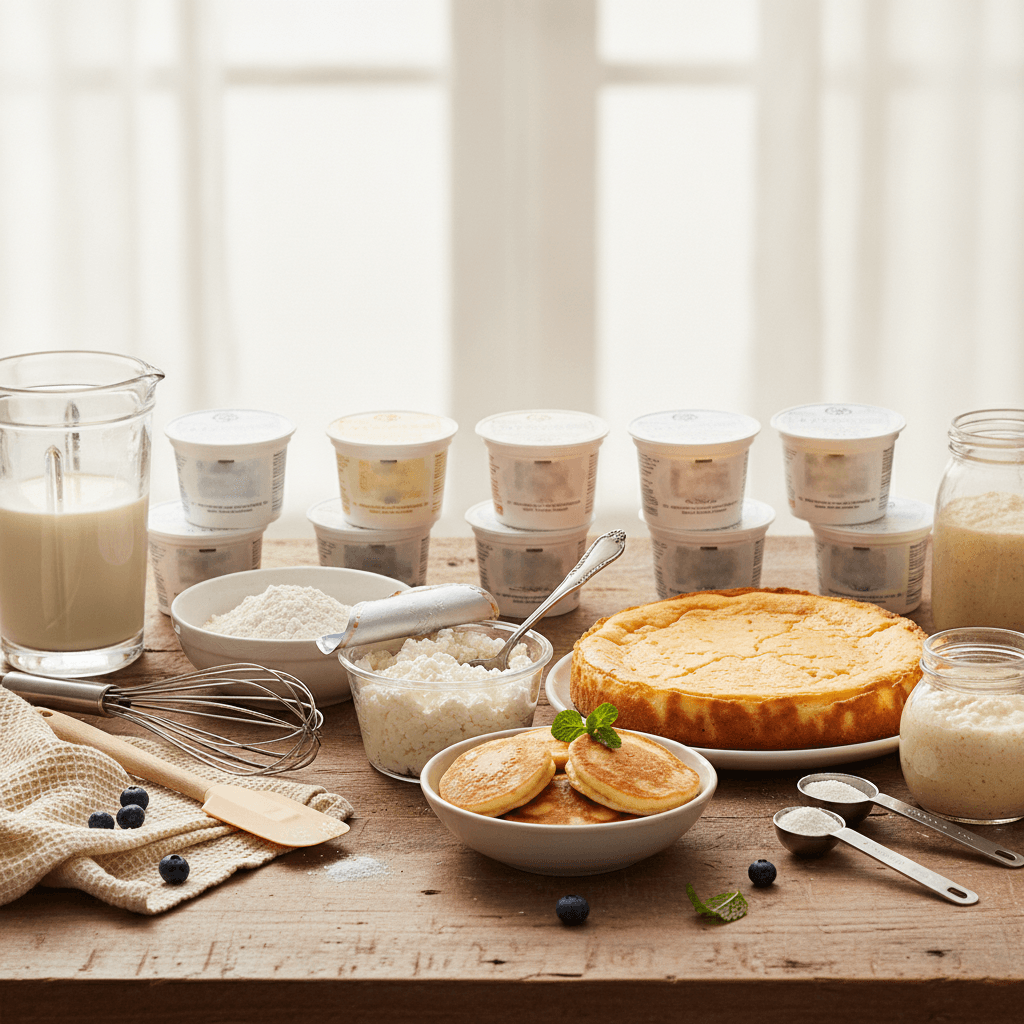
Yes, cottage cheese is excellent for baking. It adds moisture, protein (roughly 11g per 100g for full-fat varieties), and a subtle tang that works in pancakes, muffins, cheesecakes, and quick breads. But not every brand performs the same way. Some blend completely smooth in 30 seconds. Others stay stubbornly grainy no matter how long you process them. We compared nine widely available brands, and curd size and fat percentage matter far more than the label's marketing claims.
Key takeaways
Cottage cheese adds 10-12g protein per 100g to baked goods while keeping them moist, making it one of the easiest ways to add protein to baked goods without wrecking texture.
Small-curd, full-fat (4%) cottage cheese blends the smoothest and performs most like ricotta in baking applications.
Small-curd brands like Good Culture and Muuna blend smooth quickly with an immersion blender. Large-curd brands like Friendship tend to leave visible bits.
You need to drain excess whey from wetter brands (Breakstone's, Kirkland) or reduce other liquids in your recipe by 1-2 tablespoons per cup of cottage cheese.
Cottage cheese curdles above 375F / 190C when exposed directly to dry heat. In batter-based recipes, the surrounding starches and fats protect it, but thin layers (like a topping) will break.
At $0.18-$0.31 per 100g depending on brand and retailer, cottage cheese is cheaper than ricotta ($0.44-$0.55 per 100g) for nearly identical baking results.
Why cottage cheese works in baking
Cottage cheese is roughly 80% water, 11% protein, and 4% fat (for full-fat versions). That ratio is surprisingly close to ricotta, which is why the two are nearly interchangeable in baked goods. The casein protein in cottage cheese coagulates during baking, creating structure and a tender crumb. The whey adds moisture without the heaviness of sour cream or cream cheese.
Where cottage cheese really shines is in recipes that benefit from a mild tang: think lemon muffins, blueberry pancakes, and cheesecake bars. The acidity (pH around 4.5-5.0) also activates baking soda, so if your recipe uses baking soda as the sole leavener, cottage cheese gives it something to react with. For more on how acidic dairy works with leaveners, see our buttermilk substitution guide.
The protein boost is real, too. Swapping 1 cup of cottage cheese for 1 cup of sour cream in a coffee cake recipe adds roughly 16g of protein while cutting about 35g of fat. That is a meaningful shift if you are trying to increase protein without resorting to protein powder, which often dries out baked goods.
9 cottage cheese brands compared for baking
Not all cottage cheese is created equal for baking. Curd size determines how easily it blends. Fat percentage affects richness and moisture. Water content (listed as whey separation on the label or visible in the container) tells you whether you will need to drain before adding it to batter.
We looked at nine brands you can actually find on shelves. Here is how they compare:
Brand | Protein per 100g | Fat % | Curd size | Water content (approx.) | Blends smooth? | Where to buy |
|---|---|---|---|---|---|---|
Good Culture (4% whole milk) | 12.3g | 4% | Small | ~78% | Yes | Whole Foods, Target, Walmart |
Daisy (4% small curd) | 11.3g | 4% | Small | ~80% | Yes | Walmart, Target, Kroger |
Breakstone's (4% small curd) | 11.0g | 4% | Small | ~82% | Yes | Walmart, Target, most grocery chains |
Nancy's (organic, whole milk) | 11.5g | 4% | Small | ~79% | Yes | Whole Foods, Sprouts, natural grocers |
Friendship (California style, large curd) | 12.0g | 4% | Large | ~77% | No, large curds stay slightly grainy | Walmart, regional grocers (East Coast) |
Kalona SuperNatural (organic, whole milk) | 12.5g | 4% | Small-medium | ~78% | Yes | Whole Foods, natural grocers |
Muuna (classic plain, 4%) | 13.0g | 4% | Small | ~76% | Yes | Target, Whole Foods, some Walmart |
Trader Joe's (small curd, 4%) | 11.0g | 4% | Small | ~81% | Yes | Trader Joe's only |
Kirkland (Costco, 4% milkfat) | 11.3g | 4% | Small | ~83% | Yes | Costco only |
Best overall for baking: Good Culture and Muuna tied. Both have the highest protein, have small curds that blend smooth easily, and have moderate water content so you rarely need to drain. Muuna edges ahead on protein at 13g per 100g, but Good Culture is more widely stocked.
Best budget pick: Kirkland from Costco. At roughly $0.18 per 100g (3 lb tub for about $5.49), it is the cheapest option by a wide margin. The downside: it runs wet. Drain it through a fine mesh strainer for 10 minutes before measuring, or reduce other liquids in your recipe by 2 tablespoons per cup.
Avoid for baking: Friendship large-curd. The curds are simply too big to break down fully, even in a Vitamix, and they can leave visible white specks in your finished bake. If Friendship is all you can find, press it through a fine mesh strainer rather than blending.
How to blend cottage cheese smooth for baking
Grainy cottage cheese in batter leads to grainy baked goods. You have three options for getting it smooth, ranked by effectiveness:
Food processor (best results): Process for 60-90 seconds. A Cuisinart 14-cup food processor handles even large-curd brands. Scrape the sides at 30 seconds.
Immersion blender (fastest for small batches): An immersion blender in a tall, narrow container works in 15-30 seconds for small-curd brands. Large-curd takes longer and splatters.
Fine mesh strainer (no electricity needed): Push cottage cheese through a fine mesh strainer with a spatula. This takes about 2 minutes per cup but also drains excess whey simultaneously, which is helpful for wet brands like Kirkland and Breakstone's.
A standard blender (like a countertop Ninja or Nutribullet) works but tends to over-aerate the cottage cheese, whipping in air that can make muffin tops collapse. If you use a blender, pulse rather than run continuously.
How much cottage cheese to use in common recipes
The general swap is 1:1 by volume for ricotta, and roughly 3/4 cup cottage cheese for 1 cup sour cream (because cottage cheese is thinner). Here are specific ratios:
Pancakes: 1/2 cup blended cottage cheese per batch of 8 pancakes. Replace the milk entirely. The pancakes come out fluffier and hold together better.
Muffins: 3/4 cup cottage cheese replaces 1 cup sour cream or yogurt. Reduce any added liquid (milk, water) by 2 tablespoons.
Cheesecake: Blend 2 cups cottage cheese until completely smooth, then use in place of one block (8 oz) of cream cheese. The texture is lighter and less dense. You will want to add 1 tablespoon of cornstarch to compensate for the extra moisture.
Quick breads (banana bread, zucchini bread): 1/2 cup cottage cheese replaces 1/3 cup oil. You keep the moisture but cut about 40g of fat. For more on using purees and dairy to replace oil, see our post on pumpkin puree as an oil substitute.
When scaling a recipe up or down, keep the cottage cheese ratio proportional. Unlike some substitutions that behave differently at larger volumes, cottage cheese scales linearly.
Troubleshooting cottage cheese in baking
Grainy texture in the finished bake
This almost always means the cottage cheese was not blended long enough, or you used a large-curd variety. Blend small-curd cottage cheese for a minimum of 20 seconds with an immersion blender or 60 seconds in a food processor. If you are using Friendship or another large-curd brand, switch to pressing through a fine mesh strainer instead. Once batter is mixed and baked, you cannot fix graininess after the fact.
Excess moisture making batter too thin
Brands like Kirkland and Breakstone's have higher water content (82-83%). Drain the cottage cheese in a fine mesh strainer over a bowl for 10-15 minutes before measuring. You should see 1-3 tablespoons of whey drain off per cup. Alternatively, reduce other liquids in the recipe by 2 tablespoons per cup of cottage cheese. This is especially important in recipes that already contain high-moisture ingredients like zucchini.
Curdling or breaking at high heat
Cottage cheese proteins denature and visibly curdle when exposed to temperatures above 375F / 190C without the protection of surrounding batter. This is not a problem inside a muffin or cake (the starch and fat buffer the proteins), but it will happen if you spread cottage cheese on top of a flatbread and broil it, or use it as a thin layer in a galette. To prevent curdling in exposed applications, mix 1 tablespoon of cornstarch or flour per cup of cottage cheese before baking. This stabilizes the proteins enough to survive higher heat. The same principle applies to other high-protein dairy like eggs, which also curdle without starch protection.
Low-fat vs. full-fat cottage cheese for baking
We strongly recommend full-fat (4%) cottage cheese for baking. Here is why:
Low-fat (2%) and fat-free (0%) cottage cheese have more water and less flavor. In muffins, the extra water in fat-free cottage cheese can lengthen the bake time and leave a gummy center. The fat in full-fat cottage cheese contributes to browning, tenderness, and flavor in the same way butter fat does, just in smaller amounts.
If you are watching fat intake and want to use 2% cottage cheese, it will work, but add 1 teaspoon of oil per cup to compensate for the missing fat. Do not use fat-free cottage cheese for baking. The texture problems are not worth the 30-calorie savings per serving. For other strategies to reduce fat without sacrificing texture, see our guide on sweet potato puree as a fat substitute.
Cottage cheese vs. ricotta in baking
This is the most common comparison, and for good reason. Blended cottage cheese and ricotta produce nearly identical results in most baked goods. The differences are small but worth knowing:
Factor | Cottage cheese (4%, blended) | Ricotta (whole milk) |
|---|---|---|
Protein per 100g | 11-13g | 8-9g |
Fat per 100g | 4g | 10-13g |
Moisture | Higher (78-83%) | Lower (72-74%) |
Flavor | Slightly tangier | Milder, sweeter |
Cost per 100g | $0.18-$0.31 | $0.44-$0.55 |
Texture after blending | Very smooth, slightly thinner | Smooth, thicker |
For cheesecakes and ricotta-based cakes, blended cottage cheese works as a 1:1 substitute. The finished product will be slightly lighter and tangier. For lasagna-style baked dishes, cottage cheese can be used without blending, though some people dislike the visible curds.
Contrarian take: cottage cheese is better than Greek yogurt for high-protein baking
This goes against the current trend of adding Greek yogurt to everything. Greek yogurt is more acidic (pH 3.8-4.2 vs. cottage cheese at 4.5-5.0), which means it reacts more aggressively with baking soda and can over-leaven if you are not careful. It also has a stronger tang that competes with delicate flavors like vanilla or almond.
Cottage cheese, once blended, has a milder flavor profile and a more neutral pH. Because the leavening reaction is gentler and more predictable, muffins made with cottage cheese tend to rise more evenly than those made with Greek yogurt. The protein content is comparable (11-13g per 100g for cottage cheese vs. 9-10g for most Greek yogurts), and cottage cheese costs roughly 40% less per gram of protein.
The one place Greek yogurt wins: recipes where you want density and tang, like a lemon yogurt cake. For everything else, blended cottage cheese is the quieter, more versatile option.
Frequently asked questions
Can you taste cottage cheese in baked goods?
No, not when it is blended smooth and baked into batter. The mild tang disappears almost entirely during baking, especially in recipes with strong flavors like chocolate, banana, or cinnamon. In very plain recipes (like a white cake), you might detect a faint dairy richness, but it reads as butter rather than cottage cheese. Unblended large curds can leave a noticeable texture, which is why we recommend always blending or straining before adding to batter.
Can you substitute cottage cheese for cream cheese in baking?
Yes, but with adjustments. Cream cheese has roughly 34g of fat per 100g, while cottage cheese has only 4g. Blend the cottage cheese completely smooth, drain any excess whey, and add 2 tablespoons of softened butter per cup of cottage cheese to approximate the fat content. The result will be lighter and less rich than a cream cheese version, but it works well in cheesecake bars and frosting bases. For more on cottage cheese substitutions, see our ingredient page.
Does cottage cheese make baked goods more moist?
Yes. Cottage cheese is 76-83% water (depending on brand), so it adds significant moisture. This is a benefit in lean recipes like protein muffins or banana bread, but it can make already-wet batters too thin. Drain wetter brands (Kirkland, Breakstone's) before using, and reduce other liquids by 1-2 tablespoons per cup of cottage cheese added.
What is the best cottage cheese brand for baking?
Good Culture and Muuna are our top picks. Both are small-curd, blend smooth easily, and have high protein (12.3g and 13g per 100g respectively). For budget baking, Kirkland from Costco is hard to beat at roughly $0.18 per 100g, but you will need to drain the excess whey before measuring. Avoid large-curd brands like Friendship for baking, as they do not blend fully smooth.
Can you use cottage cheese in gluten-free baking?
Absolutely. Cottage cheese is naturally gluten-free and actually helps compensate for the moisture and binding challenges common in gluten-free baking. The casein protein provides some of the structure that gluten normally handles, and the extra moisture counteracts the dryness that plagues many gluten-free flour blends. Use it in gluten-free muffins, pancakes, and quick breads at the same ratios described above.

Written by
Co-founder, BakingSubs
Co-founder of BakingSubs, where he turns the science of ingredient substitutions into tested, reliable guidance for home bakers.
Related Posts
Bake with Confidence
See all
Confident Gluten-Free Baker Toolkit
The science-based system that replaces gluten's seven invisible jobs so your baking turns out soft, fluffy, and foolproof — every time.

Gluten-Free Recipe Vault
Instant access to our complete library of proven gluten-free recipes — no waiting, no guesswork, just results that work tonight.

Fix Your Gluten-Free Bread
Learn the 3-step formula to make bread rise and stay soft, discover why your loaves collapse, and get a tested sandwich bread recipe that actually works.