

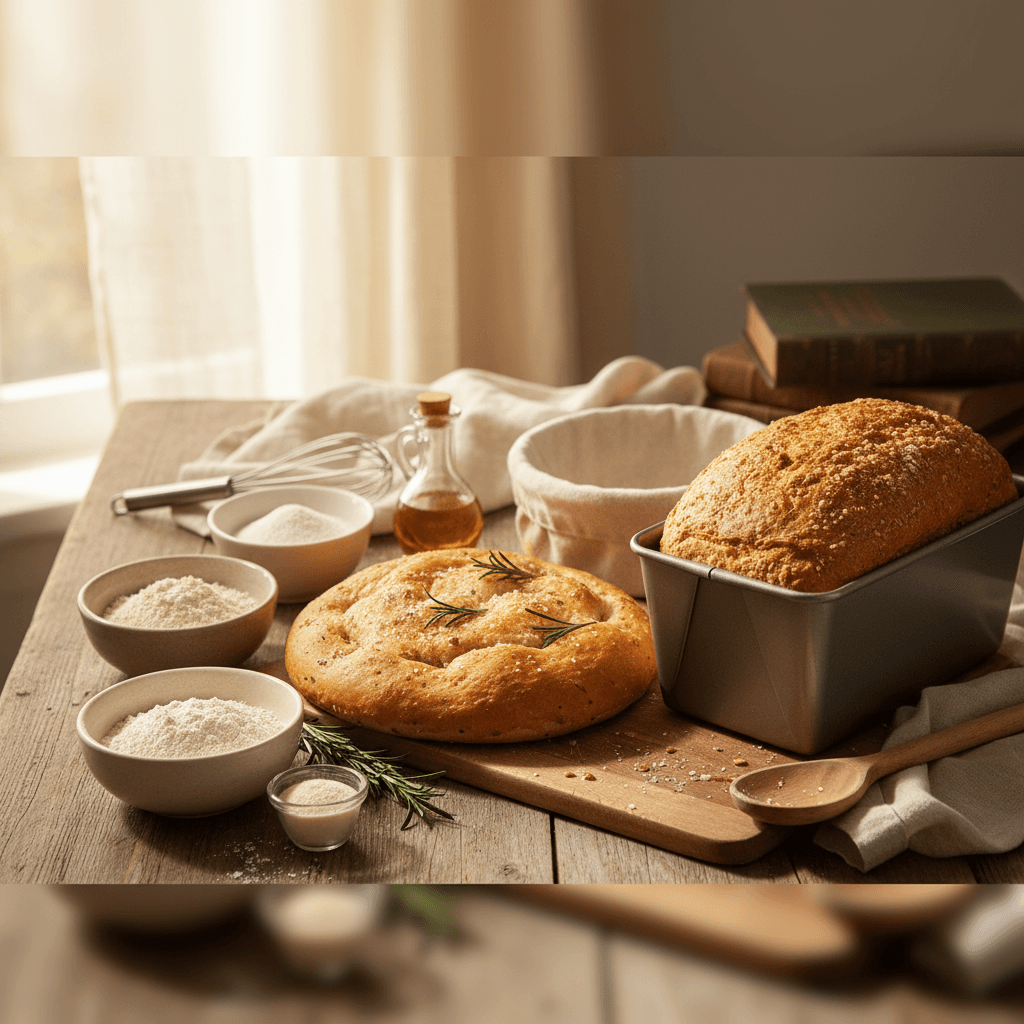
If you've tried gluten-free bread baking before and ended up with a dense, crumbly brick, you're not alone. The good news is that some styles of gluten-free bread are dramatically easier to nail than others, and we're going to walk through the five most forgiving approaches so you can finally bake a loaf you're proud of.
Key takeaways
- Focaccia is the single easiest gluten-free bread to bake at home because it's flat, forgiving, and doesn't need to hold a tall rise.
- Psyllium husk is the best binder for beginner bread recipes because it mimics gluten's elasticity more naturally than xanthan gum alone.
- Bread machine loaves remove most of the guesswork around mixing, rising, and timing — a great option if you want consistent results fast.
- Quick breads and soda breads skip yeast entirely, which eliminates the most unpredictable variable in gluten-free baking.
- Using a kitchen scale instead of measuring cups can fix most texture problems before they start.
- Internal bread temperature of 205-210°F is the most reliable way to know your loaf is actually done — not just golden on top.
Why some gluten-free breads are easier than others
The difficulty of any gluten-free bread recipe comes down to how much structural work you're asking the dough to do. Tall sandwich loaves need strong binder networks, precise hydration, and careful rise management. Flat breads, quick breads, and machine-assisted loaves reduce or eliminate those demands. That's why choosing the right style of bread matters as much as choosing the right flour blend.
Understanding the role of each ingredient helps too. Our gluten-free baking guide breaks down the science behind why gluten-free doughs behave differently and what you can do about it. Once you understand that, even the recipes below will make more intuitive sense.
If you want a structured approach to building these skills, the Confident Gluten-Free Baker Toolkit walks you through flour selection, binder ratios, and troubleshooting in a step-by-step format that takes the guesswork out of your first several bakes.
1. Gluten-free focaccia: the most forgiving bread you can bake
Focaccia is hands-down the easiest gluten-free bread to make at home. Because it bakes in a sheet pan rather than a loaf pan, it doesn't need to support a tall rise. The generous amount of olive oil keeps it moist, and the dimpled surface means imperfections are a feature, not a flaw.
What makes focaccia so beginner-friendly
Gluten-free focaccia batter is more like a thick pancake batter than a traditional dough. You spread it into an oiled pan, let it rise once, dimple it with your fingers, and bake. There's no shaping, no scoring, and no second rise to worry about. Even if your rise is modest, you'll still get a bread with crispy edges and a soft, open interior.
Best flour and binder choices for focaccia
A simple blend of brown rice flour, tapioca starch, and potato starch works beautifully here. For the binder, psyllium husk powder is our top recommendation — it gives the bread a chewier, more authentic texture than xanthan gum alone. Use about 2 teaspoons of psyllium husk powder per cup of flour blend.
Common focaccia mistakes and how to avoid them
The most common mistake is under-oiling the pan. Gluten-free focaccia needs a generous pool of olive oil on the bottom — at least 3 tablespoons — to develop that signature crispy base. The second mistake is overbaking. Pull it when the top is golden and the internal temperature hits 205°F. An instant read thermometer takes the guesswork out completely.
2. Bread machine gluten-free loaves: set it and walk away
A bread machine handles mixing, kneading, rising, and baking in a single cycle, which eliminates most of the variables that trip up new gluten-free bakers. If you want a sandwich-style loaf with minimal effort, this is the path of least resistance.
Why bread machines work well for gluten-free bread
Gluten-free dough benefits from thorough, consistent mixing to hydrate starches and activate binders evenly. A bread machine does this more reliably than hand mixing. Most modern machines have a dedicated gluten-free cycle that uses a single rise (instead of two) and adjusts bake time. Our bread machine comparison covers which models actually have good gluten-free cycles and which ones just slap a label on a standard program.
Best flour blends for bread machine loaves
Pre-made flour blends like Bob's Red Mill 1-to-1 or King Arthur Measure for Measure are the easiest starting point for bread machine recipes. If you prefer mixing your own, a ratio of 2 parts rice flour, 2/3 part potato starch, and 1/3 part tapioca starch gives you a solid base. Check our flour blend brand comparison to see which blends perform best in yeast breads specifically.
Common bread machine mistakes
The biggest mistake is adding ingredients in the wrong order. Most gluten-free bread machine recipes need wet ingredients first, then dry, with yeast on top — but always check your machine's manual. The second most common issue is collapsed loaves, which usually happens because the dough over-rose in a warm kitchen. Using slightly cool water (around 80°F instead of 110°F) can help control the rise speed.
3. Gluten-free soda bread: no yeast, no rise time, no stress
Soda bread is leavened with baking soda and buttermilk instead of yeast, which means there's no rising, no proofing, and no waiting. You mix the dough, shape a rough round, and bake it. Total hands-on time is about 10 minutes.
The science behind soda bread's simplicity
When baking soda meets the acid in buttermilk, it produces carbon dioxide immediately. That means you get lift without waiting for yeast to do its thing. The trade-off is a denser, more rustic crumb — but for many home bakers, that's a feature. Soda bread is meant to be hearty.
Best flour choices for gluten-free soda bread
This is a great place to use buckwheat flour blended with rice flour and a starch. Buckwheat adds an earthy, slightly nutty flavor that's traditional in rustic breads and helps mask any rice flour grittiness. A touch of almond flour adds moisture and fat, which keeps the bread from drying out too fast.
Common soda bread mistakes
Over-mixing is the enemy here. Once the wet and dry ingredients come together, stop mixing. Extra stirring deflates the bubbles that baking soda just created. Also, don't skip the cross-cut on top — that deep X-shaped slash isn't decorative. It lets heat penetrate the center so the bread bakes evenly. If your soda bread comes out gummy in the middle, it almost always means you needed that slash deeper or your oven was running too hot.
4. Gluten-free banana bread and quick bread loaves
Quick breads use baking powder as the leavener and include enough eggs, fat, and sugar to create structure without any binder gymnastics. Banana bread, zucchini bread, and pumpkin bread all fall into this category, and they're some of the most reliably successful gluten-free bakes you can make.
Why quick breads are so forgiving in gluten-free baking
Quick breads are forgiving because eggs and fat do most of the structural heavy lifting. The proteins in eggs set during baking and create the crumb structure, while sugar holds moisture. You can often get away with a simple 1-to-1 flour blend and no additional binder at all — though a half teaspoon of xanthan gum doesn't hurt.
Tips for the best gluten-free quick bread texture
Weigh your flour. Seriously. Gluten-free flours pack differently than wheat flour, and a cup of rice flour can vary by 30 grams depending on how you scoop it. A good kitchen scale is the single most impactful tool upgrade you can make. Also, let your quick bread cool completely in the pan for at least 15 minutes before turning it out — gluten-free quick breads are fragile when hot.
Common quick bread mistakes
The most frequent issue is a loaf that's too dense. This usually comes from too much flour (again, use a scale) or old baking powder that's lost its lift. Test your baking powder by dropping a teaspoon into hot water — if it doesn't fizz vigorously, replace it. The second common problem is a loaf that falls apart when sliced. Let it cool completely and use a serrated knife with a gentle sawing motion.
5. Simple gluten-free sandwich bread with a pre-made flour blend
If what you really want is a basic sandwich loaf, the easiest path is using a high-quality pre-made flour blend with a well-tested recipe. This isn't cheating — it's smart. Blend manufacturers have already done the work of balancing protein, starch, and fiber ratios.
How to choose the right flour blend for sandwich bread
| Flour blend type | Best for | Binder needed? | Notes |
|---|---|---|---|
| 1-to-1 all-purpose blends (Bob's Red Mill, King Arthur) | General baking, decent bread | Usually included | Convenient but may need extra psyllium for bread |
| Bread-specific blends (King Arthur GF Bread Flour) | Yeast breads specifically | Usually included | Higher protein, better rise |
| DIY blends (rice flour + starch + binder) | Full control over texture | Yes, add separately | More effort but best results once dialed in |
For your first attempt, we recommend a bread-specific blend. Our King Arthur gluten-free product review covers their bread flour blend in detail.
The technique that makes or breaks sandwich bread
Gluten-free sandwich bread dough should look like thick muffin batter, not like traditional bread dough. If you can shape it with your hands, it's too dry. Use a spatula to spread it into a well-greased loaf pan, smooth the top, and let it rise until it just crests above the rim. Then bake immediately — don't wait for a dramatic dome or it will collapse.
Common sandwich bread mistakes
Under-baking is the number one problem with gluten-free sandwich bread. The top looks done 10-15 minutes before the center is actually set. Use an instant read thermometer and don't pull it until the center reads 205-210°F. If the top is browning too fast, tent it with foil. For a complete walkthrough of what can go wrong, our bread troubleshooting guide covers 15 of the most common problems and their fixes.
Which approach should you start with?
| Bread style | Difficulty | Time (start to finish) | Special equipment needed | Best for |
|---|---|---|---|---|
| Focaccia | Easiest | 90 minutes | Sheet pan | First-time GF bakers |
| Bread machine loaf | Easy | 3-4 hours (mostly hands-off) | Bread machine | Consistent sandwich bread |
| Soda bread | Easy | 60 minutes | Baking sheet | Same-day bread, no yeast |
| Quick bread (banana, etc.) | Easy | 75 minutes | Loaf pan | Sweet breads and snacking |
| Sandwich loaf (oven) | Moderate | 2-3 hours | Loaf pan, thermometer | Classic sliced bread |
If you've never baked gluten-free bread before, start with focaccia. It builds your confidence with yeast and gluten-free dough behavior without the pressure of a tall loaf. Once you've nailed that, move to soda bread or a bread machine loaf, then work up to sandwich bread when you're ready.
Essential tools that make gluten-free bread baking easier
You don't need a lot of gear, but a few key tools make a massive difference in gluten-free bread success:
- Kitchen scale — Weighing flour is the single biggest improvement you can make. A reliable option is the OXO Good Grips 11lb Food Scale.
- Instant read thermometer — The only reliable way to know your bread is done inside. The ThermoWorks Classic Thermapen reads in 1-2 seconds and is accurate to ±0.7°F.
- Parchment paper — Gluten-free bread sticks to everything. Line your pans every time.
- Cooling rack — Letting bread cool on a rack prevents the bottom from getting soggy from trapped steam. Our cooling rack guide explains why this matters more for GF bread than wheat bread.
For a complete rundown, our beginner tools guide covers everything you need without the stuff you don't.
Frequently asked questions
What is the easiest type of gluten-free bread to bake at home?
Focaccia is the easiest gluten-free bread to bake at home. It bakes flat in a sheet pan, so it doesn't need to hold a tall rise, and the generous olive oil keeps it moist even if your flour ratio isn't perfect. It's the best starting point for anyone new to gluten-free bread baking.
Can you make gluten-free bread without xanthan gum?
Yes, you can make gluten-free bread without xanthan gum by using psyllium husk powder or ground flax as your binder instead. Psyllium husk is especially effective in yeast breads because it creates a gel-like network that traps gas bubbles similarly to gluten. Many bakers prefer it over xanthan gum for bread specifically.
Why does my gluten-free bread always come out gummy?
Gummy gluten-free bread is almost always under-baked, even when the outside looks done. Use an instant read thermometer and bake until the center reaches 205-210°F. Excess moisture from too much liquid or not enough starch in your flour blend can also cause gumminess. Our gummy centers guide walks through every cause and fix.
Do you need a bread machine to make gluten-free bread?
No, you don't need a bread machine, but it does make the process easier and more consistent. A bread machine handles mixing, rising, and baking automatically, which removes several failure points. That said, focaccia, soda bread, and quick breads are all simple enough to make entirely by hand with great results. Our bread machine guide helps you decide if one is worth the investment for your baking habits.
What is the best gluten-free flour for homemade bread?
For beginners, a pre-made bread-specific flour blend like King Arthur Gluten-Free Bread Flour gives the most reliable results. For more experienced bakers, a custom blend of brown rice flour, tapioca starch, and potato starch with psyllium husk as a binder produces excellent bread with better flavor and texture than most commercial blends.

Written by
Co-founder, BakingSubs
Co-founder of BakingSubs, where he turns the science of ingredient substitutions into tested, reliable guidance for home bakers.
Related Posts
Bake with Confidence
See all
Confident Gluten-Free Baker Toolkit
The science-based system that replaces gluten's seven invisible jobs so your baking turns out soft, fluffy, and foolproof — every time.

Gluten-Free Recipe Vault
Instant access to our complete library of proven gluten-free recipes — no waiting, no guesswork, just results that work tonight.

Fix Your Gluten-Free Bread
Learn the 3-step formula to make bread rise and stay soft, discover why your loaves collapse, and get a tested sandwich bread recipe that actually works.