

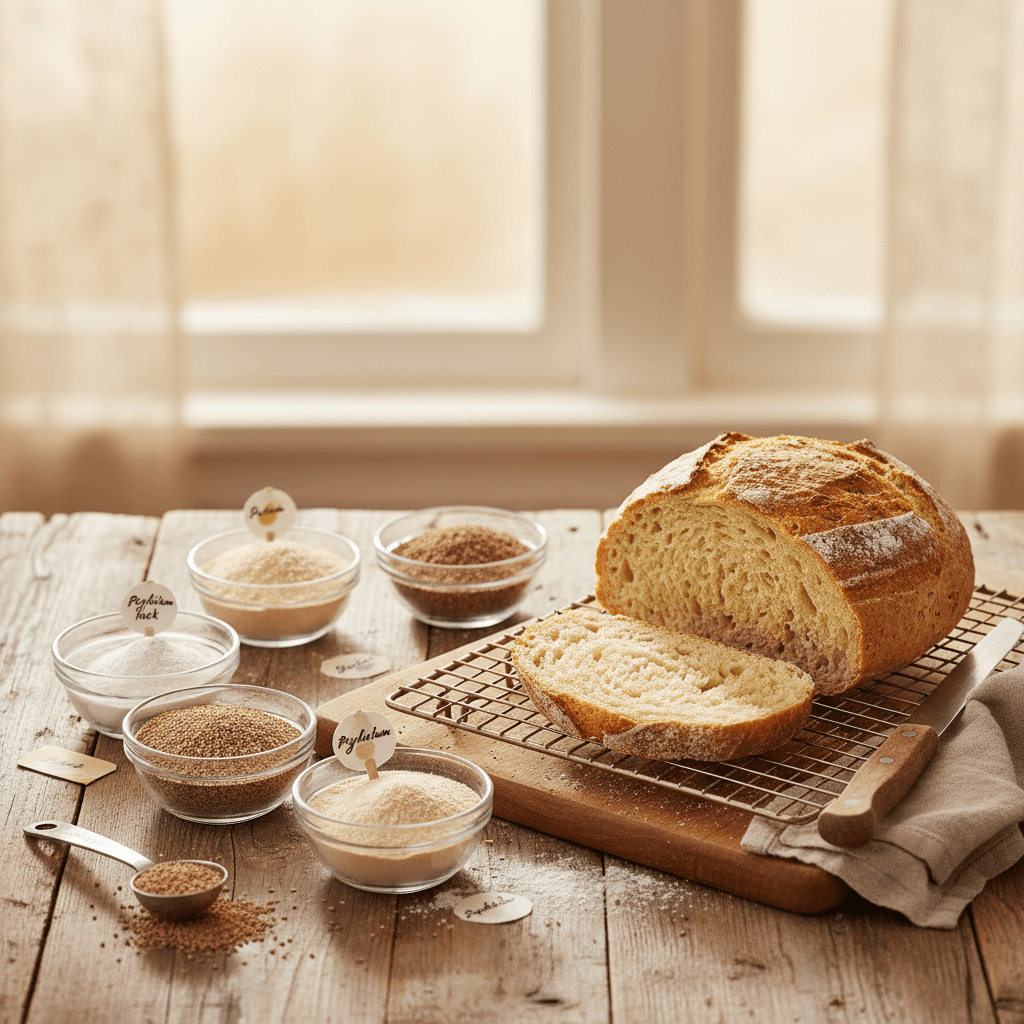
Psyllium husk is the single most important binder for gluten-free bread, and the brand you choose matters more than you might think. Not all psyllium husks behave the same way in dough — grind size, purity, and processing all affect your final loaf. Here's how the most popular options compare.
Key takeaways
- Finely ground psyllium husk powder produces the best structure in gluten-free bread — whole husks don't hydrate evenly and leave visible specks.
- Look for products with 85%+ soluble fiber content, which indicates higher purity and better gel formation.
- The color of your psyllium matters: lighter-colored powders produce bread that looks more like traditional wheat bread.
- You typically need 1-2 tablespoons of psyllium husk powder per loaf, making even premium brands extremely cost-effective.
- Always hydrate psyllium husk in your liquid ingredients before mixing with flour for the most consistent results.
- Avoid psyllium products with added sweeteners, flavoring, or laxative additives — you want 100% pure psyllium.
Why psyllium husk brand matters for gluten-free bread
Psyllium husk acts as the structural backbone of gluten-free bread, forming a gel that mimics the elasticity of gluten. When you use a high-quality, finely ground psyllium husk powder, it hydrates uniformly and creates a smooth, stretchy dough that traps gas from yeast fermentation. A low-quality or coarsely ground product can leave you with crumbly bread that falls apart when sliced.
We've covered the science behind this in our xanthan gum vs. psyllium husk comparison, but the short version is: psyllium creates a more bread-like crumb structure than any other gluten-free binder. The catch is that quality varies wildly between brands.
If you're building out your gluten-free pantry and want a solid foundation for bread baking, our Confident Gluten-Free Baker Toolkit walks you through all the essential ingredients and tools you need, including how to choose the right binder for every recipe.
What to look for when buying psyllium husk for bread
The most important factor is grind size — you want a fine powder, not whole husks. Here's a quick breakdown of what to evaluate before buying:
- Grind size: Finely ground powder hydrates faster and more evenly than whole husks. Whole husks can leave purple-gray streaks in your bread and create an uneven crumb.
- Purity: Look for 100% psyllium husk with no fillers, sweeteners, or additives. Many pharmacy-brand psyllium products contain sugar or orange flavoring — avoid these entirely.
- Color: Lighter powder (closer to off-white or pale beige) generally indicates the outer husk has been separated more thoroughly. Darker powder can tint your bread purple or gray.
- Fiber content: Higher soluble fiber per serving means better gel formation. Aim for products listing 5g+ of soluble fiber per tablespoon.
- Certified gluten-free: This is non-negotiable. Psyllium itself is naturally gluten-free, but cross-contamination during processing is a real risk. Always check for third-party certification.
A good kitchen scale is essential here because psyllium husk is incredibly absorbent — even a gram or two too much can make your dough stiff and your bread dense.
The 6 best psyllium husk products for gluten-free bread
We compared these products based on grind fineness, suitability for bread, color impact, purity, and value. Here's how they stack up.
| Product | Form | Certified GF | Color impact | Price range | Best for |
|---|---|---|---|---|---|
| Anthony's Organic Psyllium Husk Powder | Fine powder | Yes | Minimal | $12-16 / 1.5 lb | Best overall pick |
| Viva Naturals Organic Psyllium Husk Powder | Fine powder | Yes | Minimal | $14-18 / 1.5 lb | Runner-up |
| NOW Supplements Psyllium Husk Powder | Fine powder | No (GF tested) | Slight | $10-14 / 1.5 lb | Budget pick |
| Kate Naturals Psyllium Husk Powder | Fine powder | Yes | Minimal | $13-17 / 1 lb | Small batches |
| Healthworks Psyllium Husk Powder | Fine powder | No | Moderate | $11-15 / 2 lb | Bulk value |
| Bob's Red Mill Psyllium Fiber Powder | Fine powder | Yes | Slight | $9-13 / 16 oz | Easy to find locally |
Anthony's Organic Psyllium Husk Powder — best overall
Anthony's is our top pick for gluten-free bread baking. It's finely ground to a consistency that hydrates quickly and evenly, producing a smooth dough with excellent stretch. The color is relatively light for psyllium, so it won't turn your bread an off-putting shade of purple — something that matters if you're trying to make a loaf that looks like traditional sandwich bread.

Anthony's Organic Psyllium Husk Powder, 1.5 lb, Gluten Free, Non GMO, Finely Ground, Keto Friendly
Check price on Amazon →The Anthony's Organic Psyllium Husk Powder comes in a 1.5-pound resealable bag that lasts for dozens of loaves. At roughly $12-16, it's an outstanding value. It's USDA organic, non-GMO, and certified gluten-free — all the boxes checked.
Pros:
- Very fine, consistent grind
- Minimal color impact on bread
- Certified gluten-free and organic
- Excellent gel formation for bread structure
- Resealable bag
Cons:
- Can clump if not whisked into liquid immediately
- Occasionally sells out on Amazon due to popularity
Viva Naturals Organic Psyllium Husk Powder — runner-up
Viva Naturals is a close match for Anthony's for bread baking. The grind is comparably fine, and it should produce a dough with great elasticity. The color runs just a touch darker than Anthony's, but the difference in a finished loaf is negligible.
The Viva Naturals Organic Psyllium Husk Powder is priced slightly higher, which is the main reason it's our runner-up rather than co-champion. If Anthony's is out of stock, grab this one without hesitation.
Pros:
- Very fine grind with consistent performance
- Certified gluten-free, organic, non-GMO
- Hydrates quickly in liquid
Cons:
- Slightly more expensive than Anthony's for the same size
- Marginally darker color
NOW Supplements Psyllium Husk Powder — best budget option
NOW is a well-known supplement brand, and their psyllium husk powder works well in bread at a lower price point. The grind is fine, though not quite as silky as Anthony's or Viva Naturals. It creates good gel formation and produces a respectable loaf.
The NOW Psyllium Husk Powder isn't certified gluten-free by a third party, though NOW states it's tested for gluten. If you have celiac disease and need that certification for peace of mind, consider one of the certified options above. For gluten sensitivity or general gluten-free baking, this is a solid budget choice.
Pros:
- Affordable — often the cheapest per ounce
- Widely available
- Good gel formation
Cons:
- Not third-party certified gluten-free
- Slightly coarser grind than top picks
- Can add a slight grayish tint to bread
Kate Naturals Psyllium Husk Powder — best for small batches
Kate Naturals offers a 1-pound bag that's ideal if you're just getting started with psyllium in bread baking and don't want to commit to a larger quantity. The grind quality is excellent — very fine and light in color.
The Kate Naturals Psyllium Husk Powder is certified gluten-free and organic. The only downside is the per-ounce price is higher than buying a larger bag from Anthony's or Viva Naturals.
Pros:
- Fine, light-colored powder
- Certified gluten-free and organic
- Good starter size
Cons:
- Higher per-ounce cost
- Smaller bag runs out fast if you bake frequently
Healthworks Psyllium Husk Powder — best bulk value
If you bake bread regularly and go through psyllium quickly, Healthworks offers a 2-pound bag at a very competitive price. The grind is fine enough for bread, though it trends slightly darker than our top picks, which can give your loaf a slightly more noticeable tint.
The Healthworks Psyllium Husk Powder is organic but not certified gluten-free, so keep that in mind if certification is important to you.
Pros:
- Excellent value for frequent bakers
- 2-pound bag lasts a long time
- Organic
Cons:
- Not certified gluten-free
- Darker color than premium options
- Can produce a slightly more purple-tinted crumb
Bob's Red Mill Psyllium Fiber Powder — easiest to find
Bob's Red Mill is the brand you're most likely to find at your local grocery store, which makes it a great option if you need psyllium today and don't want to wait for shipping. It's certified gluten-free and performs well in bread, though the grind can be slightly less consistent batch to batch compared to our top Amazon picks.
If you already use other Bob's Red Mill products like their brown rice flour or arrowroot powder, this fits right into your pantry.
Pros:
- Available in most grocery stores
- Certified gluten-free
- Trusted brand with good quality control
Cons:
- Smaller package size for the price
- Grind consistency can vary slightly between batches
- Not always the best value per ounce
Common mistakes when using psyllium husk in gluten-free bread
Even with the best psyllium husk, technique matters. These are the most common mistakes — and they're all easy to fix.
Using whole husks instead of powder. Whole psyllium husks don't break down fully during mixing and baking. You'll end up with visible purple-gray flecks in your bread and an uneven crumb. Always use finely ground powder for bread.
Adding psyllium directly to dry ingredients. Psyllium needs to hydrate in your liquid ingredients first. Whisk it into your water, milk, or egg mixture and let it sit for 2-3 minutes until it forms a gel. Then combine with your flour blend. This produces a much more consistent dough.
Using too much. More psyllium does not mean better structure. Too much makes bread dense, gummy, and heavy. Most recipes call for 1-2 tablespoons per loaf — stick to that range. If your bread is turning out gummy in the middle, excess psyllium could be the culprit.
Not adjusting hydration. Psyllium absorbs a tremendous amount of water. If you're adding psyllium to a recipe that wasn't designed for it, you need to increase your liquid by roughly 1/4 cup per tablespoon of psyllium added. Without this adjustment, you'll get dense, heavy bread.
Buying flavored or supplement-grade products. Pharmacy psyllium products like Metamucil contain sugar, artificial sweeteners, and orange flavoring. These will ruin your bread. Always buy unflavored, 100% pure psyllium husk powder.
Psyllium husk powder vs whole husks for bread baking
This is one of the most common psyllium questions, and the answer is straightforward: use powder for bread, always. Whole husks are fine for smoothies or as a fiber supplement, but they don't work well in bread dough. The husks don't fully hydrate during the mixing and proofing stages, which means they can't form the continuous gel network that gives gluten-free bread its structure.
If you can only find whole husks, you can grind them in a high-speed blender or food processor until they reach a fine powder consistency. Just be aware that home-ground psyllium may not be as uniformly fine as commercially ground powder, so results can be less predictable.
For a deeper dive into how psyllium compares to other binders like xanthan gum and flax, check out our best binders for gluten-free bread guide.
How to store psyllium husk for maximum shelf life
Psyllium husk powder is shelf-stable and lasts a long time when stored properly. Keep it in an airtight container in a cool, dry place away from direct sunlight. The resealable bags that Anthony's and Viva Naturals come in work fine, but if you buy a brand without a good seal, transfer it to a mason jar or airtight container.
Properly stored, psyllium husk powder will maintain its binding properties for 2-3 years. You'll know it's gone stale if it doesn't form a thick gel when mixed with water — if the gel is thin or watery, it's time to replace it.
Frequently asked questions
Can I use Metamucil instead of psyllium husk powder for gluten-free bread?
No. Metamucil and similar supplement products contain sugar, artificial sweeteners, citric acid, and flavoring that will negatively affect your bread's taste and texture. Always use 100% pure, unflavored psyllium husk powder for baking. Look for products with a single ingredient on the label.
How much psyllium husk powder do I need per loaf of gluten-free bread?
Most gluten-free bread recipes call for 1 to 2 tablespoons of psyllium husk powder per loaf. The exact amount depends on the recipe and your flour blend. Because psyllium is so absorbent, even small measurement differences matter — we always recommend weighing it on a kitchen scale rather than relying on measuring spoons.
Does psyllium husk turn gluten-free bread purple?
It can, especially if you use whole husks or a darker-ground powder. The purple-gray tint comes from the outer husk pigment. Choosing a lighter-colored, finely ground powder like Anthony's or Viva Naturals minimizes this effect. The tint is purely cosmetic and doesn't affect taste or texture.
Is psyllium husk better than xanthan gum for gluten-free bread?
For bread specifically, yes — most experienced gluten-free bakers prefer psyllium husk. It creates a more elastic, bread-like crumb and better oven spring than xanthan gum. Xanthan gum works better in cookies, cakes, and quick breads. We break down exactly when to use each one in our xanthan gum vs. psyllium husk comparison.
Why does my gluten-free bread fall apart even with psyllium husk?
The most common reasons are not hydrating the psyllium before mixing, using too little, or using whole husks instead of powder. Make sure you whisk the psyllium into your liquid ingredients and let it gel for 2-3 minutes before combining with dry ingredients. If you're still having trouble, our guide to bread that falls apart covers all the possible causes.

Written by
Co-founder, BakingSubs
Co-founder of BakingSubs, where he turns the science of ingredient substitutions into tested, reliable guidance for home bakers.
Related Posts
Bake with Confidence
See all
Confident Gluten-Free Baker Toolkit
The science-based system that replaces gluten's seven invisible jobs so your baking turns out soft, fluffy, and foolproof — every time.

Gluten-Free Recipe Vault
Instant access to our complete library of proven gluten-free recipes — no waiting, no guesswork, just results that work tonight.

Fix Your Gluten-Free Bread
Learn the 3-step formula to make bread rise and stay soft, discover why your loaves collapse, and get a tested sandwich bread recipe that actually works.