

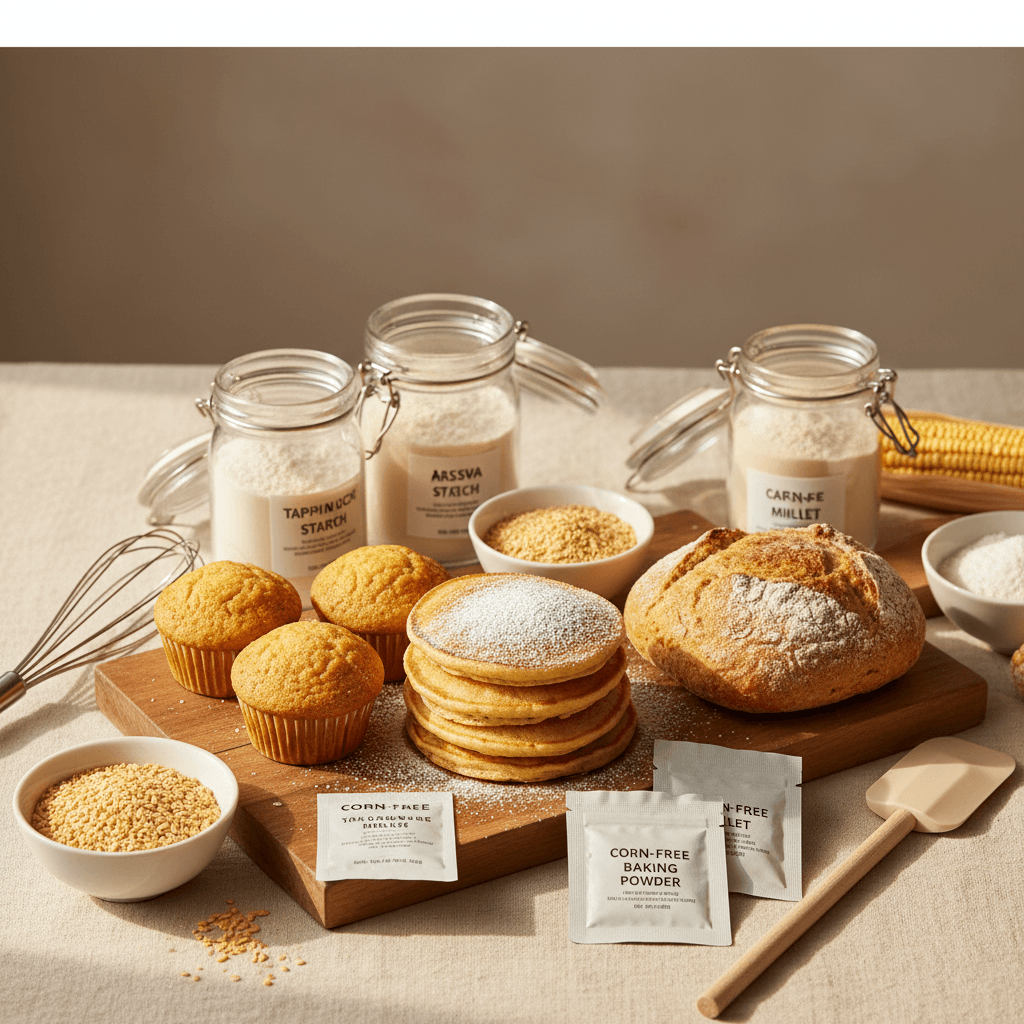
Managing both gluten-free and corn-free diets at the same time makes baking feel like navigating a minefield — corn derivatives hide in everything from baking powder to powdered sugar. Here are the products that keep your baking safe, delicious, and free from both gluten and corn.
Key takeaways
- Most commercial baking powders contain cornstarch, making them unsafe for corn-free bakers — you need a specifically corn-free formula or can make your own.
- Powdered sugar almost always contains cornstarch as an anti-caking agent; look for brands that use tapioca starch instead.
- Corn-derived ingredients hide under names like dextrose, maltodextrin, citric acid, and modified food starch — always read the full ingredient list.
- Tapioca starch and arrowroot powder are your best corn-free alternatives to cornstarch for thickening and adding lightness to baked goods.
- Several naturally gluten-free flours — sorghum, buckwheat, millet, and tigernut — are inherently corn-free and form the backbone of safe flour blends.
- Dedicated gluten-free facilities don't guarantee corn-free processing, so you still need to verify each product independently.
Why gluten-free and corn-free baking is harder than it sounds
When you go gluten-free, corn becomes the default replacement starch in almost every commercial product. Cornstarch shows up in flour blends, baking powder, powdered sugar, and even vanilla extract. That means most "gluten-free" products on the shelf are loaded with corn derivatives, and people with corn allergies or intolerances get left behind.
The challenge is compounded by the fact that corn hides under dozens of names on ingredient labels. Dextrose, maltodextrin, modified food starch, citric acid (often derived from corn), caramel color, and xanthan gum (frequently grown on corn-based media) can all be corn-derived. The safest approach is to build your pantry from single-ingredient products and verified corn-free brands rather than relying on pre-made mixes.
If you're new to gluten-free baking in general, our complete beginner's guide covers the fundamentals — then come back here to layer on the corn-free piece.
Hidden corn ingredients to watch for on labels
Before we get into specific products, here's a reference table of common corn-derived ingredients that show up in baking products. Print this out and keep it in your pantry — it'll save you a lot of frustration at the store.
| Ingredient name | Commonly found in | Corn-free alternative |
|---|---|---|
| Cornstarch | Baking powder, powdered sugar, flour blends | Tapioca starch, arrowroot powder |
| Dextrose | Baking mixes, flavored extracts | Cane sugar, beet sugar |
| Maltodextrin | Flavored chips, drink mixes, spice blends | Tapioca maltodextrin (verify source) |
| Modified food starch | Pudding mixes, pie fillings, sauces | Arrowroot, tapioca starch |
| Citric acid | Canned goods, drink mixes, some leaveners | Lemon juice, cream of tartar |
| Xanthan gum | Gluten-free flour blends, sauces | Psyllium husk, guar gum (verify source) |
| Caramel color | Vanilla extract, syrups, brown sugar | Pure vanilla, unprocessed sugars |
| Confectioner's glaze | Sprinkles, candy decorations | Homemade decorations |
One note on xanthan gum: while it's not always corn-derived, many manufacturers grow it on a corn-based substrate. If you're highly sensitive, contact the manufacturer directly or switch to psyllium husk as a binder instead.
The 7 best gluten-free corn-free baking products
We picked each of these products based on its ingredient list and labeling for both gluten-free and corn-free safety. These are the staples that make up the backbone of a corn-free, gluten-free baking pantry.
1. Hain Featherweight baking powder (corn-free)
This is the single most important swap in your corn-free baking pantry. Standard baking powder — including most "gluten-free" brands — uses cornstarch as a filler. Hain Featherweight Baking Powder replaces corn with potato starch, making it safe for corn-free bakers. It's double-acting and works identically to regular baking powder in recipes.
Use it as a 1:1 replacement for any baking powder called for in your recipes. If you can't find Hain, you can also make your own by combining 1 part baking soda with 2 parts cream of tartar — though this is single-acting, so you'll need to get your batter into the oven quickly.
2. Wholesome organic powdered sugar
Most powdered sugar contains cornstarch to prevent clumping. Wholesome Organic Powdered Sugar uses tapioca starch instead, making it the go-to for corn-free frostings, glazes, and dusting. It dissolves smoothly and tastes identical to conventional powdered sugar.
This matters more than people realize — if you're making buttercream, royal icing, or any frosted baked good, conventional powdered sugar introduces corn into your recipe.
3. Bob's Red Mill sorghum flour
Sorghum is one of the best base flours for gluten-free corn-free baking. It has a mild, slightly sweet flavor that works in everything from bread to cookies. Bob's Red Mill Sorghum Flour is milled from whole grain sorghum with no additives — just pure sorghum. We compare sorghum flour options in our sorghum flour brand comparison, and Bob's Red Mill is a dependable choice for structure and flavor.
Sorghum works best when blended with a starch (tapioca or arrowroot) and a protein-rich flour like buckwheat or almond flour.
4. Anthony's tapioca starch
Tapioca starch is your corn-free answer to cornstarch in virtually every baking application. Anthony's Premium Tapioca Starch is verified gluten-free, non-GMO, and naturally corn-free. It adds chewiness and lightness to baked goods and works as a thickener for fillings and sauces.
In most gluten-free flour blends, tapioca starch makes up about 30-40% of the total weight. If you've been using a blend that contains cornstarch, swapping in tapioca starch at the same ratio gives you nearly identical results. For more on building your own blend, check out our homemade gluten-free flour blend recipe — just substitute tapioca for any corn-based starch listed.
5. Bob's Red Mill arrowroot starch
Arrowroot is another excellent corn-free starch, especially for delicate baked goods and as a thickener for fruit fillings. Bob's Red Mill Arrowroot Starch is a single-ingredient product with no risk of corn contamination. We compared the top brands in our arrowroot starch brand comparison if you want to see how they stack up.
Arrowroot produces a slightly lighter, more tender crumb than tapioca starch, so a combination of both works well in flour blends. It also freezes better than cornstarch-thickened fillings, which is a nice bonus for make-ahead baking.
6. Jovial cassava flour
Jovial Organic Cassava Flour is a game-changer for corn-free gluten-free baking because it behaves more like wheat flour than almost any other alternative. It's made from a single ingredient — peeled, dried, and ground yuca root — and it's naturally free of both gluten and corn. The texture is fine and smooth, and it produces baked goods with a more "normal" crumb than many GF flours.
Cassava flour is particularly good for tortillas, flatbreads, and simple cakes. It absorbs a lot of liquid, so you'll typically use about 15-20% less than you would all-purpose flour.
7. Frontier Co-op cream of tartar
Cream of tartar is essential for corn-free baking because it lets you make your own baking powder and stabilize egg whites without any corn-derived ingredients. Frontier Co-op Cream of Tartar is a pure, single-ingredient product — just potassium bitartrate, a byproduct of winemaking. No corn, no gluten, no fillers.
Beyond homemade baking powder, cream of tartar helps snickerdoodles get their signature tang and keeps whipped egg whites stiff. It's a small but mighty pantry staple for anyone avoiding corn.
If you're building out a full gluten-free pantry and want a structured approach to understanding how all these ingredients work together, the Confident Gluten-Free Baker Toolkit walks you through flour functions, blend ratios, and troubleshooting — all skills that become even more critical when you're also avoiding corn.
How to build a corn-free gluten-free flour blend
The easiest approach is to take a standard gluten-free flour blend ratio and swap out any corn-based starches. Here's a simple formula that works for most recipes:
| Component | Percentage | Recommended flour |
|---|---|---|
| Whole grain flour (base) | 40% | Sorghum, millet, or buckwheat |
| Light starch | 30% | Tapioca starch |
| Medium starch | 20% | Arrowroot or potato starch |
| Protein flour | 10% | Almond flour or chickpea flour |
For the whole grain base, sorghum gives the most neutral flavor. Millet flour is slightly sweeter and lighter, which works beautifully in cakes and muffins. Buckwheat flour adds a nutty depth that's perfect for pancakes, waffles, and hearty breads.
For the protein component, chickpea flour adds excellent binding and structure but has a stronger flavor. Almond flour is milder and adds moisture. Either works — pick based on your recipe and any additional allergen concerns.
Add psyllium husk or guar gum as your binder at about 1 teaspoon per cup of flour blend. Avoid xanthan gum unless you've confirmed the specific brand is grown on a non-corn medium.
Corn-free baking powder: make your own in 30 seconds
If you can't find Hain Featherweight or want to save money, making corn-free baking powder at home is dead simple. Combine 1 part baking soda with 2 parts cream of tartar. For a full batch you can store, mix 1/4 cup cream of tartar with 2 tablespoons baking soda and sift together three times.
The catch: this is single-acting, meaning it only reacts once when it hits liquid. Double-acting commercial baking powder gets a second rise in the oven. To compensate, work quickly once your wet and dry ingredients are combined, and get your batter into a preheated oven as fast as possible. For most muffins, quick breads, and pancakes, the difference is minimal.
Tips for avoiding cross-contamination with corn
Even with the right products, corn can sneak in through cross-contamination and hidden sources. Here are the practices that keep your baking truly corn-free:
- Check every ingredient, every time. Manufacturers change formulations without warning. A product that was corn-free six months ago might not be today.
- Call the manufacturer about "natural flavors." This catch-all term can include corn-derived ingredients. Most companies will tell you the source if you ask.
- Watch your vanilla extract. Many brands use corn-derived alcohol or contain dextrose. Look for brands that specify cane sugar or use glycerin-based formulations.
- Be cautious with chocolate chips. Many contain corn syrup, maltodextrin, or soy lecithin derived from corn-adjacent processing. Enjoy Life brand is generally considered safe for both restrictions.
- Verify your parchment paper. Some parchment papers are coated with a silicone that uses corn-derived processing aids. Unbleached, quilon-free options are safest.
Understanding how different ingredients function in your baking helps you troubleshoot when things go wrong. Our guide on what gluten does in baking explains the roles you're replacing, which becomes even more important when your starch options are limited by a corn restriction.
Frequently asked questions
Is xanthan gum made from corn?
Xanthan gum is often produced using corn sugar (glucose) as the fermentation medium, which means it can contain trace corn proteins. If you have a corn allergy, it's safest to use psyllium husk or guar gum as a binder instead. Some brands produce xanthan gum on non-corn substrates, but you'll need to contact the manufacturer directly to confirm.
Does baking powder contain corn?
Yes, most baking powder brands — including popular ones like Clabber Girl, Rumford, and even many "gluten-free" labeled options — contain cornstarch as a buffer between the acid and base. Hain Featherweight baking powder uses potato starch instead and is the most widely available corn-free option. You can also make your own by combining baking soda and cream of tartar.
Can I use a regular gluten-free flour blend if I'm also corn-free?
Most commercial gluten-free flour blends contain cornstarch or corn flour as a primary ingredient, so they're not safe for corn-free bakers. You'll need to either find a blend that specifically excludes corn (they're rare) or make your own using our homemade flour blend recipe with tapioca and arrowroot in place of cornstarch.
What can I use instead of cornstarch in gluten-free baking?
Tapioca starch and arrowroot starch are the two best direct replacements for cornstarch in gluten-free baking. Both can be swapped at a 1:1 ratio in most recipes. Tapioca adds a slightly chewier texture, while arrowroot produces a lighter, more delicate crumb. Potato starch is another option for adding moisture and tenderness, though it behaves a bit differently than corn or tapioca starch.
Is powdered sugar gluten-free and corn-free?
Powdered sugar is gluten-free, but almost all conventional brands contain 3-5% cornstarch as an anti-caking agent. Wholesome Organic Powdered Sugar uses tapioca starch instead and is the easiest corn-free option to find. You can also make your own by blending granulated cane sugar with a tablespoon of tapioca starch per cup in a high-speed blender until powdery.

Written by
Co-founder, BakingSubs
Co-founder of BakingSubs, where he turns the science of ingredient substitutions into tested, reliable guidance for home bakers.
Related Posts
Bake with Confidence
See all
Confident Gluten-Free Baker Toolkit
The science-based system that replaces gluten's seven invisible jobs so your baking turns out soft, fluffy, and foolproof — every time.

Gluten-Free Recipe Vault
Instant access to our complete library of proven gluten-free recipes — no waiting, no guesswork, just results that work tonight.

Fix Your Gluten-Free Bread
Learn the 3-step formula to make bread rise and stay soft, discover why your loaves collapse, and get a tested sandwich bread recipe that actually works.