

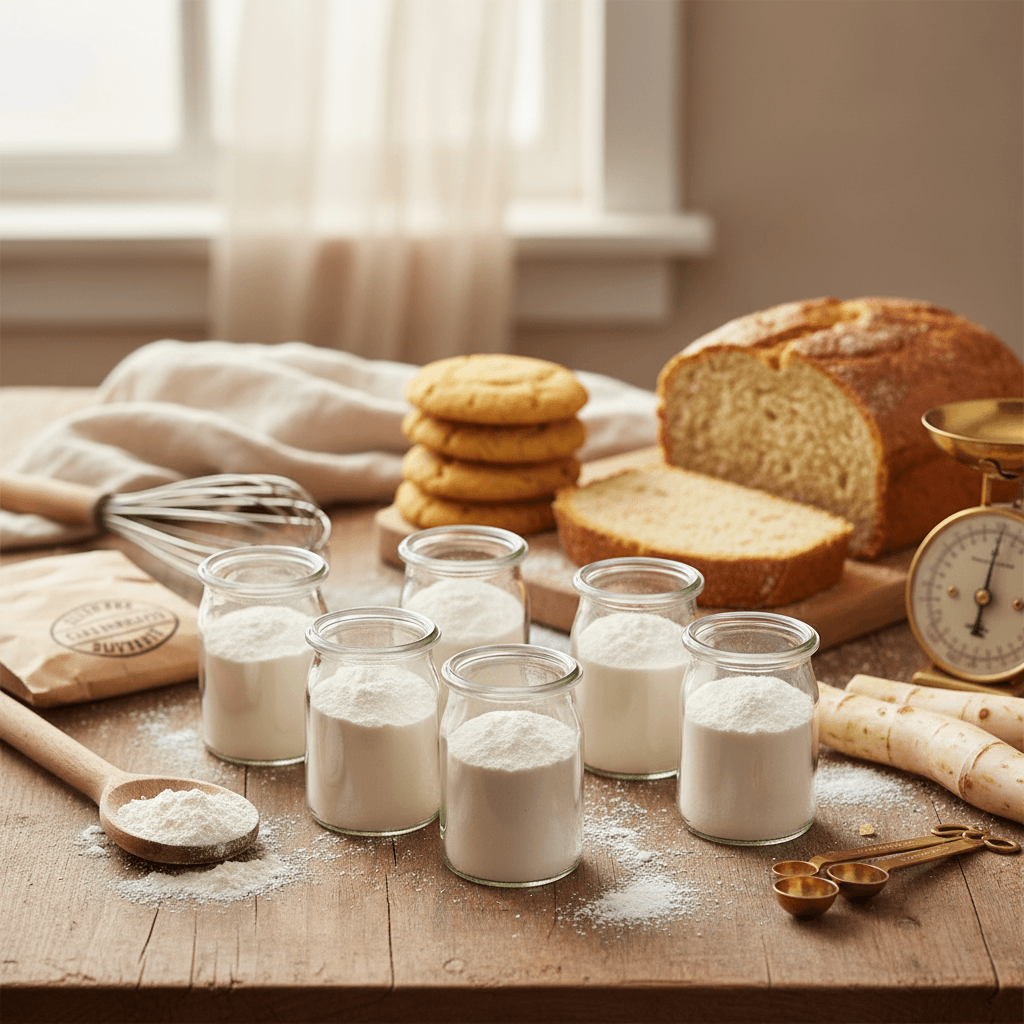
Arrowroot starch is one of the most versatile ingredients in a gluten-free baker's pantry, but not all brands perform the same way. We've compared six popular arrowroot starch brands so you can pick the one that works best for your recipes and budget.
Key takeaways
- Arrowroot starch is a neutral-flavored, grain-free thickener and lightener that works beautifully in gluten-free flour blends, sauces, and delicate baked goods.
- Quality varies significantly between brands — look for pure, finely milled arrowroot with no additives and certified gluten-free labeling if cross-contamination is a concern.
- Price per pound ranges from about $2.50 to over $8.00 depending on the brand and bag size, so buying in bulk can save serious money.
- Arrowroot thickens at a lower temperature than cornstarch and produces a clearer, glossier result, making it ideal for fruit fillings and glazes.
- For most gluten-free flour blends, arrowroot starch makes up 15-25% of the total blend by weight, contributing tenderness without grittiness.
What arrowroot starch does in gluten-free baking
Arrowroot starch lightens the texture of gluten-free baked goods and helps bind ingredients without adding any flavor or grittiness. It's extracted from the root of the Maranta arundinacea plant and is naturally gluten-free, grain-free, and paleo-friendly.
In homemade gluten-free flour blends, arrowroot acts as the starch component — the part that gives your bakes a tender, less dense crumb. It works similarly to tapioca starch or cornstarch, but it has a few advantages: it's completely flavorless, produces a silkier texture, and thickens at lower temperatures. That last point makes it especially useful for pie fillings, puddings, and glazes where you don't want a cloudy, starchy look.
Arrowroot also freezes and thaws well, unlike cornstarch which can break down and get watery. If you're batch baking and freezing gluten-free goods, arrowroot-based recipes tend to hold up better. Check out our arrowroot powder substitution guide for details on how to swap it in and out of recipes.
If you're still building your gluten-free pantry and want a structured approach to understanding how starches, flours, and binders work together, the Confident Gluten-Free Baker Toolkit walks you through exactly that — including blend ratios and troubleshooting guides.
How we evaluated these arrowroot starch brands
We looked at six widely available arrowroot starch brands and compared them across the factors that actually matter for baking:
- Purity and ingredients — Is it 100% arrowroot, or does it contain fillers?
- Grind fineness — Finer starches dissolve and incorporate more smoothly.
- Gluten-free certification — Important if you're baking for celiac or serious intolerance.
- Price per pound — Because gluten-free baking is already expensive enough.
- Best use cases — Some brands are better suited for specific applications.
6 best arrowroot starch brands compared
| Brand | Grind | Certified GF | Approx. price/lb | Best for |
|---|---|---|---|---|
| Bob's Red Mill | Very fine | Yes | $4.50-$5.50 | All-purpose baking and thickening |
| Anthony's | Very fine | Yes (batch tested) | $3.00-$4.00 | Bulk buying, flour blends |
| Hearthy Foods | Ultra-fine | Yes | $5.00-$6.00 | Delicate pastries, sauces |
| Kate Naturals | Fine | No (labeled GF, not certified) | $4.00-$5.00 | General baking, budget-friendly |
| Judee's | Very fine | Yes (dedicated facility) | $5.50-$7.00 | Celiac-safe baking, allergen-free needs |
| Landor Trading | Fine to medium | No | $2.50-$3.50 | Bulk thickening, non-celiac use |
Bob's Red Mill arrowroot starch
Bob's Red Mill Arrowroot Starch/Flour is the most widely available option and a solid all-around choice. It's certified gluten-free through their dedicated testing program, and the grind is consistently very fine — it practically disappears into flour blends and batters.
The flavor is completely neutral, which is exactly what you want. Bob's Red Mill is our go-to recommendation for bakers who are just getting started with gluten-free baking because it's easy to find in grocery stores and the quality is reliable batch to batch. The downside is the price — you're paying a premium for the brand name and smaller bag sizes. If you're using arrowroot regularly in flour blends, you'll burn through a 16 oz bag fast.
Best for: Beginners, grocery store convenience, reliable certified gluten-free option.
Anthony's arrowroot flour
Anthony's Arrowroot Flour is our top pick for value, especially if you buy the larger 2.5 lb or 5 lb bags. It's batch tested for gluten and verified gluten-free, and the grind quality is on par with Bob's Red Mill — very fine, smooth, and easy to incorporate.
At roughly $3-4 per pound in bulk, it's one of the most affordable options without sacrificing quality. If you're making your own gluten-free flour blends regularly, this is the brand that makes the most financial sense.
Best for: Bulk buying, regular flour blend making, budget-conscious bakers.
Hearthy Foods arrowroot starch
Hearthy Foods Arrowroot Starch stands out for its ultra-fine grind. If you've ever had an issue with slightly grainy textures in delicate baked goods, this brand is worth trying. The powder is almost talc-like in fineness, which means it hydrates quickly and produces an exceptionally smooth result in sauces, puddings, and tender cakes.
It's certified gluten-free and comes in a resealable bag, which is a small detail that matters when you're storing starches. The price is a bit higher than Anthony's, but the quality justifies it for applications where texture really matters — think delicate gluten-free cakes and cream-based fillings.
Best for: Delicate pastries, sauces, puddings, and bakers who prioritize ultra-smooth texture.
Kate Naturals arrowroot powder
Kate Naturals Arrowroot Powder is a decent mid-range option that's widely available on Amazon. The grind is fine (though not quite as silky as Hearthy Foods), and the taste is neutral. It works well for general baking and thickening applications.
The important caveat: Kate Naturals labels their product as gluten-free but it is not third-party certified. For most people, this is fine. But if you're baking for someone with celiac disease, we'd recommend going with a certified brand like Bob's Red Mill or Judee's instead. The price point is reasonable, landing in the $4-5 per pound range.
Best for: General baking for non-celiac households, good middle-ground option.
Judee's arrowroot starch powder
Judee's Arrowroot Starch Powder is the brand we recommend when cross-contamination is a serious concern. Judee's products are made in a dedicated gluten-free, nut-free, and soy-free facility, which is a level of safety that most other brands can't match.
The grind is very fine, in line with Bob's Red Mill. The trade-off is price. Judee's runs about $5.50-7.00 per pound, making it the most expensive option on this list. But for celiac bakers or anyone managing multiple food allergies, the peace of mind is worth every penny. If you're newly diagnosed with celiac, this is a great brand to start with.
Best for: Celiac bakers, multi-allergen households, dedicated facility safety.
Landor Trading Company arrowroot powder
Landor Trading Company Arrowroot Powder is the budget pick. Available in large bulk bags, it comes in at around $2.50-3.50 per pound, making it the cheapest option by a wide margin. The grind is fine to medium — coarser than Hearthy Foods or Bob's Red Mill, but perfectly adequate for thickening sauces and using in flour blends where other ingredients mask any slight texture difference.
This brand is not certified gluten-free, so it's best suited for households where gluten-free is a preference rather than a medical necessity. If you go through a lot of arrowroot for thickening soups, gravies, and general cooking alongside your baking, Landor's bulk pricing is hard to beat.
Best for: Budget bulk buying, thickening applications, non-celiac households.
How to pick the right arrowroot starch for your needs
Choosing between these brands really comes down to three questions:
Do you need certified gluten-free? If you or someone you're baking for has celiac disease, stick with Bob's Red Mill, Anthony's, Hearthy Foods, or Judee's. For the strictest cross-contamination standards, Judee's dedicated facility is the safest bet.
How much do you use? If arrowroot is a regular part of your flour blends, buying Anthony's or Landor in bulk will save you a lot of money over time. If you only use it occasionally for thickening, a smaller Bob's Red Mill bag from the grocery store is perfectly fine.
What are you making? For delicate applications like custards, glazes, and tender cakes, the ultra-fine grind of Hearthy Foods makes a noticeable difference. For bread and heartier baked goods, any brand on this list will work well.
How to use arrowroot starch in gluten-free flour blends
Arrowroot starch typically makes up 15-25% of a gluten-free flour blend by weight. It works alongside a base flour (like brown rice flour or cassava flour) and usually a binding agent like xanthan gum or psyllium husk.
A common starting ratio is 2 parts base flour to 2/3 part arrowroot starch to 1/3 part tapioca starch. You can swap arrowroot 1:1 for tapioca starch or cornstarch in most recipes, though the texture will be slightly different — arrowroot tends to produce a lighter, more tender crumb. If your gluten-free bakes are coming out gummy in the center or dry and crumbly, adjusting your starch ratio is often the fix.
One thing to keep in mind: arrowroot doesn't hold up well in dairy-heavy recipes that are cooked at high heat. It can turn slimy when combined with dairy and overheated. For dairy-based custards or cream sauces, cornstarch is usually the better choice.
Frequently asked questions
Is arrowroot starch the same as arrowroot flour?
Yes, arrowroot starch and arrowroot flour are the same product — different brands just label it differently. Both refer to the fine white powder extracted from the arrowroot plant root. Don't confuse it with arrowroot root powder, which is sometimes a coarser, less refined product used in supplements rather than baking.
Can I substitute arrowroot starch for cornstarch in gluten-free baking?
You can substitute arrowroot starch for cornstarch at a 1:1 ratio in most recipes. Arrowroot thickens at a lower temperature and produces a clearer, glossier result, which makes it better for fruit pie fillings and glazes. However, arrowroot can break down in dairy-heavy or very acidic recipes, so cornstarch is sometimes the better choice in those cases. See our arrowroot powder page for a full substitution breakdown.
Does arrowroot starch need to be certified gluten-free?
Arrowroot starch is naturally gluten-free, but cross-contamination can happen during manufacturing if the product is processed on shared equipment with wheat-containing ingredients. If you have celiac disease, choosing a certified gluten-free brand like Bob's Red Mill or Judee's is the safest approach. For gluten sensitivity or general preference, any pure arrowroot product is typically fine.
How should I store arrowroot starch?
Store arrowroot starch in an airtight container in a cool, dry place. It has a very long shelf life — typically two to three years if kept sealed and away from moisture. Humidity is the biggest enemy because it causes clumping. A resealable bag or glass jar with a tight lid works well.
What recipes work best with arrowroot starch?
Arrowroot starch excels in fruit pie fillings, puddings, glazes, shortbread cookies, and as a component of gluten-free flour blends for cakes and muffins. It's also great for coating foods before frying because it creates a light, crispy crust. It's less ideal as a standalone thickener in dairy-based sauces or recipes that require prolonged high heat.

Written by
Co-founder, BakingSubs
Co-founder of BakingSubs, where he turns the science of ingredient substitutions into tested, reliable guidance for home bakers.
Related Posts
Bake with Confidence
See all
Confident Gluten-Free Baker Toolkit
The science-based system that replaces gluten's seven invisible jobs so your baking turns out soft, fluffy, and foolproof — every time.

Gluten-Free Recipe Vault
Instant access to our complete library of proven gluten-free recipes — no waiting, no guesswork, just results that work tonight.

Fix Your Gluten-Free Bread
Learn the 3-step formula to make bread rise and stay soft, discover why your loaves collapse, and get a tested sandwich bread recipe that actually works.