

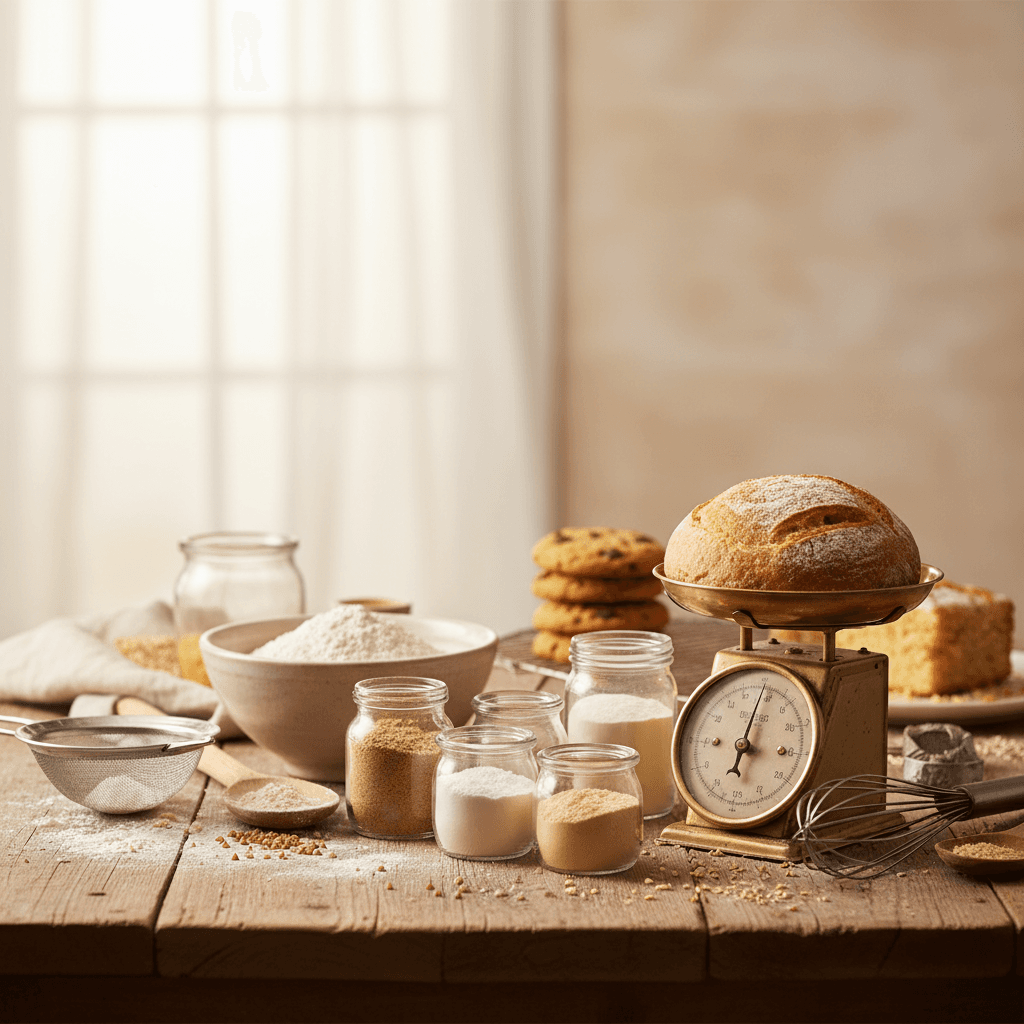
Most homemade gluten-free flour blends fail because they only solve one problem — replacing wheat flour's starch — while ignoring the six other jobs gluten performs. Here's how to build blends with the right ratios for every type of baking, plus the science behind why each component matters.
Key takeaways
- A reliable all-purpose gluten-free flour blend uses a 60/20/20 ratio: 60% superfine rice flour, 20% potato starch, and 20% tapioca starch.
- Gluten performs 7 jobs in baking (structure, elasticity, gas retention, moisture retention, texture/chew, binding, and flexibility), and a flour blend alone only covers one — you need additional ingredients to replace the rest.
- Different baked goods need different blends: bread requires more protein and elasticity support, while cakes need lighter starches for a tender crumb.
- Psyllium husk gel is the gold standard binder for gluten-free bread, xanthan gum works best for cookies and cakes, and eggs or aquafaba provide lift.
- Weighing your flour with a kitchen scale is non-negotiable — gluten-free flours vary dramatically in density, and a cup of rice flour can range from 120g to 180g depending on how you scoop.
- Mixing your own blends costs roughly 40-60% less than buying premade blends and gives you full control over ingredients and allergens.
Why most homemade gluten-free flour blends don't work
The core problem is that most recipes treat gluten-free flour blending as a simple swap: take out wheat flour, put in rice flour, maybe add a starch, and hope for the best. But wheat flour's power comes from gluten — a protein network that does seven distinct jobs in your baked goods:
- Structure — provides the framework that holds everything together
- Elasticity — lets dough stretch without tearing
- Gas retention — traps CO2 from leaveners so your bake rises
- Moisture retention — keeps baked goods from drying out
- Texture and chew — gives bread its satisfying bite and cookies their chew
- Binding — holds ingredients together so they don't crumble apart
- Flexibility — prevents baked goods from being rigid and crackly
We call this the Gluten Replacement Protocol — the idea that each of these seven jobs must be intentionally replaced. Your flour blend handles the structure component. The other six? Those require strategic additions like binders, gels, fats, and leaveners. If you've been getting dry, crumbly results or gummy centers, it's almost certainly because one or more of these jobs went unaddressed.
The all-purpose gluten-free flour blend recipe (60/20/20 ratio)
This is the blend we recommend as your starting point for most everyday baking — muffins, pancakes, quick breads, simple cakes, and cookies. It's designed to be neutral in flavor and versatile in application.
Ingredients and ratio
| Ingredient | Ratio | For 500g batch | Job it performs |
|---|---|---|---|
| Superfine white rice flour | 60% | 300g | Structure, bulk, neutral flavor |
| Potato starch (not potato flour) | 20% | 100g | Moisture retention, tenderness |
| Tapioca starch | 20% | 100g | Binding, chew, browning |
Why these three ingredients work together
Superfine white rice flour provides the structural backbone. The key word here is superfine — standard rice flour has a coarser grind that produces a gritty texture nobody wants. Superfine rice flour has been milled to a particle size close to wheat flour, which gives you a smoother crumb and better hydration.
Potato starch is a powerhouse for moisture. It absorbs and holds water exceptionally well, which directly addresses the moisture retention job that gluten normally handles. It also creates a lighter, more tender texture. Don't confuse it with potato flour — they're completely different ingredients with different absorption rates.
Tapioca starch adds the chew and elasticity that rice flour alone can't provide. It also helps with browning and creates a slightly stretchy quality in the finished product. Without it, your baked goods will be dry and crumbly.
If you're tired of guessing at ratios and want the complete system — including our Cake/Cookie blend, Bread/Roll blend, and the full Gluten Replacement Protocol — the Confident Gluten-Free Baker Toolkit walks you through every formula and technique we use.
How to adjust your blend for different baked goods
The 60/20/20 all-purpose blend is a great starting point, but different baked goods have different structural demands. Here's how the ratios shift and why.
For bread and rolls
Bread needs significantly more elasticity and gas retention than cookies or muffins. The all-purpose blend alone won't give you the stretch and rise that bread demands. Our Bread/Roll blend adjusts the protein and starch ratios and relies heavily on psyllium husk gel as the primary binder.
Psyllium husk gel is the gold standard for gluten-free bread because it forms a viscous, stretchy network that mimics gluten's gas-trapping ability. When hydrated, psyllium creates a gel that holds CO2 bubbles in place during proofing and baking, giving you actual rise and an open crumb structure. Without it, gluten-free bread tends to suffer from poor rise and a dense, brick-like texture.
If you're interested in turning gluten-free bread into a business, our guide on how to sell gluten-free bread from home covers everything from recipes to building a customer base.
For cakes and pastries
Cakes need tenderness and a fine, even crumb — not chew or elasticity. Our Cake/Cookie blend shifts the starch ratios higher relative to the rice flour, creating a lighter, more delicate texture. For cakes, xanthan gum is the preferred binder at about 1/2 teaspoon per cup of flour blend. It provides just enough structure to hold the crumb together without making the texture gummy or dense.
Eggs play a critical role here too — they provide lift, structure, and moisture all at once. For vegan baking, aquafaba whipped to stiff peaks can replace egg whites for lift, while applesauce or flax eggs handle moisture and binding.
For cookies
Cookies sit between bread and cake in terms of structural needs. You want some chew but not too much stretch, some tenderness but enough structure to hold a shape. The all-purpose 60/20/20 blend works well for most cookies with the addition of 1/4 to 1/2 teaspoon of xanthan gum per cup of blend. The tapioca starch in the blend provides the chew, while the potato starch keeps the interior tender.
How to mix and store your homemade flour blend
Proper mixing is just as important as the ratios themselves. Gluten-free flours and starches have different densities and particle sizes, so a lazy stir won't cut it.
Mixing method
- Weigh each ingredient using a kitchen scale. Volume measurements are unreliable for gluten-free flours because they pack differently depending on humidity, brand, and how you scoop.
- Whisk together thoroughly in a large bowl for at least 60 seconds. You want the starches and flour completely integrated — any pockets of pure starch will create gummy spots in your baking.
- Sift if possible. Running the blend through a fine-mesh sieve breaks up clumps and aerates the mixture, which improves hydration when you add liquids.
- Transfer to an airtight container and label it with the blend name and date.
Storage guidelines
Store your blend in a cool, dry place for up to 3 months at room temperature, or up to 6 months in the freezer. Rice flour can go rancid over time, especially in warm kitchens, so the freezer is your friend for large batches. Let frozen blend come to room temperature before using — cold flour absorbs liquid differently and can throw off your hydration.
The binder you need depends on what you're baking
Your flour blend provides structure, but it does not replace gluten's binding, elasticity, or gas retention functions. You need a dedicated binder, and the right one depends entirely on what you're making.
| Binder | Best for | Amount per cup of GF flour | What it replaces |
|---|---|---|---|
| Psyllium husk gel | Bread, rolls, pizza dough | 1-2 tbsp psyllium + 3-6 tbsp water | Elasticity, gas retention, flexibility |
| Xanthan gum | Cookies, cakes, muffins | 1/4 - 1/2 tsp | Binding, light structure |
| Eggs | Nearly everything | Per recipe | Lift, moisture, binding, structure |
| Aquafaba (whipped) | Vegan cakes, meringues | 3 tbsp = 1 egg | Lift, binding |
| Guar gum | Cold applications, some baked goods | 1/4 - 1/2 tsp | Binding, moisture retention |
A common mistake is adding xanthan gum to bread and wondering why it's dense and crumbly. Xanthan gum doesn't create the stretchy, gas-trapping network that bread needs — that's psyllium's job. Conversely, psyllium in cookies can make them chewy and heavy. Match the binder to the bake.
Common mistakes when making homemade gluten-free flour blends
Even with the right ratios, a few common errors can derail your results.
Using the wrong grind of rice flour
Standard rice flour from the grocery store is often too coarse for baking. You need superfine (sometimes labeled "extra fine" or "baking grade") rice flour. The difference is dramatic — coarse rice flour produces a sandy, gritty texture that no amount of binder will fix. Check the gluten-free baking guide for recommended brands and grind sizes.
Confusing potato starch with potato flour
Potato starch is a fine, white, neutral powder. Potato flour is heavy, yellowish, and tastes strongly of potato. Using potato flour in place of potato starch will completely wreck your blend — it absorbs far more liquid and adds an overpowering flavor.
Skipping the binder entirely
A flour blend without a binder is just a pile of starch and grain. If your recipe doesn't include xanthan gum, psyllium, or enough eggs to provide binding, your baked goods will crumble the moment you touch them.
Measuring by volume instead of weight
A cup of tapioca starch weighs about 120g. A cup of rice flour can weigh anywhere from 120g to 180g depending on how you scoop it. That variance alone can shift your blend ratio by 15-20%, which is enough to ruin a batch. Use a scale. Every time.
Not accounting for quick staling
Gluten-free baked goods stale faster than wheat-based ones because they lack gluten's moisture-retention network. Adding a tablespoon of oil or a bit of honey to your recipe helps, but it's also important to store gluten-free baked goods properly — wrapped tightly and consumed within 1-2 days, or frozen immediately after cooling.
Cost comparison: homemade blend vs. store-bought
One of the biggest advantages of mixing your own blend is cost savings, especially if you bake frequently or run a home bakery.
| Option | Approximate cost per pound | Notes |
|---|---|---|
| Homemade 60/20/20 blend | $1.50 - $2.50 | Buying flour and starches in bulk |
| Bob's Red Mill 1-to-1 | $3.50 - $4.50 | Widely available, includes xanthan gum |
| King Arthur Measure for Measure | $4.00 - $5.00 | Good quality, includes xanthan gum |
| Cup4Cup | $5.00 - $7.00 | Premium price, contains milk powder |
When you're making 5-10 batches a week, that price difference adds up fast. Plus, mixing your own means you can adjust ratios for specific recipes and avoid allergens that some commercial blends include (like milk powder in Cup4Cup).
Frequently asked questions
What is the best ratio for a homemade gluten-free flour blend?
The most versatile all-purpose ratio is 60% superfine white rice flour, 20% potato starch, and 20% tapioca starch. This 60/20/20 blend works well for muffins, pancakes, quick breads, cookies, and simple cakes. For bread or more specialized baking, you'll want adjusted ratios with higher protein support and different binders.
Do I need xanthan gum in my gluten-free flour blend?
You need a binder, but it doesn't have to be mixed into the blend itself. We recommend adding xanthan gum (1/4 to 1/2 tsp per cup of flour) directly to your recipe for cookies and cakes. For bread, skip xanthan gum entirely and use psyllium husk gel instead — it provides the elasticity and gas retention that bread requires. Learn more about binder options on our gluten-free baking page.
Can I substitute tapioca starch with arrowroot powder in a gluten-free flour blend?
Yes, arrowroot powder can replace tapioca starch at a 1:1 ratio in most blends. The texture will be very slightly different — arrowroot produces a somewhat silkier crumb and doesn't add quite as much chew. It's a good option if you have a tapioca sensitivity, but tapioca starch is generally preferred for its browning and binding properties.
Why is my homemade gluten-free flour blend gritty?
Grittiness almost always comes from using rice flour that isn't finely milled enough. Standard rice flour has a coarser particle size that doesn't fully hydrate during mixing and baking, leaving a sandy texture. Switch to superfine or extra-fine rice flour and the problem should disappear. You can also try brown rice flour if you prefer a whole-grain option, but make sure it's also a superfine grind.
How long does a homemade gluten-free flour blend last?
Stored in an airtight container in a cool, dry place, your blend will stay fresh for about 3 months. In the freezer, it lasts up to 6 months. Rice flour contains oils that can go rancid over time, especially in warm or humid environments, so freezer storage is ideal for large batches. Always bring the blend to room temperature before baking for consistent hydration.
Stop guessing and start baking with confidence
The 60/20/20 all-purpose blend is a solid foundation, but it's just the beginning. Real gluten-free baking success comes from understanding the Gluten Replacement Protocol — knowing which of gluten's seven jobs each recipe demands and how to replace them intentionally. That's the difference between another failed batch and baked goods that people can't believe are gluten-free.
The Confident Gluten-Free Baker Toolkit gives you our complete set of flour blend formulas (including the Cake/Cookie blend and Bread/Roll blend), the full Gluten Replacement Protocol, and step-by-step guidance for every type of bake. No more wasting expensive ingredients on guesswork. Check out all the details at BakingSubs.com/ingredients for individual substitution guides, or grab the full toolkit to get the complete system.

Written by
Co-founder, BakingSubs
Co-founder of BakingSubs, where he turns the science of ingredient substitutions into tested, reliable guidance for home bakers.
Related Posts
Bake with Confidence
See all
Confident Gluten-Free Baker Toolkit
The science-based system that replaces gluten's seven invisible jobs so your baking turns out soft, fluffy, and foolproof — every time.

Gluten-Free Recipe Vault
Instant access to our complete library of proven gluten-free recipes — no waiting, no guesswork, just results that work tonight.

Fix Your Gluten-Free Bread
Learn the 3-step formula to make bread rise and stay soft, discover why your loaves collapse, and get a tested sandwich bread recipe that actually works.