

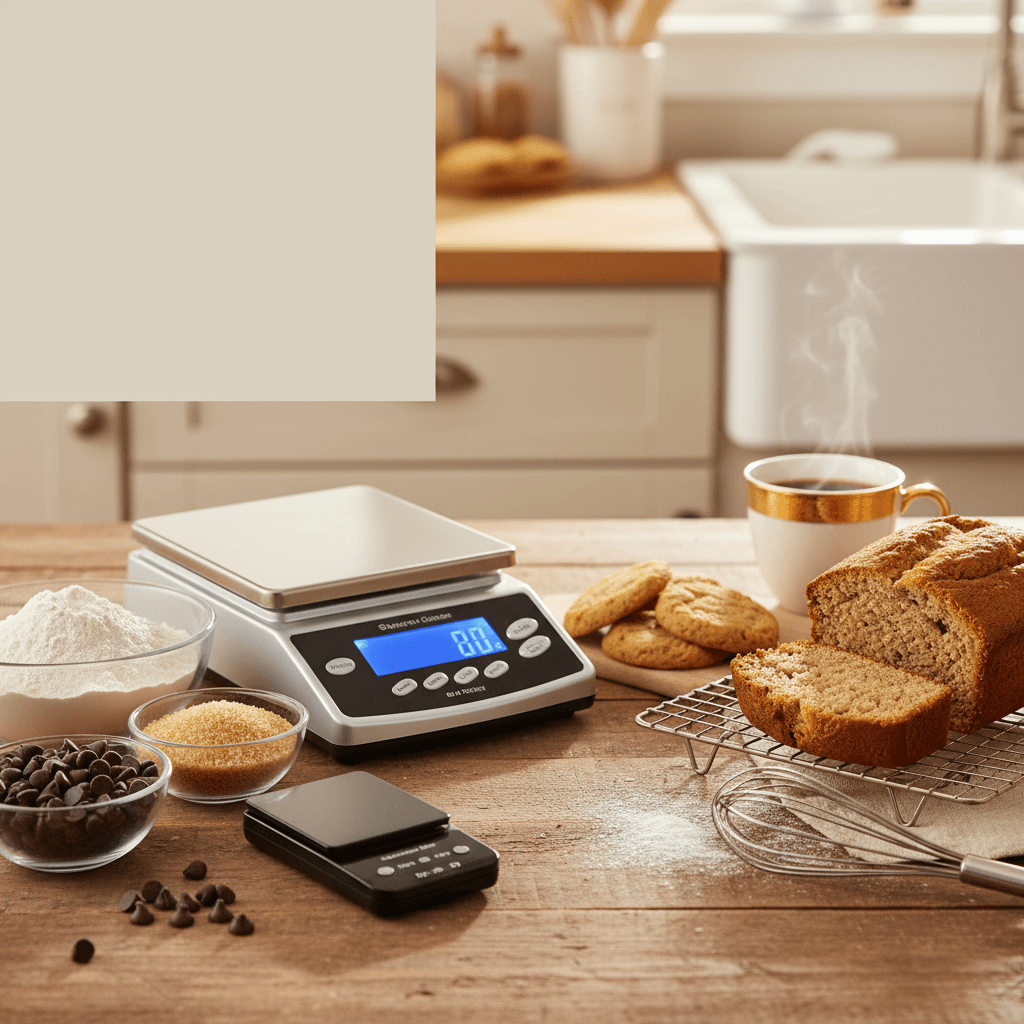
When you're baking for customers, "a cup of flour" isn't good enough anymore. A reliable food scale is the single most important tool for consistent results, accurate costing, and scaling recipes up or down without guesswork. Here are the best food scales for home bakers running a real business, from budget-friendly to professional-grade.
Key takeaways
- Best overall: The Ohaus Valor 2000 gives you commercial-grade accuracy, washdown-rated durability, and a large platform perfect for production baking — all for under $150.
- Best budget pick: The Escali Primo at around $25 is the best entry point for home bakers who need reliable gram-level accuracy without overspending.
- For commercial baking at home, you want at least 0.1g readability for small measurements (leaveners, xanthan gum) and 5kg+ capacity for dough batches.
- Owning two scales — one high-capacity for dough and one precision scale for small ingredients — is the most practical setup for production baking.
- Weighing every ingredient is essential for accurate recipe costing and pricing, which directly impacts your profit margins.
- Look for scales with a tare function, stable readings, and easy-to-clean surfaces — you'll be using this thing dozens of times per bake day.
Why a food scale matters for home bakery production
A food scale isn't optional when you're selling baked goods — it's the foundation of your entire operation. Volume measurements (cups and tablespoons) can vary by 20% or more between scoops, which means your cookies might be perfect one batch and flat the next. When customers are paying for consistency, that's a problem.
Beyond consistency, weighing ingredients is how you calculate your actual cost per item. If you're following our guide on how to price baked goods for a home bakery, you know that accurate ingredient costs are the starting point for profitable pricing. Eyeballing flour means you're guessing at your margins.
For gluten-free bakers especially, precision matters even more. Ingredients like xanthan gum and baking powder are measured in tiny amounts where a gram or two off can completely change the texture. A good scale pays for itself in wasted batches you'll never have to throw out.
What to look for in a food scale for commercial home baking
Not all kitchen scales are created equal, and the cute little scale that works for weekend baking might not hold up to production days. Here's what actually matters when you're choosing a scale for your home bakery kitchen.
Capacity and readability
You need a scale that can handle large bowls of dough (at least 5kg/11lb capacity) while still reading in 1g increments. For small ingredients, a precision scale with 0.1g or even 0.01g readability is worth having as a second scale.
Platform size
A tiny 5-inch platform won't fit your mixing bowl. Look for platforms at least 6 inches across, or better yet, a scale designed to hold commercial-sized containers.
Durability and cleanability
Flour dust, sticky dough, and the occasional splash of liquid are part of bake day. Stainless steel platforms are easiest to clean. Some commercial models are IP-rated for washdown, meaning you can wipe them with a damp cloth without worry.
Power source
Battery-powered scales are convenient but can die mid-production. AC adapter options are a huge plus for long bake days. Some models offer both.
Response time and stability
Cheap scales can take several seconds to settle on a reading or drift over time. When you're adding ingredients to a bowl on the fly, you need a scale that locks onto a weight quickly and holds it.
The 7 best food scales for home bakery production
We've organized these from best overall to most specialized, with our budget pick clearly marked. Every recommendation here is based on what actually works for production baking, not just casual home cooking.
1. Ohaus Valor 2000 — best overall
The Ohaus Valor 2000 is our top pick for home bakers who are serious about production. It's a commercial-grade scale with a washdown-rated body (IP68), meaning flour and moisture won't destroy it. The stainless steel platform is generous, the 5kg capacity with 1g readability covers most baking needs, and the AC adapter means no battery anxiety on long bake days.
| Feature | Details |
|---|---|
| Capacity | 5kg / 11lb |
| Readability | 1g / 0.05oz |
| Platform | 7.5" stainless steel |
| Power | AC adapter or batteries |
| Price | ~$120-$150 |
Pros: Truly commercial-grade durability, fast stable readings, large platform, AC adapter included, easy to clean.
Cons: Overkill if you're only baking a few items a week. No 0.1g precision for very small measurements.
2. Escali Primo P115C — best budget pick
The Escali Primo P115C is the workhorse that thousands of home bakers start with, and many never feel the need to upgrade. At around $25, it gives you 5kg capacity with 1g readability, a clean design, and a two-button interface that couldn't be simpler. It's not fancy, but it's accurate and reliable.
| Feature | Details |
|---|---|
| Capacity | 5kg / 11lb |
| Readability | 1g / 0.05oz |
| Platform | 6" smooth surface |
| Power | 2 AA batteries |
| Price | ~$25-$30 |
Pros: Incredibly affordable, accurate, simple to use, compact for small kitchens.
Cons: Battery-only (no AC adapter), platform is on the small side for large bowls, no backlight on the display.
3. My Weigh KD-8000 — best for recipe scaling
The My Weigh KD-8000 is beloved by serious bakers because of its built-in baker's percentage function. You can set your flour weight as 100% and the scale automatically calculates the target weight for every other ingredient based on the percentage you enter. For anyone regularly scaling recipes up or down for customer orders, this is a game changer.
| Feature | Details |
|---|---|
| Capacity | 8kg / 17.6lb |
| Readability | 1g / 0.05oz |
| Platform | 6.5" stainless steel |
| Power | AC adapter or batteries |
| Price | ~$40-$50 |
Pros: Baker's percentage mode, high capacity, AC adapter included, very accurate, great value for features.
Cons: Interface has a learning curve, display can be hard to read under certain lighting, slightly bulky.
If you're working on scaling your home bakery business, this scale practically does the math for you when you need to double or triple a recipe for a big order.
4. OXO Good Grips 11lb food scale — best display design
The OXO Good Grips 11lb Food Scale has a pull-out display that solves one of the most annoying problems in baking: you can't see the numbers when a big bowl is on the platform. The display slides toward you so it's always visible. It's well-built, accurate, and the kind of thoughtful design OXO is known for.
| Feature | Details |
|---|---|
| Capacity | 5kg / 11lb |
| Readability | 1g / 0.125oz |
| Platform | 6" stainless steel |
| Power | 2 AAA batteries |
| Price | ~$50-$55 |
Pros: Pull-out display is brilliant for large bowls, solid build quality, easy to clean, intuitive interface.
Cons: Battery-only, 1g readability only (no 0.1g mode), slightly pricier than comparable models without the display feature.
5. Ohaus Scout SPX2201 — best high-capacity precision scale
When you're mixing large batches of bread dough or cake batter, the Ohaus Scout SPX2201 gives you a massive 2200g capacity with 0.1g readability. That combination is rare and incredibly useful for production baking where you need both volume and precision in one scale. It's a lab-grade instrument that happens to be perfect for serious bakers.
| Feature | Details |
|---|---|
| Capacity | 2200g / 4.85lb |
| Readability | 0.1g |
| Platform | 5.5" stainless steel |
| Power | AC adapter or batteries |
| Price | ~$200-$250 |
Pros: Exceptional 0.1g precision at high capacity, lab-grade accuracy, very fast response, AC adapter included.
Cons: Expensive, capacity may not be enough for very large dough batches, smaller platform.
6. Weightman precision pocket scale — best for small measurements
The Weightman precision pocket scale costs about $10 and measures down to 0.01g. That's the level of precision you need for ingredients like xanthan gum, instant yeast, and leaveners where being off by even a gram matters. Every production baker should have one of these in their toolkit alongside their main scale.
| Feature | Details |
|---|---|
| Capacity | 500g / 1.1lb |
| Readability | 0.01g |
| Platform | Small flip-top cover |
| Power | 2 AAA batteries |
| Price | ~$10-$13 |
Pros: Incredibly cheap, 0.01g precision, compact, perfect companion to a larger scale.
Cons: Very small capacity, not suitable as a primary scale, cheap build quality (but at this price, you can replace it easily).
This is especially important for gluten-free baking, where small amounts of xanthan gum or psyllium husk can make or break a recipe's texture.
7. Nicewell 33lb food scale — best for large batch baking
If you regularly bake in very large quantities — think 10-pound batches of cookie dough or bulk bread production — the Nicewell 33lb food scale has the capacity you need. At 15kg/33lb, it handles big mixing bowls loaded with dough without maxing out. The large tempered glass platform is easy to wipe down between batches.
| Feature | Details |
|---|---|
| Capacity | 15kg / 33lb |
| Readability | 1g / 0.1oz |
| Platform | Large tempered glass |
| Power | 2 AAA batteries |
| Price | ~$15-$20 |
Pros: Huge capacity, very affordable, large platform, easy to clean.
Cons: No AC adapter, glass platform can be slippery, 1g minimum readability, not as durable as stainless steel models.
Comparison of all 7 food scales
| Scale | Best for | Capacity | Readability | Power | Price |
|---|---|---|---|---|---|
| Ohaus Valor 2000 | Best overall | 5kg | 1g | AC + battery | ~$130 |
| Escali Primo P115C | Best budget | 5kg | 1g | Battery | ~$25 |
| My Weigh KD-8000 | Recipe scaling | 8kg | 1g | AC + battery | ~$45 |
| OXO Good Grips 11lb | Best display | 5kg | 1g | Battery | ~$52 |
| Ohaus Scout SPX2201 | Precision + capacity | 2200g | 0.1g | AC + battery | ~$225 |
| Weightman pocket scale | Small measurements | 500g | 0.01g | Battery | ~$10 |
| Nicewell 33lb | Large batches | 15kg | 1g | Battery | ~$17 |
Why most production bakers need two scales
Here's something most buying guides won't tell you: one scale usually isn't enough for serious production baking. You need a main scale with high capacity for flour, sugar, and liquids, plus a precision scale for small-quantity ingredients like yeast, xanthan gum, salt, and leaveners.
Think about it this way. If your main scale reads in 1g increments and your recipe calls for 3g of xanthan gum, you could be anywhere from 2.5g to 3.4g and the scale would show "3g" either way. That 30% variance is enough to make your gluten-free bread go from perfectly springy to gummy. A 0.01g pocket scale solves this for about $10.
This two-scale setup is something we recommend in our home bakery equipment list for beginners because it's a small investment that dramatically improves consistency.
How to use your food scale to track ingredient costs
Once you're weighing everything, you can calculate your exact cost per recipe. Here's the simple process:
- Weigh every ingredient you add to a recipe and note the weight in grams.
- Calculate the cost per gram for each ingredient (total package cost divided by total grams in the package).
- Multiply cost per gram by the amount used in your recipe.
- Add up all ingredient costs for your total recipe cost.
This is the foundation of the pricing method we walk through in our pricing guide for home bakers. Without a scale, you're guessing at your costs, which means you're guessing at your profits. For a deeper look at what realistic margins look like, check out our breakdown of the most profitable baked goods to sell from home.
Your starter kit: exactly what to buy
If you're just getting your home bakery off the ground and want to keep costs down while still getting professional-level accuracy, here's what we'd recommend:
| Item | Recommendation | Estimated cost |
|---|---|---|
| Main production scale | My Weigh KD-8000 (best value with baker's math) | ~$45 |
| Precision scale | Weightman pocket scale (0.01g for small ingredients) | ~$10 |
| Spare batteries | AAA and AA variety pack | ~$8 |
Total estimated cost: approximately $63
That's less than the cost of one wasted batch of specialty gluten-free ingredients. If you have a bit more budget, upgrade the main scale to the Ohaus Valor 2000 for about $130 — the durability and AC adapter are worth it if you're baking multiple days per week.
For the full picture of everything you need to launch, our complete home bakery startup cost breakdown covers equipment, ingredients, packaging, and licensing so you can budget realistically from day one.
Frequently asked questions
Do I need a commercial food scale for a home bakery?
You don't need an industrial-grade scale, but you do need something more reliable than a basic kitchen scale. A mid-range scale like the My Weigh KD-8000 or Escali Primo gives you the accuracy and durability needed for production baking without the commercial price tag. The key features to look for are at least 1g readability, 5kg+ capacity, and a stable tare function.
What is baker's percentage mode on a food scale?
Baker's percentage mode lets you set your flour weight as 100% and then calculates target weights for all other ingredients as a percentage of the flour. This makes it much easier to scale recipes up or down for different order sizes. The My Weigh KD-8000 is one of the few affordable scales that includes this feature.
How accurate does a food scale need to be for baking?
For most baking ingredients like flour, sugar, and butter, 1g readability is perfectly fine. For small-quantity ingredients like baking powder, yeast, xanthan gum, and salt, you want 0.1g or ideally 0.01g readability. That's why we recommend a two-scale setup — a main scale for bulk ingredients and a precision pocket scale for the small stuff.
Can I use a food scale to portion my baked goods for consistent sizing?
Absolutely, and you should. Weighing your dough portions ensures every cookie, roll, or loaf is the same size, which means even baking times and a professional presentation. Customers notice when every item looks identical — it builds trust and justifies charging premium prices.
Is it worth spending over $100 on a food scale for home baking?
If you're baking for customers multiple days per week, yes. A commercial-grade scale like the Ohaus Valor 2000 will last years, handles the abuse of production baking, and includes an AC adapter so you're never scrambling for batteries mid-batch. If you're just starting out or baking less frequently, the $25-$50 range is perfectly adequate to get going.

Written by
Co-founder, BakingSubs
Co-founder of BakingSubs, where he turns the science of ingredient substitutions into tested, reliable guidance for home bakers.
Related Posts
Bake with Confidence
See all
Confident Gluten-Free Baker Toolkit
The science-based system that replaces gluten's seven invisible jobs so your baking turns out soft, fluffy, and foolproof — every time.

Gluten-Free Recipe Vault
Instant access to our complete library of proven gluten-free recipes — no waiting, no guesswork, just results that work tonight.

Fix Your Gluten-Free Bread
Learn the 3-step formula to make bread rise and stay soft, discover why your loaves collapse, and get a tested sandwich bread recipe that actually works.