

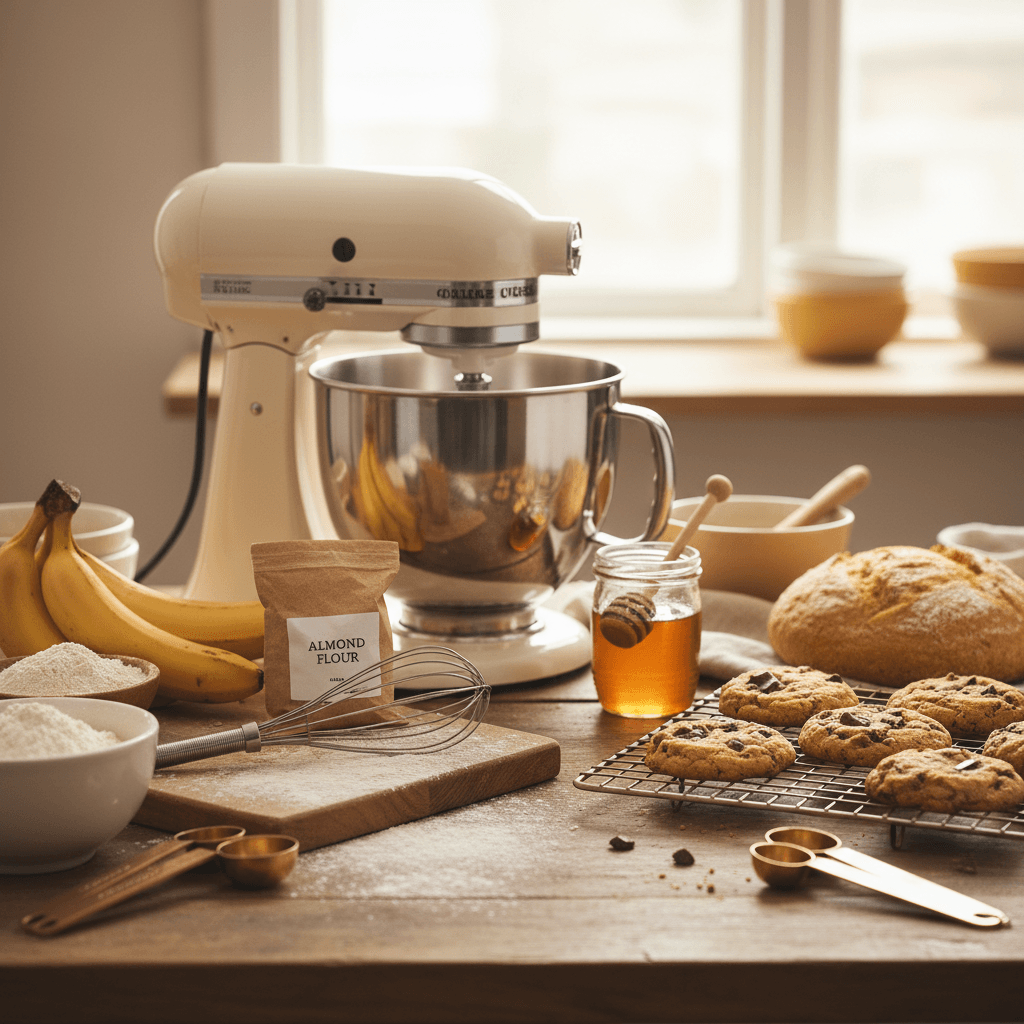
A stand mixer is the single most important piece of equipment in your home bakery, and you do not need to spend a fortune to get one that handles production-level batches. We tested and researched the best options under $500 so you can invest wisely and start taking orders with confidence.
Key takeaways
The KitchenAid Professional 5 Plus is the best overall stand mixer for home bakers under $500, offering 5-quart capacity with a powerful 450-watt motor and excellent reliability.
The Hamilton Beach Eclectrics is the best budget pick at around $200, giving you solid performance for lighter production schedules.
Bowl-lift mixers are significantly more stable than tilt-head models when mixing heavy doughs — prioritize this design if you bake bread or thick cookie doughs regularly.
Motor wattage matters less than you think — gear-driven power trains outperform direct-drive motors at the same wattage for heavy dough work.
Spending $300-$450 hits the sweet spot for home bakery mixers that can handle 2-4 dozen cookies or 2-3 loaves of bread per batch without overheating.
Your mixer is likely your single biggest equipment expense — see our full home bakery startup cost breakdown to plan the rest of your budget.
How we picked these mixers
We evaluated stand mixers based on the criteria that actually matter for a home bakery business, not just casual weekend baking. That means we focused on batch capacity, motor durability under sustained use, dough-handling ability, and long-term reliability. We also weighed the total cost of ownership, including attachment availability and warranty coverage.
Every mixer on this list can handle at least double batches of cookie dough or bread dough without straining. If you are building out your full kitchen setup, our home bakery equipment list for beginners covers everything else you will need alongside your mixer.
Best overall: KitchenAid Professional 5 Plus
The KitchenAid Professional 5 Plus is our top pick for home bakers under $500. It consistently sells in the $350-$430 range and delivers the reliability and power that production baking demands.
What makes it stand out
This is a bowl-lift design with a 5-quart stainless steel bowl and a 450-watt motor. The bowl-lift mechanism keeps the mixer rock-stable when you are working heavy bread doughs or double batches of thick cookie dough. It handles up to 9 cups of flour in a single batch, which translates to roughly 4 dozen cookies or 2 standard loaves of bread.
Pros and cons
Pros | Cons |
|---|---|
Bowl-lift design is very stable for heavy doughs | Heavier than tilt-head models at about 25 lbs |
Huge attachment ecosystem (pasta, grinder, spiralizer) | 5-quart bowl can feel limiting for very large orders |
Excellent resale value if you upgrade later | Some colors cost more than others |
10-speed control for precise mixing | No included pour shield on all versions |
Price: Approximately $350-$430
Best for: Home bakers who want a proven workhorse that will last years of regular production use.
Best budget pick: Hamilton Beach Eclectrics All-Metal Stand Mixer
The Hamilton Beach Eclectrics All-Metal Stand Mixer comes in around $200 and punches well above its price point. If you are just starting out and watching every dollar, this is where to begin.
What makes it stand out
It features a 4.5-quart stainless steel bowl, 400-watt motor, and a tilt-head design. The all-metal construction sets it apart from other budget mixers that rely on plastic housings. It handles standard single batches of most recipes without breaking a sweat, and the planetary mixing action does a solid job with cookie dough and cake batters.
Pros and cons
Pros | Cons |
|---|---|
All-metal construction at a budget price | Tilt-head design less stable for stiff doughs |
12-speed settings for good control | 4.5-quart bowl limits batch size |
Includes flat beater, dough hook, and whisk | Fewer attachment options than KitchenAid |
Solid 3-year warranty | Motor can strain on very heavy double batches |
Price: Approximately $190-$220
Best for: New home bakers testing the waters or those with lighter production schedules (weekend orders, farmers market prep). Check our guide on the best baked goods to sell at farmers markets to see what sells well with this kind of setup.
Best for heavy bread dough: KitchenAid Pro 600 Series
The KitchenAid Pro 600 Series is the mixer to get if bread is a significant part of your menu. At around $450-$500, it sits right at the top of our budget range but justifies every dollar with its 6-quart capacity and 575-watt motor.
What makes it stand out
The 6-quart bowl and powerful motor let you mix up to 14 cups of flour — enough for 3-4 loaves of bread or a massive batch of cinnamon rolls in one go. The spiral dough hook design develops gluten more efficiently than the C-shaped hooks on smaller models. If you are doing gluten-free bread, that extra power also helps thoroughly incorporate arrowroot powder, xanthan gum, and other binders that need aggressive mixing.
Pros and cons
Pros | Cons |
|---|---|
6-quart capacity handles large batches | Right at the $500 ceiling — sometimes over on sale colors |
575-watt motor handles any dough | Heavy at 29 lbs — not easy to move around |
Soft-start feature prevents flour clouds | Takes up significant counter space |
Full KitchenAid attachment compatibility | Overkill if you mainly make cakes and cookies |
Price: Approximately $450-$500
Best for: Home bakers with bread-heavy menus who need large batch capacity.
Best lightweight option: Cuisinart Precision Master 5.5-Quart
The Cuisinart Precision Master 5.5-Quart offers an impressive 5.5-quart capacity at roughly $250-$300, making it a strong value pick for bakers who want more bowl space without the KitchenAid price tag.
What makes it stand out
Cuisinart managed to pack a 500-watt motor into a mixer that weighs only about 18 pounds — significantly lighter than comparable KitchenAid models. It uses a tilt-head design but compensates with suction-cup feet that keep it planted. The 5.5-quart bowl gives you slightly more capacity than the KitchenAid Professional 5 Plus at a lower price.
Pros and cons
Pros | Cons |
|---|---|
5.5-quart bowl at a mid-range price | Tilt-head less stable than bowl-lift for bread |
500-watt motor is strong for the price | Attachment ecosystem is smaller than KitchenAid |
Lightweight — easy to store and move | Plastic gear housing on some internal components |
Includes splash guard with pour spout | Some reports of motor strain after 2-3 years of heavy use |
Price: Approximately $250-$300
Best for: Home bakers who need a capable mixer with a larger bowl but want to keep the price moderate and the weight manageable.
Best value workhorse: Kenwood Chef XL
The Kenwood Chef XL is less well-known in the US than KitchenAid, but it is a serious production mixer that European bakers have relied on for decades. You can typically find it in the $350-$450 range.
What makes it stand out
The Kenwood Chef XL has a massive 6.7-quart bowl and a 1400-watt motor — dramatically more powerful than anything else on this list. It uses a fold-down head design that is extremely stable, and the metal gearing is built for sustained heavy use. If you are scaling up production and want a mixer that will not flinch at back-to-back batches, this is the one.
Pros and cons
Pros | Cons |
|---|---|
6.7-quart bowl — largest on this list | Less common in the US, so finding local service can be harder |
1400-watt motor handles anything | Attachment system is Kenwood-specific, not KitchenAid compatible |
All-metal gearing built for production | Heavier and larger footprint than competitors |
Excellent for sustained back-to-back batching | Learning curve if you are used to KitchenAid speed settings |
Price: Approximately $350-$450
Best for: Home bakers who are already scaling up and need maximum capacity and motor power. If you are thinking about how to scale your home bakery, this mixer grows with you.
Best compact option: KitchenAid Artisan Mini Plus
The KitchenAid Artisan Mini Plus is not a production powerhouse, but at around $280-$330, it is a smart choice for home bakers with small kitchens who are starting with a limited menu and modest order volume.
What makes it stand out
At 3.5 quarts, this is the smallest mixer on our list, but it weighs just 18 pounds and takes up 20% less counter space than a full-size KitchenAid. The 250-watt motor handles single batches of cookies, cakes, and quick breads without issue. It also has full compatibility with the KitchenAid attachment hub, so you can add a pasta roller or food grinder if your menu expands.
Pros and cons
Pros | Cons |
|---|---|
Compact footprint for small kitchens | 3.5-quart bowl limits batch sizes significantly |
Full KitchenAid attachment compatibility | 250-watt motor not suited for heavy bread doughs |
Lightweight and easy to store | You will need to run multiple batches for larger orders |
Reliable KitchenAid build quality | Not ideal if you plan to scale beyond small orders |
Price: Approximately $280-$330
Best for: Home bakers with very small kitchens or those just starting with a limited menu of cakes, cookies, and cupcakes.
Stand mixer comparison at a glance
Mixer | Bowl size | Motor | Design | Price range | Best for |
|---|---|---|---|---|---|
KitchenAid Professional 5 Plus | 5 qt | 450W | Bowl-lift | $350-$430 | Best overall |
Hamilton Beach Eclectrics | 4.5 qt | 400W | Tilt-head | $190-$220 | Best budget |
KitchenAid Pro 600 | 6 qt | 575W | Bowl-lift | $450-$500 | Heavy bread dough |
Cuisinart Precision Master | 5.5 qt | 500W | Tilt-head | $250-$300 | Lightweight value |
Kenwood Chef XL | 6.7 qt | 1400W | Fold-down | $350-$450 | Scaling production |
KitchenAid Artisan Mini Plus | 3.5 qt | 250W | Tilt-head | $280-$330 | Small kitchens |
What to look for in a home bakery stand mixer
Not every stand mixer feature matters equally when you are baking for profit. Here is what to prioritize.
Bowl-lift vs. tilt-head design
Bowl-lift mixers are more stable and handle heavy doughs better because the bowl locks into place from below. Tilt-head mixers are more convenient for scraping the bowl and adding ingredients, but they can walk across your counter with stiff doughs. For production baking, bowl-lift wins.
Motor power and duty cycle
Wattage is one factor, but duty cycle — how long the motor can run before needing to rest — matters more for production. Consumer-grade mixers typically need a 5-10 minute rest between heavy batches. The mixers on this list can handle longer runs, but none are truly commercial-rated for continuous use. Plan your batching schedule accordingly.
Bowl capacity and batch planning
A 5-quart bowl handles roughly 9 cups of flour. A 6-quart bowl handles about 14 cups. Think about your most popular items and how many batches you will need per order cycle. Running fewer, larger batches saves significant time. Our pricing guide for home bakers can help you figure out how batch size affects your margins.
Attachment compatibility
KitchenAid's attachment hub is the most versatile ecosystem available, with pasta rollers, food grinders, spiralizers, and more. If you think your menu might expand to include pasta, ground fillings, or other products, KitchenAid's ecosystem gives you room to grow without buying separate appliances.
How to make your mixer last in a production environment
Even the best sub-$500 mixer is not a true commercial unit, so you need to treat it right to get years of reliable service.
Respect the flour limit. Every mixer has a maximum flour capacity listed in the manual. Exceeding it is the fastest way to burn out the motor or strip gears.
Let it rest between heavy batches. Give the motor 5-10 minutes to cool down between bread dough or thick cookie dough batches.
Start on low speed. Always start mixing on the lowest speed setting and work up. Jumping straight to high speed with dry ingredients strains the motor and makes a mess.
Hand-tighten only. Do not use tools to tighten attachments. Over-tightening damages the attachment hub.
Keep it clean and dry. Wipe down after every use and never submerge the motor housing. Flour dust inside the vents can cause overheating over time.
If you are setting up your kitchen for production baking, our guide on how to set up a home bakery kitchen covers layout, workflow, and compliance alongside equipment care.
Starter kit: what to buy if you are just getting started
If you are launching a home bakery on a budget, here is exactly what we would buy for the mixer station:
Item | Our pick | Estimated cost |
|---|---|---|
Stand mixer | KitchenAid Professional 5 Plus (best overall) or Hamilton Beach Eclectrics (budget) | $200-$400 |
Extra mixing bowl | $30-$40 | |
Bowl scraper spatula | $13-$15 | |
Digital kitchen scale | $30-$35 |
Total estimated cost: $273-$490 depending on whether you go with the budget or best overall mixer pick.
The extra bowl is not optional for production — it lets you move immediately to the next batch while the first one rests or rises. The scale ensures consistent results batch after batch, which is critical when customers expect the same product every time. For a full breakdown of everything else you need, check our complete home bakery equipment list.
Frequently asked questions
Can you use a regular stand mixer for a home bakery?
Yes, many successful home bakers use consumer-grade stand mixers like the KitchenAid Professional series. The key is respecting the mixer's capacity limits and giving the motor rest between heavy batches. A $350-$500 mixer can handle most home bakery production levels. See our complete guide to starting a home bakery for more on equipment requirements.
How big of a stand mixer do I need for a home bakery?
A 5-quart mixer handles most home bakery needs, covering batches of up to 4 dozen cookies or 2 loaves of bread at once. If bread is a major part of your menu or you regularly fill large orders, step up to a 6-quart model. Anything larger than 6.7 quarts typically exceeds the $500 budget and enters commercial territory.
Is KitchenAid better than Cuisinart for baking?
KitchenAid has a larger attachment ecosystem, better resale value, and a longer track record for durability under heavy use. Cuisinart offers more motor wattage per dollar and lighter weight. For production baking, KitchenAid's bowl-lift models have the edge in stability and long-term reliability, but Cuisinart is a solid choice if budget is the top priority.
How long do stand mixers last with daily use?
A well-maintained KitchenAid Professional series mixer typically lasts 8-15 years with daily home bakery use. Budget models like the Hamilton Beach Eclectrics may last 3-5 years under similar conditions. Regular maintenance — keeping vents clear, not exceeding flour limits, and letting the motor rest — significantly extends lifespan.
Do I need a commercial mixer for cottage food baking?
No. Most cottage food laws do not require commercial equipment. A quality consumer stand mixer in the $300-$500 range handles the production volumes allowed under most cottage food regulations. You only need to consider a true commercial mixer if you are scaling beyond cottage food limits into a licensed commercial kitchen.

Written by
Co-founder, BakingSubs
Co-founder of BakingSubs, where he turns the science of ingredient substitutions into tested, reliable guidance for home bakers.
Related Posts
Bake with Confidence
See all
Confident Gluten-Free Baker Toolkit
The science-based system that replaces gluten's seven invisible jobs so your baking turns out soft, fluffy, and foolproof — every time.

Gluten-Free Recipe Vault
Instant access to our complete library of proven gluten-free recipes — no waiting, no guesswork, just results that work tonight.

Fix Your Gluten-Free Bread
Learn the 3-step formula to make bread rise and stay soft, discover why your loaves collapse, and get a tested sandwich bread recipe that actually works.