

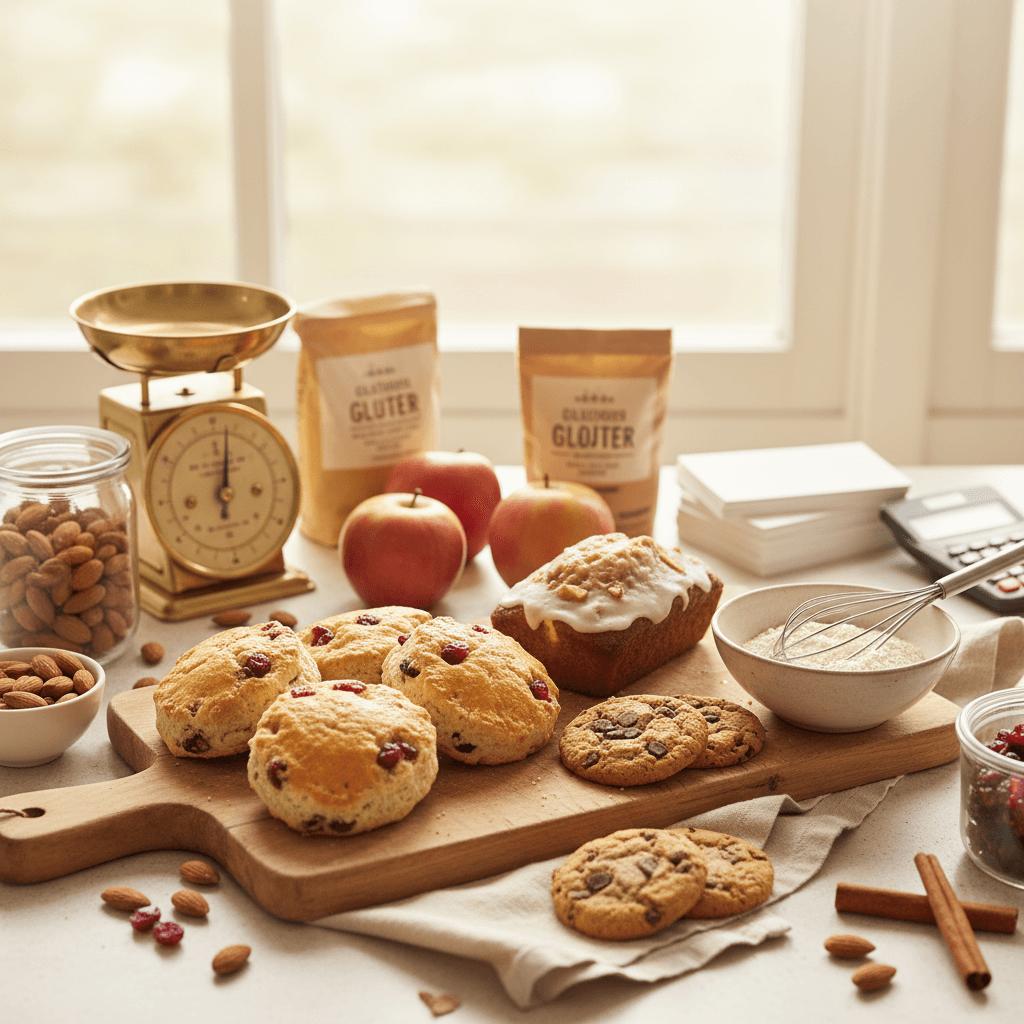
Choosing the right baked goods to sell at farmers markets can mean the difference between a profitable weekend and hauling home unsold inventory. We're breaking down which products have the best margins, what gluten-free bakers should focus on, and realistic income expectations so you can decide if this path is right for you.
Key takeaways
- Cookies, brownies, and quick breads have the highest profit margins for farmers market bakers, often 65-80% when ingredients are bought in bulk.
- Gluten-free baked goods command a 30-50% pricing premium over conventional items, and GF customers are fiercely loyal once they find a baker they trust.
- Realistic side-hustle income from farmers markets is $500-$2,000/month. Full-time replacement income ($3,000-$6,000/month) typically requires multiple markets plus pre-orders.
- Items priced between $5-$12 sell fastest at markets because they hit the impulse-buy sweet spot.
- Your best sellers will likely be 3-5 core products, not a huge menu. A focused lineup reduces waste and speeds up production.
- Packaging, presentation, and clear allergen labeling significantly impact sales volume, especially for specialty items.
Which baked goods have the best profit margins at farmers markets
The most profitable farmers market baked goods share three traits: low ingredient cost per unit, fast batch production, and broad appeal. Cookies, brownies, banana bread, and muffins consistently top the list because they're cheap to make, easy to scale, and nearly everyone buys them.
Here's a realistic margin breakdown based on what home bakers actually report:
| Product | Typical ingredient cost | Market price | Profit margin |
|---|---|---|---|
| Cookies (per dozen) | $1.50-$2.50 | $8-$12 | 70-80% |
| Brownies (per batch of 12) | $2.00-$3.50 | $3-$4 each | 65-75% |
| Banana/quick bread (per loaf) | $2.00-$3.00 | $8-$12 | 65-75% |
| Muffins (per dozen) | $2.50-$4.00 | $3-$4 each | 60-70% |
| Cinnamon rolls (per batch of 9) | $3.50-$5.00 | $4-$6 each | 60-70% |
| Decorated cakes | $8-$15 | $30-$60 | 50-65% |
| Artisan bread (per loaf) | $1.50-$3.00 | $6-$10 | 55-65% |
Notice that decorated cakes have decent margins on paper, but they're time-intensive. When you factor in labor hours, cookies and brownies almost always win. If you're just starting out, we'd strongly recommend beginning with items you can batch produce quickly. You can always add specialty items once you know your market.
Ingredient quality matters for both flavor and margins. If you're building your pantry from scratch, our guide to stocking a baking pantry on a budget walks through where to save and where to invest.
Why gluten-free baked goods are a farmers market goldmine
Gluten-free baked goods are one of the highest-margin niches at farmers markets, and the competition is surprisingly thin. Most markets have several conventional bakers and zero dedicated GF options. That gap is your opportunity.
Here's what makes GF products so profitable at markets:
- Pricing premium: Customers with celiac disease or gluten sensitivity expect to pay 30-50% more for safe, quality baked goods. A $10 loaf of banana bread becomes $14-$15 when it's gluten-free, and nobody blinks.
- Customer loyalty: GF customers don't casually browse. When they find a baker they trust to keep them safe, they come back every single week. Many home bakers report that 60-70% of their market revenue comes from repeat GF customers.
- Lower competition: Most bakers don't want to deal with the complexity of gluten-free baking. That complexity is your moat.
The catch? You need to actually know what you're doing. Gluten-free baking has a learning curve, and selling a dry, crumbly muffin will lose customers fast. If you're still dialing in your recipes, our gluten-free baking guide covers the fundamentals, and our troubleshooting pages on dry, crumbly results and gummy centers will help you fix the most common problems before you put anything in front of a paying customer.
If you're serious about turning your baking skills into income, the Confident Gluten-Free Baker Toolkit gives you the foundation to produce consistent, sellable results every time. Consistency is everything when customers are counting on you week after week.
Best baked goods to sell at farmers markets by category
Grab-and-go items (your bread and butter)
These are the items that sell in volume. They're individually packaged, priced under $6, and people buy them on impulse while walking through the market.
- Cookies — chocolate chip, oatmeal raisin, snickerdoodle. Sell them individually ($2-$3) and in bags of 4-6 ($8-$12). The bag upsell is where the real money is.
- Brownies and blondies — cut them generously, wrap them well. These look indulgent and sell themselves.
- Muffins — blueberry, lemon poppy seed, morning glory. Muffins sell especially well at early morning markets.
- Scones — slightly more premium positioning. Price at $3.50-$5 each.
Loaves and larger items (higher ticket, fewer sales)
These move slower but at higher price points. They're great for building your average transaction value.
- Banana bread and quick breads — zucchini bread, pumpkin bread, lemon loaf. These have incredible margins because the ingredients are dirt cheap.
- Artisan bread — sourdough, focaccia, sandwich loaves. Bread has a dedicated following, but production time is higher. If you're working with active dry yeast or sourdough starters, factor in the time cost.
- Coffee cakes and pound cakes — whole cakes priced at $18-$25 sell well to families and people hosting brunch.
Seasonal and specialty items (your differentiators)
Rotating seasonal items create urgency and give repeat customers a reason to check in every week.
- Pies (fall/winter) — whole pies at $20-$30 have solid margins if you're efficient with crust production.
- Cinnamon rolls — these are a farmers market cult favorite. Price at $4-$6 each and watch them disappear.
- Holiday cookies (November-December) — decorated sugar cookies can command $4-$6 per cookie. Our post on stocking up for holiday cookie season can help you keep supply costs in check during the rush.
Realistic income expectations for farmers market bakers
Let's be honest about the numbers, because there's a lot of hype online about baking businesses and not enough reality. Your income depends on your market size, product mix, pricing, and how many markets you attend.
| Level | Markets per week | Avg. revenue per market | Monthly gross | Monthly net (after costs) |
|---|---|---|---|---|
| Beginner side hustle | 1 | $200-$500 | $800-$2,000 | $500-$1,400 |
| Established side hustle | 1-2 | $500-$1,000 | $2,000-$4,000 | $1,200-$2,800 |
| Full-time replacement | 2-3 + pre-orders | $800-$1,500 | $4,000-$8,000 | $3,000-$6,000 |
A few things to keep in mind:
- Your first few markets will be slow. It takes 4-8 weeks to build a customer base. Don't panic if week one is $150.
- Ingredient costs typically run 20-35% of revenue once you're buying in bulk. Add booth fees ($25-$75/week), packaging, and gas, and your total cost of goods is usually 30-45%.
- Pre-orders change everything. Bakers who take pre-orders through text, email, or a simple order form consistently out-earn walk-up-only sellers by 40-60%. You bake exactly what's sold, waste drops to near zero, and you show up to market with guaranteed revenue.
- Scaling beyond $3K/month usually means adding custom orders, wholesale, or online sales alongside your market presence. Markets alone have a ceiling.
This is not a get-rich-quick path. It's early mornings, hot kitchens, and weekends at a booth. But if you enjoy baking and want a flexible income stream, it's one of the lowest-barrier ways to start a food business.
How to price baked goods for farmers markets
Price based on your costs and the value you deliver, not on what the grocery store charges. You are not competing with grocery store prices. You're selling fresh, handmade, often specialty products — and your customers know that.
Here's a simple pricing formula that works:
(Ingredient cost + packaging) x 3 to 4 = your retail price
If a batch of 12 cookies costs you $2.50 in ingredients and $0.50 in packaging, that's $3.00 total. Multiply by 3.5 and you get $10.50 — round to $10 or $11 for a dozen. For gluten-free items, use a 4x multiplier. Your ingredients cost more and your expertise is worth more.
A few pricing tips from experienced market bakers:
- Price in whole dollars. Nobody wants to make change at a farmers market.
- Offer bundle deals: "3 muffins for $10" moves more product than "$4 each."
- Don't underprice to compete. Cheap prices signal cheap quality. Customers at farmers markets are there because they want better than grocery store.
If you're curious about where to save on your ingredient costs without sacrificing quality, our guide to budget-friendly baking substitutes has some useful strategies.
Essential tips for selling baked goods at farmers markets
Great products are only half the equation. How you present and sell them matters just as much.
Presentation and packaging
- Invest in clean, consistent packaging. Clear bags with printed labels look professional and build trust.
- Always list ingredients and allergens clearly. For gluten-free items, bold the "gluten-free" label — it's the first thing your target customers scan for.
- Use risers and tiered displays to create visual depth at your booth. A flat table with scattered bags looks amateur.
Building repeat customers
- Collect emails or phone numbers from day one. A simple clipboard sign-up sheet works. Text your customer list before each market with what you're bringing.
- Offer samples. One free bite of your best cookie converts more customers than any sign ever will.
- Be consistent. Same products, same quality, same booth location every week. People are creatures of habit.
Managing production and waste
- Start with 3-5 core products. A huge menu means more waste and more stress. Add variety slowly as you learn what sells.
- Track everything. Write down what you bring, what you sell, and what you take home. After 4-6 markets, the data tells you exactly what to bake.
- Bake less than you think you need for your first few markets. It's better to sell out early than to throw away inventory.
If you're still building out your equipment setup, our guide to budget batch-cooking essentials covers the tools that make high-volume baking manageable without a commercial kitchen.
Frequently asked questions
What is the most profitable baked good to sell at a farmers market?
Cookies and brownies are consistently the most profitable baked goods at farmers markets. They have ingredient costs of $1.50-$3.50 per batch, sell for $8-$12 per dozen or $3-$4 each, and can be produced in high volume with minimal hands-on time. Gluten-free versions of these same items are even more profitable due to the pricing premium.
How much can you realistically make selling baked goods at farmers markets?
As a side hustle attending one market per week, expect $500-$2,000/month in net income after expenses. Reaching full-time replacement income of $3,000-$6,000/month typically requires attending 2-3 markets weekly plus taking pre-orders. Your first month will likely be on the lower end while you build a customer base.
Do you need a license to sell baked goods at a farmers market?
In most US states, cottage food laws allow you to sell certain home-baked goods at farmers markets without a commercial kitchen or food handler's license, but requirements vary significantly by state. Some states have annual revenue caps, required labeling, or product restrictions. Always check your state's specific cottage food laws before your first market. Many markets also ask vendors for proof of liability insurance before they can set up a booth; our bakery insurance guide covers what it costs and what markets typically ask for.
Is it worth selling gluten-free baked goods at farmers markets?
Yes, gluten-free baked goods are one of the most underserved and profitable niches at farmers markets. You can charge 30-50% more than conventional prices, competition is minimal, and GF customers are extremely loyal repeat buyers. The tradeoff is higher ingredient costs and a steeper learning curve — you need to produce consistently excellent results. Our gluten-free baking guide can help you get there.
What baked goods sell best at morning farmers markets?
Muffins, scones, cinnamon rolls, and coffee cake dominate morning markets because they pair naturally with coffee. Quick breads like banana bread and zucchini bread also sell well in the morning. If your market starts early (7-8 AM), lean heavily into breakfast items and save cookies and brownies for afternoon or all-day markets.
Ready to turn your baking into real income?
Selling at farmers markets is one of the best entry points into a home baking business, but knowing what to bake is just the first step. You also need a system for getting consistent orders, building a loyal customer base, and pricing for profit — not just survival.
Watch the free Home Bakery Pro masterclass
This free masterclass is taught by a home baker who built a full-time income in 3 months — and shows you how to get consistent repeat customers without relying on social media. If you're serious about making this work, it's the natural next step.

Written by
Co-founder, BakingSubs
Co-founder of BakingSubs, where he turns the science of ingredient substitutions into tested, reliable guidance for home bakers.
Related Posts
Bake with Confidence
See all
Confident Gluten-Free Baker Toolkit
The science-based system that replaces gluten's seven invisible jobs so your baking turns out soft, fluffy, and foolproof — every time.

Gluten-Free Recipe Vault
Instant access to our complete library of proven gluten-free recipes — no waiting, no guesswork, just results that work tonight.

Fix Your Gluten-Free Bread
Learn the 3-step formula to make bread rise and stay soft, discover why your loaves collapse, and get a tested sandwich bread recipe that actually works.