

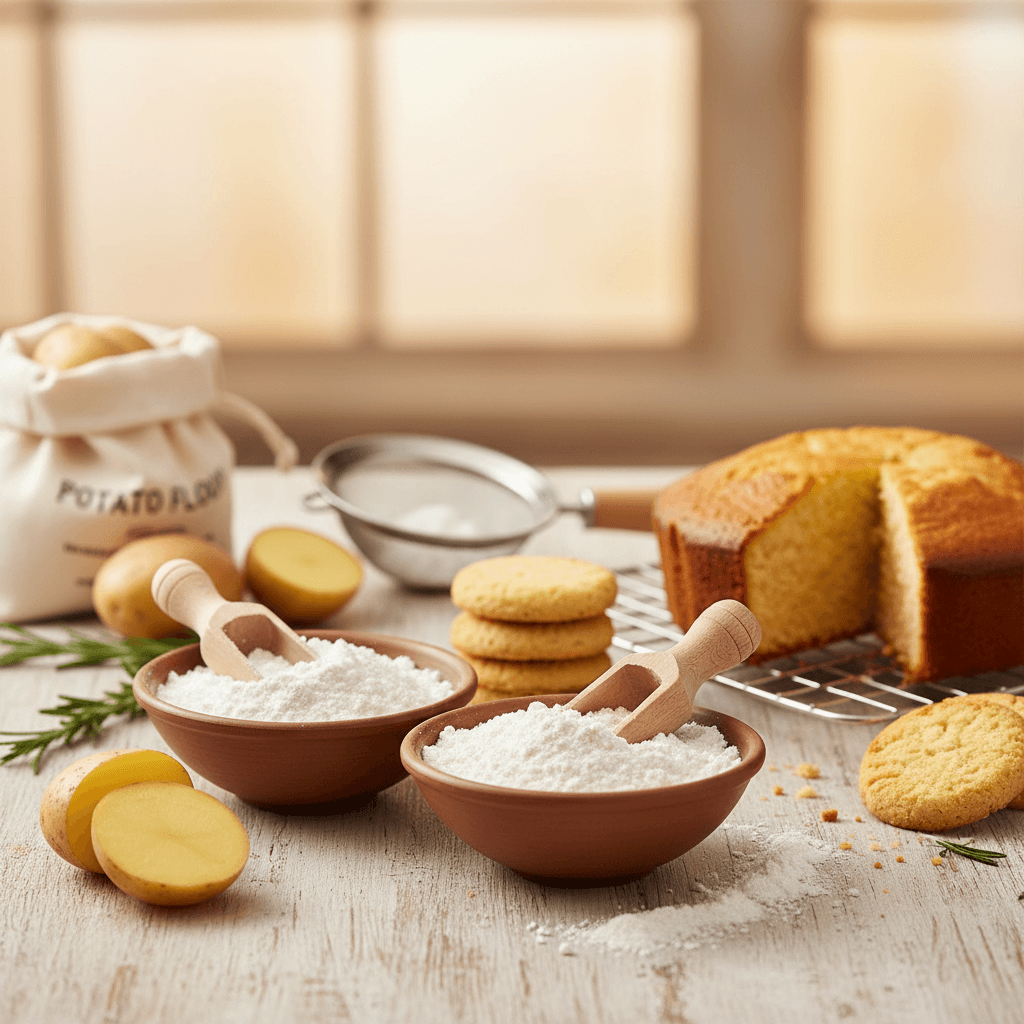
Potato flour and potato starch look similar on the shelf but behave completely differently in your mixing bowl. This guide breaks down exactly what each one does in gluten-free baking, compares the top brands side by side, and helps you pick the right product for every recipe.
Key takeaways
- Potato flour is made from whole dehydrated potatoes and absorbs massive amounts of liquid, while potato starch is a refined starch extracted from potatoes that adds lightness and moisture.
- You cannot substitute potato flour for potato starch 1:1 — doing so will result in a dense, gummy mess.
- Potato starch is the more commonly used ingredient in gluten-free flour blends, working as a tenderizer alongside rice flour and tapioca starch.
- Potato flour shines in bread recipes where you want moisture retention and a soft, pillowy crumb.
- Both ingredients are naturally gluten-free, but always check for certified gluten-free labeling to avoid cross-contamination.
- Price ranges from about $0.30 to $1.50 per ounce depending on the brand and whether it is organic.
What is the difference between potato flour and potato starch?
Potato flour is made from whole cooked, dehydrated, and ground potatoes. It retains the fiber, protein, and flavor of the potato, has a distinctly creamy-yellow color, and absorbs an extraordinary amount of water — roughly 8 to 10 times its weight. Potato starch, on the other hand, is a pure white, flavorless powder extracted by washing the starch out of crushed raw potatoes. It behaves like arrowroot powder or tapioca starch: light, neutral, and excellent at tenderizing baked goods.
Here is a quick side-by-side comparison:
| Property | Potato flour | Potato starch |
|---|---|---|
| Source | Whole dehydrated potatoes | Starch extracted from raw potatoes |
| Color | Creamy yellow | Bright white |
| Flavor | Mild potato flavor | Neutral / flavorless |
| Protein (per 1/4 cup) | ~3 g | 0 g |
| Fiber (per 1/4 cup) | ~2 g | 0 g |
| Water absorption | Very high | Moderate |
| Best role in GF baking | Moisture retention, soft crumb in bread | Lightening texture, tenderizing crumb |
| Typical amount in recipes | 1-3 tablespoons | 1/4 to 1 cup (as part of a blend) |
The critical thing to understand is that these are not interchangeable. If a recipe calls for 1/2 cup of potato starch and you use 1/2 cup of potato flour, your batter will seize up into a thick paste. If you are new to gluten-free baking and want to understand how different flours and starches work together, our complete guide for beginners is a great place to start.
How potato starch works in gluten-free baking
Potato starch is one of the three core starches used in most gluten-free flour blends, alongside tapioca starch and cornstarch. Its job is to lighten the crumb and add tenderness — it essentially does what cake flour does in wheat baking, but without any protein or gluten to toughen things up.
When heated, potato starch granules swell and gelatinize, trapping moisture inside your baked goods. This is why gluten-free cakes and muffins made with potato starch stay moist longer than those made with rice flour alone. It also contributes to a slightly chewy texture that helps mimic the stretch you lose without gluten. If you have been struggling with dry, crumbly results, adding potato starch to your blend is often the fix.
Potato starch works best in:
- Custom gluten-free flour blends (typically 25-35% of the blend)
- Cakes, cupcakes, and muffins
- Cookies where you want a tender, melt-in-your-mouth texture
- Pie crusts and pastry dough
- As a thickener for gravies and sauces
If you are building your own flour blend, check out our homemade gluten-free flour blend recipe with ratios that actually work for exact proportions.
If you have been looking for a structured approach to mastering gluten-free baking — understanding which flours to combine, how to troubleshoot, and how to get consistent results — the Confident Gluten-Free Baker Toolkit walks you through everything step by step.
How potato flour works in gluten-free baking
Potato flour plays a very different role than potato starch. Because it absorbs so much liquid, a small amount goes a long way toward keeping bread soft and extending shelf life. Most gluten-free bread recipes that include potato flour use just 2 to 4 tablespoons — never cups.
The protein and fiber content in potato flour also gives your baked goods a slightly more complex flavor and a denser, more satisfying crumb. This makes it ideal for yeasted breads, sandwich loaves, and dinner rolls. If you have been chasing that soft, bakery-style gluten-free bread texture, potato flour is often the missing ingredient.
Potato flour works best in:
- Yeasted gluten-free bread (sandwich loaves, rolls, focaccia)
- Pizza dough for a softer, more pliable crust
- Pancakes and waffles for extra moisture
- Mashed potato-based recipes like gnocchi
A word of caution: potato flour clumps easily and can create a gummy texture if overused. Always measure carefully and whisk it into your dry ingredients before adding liquids.
Best potato starch brands for gluten-free baking
Here are the top potato starch brands we recommend, compared across the factors that matter most for baking.
| Brand | Certified GF | Organic | Texture | Approx. price per oz | Best for |
|---|---|---|---|---|---|
| Bob's Red Mill | Yes | No | Very fine, silky | $0.30 | All-purpose GF baking, flour blends |
| Anthony's Goods | Yes (batch tested) | No | Fine, consistent | $0.25 | Budget-friendly bulk baking |
| Judee's | Yes (dedicated facility) | No | Ultra-fine | $0.35 | Celiac-safe baking, sensitive households |
| Kate Naturals | No (GF labeled) | Yes | Fine | $0.50 | Organic-focused bakers |
| Hoosier Hill Farm | No | No | Fine | $0.22 | High-volume baking on a budget |
| Landor Trading Company | No (GF labeled) | No | Very fine | $0.28 | General baking, thickening |
Bob's Red Mill potato starch
Bob's Red Mill is the most widely available option and the one most gluten-free recipes are tested with. Their potato starch is certified gluten-free, unmodified, and has a consistently silky texture that blends smoothly into flour mixes. At around $0.30 per ounce, it hits a sweet spot between quality and price. It's worth keeping a bag of Bob's Red Mill Potato Starch in your pantry at all times.
Anthony's Goods potato starch
If you bake in volume, Anthony's Goods Potato Starch is one of the best values available. It comes in larger bags (typically 2-5 lb), is batch tested for gluten, and is a close alternative to Bob's Red Mill. The texture is fine and consistent, and at roughly $0.25 per ounce, it is hard to beat for anyone making their own flour blends regularly.
Judee's potato starch
Judee's Potato Starch is processed in a dedicated gluten-free, top-8-allergen-free facility, making it the safest choice for celiac households or anyone with multiple food allergies. The ultra-fine grind dissolves beautifully in batters. It costs a bit more, but the peace of mind is worth it if cross-contamination is a serious concern for you.
Kate Naturals organic potato starch
For bakers who prioritize organic ingredients, Kate Naturals Organic Potato Starch is a solid pick. It is USDA organic and performs well in baking, though it comes at a premium — roughly $0.50 per ounce. The main difference from conventional options is the organic certification, so this one comes down to personal values.
Hoosier Hill Farm potato starch
Hoosier Hill Farm Potato Starch is the budget king at around $0.22 per ounce. It is not certified gluten-free, so we would not recommend it for celiac bakers, but if you are baking gluten-free by preference rather than medical necessity, it works perfectly well. The texture is fine and it performs reliably in flour blends and as a thickener.
Best potato flour brands for gluten-free baking
Potato flour is less commonly stocked than potato starch, but these brands are reliable and easy to find online.
| Brand | Certified GF | Organic | Grind | Approx. price per oz | Best for |
|---|---|---|---|---|---|
| Bob's Red Mill | Yes | No | Fine, slightly grainy | $0.35 | Bread, rolls, general GF baking |
| Judee's | Yes (dedicated facility) | No | Very fine | $0.45 | Celiac-safe baking |
| Anthony's Goods | Yes (batch tested) | No | Fine | $0.30 | Bulk baking, bread recipes |
| King Arthur Baking | No (GF labeled) | No | Fine, smooth | $0.55 | Premium baking, recipe development |
| Nuts.com | No | No | Medium-fine | $0.40 | General baking |
Bob's Red Mill potato flour
Bob's Red Mill Potato Flour is the go-to for most gluten-free bread bakers. It is certified gluten-free, widely available, and has a fine grind that incorporates well into dough. The flavor is subtly potato-forward, which is exactly what you want in a sandwich loaf. At $0.35 per ounce, it is reasonably priced for an ingredient you use in small quantities.
Judee's potato flour
Just like their potato starch, Judee's Potato Flour is produced in a dedicated allergen-free facility. The grind is very fine — finer than Bob's — which means it hydrates more evenly and reduces the risk of clumping. If you are baking for someone with celiac disease, this is the safest potato flour option on the market.
Anthony's Goods potato flour
Anthony's Goods Potato Flour offers a good balance of quality and price. It is batch tested for gluten and comes in a resealable bag, which is a nice practical touch since potato flour can absorb moisture from the air quickly. At $0.30 per ounce, it is the most affordable option here.
King Arthur Baking potato flour
King Arthur Baking Potato Flour has a reputation for consistency, and their potato flour delivers. The grind is smooth and fine, and it performs beautifully in bread recipes. It is the most expensive option at $0.55 per ounce, but King Arthur's quality control is excellent. Note that it is labeled gluten-free but not third-party certified, so check your comfort level if you are baking for celiac.
When to use potato starch vs potato flour in recipes
Potato starch belongs in your gluten-free flour blend as a structural component. Potato flour is an add-in you use in small amounts for specific effects. Here is a quick recipe-by-recipe guide:
| Recipe type | Use potato starch? | Use potato flour? | Notes |
|---|---|---|---|
| Sandwich bread | Yes (in flour blend) | Yes (2-3 tbsp) | Potato flour keeps bread soft for days |
| Cakes and cupcakes | Yes (in flour blend) | No | Potato flour would make cake too dense |
| Cookies | Yes (in flour blend) | Rarely (1 tbsp max) | Can add chewiness to thick cookies |
| Pie crust | Yes (in flour blend) | No | Potato starch keeps crust tender and flaky |
| Pizza dough | Yes (in flour blend) | Yes (1-2 tbsp) | Helps with pliability and browning |
| Pancakes / waffles | Yes | Optional (1 tbsp) | Adds fluffiness and moisture retention |
| Thickening sauces | Yes | No | Potato starch makes a clear, glossy thickener |
If you are converting a wheat recipe to gluten-free, potato starch is almost always the one you need. Potato flour only enters the picture when a recipe specifically calls for it or when you are trying to improve moisture in bread.
How to store potato flour and potato starch
Both products should be stored in airtight containers in a cool, dry place. Potato flour is especially hygroscopic — it pulls moisture from the air — so we recommend transferring it to a sealed glass jar or airtight container the moment you open the bag. Stored properly, both will last 12 to 18 months in the pantry.
Potato starch can also be stored in the freezer if you buy in bulk, which extends its shelf life even further. Just let it come to room temperature before measuring, since cold starch can clump.
Common mistakes when using potato flour and potato starch
These are the most common errors, and they are all easy to avoid once you know what to watch for.
- Swapping them 1:1. This is the number one mistake. Potato flour absorbs far more liquid than potato starch. If a recipe says "potato starch," use potato starch.
- Using too much potato flour. More than 3-4 tablespoons per loaf of bread will make your crumb gummy and heavy. A little goes a long way.
- Heating potato starch too aggressively. When used as a thickener, potato starch breaks down if boiled for too long. Add it at the end of cooking and remove from heat once thickened.
- Ignoring cross-contamination risk. Not all potato products are processed in gluten-free facilities. If you are baking for someone with celiac disease, choose certified gluten-free brands like Bob's Red Mill or Judee's.
- Confusing potato starch with potato flakes. Instant mashed potato flakes are a completely different product and cannot replace either potato starch or potato flour in baking recipes.
Understanding what gluten does in baking can help you see why getting the starch-to-flour ratio right matters so much — each component is doing a specific job that wheat flour used to handle all by itself.
Frequently asked questions
Can I substitute potato flour for potato starch in gluten-free baking?
No, you cannot substitute them 1:1. Potato flour absorbs far more liquid than potato starch and will make your recipe dense and gummy. If you are out of potato starch, arrowroot powder or tapioca starch are much closer substitutes.
What does potato starch do in a gluten-free flour blend?
Potato starch lightens the crumb and adds tenderness to baked goods. It works alongside rice flour and tapioca starch to create a texture that mimics all-purpose wheat flour. Most gluten-free flour blends use potato starch as 25-35% of the total mix. You can learn more in our homemade flour blend recipe.
Is potato starch or potato flour better for gluten-free bread?
You usually want both. Potato starch goes into your flour blend to lighten the overall texture, while 2-3 tablespoons of potato flour added separately helps the bread stay soft and moist for longer. The combination is what gives the best results in sandwich loaves and dinner rolls.
Is Bob's Red Mill potato starch safe for celiac disease?
Yes, Bob's Red Mill Potato Starch is certified gluten-free and tested to below 20 ppm. For even stricter safety, Judee's brand is processed in a dedicated gluten-free, top-8-allergen-free facility.
Why is my gluten-free bread gummy inside?
Gummy centers in gluten-free bread are often caused by too much potato flour, underbaking, or too much liquid in the recipe. If you used potato flour where the recipe called for potato starch, that is very likely the culprit. Check out our guide on fixing gummy centers in gluten-free baking for a full troubleshooting walkthrough.

Written by
Co-founder, BakingSubs
Co-founder of BakingSubs, where he turns the science of ingredient substitutions into tested, reliable guidance for home bakers.
Related Posts
Bake with Confidence
See all
Confident Gluten-Free Baker Toolkit
The science-based system that replaces gluten's seven invisible jobs so your baking turns out soft, fluffy, and foolproof — every time.

Gluten-Free Recipe Vault
Instant access to our complete library of proven gluten-free recipes — no waiting, no guesswork, just results that work tonight.

Fix Your Gluten-Free Bread
Learn the 3-step formula to make bread rise and stay soft, discover why your loaves collapse, and get a tested sandwich bread recipe that actually works.