

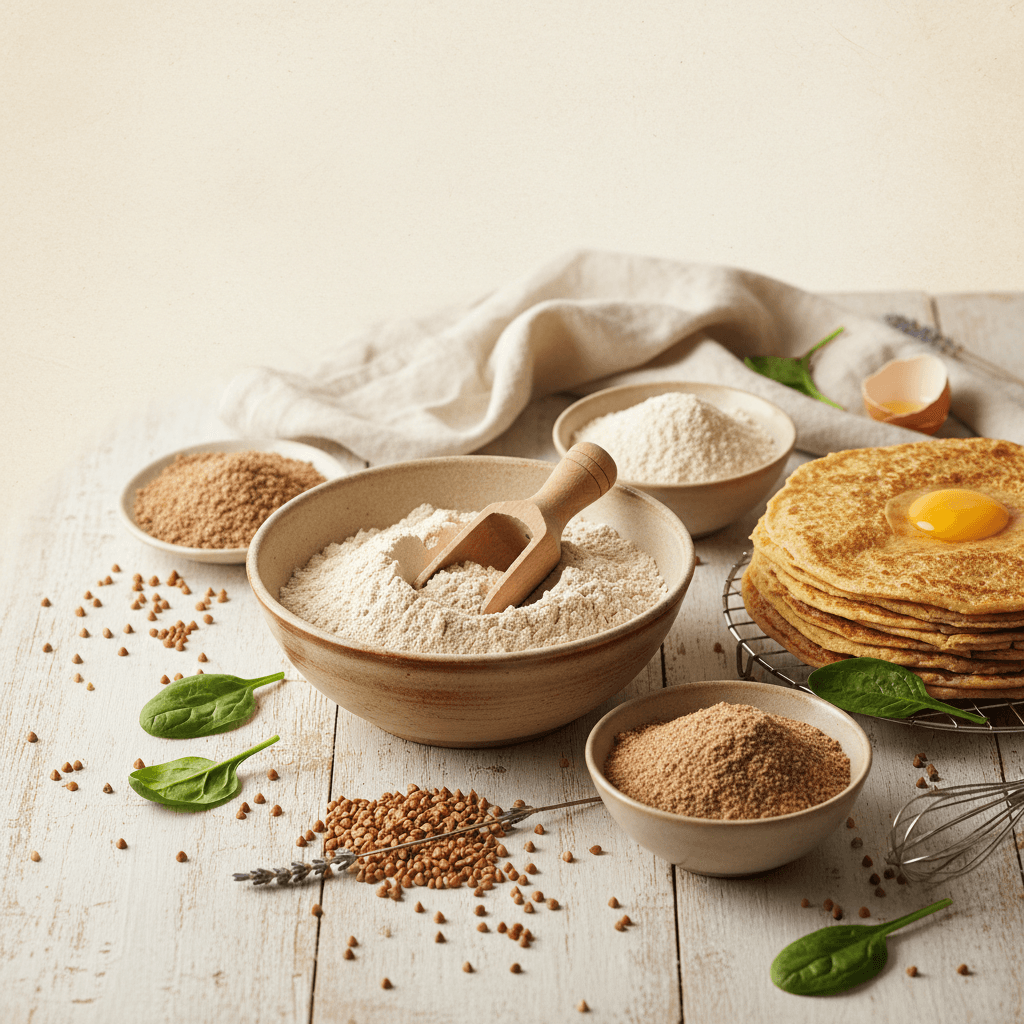
Buckwheat flour is one of the most flavorful and nutritious flours you can use in gluten-free baking, but the brand you pick matters more than you might think. We researched five popular buckwheat flour brands to help you find the right one for your recipes.
Key takeaways
- Despite the name, buckwheat is naturally gluten-free — it is a seed, not a wheat grain — but not all brands are processed in dedicated gluten-free facilities.
- Light buckwheat flour has a milder taste and works better in delicate bakes like crepes and cakes, while dark buckwheat flour has more fiber, a stronger earthy flavor, and excels in hearty breads and pancakes.
- Protein runs about 10-11g per 100g on the two nutrition labels we checked (Arrowhead Mills and Bob's Red Mill).
- Grind fineness varies significantly between brands and directly affects texture — a gritty buckwheat flour can ruin an otherwise great recipe.
- For most gluten-free baking, buckwheat works best as 25-40% of a flour blend rather than as a 100% replacement for all-purpose flour.
- Certified gluten-free labeling is essential if you have celiac disease, since cross-contamination during milling is common with buckwheat.
What makes buckwheat flour useful in gluten-free baking
Buckwheat flour brings a distinctive earthy, slightly nutty flavor that adds complexity to baked goods — something many gluten-free flours lack. It contains a useful amount of protein (about 10-11g per 100g on the Arrowhead Mills and Bob's Red Mill labels), which helps give structure to breads, pancakes, and muffins that would otherwise fall flat with lower-protein rice flour blends.
Buckwheat also contains a decent amount of soluble fiber, which helps with moisture retention. If you have been struggling with dry, crumbly gluten-free bakes, adding buckwheat to your blend can make a noticeable difference. It pairs especially well with brown rice flour and starches like arrowroot powder in custom blends.
For a deeper dive into how different flours work together, check out our guide to homemade gluten-free flour blend recipes with ratios that actually work.
The recipes where buckwheat truly shines include French-style galettes (buckwheat crepes), pancakes, soba-inspired noodles, hearty muffins, quick breads, and rustic loaves. It also works beautifully in chocolate baked goods, where its deep flavor complements cocoa rather than competing with it.
If you are still building your gluten-free pantry and want a structured approach to understanding how different flours and binders work together, the Confident Gluten-Free Baker Toolkit walks you through flour selection, blend ratios, and troubleshooting so you stop wasting ingredients on failed experiments.
How we compared these buckwheat flour brands
We evaluated each brand on five criteria that matter most to gluten-free home bakers:
- Protein content — Higher protein generally means better structure in baked goods.
- Grind fineness — A fine, smooth grind integrates better and avoids the gritty texture that plagues many gluten-free flours.
- Flavor profile — Some bakers want bold buckwheat flavor; others want something milder.
- Gluten-free certification — Critical for celiac bakers who need assurance against cross-contamination.
- Price per pound — Buckwheat flour can range from budget-friendly to premium pricing.
Best buckwheat flour brands for baking compared
| Brand | Type | Protein (per 100g) | Grind | GF certified | Approx. price/lb | Best for |
|---|---|---|---|---|---|---|
| Arrowhead Mills Organic Gluten Free | Organic buckwheat flour | 10g | Not stated | Yes (certifier not named on brand page) | Varies by retailer (22 oz bag) | Best overall: certified gluten-free and organic |
| Anthony's Organic | Ground groats (organic) | Not listed | Fine (per brand) | No seal (labeled GF, batch tested) | About $6.75 (3 lb bag, brand site) | Organic, batch-tested, larger bag |
| Bouchard Family Farms | Light | Not listed | Not stated | Yes (GFFP) | About $2.50 (3 lb bag, brand site) | Crepes, galettes, delicate pastries |
| Birkett Mills Pocono | Whole grain (organic) | Not listed | Stone-ground | No (labeled GF; dedicated buckwheat line, tested under 10 ppm) | About $3.30 (2 lb bag, brand site) | Celiac bakers who want a dedicated milling line |
| Bob's Red Mill Organic | Whole grain (dark) | 11g | Fine (per brand) | No (not labeled gluten-free) | Varies by retailer (22 oz bag) | Pancakes and everyday baking when you don't need gluten-free |
1. Arrowhead Mills organic gluten-free buckwheat flour — best overall
Arrowhead Mills' Organic Gluten Free Buckwheat Flour is our top pick because it's the only flour on this list that is both certified gluten-free and certified organic. Arrowhead Mills' product page lists "Certified Gluten Free" among its benefits (the page doesn't name the certifying body), and the only ingredient is organic buckwheat flour.
The nutrition label lists 3g of protein and 3g of fiber per 1/4-cup (30g) serving, with about 20 servings in the 22 oz bag. Arrowhead Mills suggests it for soba noodles, blinis, crepes, and pancakes. Like any buckwheat flour, it's best used as part of a blend in muffins and quick breads (see our tips below).
Arrowhead Mills Organic Buckwheat Flour — certified gluten-free and organic in one bag.
2. Anthony's organic buckwheat flour — batch-tested and organic
Anthony's Organic Buckwheat Flour is labeled "Batch Tested and Verified Gluten Free" and is USDA certified organic. Anthony's doesn't list a third-party gluten-free certification, so celiac bakers who require formal certification should be aware of the distinction. The buckwheat is grown and packed in the USA, and Anthony's describes the flour as ground from buckwheat groats into a fine flour.
It comes in a 3 lb bag, listed at $20.29 on Anthony's own site (about $6.75 per pound), the highest brand-site price per pound among the flours we priced; Amazon pricing can differ. Anthony's suggests it for pancakes, soba noodles, and bread.
Anthony's Organic Buckwheat Flour — organic and batch-tested gluten-free, in a 3 lb bag.
3. Bouchard Family Farms light buckwheat flour — best for crepes and galettes
Bouchard Family Farms mills its light buckwheat flour in northern Maine, and it's certified gluten-free through the Gluten Free Food Program (GFFP), which the Celiac Sprue Association established in 2004. The brand says it has no additives or preservatives.
As a light buckwheat flour, it's paler and milder than the dark whole-groat flours on this list (see the light vs. dark section below), which makes it the better fit for crepes, galettes, and delicate bakes. It's also the flour behind the family's ployes, a French-Acadian flatbread they sell as a mix. Bouchard sells a 3 lb bag for $7.50 on its own site (about $2.50 per pound).
Bouchard Family Farms Light Buckwheat Flour — certified gluten-free light buckwheat for crepes, galettes, and delicate pastries.
4. Birkett Mills Pocono buckwheat flour — milled on a dedicated buckwheat line
The Birkett Mills in Penn Yan, New York, mills its buckwheat on a dedicated line whose equipment is used only for buckwheat. The company says it inspects incoming buckwheat for gluten-containing grains and tests the finished product to under 10 ppm gluten, stricter than the FDA's 20 ppm limit. Its buckwheat is labeled gluten-free, but Birkett Mills says plainly that it isn't third-party certified, and wheat is milled in the same facility on separate lines.
Its retail flour is Pocono Buckwheat Flour: USDA certified organic, whole grain, and stone-ground from a single ingredient, organic buckwheat. It's listed at $6.60 for a 2 lb bag on Birkett Mills' site (about $3.30 per pound). The company's FAQ also lists light, whole, and dark buckwheat flours.
Birkett Mills Pocono Buckwheat Flour — a good choice for celiac bakers who want buckwheat milled on a dedicated line.
5. Bob's Red Mill organic buckwheat flour — not labeled gluten-free
Celiac warning: Bob's Red Mill does not label its Organic Buckwheat Flour gluten-free. The company says it can't guarantee the flour meets its gluten-free standards because of possible cross-contact with gluten grains in the supply chain, and it isn't processed as one of Bob's gluten-free products. If you have celiac disease, choose a buckwheat flour labeled gluten-free instead.
Bob's Red Mill's Organic Buckwheat Flour is made from organic whole grain buckwheat and sold in a 22 oz bag. The little black specks come from the ground seed hull, so it's a dark flour with the robust, earthy flavor that suits pancakes, hearty muffins, and rustic breads. The label lists 4g of protein per 1/4-cup (37g) serving.

Bob's Red Mill describes the flour as milled to a fine texture. Because it isn't labeled gluten-free, it's only suitable for bakers who aren't avoiding gluten for medical reasons.
It is a natural fit for buckwheat pancakes or for adding buckwheat to a custom flour blend. It is easy to find at most grocery stores and online.
Bob's Red Mill Organic Buckwheat Flour — widely available, but not labeled gluten-free, so not for celiac bakers.
Light vs. dark buckwheat flour: which should you use
Light buckwheat flour is milled from groats with the dark outer hull removed. It has a milder, slightly sweet flavor, a finer texture, and a pale gray appearance. Use it for crepes, galettes, tender cakes, and any recipe where you want buckwheat's nutrition without a strong earthy taste.
Dark buckwheat flour is milled from whole groats, hull and all. It has a more intense, earthy flavor, more fiber, slightly more protein, and a coarser texture. It is the better choice for pancakes, hearty muffins, rustic breads, and chocolate baked goods where the bold flavor is an asset.
Most recipes that simply call for "buckwheat flour" are referring to dark (whole groat) buckwheat flour, since that is what is most commonly sold. If a recipe specifically calls for light buckwheat flour — particularly French galette recipes — do not substitute dark, or the flavor and texture will be noticeably different.
Tips for baking with buckwheat flour
Buckwheat flour absorbs more liquid than many other gluten-free flours, so you may need to increase your liquid slightly when adding it to an existing recipe. Start with an extra tablespoon or two of milk or water and adjust from there.
Because buckwheat has no gluten, it needs a binder when used in larger proportions. Xanthan gum, psyllium husk, or eggs all work well. If you are unsure which binder to use, our guide to what gluten does in baking and how to replace it breaks down the options.
For the best results in most recipes, use buckwheat as 25-40% of your total flour blend. Pair it with a neutral starch like arrowroot or tapioca starch and a mild flour like white rice flour. Going above 50% buckwheat will give you a very strong flavor that not everyone enjoys.
Store buckwheat flour in an airtight container in the refrigerator or freezer. Because it is milled from a whole seed with natural oils, it can go rancid faster than refined starches — especially in warm kitchens.
Frequently asked questions
Is buckwheat flour actually gluten-free
Yes, buckwheat is naturally gluten-free despite its misleading name. It is a seed related to rhubarb and sorrel, not a grain related to wheat. However, cross-contamination during milling is common, so celiac bakers should always look for certified gluten-free buckwheat flour or flour from a dedicated facility. Our buckwheat flour ingredient page has more details on substitutions and usage.
Can I use buckwheat flour as a 1:1 substitute for all-purpose flour
No, buckwheat flour does not work as a straight 1:1 replacement for all-purpose flour. It has no gluten, absorbs more liquid, and has a strong flavor. For best results, use it as 25-40% of a gluten-free flour blend and add a binder like xanthan gum. If you need guidance on converting wheat recipes, check out our post on how to convert any recipe to gluten-free.
What does buckwheat flour taste like in baking
Dark buckwheat flour has a distinctive earthy, slightly bitter, nutty flavor that pairs especially well with chocolate, maple syrup, and warm spices. Light buckwheat flour is much milder with a subtle sweetness. The intensity of the flavor depends on the brand and whether you are using light or dark flour.
Which buckwheat flour brand is best for celiac bakers
Arrowhead Mills and Bouchard Family Farms are the two certified gluten-free options on this list. Arrowhead Mills labels its Organic Gluten Free Buckwheat Flour certified gluten-free, and Bouchard's light buckwheat flour is certified through the Gluten Free Food Program (GFFP). Birkett Mills mills its buckwheat on a dedicated buckwheat-only line and tests to under 10 ppm (labeled gluten-free, not third-party certified), and Anthony's labels its flour batch tested and verified gluten-free. Bob's Red Mill does not label its Organic Buckwheat Flour gluten-free because of possible cross-contact in the supply chain, so it isn't a safe choice for celiac disease. Always check the packaging for the most current certification status before purchasing.
How should I store buckwheat flour to keep it fresh
Store buckwheat flour in an airtight container in the refrigerator or freezer. Because it is milled from a whole seed containing natural oils, it can go rancid within a few months at room temperature. Refrigerated, it will stay fresh for 3-6 months. Frozen, it can last up to a year. Let it come to room temperature before baking for the most accurate measurements.

Written by
Co-founder, BakingSubs
Co-founder of BakingSubs, where he turns the science of ingredient substitutions into tested, reliable guidance for home bakers.
Related Posts

Bake with Confidence
See all
Confident Gluten-Free Baker Toolkit
The science-based system that replaces gluten's seven invisible jobs so your baking turns out soft, fluffy, and foolproof — every time.

Gluten-Free Recipe Vault
Instant access to our complete library of proven gluten-free recipes — no waiting, no guesswork, just results that work tonight.

Fix Your Gluten-Free Bread
Learn the 3-step formula to make bread rise and stay soft, discover why your loaves collapse, and get a tested sandwich bread recipe that actually works.