

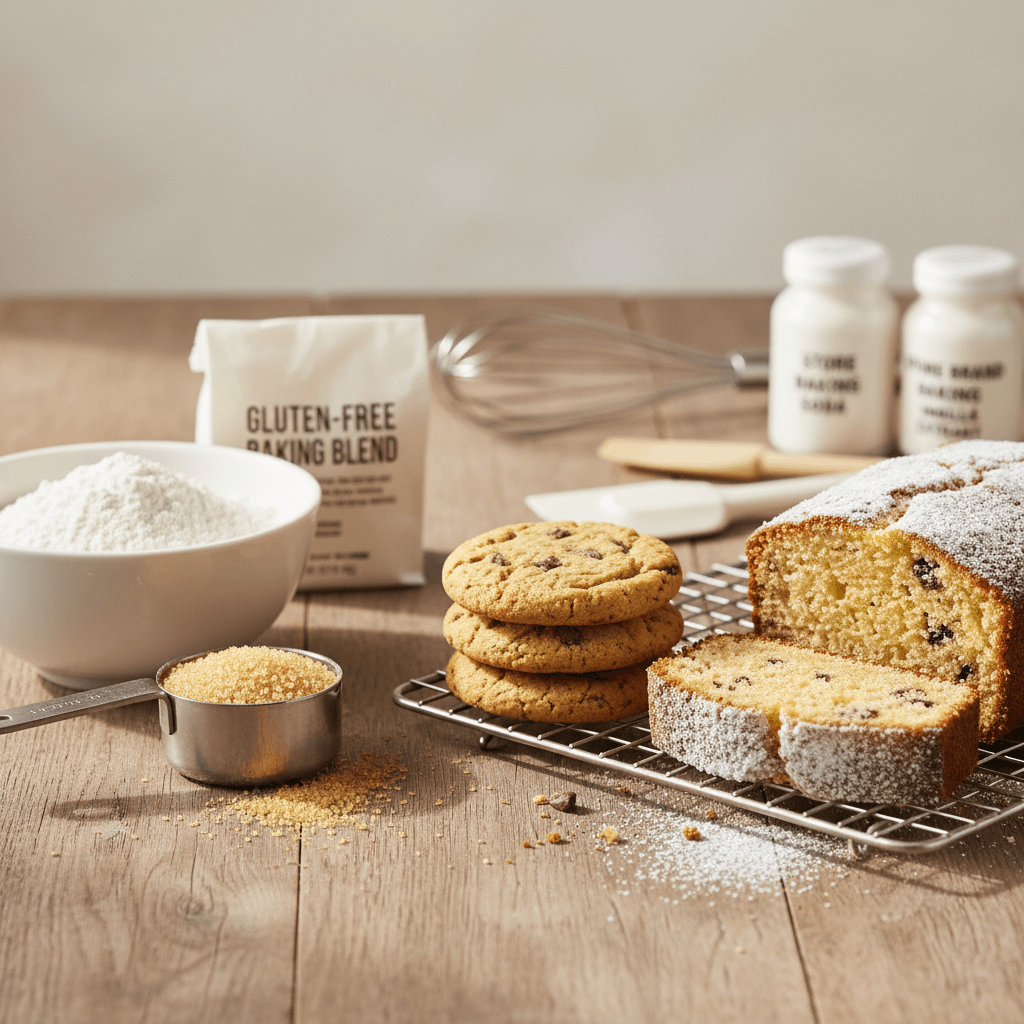
You don't need to spend a fortune on name-brand baking products to get great results. Whether you're newly diagnosed with celiac disease, baking on a college budget, or just tired of paying premium prices, plenty of store brand options perform just as well as the big names. Here's exactly where to find them and how much you'll save.
Key takeaways
- Store brand baking staples like flour, sugar, baking powder, and vanilla extract often come from the same manufacturers as name brands, at 30-50% less cost.
- Aldi, Walmart, and Target all carry store brand baking lines that consistently rival name-brand quality.
- Gluten-free store brands have improved dramatically — Walmart's Great Value and Aldi's liveGfree lines offer real savings over brands like Bob's Red Mill and King Arthur.
- Buying multi-use ingredients (like a good all-purpose gluten-free flour blend) saves more than buying specialty mixes for every recipe.
- Making your own substitutes — like buttermilk from milk and vinegar, or oat flour from oats — can cut ingredient costs by 50-75%.
- Bulk buying on Amazon or at Sam's Club drops per-unit prices significantly on pantry staples you use often.
Why store brands are closer to name brands than you think
Here's something most people don't realize: many store brand products are manufactured in the same facilities as their name-brand counterparts. The difference is often just packaging and marketing — not what's inside the bag. Store brands like Walmart's Great Value, Target's Good & Gather, Aldi's Baker's Corner, and Kroger's own line source from major suppliers and have to meet the same FDA standards as everyone else.
For baking specifically, this matters a lot. Granulated sugar is granulated sugar. Baking soda is baking soda. And even more complex products like flour blends and chocolate chips have gotten remarkably good at the store brand level. The days of store brands being noticeably inferior are mostly behind us.
Best store brand baking staples compared to name brands
Let's start with the everyday essentials that every baker needs. These are the products where switching to store brand gives you the biggest cumulative savings over time.
| Product | Store brand (price) | Name brand (price) | Savings |
|---|---|---|---|
| All-purpose flour (5 lb) | Great Value $2.48 (Walmart) | Gold Medal $4.28 | ~42% |
| Granulated sugar (4 lb) | Good & Gather $3.29 (Target) | Domino $5.49 | ~40% |
| Baking powder (8.1 oz) | Baker's Corner $1.09 (Aldi) | Clabber Girl $3.29 | ~67% |
| Pure vanilla extract (2 oz) | Great Value $4.97 (Walmart) | McCormick $8.98 | ~45% |
| Semi-sweet chocolate chips (12 oz) | Good & Gather $2.49 (Target) | Nestlé Toll House $4.29 | ~42% |
| Baking soda (16 oz) | Great Value $0.68 (Walmart) | Arm & Hammer $1.28 | ~47% |
| Unsalted butter (1 lb) | Baker's Corner $3.49 (Aldi) | Land O'Lakes $5.99 | ~42% |
| Brown sugar (2 lb) | Great Value $2.78 (Walmart) | Domino $4.68 | ~41% |
Across a typical baking pantry restock, these savings add up to $15-25 per trip. Over a year of regular baking, that's easily $100 or more back in your pocket.
A few notes on quality: store brand baking powder and baking soda are genuinely identical to name brands — there's zero reason to pay more. Vanilla extract is where you'll notice the most variation, but Great Value pure vanilla extract is a solid choice for the price. The key word is "pure" — skip the imitation stuff regardless of brand.
If you're just getting started with dietary baking and want a structured approach to building your pantry without overspending, our Confident Gluten-Free Baker Toolkit walks you through exactly what to buy first and what you can skip.
Best budget gluten-free baking products by store
Gluten-free baking is where store brands really shine as money-savers, because name-brand gluten-free products carry a significant premium. Here's where to find the best deals.
Walmart Great Value gluten-free line
Walmart's Great Value line has expanded its gluten-free offerings significantly. Their all-purpose gluten-free flour blend runs about $3.96 for a 22 oz bag, compared to $5-7 for comparable Bob's Red Mill or King Arthur blends. For a deeper dive on everything available, check out our complete guide to gluten-free products at Walmart.
Best Great Value picks for bakers:
- All-purpose gluten-free flour blend — $3.96 (22 oz)
- Gluten-free brownie mix — $3.24 (16 oz)
- Gluten-free pancake mix — $3.48 (16 oz)
- Almond flour — $5.97 (16 oz) vs. $8-10 for Blue Diamond
- Coconut flour — $3.97 (16 oz) vs. $6-8 for Bob's Red Mill
Aldi liveGfree and Baker's Corner
Aldi is arguably the best store for budget-conscious gluten-free bakers. Their liveGfree line covers mixes, snacks, and baking staples at prices that consistently undercut specialty brands by 40-60%. Their Baker's Corner line handles all the conventional baking basics. See our complete Aldi gluten-free shopping guide for the full breakdown.
Standout Aldi picks:
- liveGfree all-purpose flour blend — $3.49 (22 oz)
- liveGfree brownie mix — $2.99 (16 oz)
- liveGfree pizza crust mix — $2.99
- Baker's Corner brown sugar (2 lb) — $2.29
- Baker's Corner chocolate chips (12 oz) — $1.89
Target Good & Gather and Favorite Day
Target's store brands have gotten really good in recent years. Good & Gather covers pantry staples, while Favorite Day handles more specialty baking items. Prices tend to fall between Aldi and Walmart. Our Target gluten-free shopping guide covers everything in detail.
Amazon basics and bulk buying
Amazon isn't a traditional store brand play, but their competitive pricing on bulk sizes makes them worth mentioning. Buying a 4-pack of Bob's Red Mill 1-to-1 Baking Flour on Amazon drops the per-bag price by about 20% compared to buying individual bags at the grocery store. Our Amazon gluten-free baking guide has more bulk buying strategies.
Store brand gluten-free flour blends vs. name brands
Flour is the foundation of everything you bake, so this is where quality matters most. The good news is that store brand gluten-free flour blends have gotten genuinely competitive. Most use the same base formula: rice flour, tapioca starch, and potato starch, sometimes with xanthan gum included.
| Flour blend | Price per oz | Xanthan gum included? | Where to buy |
|---|---|---|---|
| Great Value GF All-Purpose | $0.18/oz | Yes | Walmart |
| liveGfree All-Purpose (Aldi) | $0.16/oz | Yes | Aldi |
| Bob's Red Mill 1-to-1 | $0.22/oz | Yes | Walmart, Target, Amazon |
| King Arthur Measure for Measure | $0.25/oz | Yes | Target, Kroger, Amazon |
| Cup4Cup | $0.42/oz | Yes | Whole Foods, Amazon |
As you can see, the store brand blends cost 25-60% less per ounce than name brands. For everyday baking — cookies, muffins, quick breads — the store brand blends work perfectly well. Where name brands like Bob's Red Mill or King Arthur tend to edge ahead is in more demanding recipes like sandwich bread or delicate pastries, where the specific starch ratios and protein content matter more.
If you're deciding between the two big name brands, our Bob's Red Mill vs. King Arthur comparison breaks down exactly where each one performs best.
Best store brand baking mixes that rival premium options
Baking mixes are where the name-brand premium gets especially steep. A box of Simple Mills almond flour cookies runs $5-7, while store brand equivalents cost $2-4. Here's where store brands genuinely deliver.
Brownie mixes: This is where store brands truly shine. Brownies are forgiving — they're supposed to be dense and fudgy, which means the flour blend matters less than in something like a cake. Great Value and liveGfree gluten-free brownie mixes ($2.99-3.24) are a practical alternative to a $6 box of King Arthur or Pamela's. For more options, see our best gluten-free brownie mix roundup.
Pancake and waffle mixes: Another category where store brands excel. Walmart's Great Value gluten-free pancake mix ($3.48) competes with Birch Benders ($5-6) in everyday breakfast situations.
Cake mixes: This is where we'd be more cautious. Cakes demand more from the flour blend, so name-brand cake mixes tend to have the edge on crumb and moisture. If cake is your thing, it might be worth spending the extra $2-3 on a proven mix.
Cookie mixes: Split decision. Store brand chocolate chip cookie mixes are generally great. More delicate cookies (like snickerdoodles or sugar cookies) tend to benefit from a name-brand mix with a more refined flour blend.
How to save even more by making your own substitutes
The single biggest money-saving move in baking isn't switching brands — it's making some things yourself. Several common baking ingredients can be made at home for a fraction of the cost.
Make your own oat flour
A bag of certified gluten-free oats costs about $3-4 for 32 oz at Walmart or Aldi. Pulse them in a blender for 30 seconds and you have oat flour that would cost $6-8 to buy pre-ground. That's roughly 50% savings, and it takes less than a minute. If you bake with oat flour regularly, a dedicated grain mill pays for itself within a few months.
Make your own buttermilk
Don't buy a whole carton of buttermilk for a recipe that calls for one cup. Add one tablespoon of white vinegar or lemon juice to one cup of milk (dairy or non-dairy), let it sit for 5 minutes, and you're done. Cost: essentially free with ingredients you already have.
Make your own brown sugar
One cup of white sugar plus one tablespoon of molasses, mixed together, gives you brown sugar that's identical to what's in the bag. This is especially handy when you run out mid-recipe.
Use aquafaba instead of buying egg replacer
The liquid from a can of chickpeas — aquafaba — works as an egg replacer in many recipes. Three tablespoons replaces one egg. A $0.89 can of chickpeas gives you enough for 3-4 eggs worth of replacer, compared to $6-8 for a box of commercial egg replacer powder. You get dinner (chickpeas) and a baking ingredient from the same purchase.
Multi-use ingredients that stretch your budget further
One of the biggest budget traps in dietary baking is buying a specialty ingredient for one recipe and then watching it sit in your pantry. Focus your spending on versatile ingredients that work across many recipes.
Top multi-use investments:
- A good all-purpose gluten-free flour blend ($3.50-5.00) — Use it for cookies, muffins, quick breads, pancakes, thickening sauces, and more. One bag replaces the need for multiple specialty flours when you're starting out.
- Xanthan gum ($8-12 for 8 oz) — Seems expensive upfront, but you use just 1/2 to 1 teaspoon per recipe. One bag lasts months. Learn more about xanthan gum vs. guar gum to pick the right one.
- Tapioca starch ($2-4 for 16 oz at Walmart) — Works as a thickener, improves texture in gluten-free baking, and helps with browning. Incredibly versatile for the price.
- Coconut oil ($5-7 for 14 oz) — Works as a butter substitute in vegan baking, a pan greaser, and an ingredient in its own right. Great Value coconut oil at Walmart is about $5.47 and works identically to $9-12 name-brand options.
- Applesauce ($2-3 for 24 oz) — Replaces oil, eggs, or some sugar depending on the recipe. A jar of Great Value unsweetened applesauce lasts through many baking sessions.
Smart bulk-buying strategies for bakers on a budget
Buying in bulk is one of the fastest ways to lower your per-recipe cost, but only if you buy things you'll actually use before they go stale. Here's a practical approach.
Best items to buy in bulk:
- Gluten-free all-purpose flour (Amazon multi-packs or Sam's Club) — saves 15-25% per bag
- Sugar and brown sugar (Costco or Sam's Club 10 lb bags) — $0.30-0.40/lb vs. $0.70-0.90/lb at grocery stores
- Chocolate chips (Costco Kirkland brand 4.5 lb bag, ~$10) — roughly half the per-ounce cost of grocery store bags
- Certified gluten-free oats (Amazon 4-packs of Bob's Red Mill) — drops from ~$5.50/bag to ~$4.00/bag
Items NOT worth buying in bulk:
- Specialty flours you use rarely (almond flour, coconut flour) — they go rancid faster than you think
- Baking powder — loses potency after opening, so a smaller container you'll use within 6 months is smarter
- Yeast — unless you bake bread weekly, buy small packets
For Sam's Club shoppers, our Sam's Club gluten-free shopping guide covers the best bulk buys in detail.
Frequently asked questions
Are store brand baking products the same quality as name brands?
In most cases, yes — especially for commodity ingredients like sugar, baking soda, baking powder, and basic flour. Many store brand products are manufactured in the same facilities as name brands. The biggest quality differences show up in specialty items like gluten-free flour blends and cake mixes, where the specific formulation matters more.
What is the cheapest store for gluten-free baking products?
Aldi is consistently the cheapest brick-and-mortar store for gluten-free baking products, with their liveGfree line priced 40-60% below specialty brands. Walmart's Great Value line is a close second and has wider availability. For bulk purchases, Amazon and Sam's Club offer the best per-unit pricing on staples you use frequently.
Is it worth making your own gluten-free flour blend to save money?
It can be, but only if you bake frequently enough to use the individual flours and starches before they go stale. A basic DIY blend of rice flour, tapioca starch, and potato starch costs about $0.12-0.15 per ounce when sourced from store brands, compared to $0.16-0.25 per ounce for pre-made blends. If you're just starting out, a store brand pre-made blend is simpler and nearly as affordable.
Do cheap baking products affect the taste of gluten-free baked goods?
For most recipes, no. The biggest factors in gluten-free baking quality are technique, hydration, and the specific flour blend — not whether your sugar cost $2.78 or $4.68. Where you might notice a difference is in vanilla extract (always buy pure, even in store brand) and chocolate chips (higher cocoa butter content in premium brands gives a smoother melt). For troubleshooting texture issues in gluten-free baking, our gluten-free baking guide covers the most common problems.
What should I splurge on vs. save on in gluten-free baking?
Save on: sugar, baking soda, baking powder, butter, oil, eggs, basic starches like tapioca and cornstarch, and brownie or pancake mixes. Splurge on: your primary gluten-free flour blend if you bake bread or cakes regularly, pure vanilla extract, and good chocolate for recipes where chocolate is the star. Xanthan gum is worth buying a quality brand since a small amount goes a long way.

Written by
Co-founder, BakingSubs
Co-founder of BakingSubs, where he turns the science of ingredient substitutions into tested, reliable guidance for home bakers.
Related Posts
Bake with Confidence
See all
Confident Gluten-Free Baker Toolkit
The science-based system that replaces gluten's seven invisible jobs so your baking turns out soft, fluffy, and foolproof — every time.

Gluten-Free Recipe Vault
Instant access to our complete library of proven gluten-free recipes — no waiting, no guesswork, just results that work tonight.

Fix Your Gluten-Free Bread
Learn the 3-step formula to make bread rise and stay soft, discover why your loaves collapse, and get a tested sandwich bread recipe that actually works.