

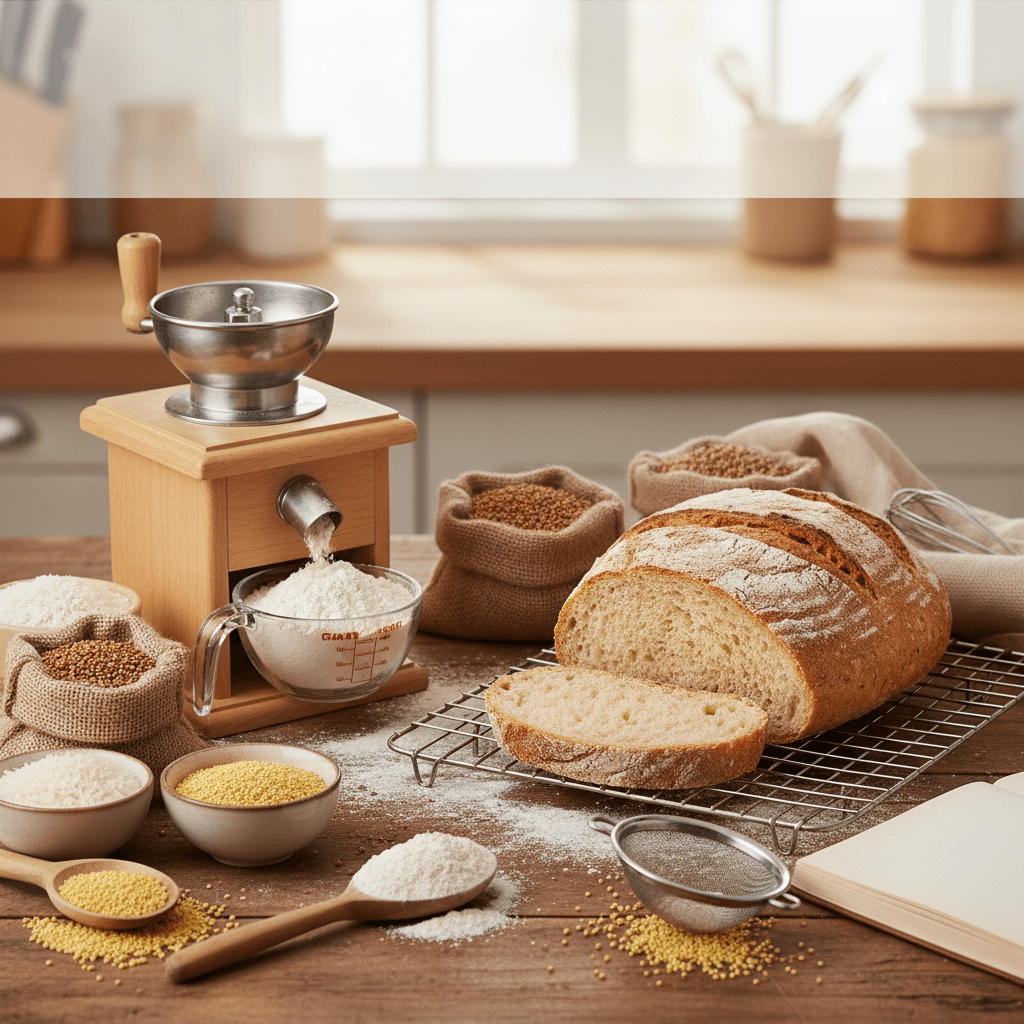
Milling your own gluten-free flour at home gives you total control over freshness, flavor, and cross-contamination — but not every grain mill is up to the job. We researched the top options to find the mills that handle rice, oats, sorghum, millet, and other gluten-free grains without compromising texture or safety.
Key takeaways
- A dedicated grain mill is the single best way to guarantee your flour is free from gluten cross-contamination.
- Impact mills (like the WonderMill) produce the finest flour for gluten-free baking, while stone burr mills (like the Mockmill or KoMo) work well for most grains, though lower-powered models may struggle with very hard rice at the finest setting.
- You want a mill that can achieve a fine, consistent grind — gritty flour is one of the most common complaints in gluten-free baking.
- Cleaning matters more than you think: mills with easy-to-access grinding chambers help prevent cross-contamination if you share a kitchen.
- Freshly milled flour tastes noticeably better than store-bought, especially with grains like sorghum, millet, and brown rice.
- Budget options exist, and a quality mill can pay for itself over time if you regularly buy specialty gluten-free flours.
Quick-pick summary: best grain mills for gluten-free flour
| Mill | Best for | Price range | Grind type |
|---|---|---|---|
| Mockmill 200 | Best overall for gluten-free bakers | $$$$ | Stone burr |
| KoMo Fidibus 21 | Best compact countertop option | $$$ | Stone burr |
| NutriMill Harvest | Best for fine rice flour | $$$ | Stone burr |
| Mockmill Lino 200 | Best premium option | $$$$$ | Stone burr |
| WonderMill Electric | Best impact mill for ultra-fine flour | $$ | Impact |
| Country Living Grain Mill | Best manual (hand-crank) option | $$$ | Burr |
What to look for when buying a grain mill for gluten-free flour
If you're new to milling your own flour, the options can feel overwhelming. Here are the features that matter most specifically for gluten-free baking.
Grind fineness and consistency
This is the single most important factor. Gluten-free baked goods are already prone to gritty texture, so your mill needs to produce a fine, even powder — especially with harder grains like rice. Look for mills with adjustable fineness settings and read reviews from people milling rice specifically, not just wheat.
Cross-contamination risk
If you're celiac or highly sensitive, you need a mill that has never touched wheat. Even a thorough cleaning may not remove all traces of gluten from stone burrs. Our strong recommendation: buy a dedicated mill for gluten-free grains and never run wheat through it. If you share a household with wheat bakers, this is non-negotiable.
Stone burr vs. impact mill
Stone burr mills use two grinding stones to crush grain. They produce excellent flour and preserve nutrients because they run cooler. Impact mills use stainless steel chambers that spin at high speed to pulverize grain into powder. Impact mills tend to produce finer flour from hard grains like rice, but they run hotter and louder. Both work well — it depends on your priorities.
Motor power
Gluten-free grains vary widely in hardness. Brown rice is very hard, while oats and millet are softer. A motor with at least 360 watts handles the full range without bogging down or overheating. Underpowered mills may struggle with rice and produce inconsistent results.
Ease of cleaning
For gluten-free bakers, cleaning isn't optional — it's a safety issue. Look for mills where you can access the grinding chamber easily. Some stone burr mills are essentially self-cleaning (you run a small amount of grain through to clear residue), while impact mills may need more thorough attention between different grain types.
If you're still building out your gluten-free setup, our Confident Gluten-Free Baker Toolkit walks you through everything you need in your kitchen — including when milling your own flour makes sense and when store-bought blends are the better call.
1. Mockmill 200 — best overall grain mill for gluten-free flour
The Mockmill 200 is our top pick for gluten-free bakers who want a reliable, well-built stone burr mill at a reasonable price. It produces beautifully fine flour from rice, sorghum, millet, oats, and buckwheat, and the adjustable grind settings let you go from coarse meal to fine powder with a simple twist.

The corundum-ceramic stones are self-sharpening and extremely durable. The 600-watt motor handles hard brown rice without hesitation, which is where cheaper mills often choke. It's also relatively quiet for a grain mill, and the compact design doesn't take up too much counter space.
For gluten-free bakers specifically, the Mockmill 200 shines because it produces consistent, fine flour that doesn't leave your baked goods gritty. If you're milling your own brown rice flour or buckwheat flour, this mill handles both with ease.
Pros:
- Powerful 600W motor handles all gluten-free grains including hard rice
- Produces very fine, consistent flour
- Compact and attractive design
- Self-cleaning stones — run a tablespoon of rice through between grain types
- Adjustable fineness from coarse to extra-fine
Cons:
- Can't mill oily seeds or nuts (you'll need a food processor for almond flour)
- Not the cheapest option
- Stones can crack if you accidentally run a pebble through
We recommend the Mockmill 200 as the best starting point for anyone serious about milling gluten-free flour at home.
2. KoMo Fidibus 21 — best compact countertop grain mill
The KoMo Fidibus 21 is a beautifully designed Austrian-made mill that's perfect if counter space is limited. It's smaller and lighter than the Mockmill 200 but still produces excellent flour from most gluten-free grains.
The 250-watt motor is adequate for softer grains like oats, millet, and sorghum, though it can struggle a bit with very hard brown rice if you're pushing for the finest setting. For most gluten-free baking applications, the flour it produces is more than fine enough.
What we love about the KoMo for gluten-free use is the real-wood-veneer housing and corundum-ceramic stones that are easy to adjust. The build quality is exceptional — this is a mill you'll have for decades.
Pros:
- Beautiful, compact design that looks great on the counter
- Excellent grind quality for softer gluten-free grains
- Very well-built with premium materials
- Quiet operation
Cons:
- 250W motor may struggle with hard brown rice at the finest settings
- Smaller hopper means more frequent refilling for big batches
- Higher price per watt compared to other options
The KoMo Fidibus 21 is ideal if you primarily mill softer grains and want something that won't take over your kitchen.
3. NutriMill Harvest — best for fine rice flour
The NutriMill Harvest is a stone burr mill with a 450-watt motor that hits a sweet spot between power and price. It's particularly good at milling rice — both white and brown — into genuinely fine flour, which is critical since rice flour forms the base of most gluten-free flour blends.
The micron-fine adjustment dial gives you precise control over grind fineness, and the large hopper holds enough grain for a solid batch of flour without babysitting. It also runs cooler than impact mills, which helps preserve the nutrients in whole grains.
Pros:
- Excellent at milling rice to a fine, smooth consistency
- 450W motor handles hard grains well
- Large hopper for bigger batches
- Precise fineness adjustment
- Runs relatively cool
Cons:
- Larger footprint than the KoMo or Mockmill
- Plastic housing feels less premium than wood alternatives
- Can be loud at the finest settings
If rice flour is your primary milling goal, the NutriMill Harvest is hard to beat.
4. Mockmill Lino 200 — best premium grain mill
The Mockmill Lino 200 is the luxury version of our top pick. It features a housing of wood and HI-MACS acrylic stone, the same powerful 600-watt motor and corundum-ceramic stones as the standard Mockmill 200, and a slightly refined grinding mechanism that some users report produces even finer flour.
For gluten-free bakers who mill flour regularly and want a statement piece that also performs flawlessly, the Lino is the one. It handles everything from hard brown rice to soft millet without breaking a sweat.
Pros:
- Attractive wood and acrylic-stone housing
- Same excellent 600W motor as the Mockmill 200
- Produces exceptionally fine, consistent flour
- Quiet and smooth operation
- Built to last a lifetime
Cons:
- Significantly more expensive than the standard Mockmill 200
- Performance difference over the standard model is marginal
- Still can't mill oily nuts or seeds
The Mockmill Lino 200 is a splurge, but if you mill flour multiple times a week, you'll appreciate the upgrade.
5. WonderMill Electric — best impact mill for ultra-fine flour
The WonderMill Electric takes a completely different approach. Instead of grinding grain between stones, it uses high-speed stainless steel impact heads to pulverize grain into powder. The result? Extremely fine flour — often finer than what stone burr mills can achieve in a single pass.
This matters a lot for gluten-free baking. When you're working with rice flour, even slightly coarse grinds can create that telltale gritty texture that makes gluten-free baked goods unpleasant. The WonderMill eliminates that problem almost entirely. If you've been struggling with gritty texture in your gluten-free baking, an impact mill like this might be the solution.
Pros:
- Produces the finest flour of any mill on this list
- Stainless steel chamber is easy to clean thoroughly — great for cross-contamination concerns
- Powerful 1250W motor handles any grain effortlessly
- More affordable than most stone burr mills
- Fast — mills a cup of flour in under a minute
Cons:
- Very loud — you'll want hearing protection for long sessions
- Runs hotter than stone mills, which may affect nutrient content
- Larger and less attractive than stone burr options
- No coarse grind option — it's fine flour or nothing
The WonderMill Electric is our pick for bakers who prioritize the finest possible grind above all else.
6. Country Living Grain Mill — best manual (hand-crank) option
Not everyone wants (or needs) an electric mill. The Country Living Grain Mill is a heavy-duty, American-made hand-crank mill that produces excellent flour with nothing but elbow grease. It's built like a tank and will outlast any electric mill on this list.
For gluten-free bakers, the manual approach has a unique advantage: you can feel the grain being processed and adjust your speed based on the resistance. It's also completely silent (well, aside from the cranking), and there are no electrical components to fail.
The trade-off is obvious — it's a workout. Milling a cup of fine rice flour by hand takes real effort. But for small-batch baking or off-grid kitchens, it's unbeatable.
Pros:
- Incredibly durable — lifetime investment
- No electricity needed
- Produces good-quality flour with adjustable fineness
- Easy to clean and maintain
- Made in the USA with replaceable parts
Cons:
- Physically demanding, especially for hard grains like rice
- Slow compared to electric mills
- Expensive for a manual tool
- Requires a sturdy surface to mount
The Country Living Grain Mill is perfect for the baker who values durability and simplicity over convenience.
How milling your own flour improves gluten-free baking
You might be wondering whether milling your own flour is really worth the investment. Here's why it makes such a difference specifically for gluten-free baking.
Freshness changes everything. Whole grain flours like brown rice flour and sorghum flour go rancid faster than you'd think. That slightly bitter or "off" taste people associate with gluten-free baking? It's often stale flour. Freshly milled flour tastes clean and sweet, which can eliminate the strange aftertaste many people notice in gluten-free baked goods.
Custom blends become easy. Once you have a mill, you can create your own flour blends tailored to specific recipes. Need a finer rice flour for cakes? Mill it finer. Want a slightly coarser grind for bread? Adjust the setting. This level of control simply isn't possible with pre-packaged flour.
Cost savings add up. Specialty gluten-free flours are expensive. A pound of store-bought sorghum flour usually costs noticeably more than the whole grain. If you bake regularly, those savings help offset the cost of the mill over time.
Tips for milling gluten-free flour at home
Once you have your mill, these tips will help you get the best results:
- Always sift after milling. Even the best mills may leave a few coarser particles. A fine-mesh sieve catches them and gives you silky flour.
- Mill rice twice for the finest texture. Run rice through on a coarse setting first, then again on the finest setting. This produces noticeably smoother flour.
- Let flour rest before baking. Freshly milled flour can behave differently than aged flour. Let it sit in an airtight container for 24-48 hours before using it in recipes for the most predictable results.
- Store milled flour in the freezer. Freshly milled whole grain flour contains oils that can go rancid. Freeze what you won't use within a week.
- Keep your mill dedicated to gluten-free grains. This is the whole point — don't let anyone run wheat, barley, or rye through your mill. Ever.
Frequently asked questions
Can you use a regular grain mill for gluten-free flour?
Technically yes, but we strongly recommend buying a dedicated mill that never touches wheat, barley, or rye. Stone burr mills are porous and can harbor gluten residue even after cleaning. If you have celiac disease or a serious gluten sensitivity, a dedicated mill is the only safe approach. Learn more about preventing contamination in our guide to setting up a gluten-free baking kitchen.
What grains can you mill at home for gluten-free flour?
You can mill rice (white and brown), oats (certified gluten-free), sorghum, millet, buckwheat, amaranth, teff, and corn. You cannot mill nuts, seeds, or coconut in a stone burr mill — those require a food processor or high-speed blender. Dried chickpeas and lentils can also be milled for bean flours.
Is a stone burr mill or impact mill better for gluten-free flour?
Impact mills generally produce finer flour from hard grains like rice, which makes them slightly better for avoiding gritty textures. Stone burr mills run cooler and preserve more nutrients, and they offer adjustable coarseness. For most gluten-free bakers, either type works well — the Mockmill 200 (stone burr) and WonderMill Electric (impact) are both excellent choices.
Is it cheaper to mill your own gluten-free flour?
Yes, significantly. Whole grains usually cost less per pound than the equivalent pre-milled flour. If you bake frequently using multiple specialty flours like sorghum, millet, and brown rice, those savings add up over time. The upfront cost of the mill is real, so how quickly it pays off depends on how much you bake.
Do you need to sift freshly milled gluten-free flour?
We recommend it, especially for delicate baked goods like cakes and pastries. Even a fine grind may contain a few larger particles that can affect texture. For bread and heartier baked goods, sifting is less critical but still improves consistency. A fine-mesh sieve or flour sifter does the job in seconds.

Written by
Co-founder, BakingSubs
Co-founder of BakingSubs, where he turns the science of ingredient substitutions into tested, reliable guidance for home bakers.
Related Posts
Bake with Confidence
See all
Confident Gluten-Free Baker Toolkit
The science-based system that replaces gluten's seven invisible jobs so your baking turns out soft, fluffy, and foolproof — every time.

Gluten-Free Recipe Vault
Instant access to our complete library of proven gluten-free recipes — no waiting, no guesswork, just results that work tonight.

Fix Your Gluten-Free Bread
Learn the 3-step formula to make bread rise and stay soft, discover why your loaves collapse, and get a tested sandwich bread recipe that actually works.