

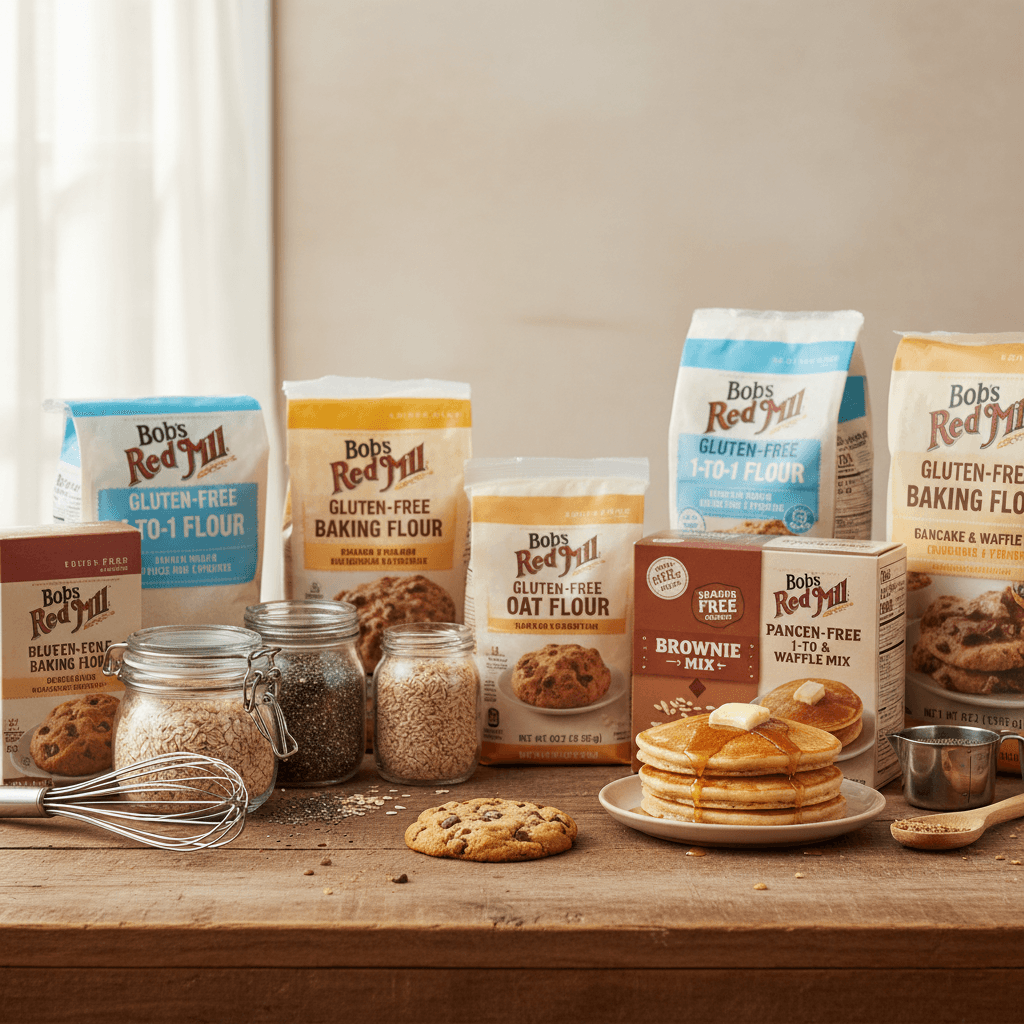
Bob's Red Mill is one of the most widely available gluten-free brands in the U.S., but their product line is massive and not everything performs equally. This guide breaks down their full gluten-free lineup so you know exactly what to buy, what to skip, and what works best for your style of baking.
Key takeaways
- Bob's Red Mill offers over 30 certified gluten-free products spanning flours, starches, baking mixes, oats, and specialty items — all processed in their dedicated gluten-free facility.
- Their 1-to-1 Baking Flour is the best overall pick for beginners who want a simple, reliable all-purpose substitute.
- Individual flours like their brown rice flour and tapioca starch are excellent for experienced bakers building custom blends.
- Their baking mixes are hit-or-miss — the pancake mix and pizza crust mix perform well, while the bread mix needs extra help.
- Bob's Red Mill products are available at Amazon, Walmart, Target, Whole Foods, and most grocery stores, making them one of the easiest gluten-free brands to find.
- Compared to King Arthur, Bob's Red Mill offers more individual flour options but King Arthur's blends tend to produce slightly better texture in delicate baked goods.
Who Bob's Red Mill gluten-free products are best for
Bob's Red Mill is an ideal brand for a few specific types of bakers. If you're just starting your gluten-free journey, their 1-to-1 Baking Flour and pre-made mixes give you an easy on-ramp without needing to understand flour blending. If you have celiac disease, their dedicated gluten-free facility and third-party testing (under 20 ppm) provide a meaningful layer of safety. And if you're an experienced baker who likes to build your own flour blends, their extensive single-flour lineup — brown rice flour, tapioca starch, potato starch, sorghum flour, and more — is hard to beat.
Budget shoppers will also appreciate Bob's Red Mill. Their individual flours are generally cheaper per ounce than King Arthur's equivalents, and their mixes are competitively priced against specialty gluten-free brands. The trade-off is that their mixes sometimes need a little tweaking to get the best results, which may frustrate true beginners who want a perfect-out-of-the-box experience.
If you're building out a full gluten-free baking pantry, Bob's Red Mill is likely going to fill several slots on your shelf regardless of your skill level.
Bob's Red Mill gluten-free flours and starches
This is where Bob's Red Mill really shines. Their individual flour and starch selection is the broadest of any mainstream brand, and the quality is consistently solid. Here's a breakdown of the key products.
1-to-1 Baking Flour (best overall pick)
This is Bob's Red Mill flagship gluten-free blend, and it's the product we recommend most often to people just getting started. It contains rice flour, tapioca starch, potato starch, and sorghum flour, plus xanthan gum already mixed in. You can swap it directly for all-purpose flour in most recipes without any other adjustments.
Best use case: Cookies, muffins, quick breads, pancakes, and simple cakes. It handles anything that doesn't require strong gluten structure.
Texture and taste: Slightly grainier than King Arthur Measure for Measure, but still very good. Mild, neutral flavor that doesn't compete with other ingredients.
Value: Excellent — typically $6-8 for a 44oz bag, making it one of the most affordable all-purpose GF blends available.
We did a detailed head-to-head comparison in our Bob's Red Mill vs King Arthur gluten-free flour post if you want the full breakdown.
If you're looking to stock your pantry with the essentials and stop second-guessing your flour choices, our Confident Gluten-Free Baker Toolkit walks you through exactly which products to buy and when to use them.
Brown rice flour
A staple building block for custom GF blends. Bob's version is finely milled, which helps reduce the grittiness that cheaper brown rice flours can have.
Best use case: Custom flour blends, breading, and as a base flour combined with starches. Check our best rice flour for gluten-free baking comparison for how it stacks up against other brands.
Texture and taste: Slightly nutty, mild. Good protein content for a rice flour. Can be gritty if used alone in high proportions.
Value: Good — usually $4-6 for a 24oz bag.
White rice flour
Lighter and more neutral than brown rice flour. Bob's white rice flour is a solid choice for delicate baked goods where you want a cleaner flavor profile.
Best use case: Cakes, pastries, and lighter baked goods. Works well blended with tapioca starch and potato starch.
Texture and taste: Neutral, slightly sweet. Finer texture than their brown rice flour.
Value: Good — comparable pricing to the brown rice flour.
Tapioca flour/starch
Bob's labels this as "tapioca flour" but it's the same thing as tapioca starch. It adds chewiness and helps bind gluten-free doughs. We covered this product in our best tapioca flour and starch brands roundup.
Best use case: Adding stretch and chew to bread, pizza dough, and Brazilian cheese bread (pao de queijo). Also great for thickening.
Texture and taste: Very fine, white, neutral. Adds a pleasant chewiness when used at 20-30% of a flour blend.
Value: Excellent — one of the cheapest GF starches available.
Potato starch
Not to be confused with potato flour (which is much heavier), potato starch adds moisture and tenderness to gluten-free baking. Bob's version is reliable and widely available. See our best potato starch and cornstarch comparison for more details.
Best use case: Lightening flour blends, adding moisture to cakes and muffins, and as a component in bread recipes.
Texture and taste: Very fine, completely neutral. Dissolves well.
Value: Excellent.
Almond flour
Bob's offers both blanched and unblanched almond flour. The blanched version (made from skinless almonds) is better for most baking because it's finer and lighter in color.
Best use case: Macarons, almond cakes, cookies, and grain-free baking. Works beautifully in combination with eggs for naturally gluten-free recipes.
Texture and taste: Moist, rich, slightly sweet and nutty. The blanched version is finely ground and consistent.
Value: Moderate — almond flour is always pricier than grain-based flours, but Bob's is competitively priced for the quality.
Coconut flour
Coconut flour is extremely absorbent — you only need about 1/4 to 1/3 the amount of regular flour. Bob's version is finely ground and consistent.
Best use case: Grain-free baking, adding fiber and protein to recipes. Requires extra eggs and liquid. If you're comparing brands, check our best coconut flour brands guide.
Texture and taste: Dense if overused. Mild coconut flavor that pairs well with chocolate and tropical flavors.
Value: Good — a bag lasts a long time because you use so little.
Other specialty flours
Bob's Red Mill also offers sorghum flour, millet flour, buckwheat flour, chickpea flour, and oat flour in gluten-free certified versions. These are mostly useful for experienced bakers building custom blends or following specific recipes. The sorghum flour is particularly worth noting — it has a mild, slightly sweet flavor that works well as a primary flour in blends.
Bob's Red Mill gluten-free baking mixes
The mixes are where things get more variable. Some are genuinely good out of the box, while others need extra attention to get great results.
Pancake and waffle mix
This is one of Bob's best mixes, full stop. It makes fluffy, tender pancakes with minimal effort. We ranked it well in our best gluten-free pancake and waffle mix roundup.
Texture and taste: Light, fluffy, and pleasantly mild. Not gummy or dense like some GF pancake mixes.
Value: Great — the bag makes a lot of pancakes and costs less than most specialty GF mixes.
Pizza crust mix
Another strong performer. The dough is easy to work with (by GF standards), and it bakes up with a nice crispy exterior. It does best when you roll it thin and bake on a preheated stone or steel.
Texture and taste: Crispy outside, slightly chewy inside. Not identical to wheat pizza dough, but satisfying.
Value: Good — one bag makes one large or two small pizzas.
Chocolate chip cookie mix
Decent but not exceptional. The cookies come out a bit flat and crunchy rather than chewy. Adding an extra egg yolk and chilling the dough for 30 minutes helps significantly.
Texture and taste: Crispy-crunchy with good chocolate chip distribution. Flavor is solid but texture needs help for chewy-cookie lovers.
Value: Fair — you can get better results from scratch with the 1-to-1 flour for about the same cost.
Brownie mix
This mix makes a serviceable brownie but leans cakey rather than fudgy. If you prefer fudgy brownies, reduce the eggs by one or add an extra tablespoon of oil. We have more brownie mix recommendations in our best gluten-free brownie mix guide.
Texture and taste: Chocolatey flavor is good. Texture is more cakey than fudgy out of the box.
Value: Fair — similar price to competitors but requires tweaking for best results.
Homemade wonderful bread mix
This is probably the most divisive product in the lineup. The bread mix works, but the loaf tends to be dense and crumbly compared to what you can achieve with a good recipe and the 1-to-1 flour. Adding psyllium husk and an extra egg helps with structure.
Texture and taste: Dense, slightly dry, but decent toast bread. Not great for sandwiches without modifications.
Value: Fair — bread mixes in general are expensive for what you get. Making bread from scratch with individual flours is more cost-effective long-term.
Vanilla cake mix
Produces a tender, mild cake that works well as a base for frosted layer cakes. It's not the most flavorful mix on its own, but it takes well to add-ins and doesn't have the weird aftertaste some GF cake mixes carry.
Texture and taste: Tender, slightly dry. Benefits from an extra tablespoon of oil or sour cream.
Value: Good — competitive with other GF cake mixes.
Bob's Red Mill gluten-free oats and cereals
Bob's Red Mill was one of the first brands to offer purity protocol gluten-free oats, and their oat products remain a strong part of the lineup. Their oats are grown, harvested, and processed separately from wheat — not just sorted after the fact.
Rolled oats: Great for oatmeal, granola, and oat-based cookies. Consistent texture and reliably safe for most people with celiac disease.
Quick cooking oats: Same quality, just cut smaller for faster cooking. Good for baking when you want oats to blend into the batter more.
Oat flour: Finely ground from their purity protocol oats. Nice for adding flavor and moisture to flour blends, though it can make things dense if used as the sole flour.
Value: Their oats are pricier than conventional oats but very competitive within the certified GF oat market.
Bob's Red Mill gluten-free xanthan gum and binders
Bob's sells xanthan gum in small bags that are perfect for home bakers. Since you only need 1/2 to 1 teaspoon per recipe, a single bag lasts months. Their xanthan gum is reliably fine-textured and dissolves well without clumping.
If you're not sure whether to use xanthan gum or guar gum in your recipes, we have a full comparison in our xanthan gum vs guar gum post.
Best overall pick and best value pick
| Category | Best overall pick | Best value pick |
|---|---|---|
| All-purpose flour blend | 1-to-1 Baking Flour | 1-to-1 Baking Flour (same — it's both) |
| Individual flour | Brown rice flour | White rice flour |
| Starch | Tapioca flour/starch | Potato starch |
| Baking mix | Pancake and waffle mix | Pancake and waffle mix |
| Specialty flour | Almond flour (blanched) | Sorghum flour |
| Oats | GF rolled oats | GF rolled oats |
How Bob's Red Mill compares to King Arthur
We've written a detailed Bob's Red Mill vs King Arthur gluten-free flour comparison, but here's the quick summary for context.
| Factor | Bob's Red Mill | King Arthur |
|---|---|---|
| All-purpose blend quality | Very good — slightly grainier | Excellent — smoother texture |
| Individual flour selection | Extensive (15+ options) | Limited (mostly blends) |
| Baking mix variety | Wide range | Smaller but more refined |
| Price | Generally cheaper | Slightly more expensive |
| Availability | Very wide (grocery, Amazon, Walmart) | Wide (grocery, Amazon, King Arthur site) |
| Best for | Custom blending, budget-conscious bakers | Convenience, delicate baked goods |
In short: King Arthur tends to win on out-of-the-box blend quality, while Bob's Red Mill wins on variety, individual flour options, and price. Many experienced gluten-free bakers stock products from both brands.
Where to buy Bob's Red Mill gluten-free products
Availability is one of Bob's Red Mill's biggest advantages. You can find their products at:
- Amazon: Full lineup available, often with Subscribe and Save discounts. Best for buying in bulk.
- Walmart: Good selection of their most popular flours and mixes, both in-store and online.
- Target: Carries the 1-to-1 flour, oats, and a few mixes. More limited selection.
- Whole Foods: Strong selection, especially of specialty flours.
- Most major grocery chains: Kroger, Safeway, Publix, and others typically carry at least the 1-to-1 flour, oats, and a few mixes in the health food aisle.
- Bob's Red Mill website: Full catalog with occasional sales and bundle deals.
For the best prices, we usually buy the 1-to-1 Baking Flour and tapioca flour through Amazon Subscribe and Save, which knocks 5-15% off the regular price depending on how many subscriptions you have.
Products we'd skip
Not everything in the Bob's Red Mill gluten-free lineup is worth your money. Here are a few products we think you can pass on:
- Homemade Wonderful Bread Mix: Too dense and crumbly without significant modifications. You'll get better results with the 1-to-1 flour and a good recipe.
- Chocolate chip cookie mix: The results are just okay, and you can make better cookies from scratch with minimal extra effort.
- All-Purpose GF Baking Flour (the red bag, NOT the 1-to-1): This older blend does not include xanthan gum, which means you have to add it yourself. It's confusing because it sits right next to the 1-to-1 on shelves. Unless you specifically want a blend without xanthan gum, grab the blue bag (1-to-1) instead.
That last point trips up a lot of people. The red bag and the blue bag look similar, but they behave very differently. If your recipe doesn't call for xanthan gum separately, you want the blue 1-to-1 bag.
Frequently asked questions
Is Bob's Red Mill 1-to-1 flour really a direct substitute for all-purpose flour?
For most recipes, yes. Bob's Red Mill 1-to-1 Baking Flour includes xanthan gum and is designed to replace all-purpose flour at a 1:1 ratio. It works well in cookies, muffins, quick breads, and pancakes. However, it won't perfectly replicate recipes that rely heavily on gluten structure, like crusty artisan bread or puff pastry.
Are Bob's Red Mill gluten-free products safe for celiac disease?
Bob's Red Mill processes all of their gluten-free labeled products in a dedicated gluten-free facility in Milwaukie, Oregon. Products are tested to confirm they contain fewer than 20 parts per million of gluten, which meets the FDA standard for gluten-free labeling. Most people with celiac disease tolerate their products well, though individual sensitivity varies.
What is the difference between Bob's Red Mill red bag and blue bag gluten-free flour?
The red bag is their original All-Purpose GF Baking Flour, which does not contain xanthan gum. The blue bag is the newer 1-to-1 Baking Flour, which includes xanthan gum. If your recipe doesn't separately call for xanthan gum, use the blue 1-to-1 bag. If your recipe already includes xanthan gum in the ingredient list, the red bag works fine.
How does Bob's Red Mill compare to King Arthur for gluten-free baking?
King Arthur's Measure for Measure blend produces slightly smoother, less gritty results in delicate baked goods like cakes. Bob's Red Mill offers a much wider selection of individual flours and starches, and their products tend to cost less. Many gluten-free bakers keep both brands on hand. We break this down fully in our Bob's Red Mill vs King Arthur comparison.
Which Bob's Red Mill gluten-free product should I buy first?
Start with the 1-to-1 Baking Flour (blue bag). It's the most versatile product in their lineup and works in the widest range of recipes. From there, add tapioca starch and potato starch if you want to start experimenting with custom blends or bread recipes.

Written by
Co-founder, BakingSubs
Co-founder of BakingSubs, where he turns the science of ingredient substitutions into tested, reliable guidance for home bakers.
Related Posts
Bake with Confidence
See all
Confident Gluten-Free Baker Toolkit
The science-based system that replaces gluten's seven invisible jobs so your baking turns out soft, fluffy, and foolproof — every time.

Gluten-Free Recipe Vault
Instant access to our complete library of proven gluten-free recipes — no waiting, no guesswork, just results that work tonight.

Fix Your Gluten-Free Bread
Learn the 3-step formula to make bread rise and stay soft, discover why your loaves collapse, and get a tested sandwich bread recipe that actually works.