

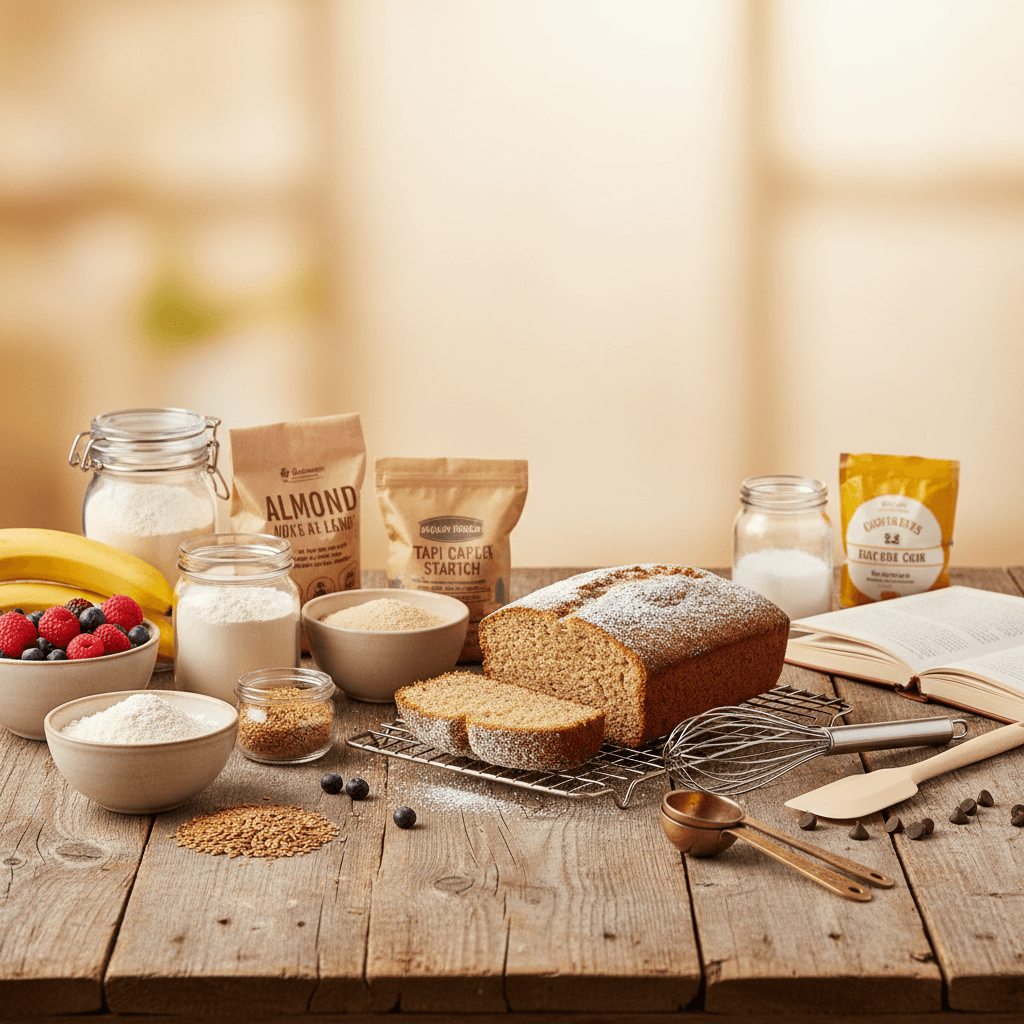
A well-stocked gluten-free pantry is the difference between confident baking and constantly running to the store mid-recipe. Here are the exact products we recommend keeping on hand, with specific brand picks you can order today.
Key takeaways
- A solid gluten-free baking pantry starts with a quality all-purpose flour blend, starches, a binder, and reliable leaveners — everything else builds from there.
- Bob's Red Mill 1-to-1 Baking Flour is our top overall pick for a versatile pantry flour blend that works across recipes.
- Buying starches like tapioca and potato starch in bulk saves money and ensures you always have them when a recipe calls for a custom blend.
- Psyllium husk powder is the most versatile binder for bread baking, while xanthan gum excels in cookies and cakes.
- Investing in certified gluten-free products matters — cross-contamination in shared facilities is a real risk with commodity starches and flours.
- A kitchen scale is more important than any single ingredient for consistent gluten-free results.
What belongs in a gluten-free baking pantry
Every gluten-free baker needs four categories of ingredients: a base flour or flour blend, starches for texture, a binder to replace gluten's structural role, and leavening agents. Beyond that, you'll want dairy or dairy alternatives, fats, sweeteners, and flavor enhancers — but most of those carry over from conventional baking. The items below are the gluten-free-specific essentials that make or break your results.
If you're also setting up your workspace from scratch, our guide on how to set up a gluten-free baking kitchen covers the equipment and organization side of things. And if you want a printable checklist plus our flour blend ratios, the Confident Gluten-Free Baker Toolkit has everything in one place.
Best all-purpose gluten-free flour blend for your pantry
A pre-made all-purpose gluten-free flour blend is the single most important item in your pantry. It's what you'll reach for in 80% of your baking. We compared five popular blends based on versatility, ingredients, price per ounce, and whether they include xanthan gum.
Our top pick: Bob's Red Mill 1-to-1 baking flour
The Bob's Red Mill 1-to-1 Baking Flour is one of the most reliable all-purpose gluten-free blends you can buy. It includes xanthan gum, so you don't need to add a binder separately for most cookie and cake recipes. It performs well in muffins, pancakes, quick breads, and simple cakes. The rice flour base gives it a neutral flavor that doesn't compete with other ingredients.
Price range: $6-9 for a 22 oz bag, or around $18-22 for a 5 lb bag.
Other blends worth considering
| Product | Includes xanthan gum | Best for | Price range (per lb) | Notes |
|---|---|---|---|---|
| Bob's Red Mill 1-to-1 | Yes | All-purpose baking | $3-4 | Our top pick — most versatile |
| King Arthur Measure for Measure | Yes | Direct wheat flour substitution | $4-5 | Slightly finer texture, great for cakes |
| Cup4Cup Multipurpose Flour | Yes | Pastry and delicate baking | $6-8 | Premium price but excellent results |
| Namaste Perfect Flour Blend | Yes | Allergy-friendly (also nut-free) | $3-4 | Good budget option for multiple allergies |
| Pamela's Artisan Flour Blend | No | Custom recipes where you control the binder | $4-5 | More flexibility for experienced bakers |
For a deeper look at how King Arthur's full lineup performs, check out our King Arthur Flour gluten-free complete product line review. And if you prefer blending your own flours, our guide to substituting all-purpose flour in gluten-free baking walks through the ratios.
Essential starches to keep on hand
Tapioca starch and potato starch are the two starches you'll use most in gluten-free baking. They improve texture, add chewiness, and help bind moisture in ways that flour alone can't achieve. Most custom flour blends call for one or both, and many recipes use them as standalone additions.
Tapioca starch (also labeled tapioca flour) adds chewiness and elasticity. It's essential for bread recipes and helps create a crispy exterior on baked goods. We like the Bob's Red Mill Tapioca Flour for its consistency and certified gluten-free labeling. You can learn more about how it works on our arrowroot powder page, which covers the differences between similar starches.
Potato starch (not potato flour — they're very different) adds moisture and tenderness. It's a staple in most homemade flour blends. Look for brands that are certified gluten-free. The Bob's Red Mill Potato Starch is widely available and affordable at around $4-6 per pound.
A note on cornstarch: it's useful but not as versatile as tapioca or potato starch for baking. Keep it around for thickening, but don't rely on it as your primary starch.
Best binder for gluten-free baking
A binder replaces the structural role that gluten plays in conventional baking. Without one, your baked goods will crumble, fall apart, or collapse. The two most common options are xanthan gum and psyllium husk powder, and they're not interchangeable — each works best in different applications.
We've covered this topic extensively in our xanthan gum vs. psyllium husk comparison, but here's the quick version for stocking your pantry.
Xanthan gum
Best for cookies, cakes, muffins, and quick breads. A little goes a long way — most recipes call for 1/4 to 1 teaspoon. The Bob's Red Mill Xanthan Gum (8 oz bag, around $10-13) will last you months. If your flour blend already includes xanthan gum, you typically don't need to add more.
Psyllium husk powder
Essential for yeast breads. Psyllium husk powder creates a gel-like structure that mimics gluten's elasticity, giving bread better rise, crumb, and sliceability. We recommend Anthony's Organic Psyllium Husk Powder — it's finely ground (which matters for even distribution) and runs about $12-15 for a 1.5 lb bag. Make sure you buy the powder, not the whole husks, for baking.
For a broader look at binding options, including flax and chia, see our post on 5 gluten-free binders that actually work.
Leavening agents and yeast
Gluten-free batters and doughs depend heavily on proper leavening because there's no gluten network to trap gas bubbles. Stock all three: baking powder, baking soda, and active dry or instant yeast.
Baking powder: Make sure yours is aluminum-free and check the expiration date — old baking powder is the silent killer of gluten-free cakes. Rumford Aluminum-Free Baking Powder is our go-to. It's double-acting, which gives you a second rise in the oven, and it's naturally gluten-free.
Baking soda: Standard Arm and Hammer works fine. It's naturally gluten-free. Just make sure it's fresh — test it by dropping a pinch into vinegar. If it fizzes vigorously, it's still good.
Yeast: For bread baking, we prefer instant yeast over active dry because it's more forgiving and doesn't require proofing. SAF Instant Yeast (Red Label) is the professional standard and costs around $6-8 for a 1 lb vacuum-sealed package. Store it in the freezer after opening and it'll stay active for a year or more. For more on yeast and bread baking, visit our active dry yeast ingredient page.
Specialty flours that round out your pantry
Beyond your all-purpose blend, a few single-origin flours open up a world of recipes and let you create custom blends. You don't need all of these on day one, but building up over time gives you much more flexibility.
| Flour | Best for | Flavor profile | Price range (per lb) |
|---|---|---|---|
| Almond flour | Cookies, cakes, crusts | Mild, slightly sweet | $5-8 |
| Brown rice flour | All-purpose blends, breading | Neutral, slightly nutty | $2-4 |
| Oat flour (certified GF) | Muffins, pancakes, cookies | Mild, slightly sweet | $3-5 |
| Buckwheat flour | Pancakes, crepes, rustic breads | Earthy, robust | $4-6 |
| Coconut flour | Low-carb baking, added fiber | Mild coconut | $4-7 |
Almond flour and coconut flour behave very differently from grain-based flours — they absorb liquid at wildly different rates. If you're deciding between them, our almond flour vs coconut flour comparison breaks down exactly when to use each one.
Common mistakes when stocking a gluten-free pantry
Even experienced bakers make these errors, and they can undermine your results before you even start mixing.
- Buying flours that aren't certified gluten-free. Rice flour, oat flour, and cornstarch are all naturally gluten-free, but they're often processed in shared facilities. Always look for certified gluten-free labeling, especially with oats.
- Measuring flour by volume instead of weight. Gluten-free flours vary dramatically in density. A cup of almond flour weighs about 96 grams, while a cup of coconut flour weighs about 128 grams. Invest in a good kitchen scale — it's the single most impactful tool upgrade you can make.
- Letting leaveners expire. Baking powder loses potency over time, and gluten-free recipes are less forgiving of weak leavening. Write the open date on the container and replace baking powder every 6-9 months.
- Storing flours at room temperature. High-fat flours like almond flour (a tree nut) and coconut flour (not a tree nut under current FDA allergen labeling) go rancid quickly. Store them in the freezer. Starch-based flours last longer but still benefit from cool, dry storage in airtight containers.
- Skipping the binder. If your flour blend doesn't include xanthan gum or another binder, you need to add one. This is the number one reason gluten-free baked goods fall apart.
Frequently asked questions
What is the minimum gluten-free baking pantry for beginners?
At minimum, you need a quality all-purpose gluten-free flour blend (like Bob's Red Mill 1-to-1), baking powder, baking soda, and a binder if your blend doesn't include one. With just these four items plus standard baking ingredients like eggs, butter, and sugar, you can make cookies, muffins, quick breads, and simple cakes. Our 10 gluten-free baking mistakes guide covers the most common beginner pitfalls.
How long do gluten-free flours last in the pantry?
Starch-based flours like rice flour and tapioca starch last 6-12 months in a cool, dry pantry. Almond flour (a tree nut) and coconut flour (which the FDA no longer treats as a tree nut) should be stored in the freezer, where they'll keep for up to a year. Pre-made flour blends typically have a best-by date on the package — follow it, because the different components degrade at different rates.
Do I need both xanthan gum and psyllium husk powder?
Ideally, yes. Xanthan gum works best in cookies, cakes, and quick breads, while psyllium husk powder is far superior for yeast-risen breads. If you only buy one, choose based on what you bake most. Our binder comparison guide goes into the science of why each works differently.
Is it cheaper to make your own gluten-free flour blend?
Usually yes, especially if you buy component flours in bulk. A homemade blend of rice flour, tapioca starch, and potato starch costs roughly $2-3 per pound compared to $4-8 per pound for pre-made blends. The trade-off is convenience and consistency — pre-made blends are formulated and tested to work as direct substitutions, which matters when you're still learning.
Can I use regular flour recipes with gluten-free pantry staples?
You can, but not without adjustments. A 1-to-1 flour blend gets you closest to a direct swap, but you may still need to tweak liquid ratios, add extra eggs, or adjust baking times. Our guide on how to substitute all-purpose flour walks through the process step by step.

Written by
Co-founder, BakingSubs
Co-founder of BakingSubs, where he turns the science of ingredient substitutions into tested, reliable guidance for home bakers.
Related Posts
Bake with Confidence
See all
Confident Gluten-Free Baker Toolkit
The science-based system that replaces gluten's seven invisible jobs so your baking turns out soft, fluffy, and foolproof — every time.

Gluten-Free Recipe Vault
Instant access to our complete library of proven gluten-free recipes — no waiting, no guesswork, just results that work tonight.

Fix Your Gluten-Free Bread
Learn the 3-step formula to make bread rise and stay soft, discover why your loaves collapse, and get a tested sandwich bread recipe that actually works.