

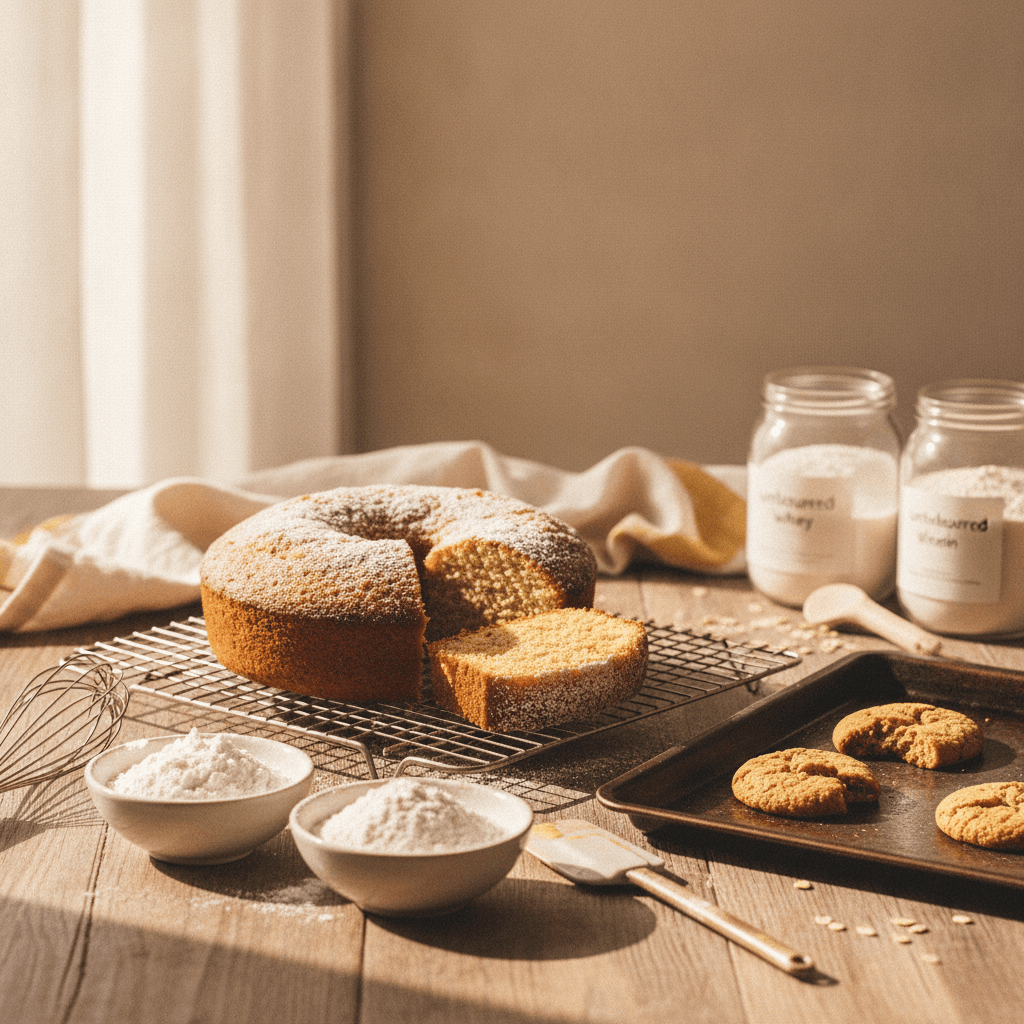
Whey and casein behave nothing alike in an oven, and picking the wrong one ruins texture before you even set the timer. This guide ranks every major protein powder type for baking, names the specific brands worth buying, and tells you exactly how much flour each one can replace before your crumb turns rubbery or your muffin tops crater.
Key takeaways
Casein concentrate is the best all-around protein powder for baking. It absorbs roughly 2.5x its weight in liquid, holds moisture during baking, and lets you replace up to 25% of flour weight without wrecking texture.
Whey protein isolate works in cookies and pancakes but caps out at about 15% flour replacement in cakes and muffins before the crumb turns rubbery and dry.
Collagen peptides add protein on paper but contribute zero structure. They make batter wetter, not stronger, and your bake will crater if you treat collagen like flour.
Unflavored powder is almost always the right call. Sucralose and stevia survive oven heat, but both develop bitter off-notes above 350 degrees F in vanilla-flavored powders. Monk fruit holds up better but still shifts flavor.
The three most common failures (dryness, rubberiness, cratering) each trace back to a different root cause, and the fix is different for each one.
The ranked verdict: casein wins for most baking, whey wins for cookies
If you bake muffins, quick breads, or cakes and want to swap in protein powder for some of the flour, casein concentrate is the top pick. It holds moisture the way flour does, browns predictably thanks to the Maillard reaction with its milk sugars, and produces a crumb that actually feels like cake rather than a protein bar.
Whey isolate is a close second for flat, crispy bakes like cookies and pancakes. It dries out faster than casein, which is a flaw in cake but a feature in a thin, chewy cookie. For everything else, casein is the safer bet.
Egg white protein is the wild card. It sets firm, almost meringue-like, and works brilliantly in angel food cake or protein waffles but makes banana bread feel like a sponge.
Collagen and most plant blends sit at the bottom. We have a full breakdown of why collagen mostly fails as a flour supplement, and the short version is: collagen peptides do not coagulate or gel when heated, so they cannot replace the structural role flour plays.

BulkSupplements.com Casein Protein Powder - Micellar Casein Powder, Slow Digesting Protein - Unflavored & Gluten Free, 30g per Serving, 1kg (2.2 lbs) (Pack of 1)
Check price on Amazon →How each protein type actually behaves in an oven
Protein powders are not interchangeable. The differences come down to how each protein denatures (unfolds) when heated and how much water it locks up during baking.
Whey protein isolate and concentrate
Whey denatures between 158 and 175 degrees F, which means it sets early in the bake. Once set, it squeezes out moisture rather than holding it. That is why whey-heavy batters produce a crumb that feels dry within hours of cooling. Whey absorbs about 1.5x its weight in liquid, roughly 60% of what all-purpose flour absorbs. You can replace up to 15% of flour by weight in muffins and cakes before the texture turns rubbery. In cookies, you can push to 20% because the thinness and fat content compensate.
Browning is aggressive. Whey contains free amino acids and lactose that fuel the Maillard reaction, so crusts darken 3 to 5 minutes faster than a standard recipe. Drop your oven temp by 25 degrees F when using whey above 10% flour replacement.
Casein (micellar casein and calcium caseinate)
Casein does not denature as sharply as whey. Instead, it forms a gel-like network that traps water throughout baking. It absorbs roughly 2.5x its weight in liquid, close to flour's absorption rate, which means you do not need to add as much extra liquid to compensate. You can replace up to 25% of flour by weight before the crumb gets dense and chewy rather than rubbery. That is a meaningful difference from whey's 15% ceiling.
Browning is moderate and even. Casein has fewer free amino acids than whey, so Maillard browning is gentler. You generally do not need to lower your oven temperature.
Egg white protein powder
Egg white protein sets hard and dry. It coagulates around 180 degrees F and creates a firm, almost brittle structure. It absorbs about 1.2x its weight in liquid. Replace no more than 15% of flour in most recipes, though it can go higher in recipes that already rely on whipped egg whites (angel food cake, protein meringues). Browning is minimal since egg white protein lacks the sugars that drive Maillard reactions. Bakes come out pale unless you add a milk wash or sugar.
If you are interested in egg white alternatives for high-protein baking, we have a full comparison of six egg white substitutes and when each one works.
Collagen peptides
Collagen dissolves completely in liquid and does not gel at baking temperatures (it needs to cool below about 95 degrees F to gel). It absorbs almost no water on its own. That means adding collagen to batter makes it wetter, not drier, and provides no structural support. Replace no more than 5 to 8% of flour, and only for the protein boost, not for texture. Browning is moderate because collagen is rich in glycine, which participates in Maillard reactions, but the lack of structure means the surface often craters before it browns evenly.
Plant protein blends (pea, rice, hemp)
Plant blends vary wildly. Pea protein isolate absorbs about 2x its weight in liquid and can replace 10 to 15% of flour, but it carries a distinct earthy, sometimes bitter taste that vanilla flavoring barely masks. Rice protein is gritty and chalky. Hemp protein adds fiber but turns everything green-brown and has a grassy flavor. Our hemp protein powder guide covers the specific adjustments. For most bakers, plant blends are a last resort unless you are avoiding dairy entirely.
Comparison table: protein powders for baking
Protein type | Protein per 30g scoop | Liquid absorption (relative to flour) | Max flour replacement | Browning behavior | Best for | Buy |
|---|---|---|---|---|---|---|
Casein concentrate (unflavored) | 24g | ~2.5x weight (close to flour) | 25% | Moderate, even | Muffins, cakes, quick breads | |
Whey protein isolate (unflavored) | 25-27g | ~1.5x weight (60% of flour) | 15% (20% in cookies) | Aggressive, browns fast | Cookies, pancakes, waffles | |
Egg white protein (unflavored) | 24g | ~1.2x weight (low) | 15% | Minimal, bakes pale | Angel food cake, meringues | |
Collagen peptides | 18-20g | Negligible | 5-8% (no structure) | Moderate but uneven | Protein boost only, not structure | |
Pea protein isolate | 21-24g | ~2x weight | 10-15% | Light | Dairy-free baking, dense bars |
Unflavored vs vanilla: why unflavored is almost always the right choice
Flavored protein powders contain sweeteners, and sweeteners behave unpredictably in an oven. Here is what actually happens to each one at baking temperatures:
Sucralose (found in Optimum Nutrition Gold Standard, Ghost, Ryse): Sucralose is heat-stable up to about 248 degrees F (120 C) in isolation, but in a batter matrix above 350 degrees F it begins to break down and produce a metallic, bitter edge. The effect is subtle in cookies (short bake time) but very noticeable in a 35-minute muffin bake.
Stevia (found in Orgain, some Legion flavors): Stevia is technically heat-stable, but the steviol glycosides concentrate as moisture evaporates during baking. The result is an intensified bitter-sweet finish that overwhelms delicate flavors like vanilla or lemon. Fine in chocolate recipes where cocoa masks it.
Monk fruit (found in some Naked Whey flavored options, Legion Whey+): Monk fruit holds up the best of the three. Mogrosides are heat-stable to well above 400 degrees F, and the sweetness does not intensify as dramatically as stevia. If you must use a flavored powder, monk fruit-sweetened is the safest bet.
The bottom line: buy unflavored for baking. Bulk Supplements unflavored casein runs about $29 for 1 kg, and Isopure unflavored whey isolate is around $42 for 3 lbs. Both are single-ingredient powders with no sweeteners, no fillers, and no flavor compounds to go sideways in the oven.
If you want sweetness in your bake, add it separately with a sweetener you can control. Allulose is our go-to because it browns like sugar and does not crystallize when cool. You can also check our ranked list of baking sweeteners by glycemic index if you are tracking blood sugar impact.
Brand-by-brand recommendations
Best casein for baking: Bulk Supplements unflavored casein
Single ingredient (micellar casein), no sweeteners, no lecithin. 24g protein per 30g scoop. Dissolves slowly, which is fine because you are mixing it into batter, not a shaker cup. The 1 kg bag lasts roughly 12 to 15 bakes if you are replacing 20% of flour in a standard muffin recipe. At about $0.87 per scoop, it is one of the cheapest unflavored caseins available.
Best whey isolate for baking: Isopure unflavored
25g protein per scoop, zero carbs, no sweeteners. Isopure dissolves cleanly and does not foam as much as some whey isolates when whisked into batter. We prefer it over Naked Whey for baking because Naked Whey is a concentrate (not isolate) and carries more lactose, which accelerates browning even further.
Best egg white protein for baking: Naked Nutrition egg white protein
Pasteurized, unflavored, no additives. 25g protein per scoop. It whips better than most egg white powders when you need aeration (think protein angel food cake). Naked Egg is about $1.30 per serving, which is pricier than whey or casein, but the clean flavor is worth it for delicate bakes.
Brands to avoid for baking
Ghost Whey and Ryse Loaded Protein are both heavily flavored with sucralose and contain cookie pieces, cereal bits, or other inclusions that burn or melt unpredictably. They taste great in a shake. They taste terrible in a muffin. Orgain plant protein has stevia and erythritol, which can produce a cooling aftertaste in baked goods. If you want to understand how erythritol and xylitol differ in baking, we break that down separately.
How to actually substitute protein powder for flour
The process is not as simple as scooping protein powder into the flour canister. Here is the method that works consistently, and it is the same framework we outline in our protein powder as flour replacement guide:
Weigh everything. Volume measurements are unreliable with protein powder because density varies between brands. A scoop of Bulk Supplements casein weighs 30g. A scoop of Isopure whey weighs 32g. Use a kitchen scale and work in grams.
Calculate your replacement percentage by weight. If your recipe calls for 200g of flour and you want to replace 20%, that is 40g of protein powder and 160g of flour. Use our recipe scaler to adjust the rest of the recipe proportionally.
Add extra liquid for whey. Whey absorbs less liquid than flour, so your batter will feel wetter than expected. Do not add more powder to thicken it. Instead, reduce liquid by about 1 tablespoon per 30g of whey added. For casein, you usually do not need to adjust liquid at all because its absorption is close to flour's.
Lower the oven temperature by 25 degrees F when using whey above 10% replacement. Casein and egg white protein do not need the temperature drop.
Add 1 to 2 tablespoons of fat (oil or melted butter) per 30g of protein powder added. Protein powder bakes dry. Fat is the single best countermeasure. This is especially important with whey and egg white protein.
For more detail on the broader technique, including how to combine protein powder with other high-protein flours like chickpea flour or quinoa flour, see our guide on how to add protein to baked goods without ruining texture.
Troubleshooting: dryness, rubberiness, and cratering
These are the three failures that drive almost every frustrated search about protein powder baking. Each one has a different cause and a different fix.
Dryness (crumb feels chalky, stales within hours)
Cause: Protein powder, especially whey, does not hold moisture the way starch does. As the bake cools, the protein matrix squeezes out water and the crumb dries rapidly.
Fix: Add a hygroscopic ingredient that holds water. The most effective options, in order:
Honey or maple syrup: 1 to 2 tablespoons per 30g protein powder. Both are hygroscopic and pull moisture back into the crumb. See our maple syrup substitution guide for ratio adjustments.
Greek yogurt: 2 tablespoons per 30g protein powder, added to the wet ingredients. Adds moisture and fat simultaneously.
Applesauce or pumpkin puree: 2 tablespoons per 30g. Both add moisture and a small amount of pectin that helps the crumb hold together. Our pumpkin puree guide covers how it interacts with fat reduction.
Rubberiness (crumb bounces back like a sponge, chewy in a bad way)
Cause: Too much protein powder. When protein exceeds about 15% of flour weight (for whey) or 25% (for casein), the denatured protein forms a dense, elastic network that mimics the texture of a protein bar rather than a baked good. This is the same mechanism that makes overworked gluten chewy, except protein powder sets permanently and does not relax.
Fix: Reduce the protein powder percentage. If you are already at the maximum and still want more protein per serving, increase the serving size rather than the protein concentration. You can also break up the protein network by adding 1 teaspoon of vinegar or lemon juice to the batter, which lowers pH and weakens the protein bonds slightly.
Cratering (top sinks or collapses after removal from oven)
Cause: Protein powder does not provide the starch structure that holds a risen bake in shape. If you replace too much flour, there is not enough gelatinized starch to support the air cells once steam escapes during cooling. Collagen is the worst offender here because it provides zero structure.
Fix: Stay within the flour replacement limits in the table above. If you are already within limits and still getting craters, your leavening is probably too high. Protein powder batters trap gas more efficiently than plain flour batters, so reduce baking powder by 25% when protein powder exceeds 10% of flour weight. Check our baking powder page for more on leavening ratios.
Frequently asked questions
Can you replace all the flour with protein powder in baking?
No. Protein powder cannot replicate the starch gelatinization that gives baked goods their structure. Even casein, which performs best, caps out at about 25% flour replacement by weight. Beyond that, you get a dense, rubbery crumb that crumbles apart once cooled. If you need a very high-protein recipe, combine protein powder with a high-protein flour like chickpea flour or almond flour rather than trying to go 100% protein powder.
Does protein powder lose its protein content when baked?
No. Baking denatures (unfolds) the protein, which changes its texture and solubility, but does not destroy the amino acids. A muffin with 30g of casein baked at 350 degrees F for 22 minutes still delivers the same grams of protein as a raw shake. The bioavailability may shift slightly, but the difference is negligible for practical purposes.
Why do my protein powder muffins taste bitter?
The most common cause is a flavored powder with sucralose or stevia. Both develop bitter off-notes at oven temperatures above 350 degrees F, especially in bakes longer than 20 minutes. Switch to an unflavored powder and add your own sweetener. If you are already using unflavored powder, the bitterness may come from over-browning. Lower your oven temperature by 25 degrees F and check 5 minutes earlier than the recipe suggests.
Is casein or whey better for protein cookies?
Whey isolate is actually better for cookies specifically. Cookies are thin, bake fast (10 to 12 minutes), and benefit from whey's tendency to dry out, which produces a chewier, crispier edge. Casein makes cookies softer and cakier, which some people prefer, but if you want a classic chewy chocolate chip cookie texture, whey at 15 to 20% flour replacement is the better choice.
How much extra liquid should I add when baking with protein powder?
It depends on the protein type. Casein absorbs roughly 2.5x its weight in liquid, which is close to flour, so you rarely need extra liquid. Whey absorbs only about 1.5x its weight, so you should actually reduce liquid by about 1 tablespoon per 30g of whey to prevent a too-wet batter. Egg white protein absorbs the least (1.2x), so reduce liquid by about 1.5 tablespoons per 30g. Always weigh your ingredients with a kitchen scale rather than eyeballing.

Written by
Co-founder, BakingSubs
Co-founder of BakingSubs, where he turns the science of ingredient substitutions into tested, reliable guidance for home bakers.
Related Posts
7 Common Healthy Baking Mistakes That Ruin Texture (and How to Fix Each One)
7 Texture Changes With Health Swaps That Catch Bakers Off Guard (and How to Handle Each One)

Gluten-Free Flour Weight Chart: Grams per Cup for 9 Major Brands (and Why the Spread Is Over 20%)
Bake with Confidence
See all
Confident Gluten-Free Baker Toolkit
The science-based system that replaces gluten's seven invisible jobs so your baking turns out soft, fluffy, and foolproof — every time.

Gluten-Free Recipe Vault
Instant access to our complete library of proven gluten-free recipes — no waiting, no guesswork, just results that work tonight.

Fix Your Gluten-Free Bread
Learn the 3-step formula to make bread rise and stay soft, discover why your loaves collapse, and get a tested sandwich bread recipe that actually works.