

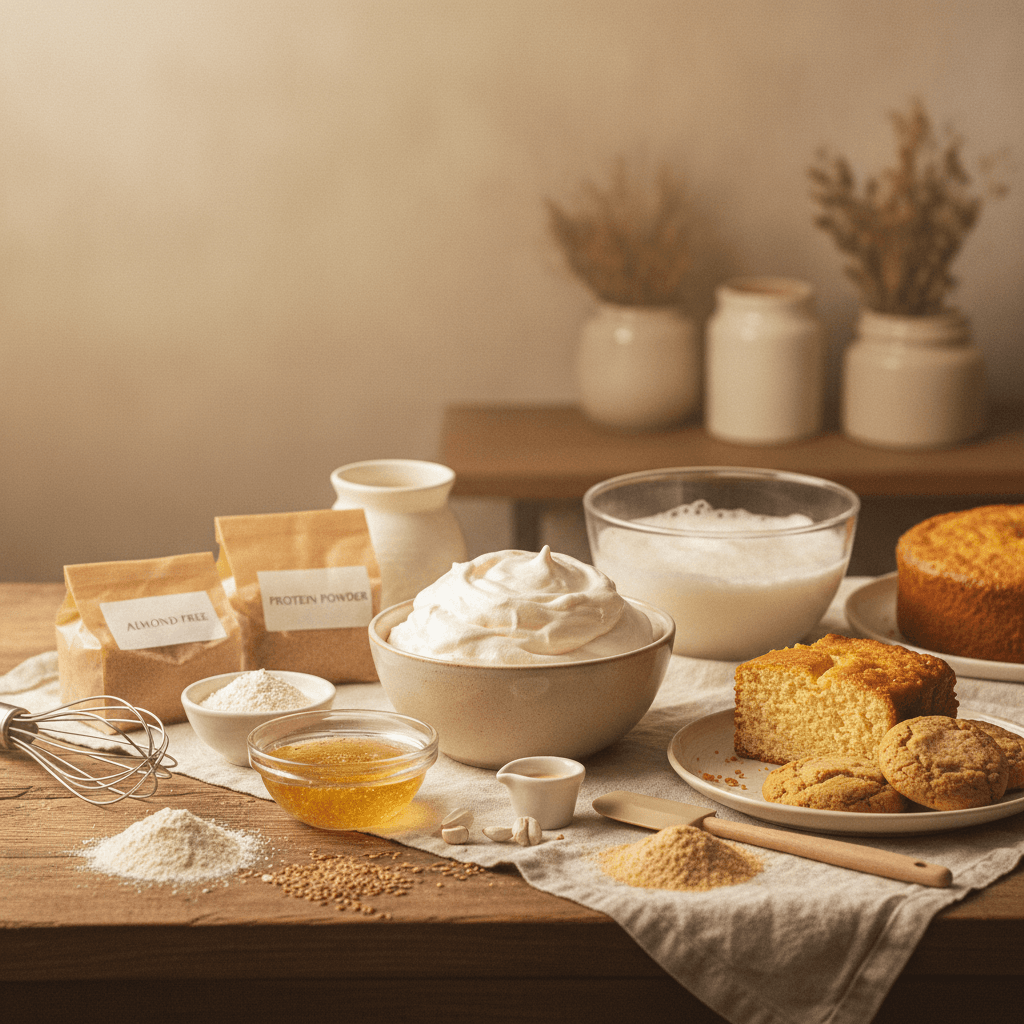
Egg whites do two critical things in high protein baking: they provide structure through coagulation and they add lift through whipped foam. Replacing them without losing both functions is harder than most substitution guides admit. Here are six options that actually hold up, along with honest notes on where each one falls short.
Key takeaways
- Egg whites contribute both structural protein and aeration — no single substitute replaces both functions equally well.
- Aquafaba is the closest functional match for whipped egg whites, but it adds zero protein to the finished product.
- Whey protein isolate and collagen peptides can replicate the structural role of egg whites, but neither foams the same way.
- Chickpea flour mixed with water provides modest protein and binding, but changes flavor noticeably.
- Combining two substitutes — one for structure, one for lift — often outperforms any single swap.
- The application matters more than the substitute: meringue-style bakes need foam, while protein bars need binding.
Why egg whites are hard to replace in high protein baking
Egg whites are roughly 90% water and 10% protein by weight. That protein — primarily ovalbumin — does something unusual: it unfolds when whipped or heated, creating a network that traps air and then sets permanently in the oven. This is why egg whites can hold a stiff peak as meringue and then firm up into a stable structure when baked.
In high protein baking specifically, egg whites often serve as the primary binder holding together ingredients like almond flour, protein powder, and other dense, low-gluten components. Without gluten's elastic network to fall back on, the egg white's coagulation becomes the structural backbone. That dual role — aeration and binding — is why a simple one-for-one swap rarely works. You need to understand which function matters most in your specific application before choosing a substitute.
For a deeper look at everything egg whites do in baked goods, the eggs functions guide breaks it down by role.
1. Aquafaba: best for whipped applications
Aquafaba — the liquid drained from canned chickpeas — is the most effective egg white substitute for applications that require whipping. It contains saponins and proteins that mimic egg white's ability to trap air, and it can be whipped to stiff peaks that hold their shape.
For meringues, macarons, and angel food cake, aquafaba is the go-to. The standard ratio is 3 tablespoons of aquafaba to replace one egg white, and it whips best when chilled and when a small amount of cream of tartar is added to stabilize the foam.
The catch: aquafaba adds essentially no protein. If your goal is a high protein finished product — not just replicating egg white behavior — aquafaba won't help your macros. It also produces a slightly less stable foam than real egg whites, so baked goods made with aquafaba meringue can deflate more during cooling. For protein bars, protein cookies, or anything where you need structural binding rather than aeration, aquafaba is the wrong choice.
Where aquafaba works and where it doesn't
| Application | Performance | Notes |
|---|---|---|
| Meringue | Good | Whips to stiff peaks; slightly less stable than egg whites |
| Angel food cake | Moderate | Works but may lose 10-15% volume compared to egg whites |
| Protein muffins | Poor | Adds no protein; doesn't bind dense batters well |
| Protein bars | Poor | Too liquid; no structural protein contribution |
2. Whey protein isolate: best for structural binding
Whey protein isolate can partially replace the structural role of egg whites because it also coagulates when heated. Mixed with water to form a slurry (roughly 1 tablespoon of whey protein isolate whisked into 3 tablespoons of water per egg white replaced), it provides binding and adds meaningful protein to the finished product.
This approach works well in protein muffins, protein pancakes, and dense baked goods where you need something to hold the crumb together. It's especially useful when you're already working with protein powder in the recipe — the additional whey integrates without introducing a new flavor profile.
The limitation is aeration. Whey protein isolate does not whip into stable foam the way egg whites do. You can get some frothiness, but it collapses quickly and won't support a meringue or a light, airy texture. If your recipe depends on whipped egg whites for lift, whey alone won't cut it.
Another consideration: whey protein can make baked goods rubbery or dry if overused. If you're already using protein powder as a significant portion of your dry ingredients, adding more whey as an egg white replacement can push the total protein content past the point where texture suffers. The post on protein powder as flour replacement covers why this happens and how to manage it.
3. Collagen peptides: binding without the foam
Collagen peptides (hydrolyzed collagen) dissolve completely in liquid and add protein without significantly changing the texture of batters and doughs. They don't gel at room temperature the way gelatin does, so they're easier to work with in most baking applications.
For high protein baking, collagen is appealing because it adds roughly 9-10g of protein per tablespoon without introducing the rubbery texture that whey can cause. It works as a partial egg white replacement in recipes where binding is the primary need — think protein brownies, protein blondies, and dense cookie bars.
The major limitation: collagen peptides do not foam at all. They also don't coagulate as firmly as egg whites or whey when heated, so they're a weaker structural binder. In recipes that rely on egg whites as the only structural element, collagen alone may leave you with a crumbly result. Pairing collagen with a small amount of arrowroot powder or tapioca starch can help compensate for the weaker binding.
Worth noting: collagen is derived from animal sources (typically bovine or marine), so it's not suitable for vegan baking.
4. Chickpea flour slurry: a whole-food option with trade-offs
Mixing chickpea flour with water (about 3 tablespoons of chickpea flour whisked into 3 tablespoons of water per egg white) creates a slurry that binds reasonably well and adds some protein. Chickpea flour contains roughly 20-22g of protein per 100g, so it's a meaningful protein contributor.
This option works best in savory or strongly flavored baked goods — banana bread, spice muffins, chocolate protein brownies — because chickpea flour has a distinct beany flavor that's hard to mask in plain or vanilla-forward recipes. Toasting the chickpea flour in a dry pan before mixing can reduce the raw bean taste, but it doesn't eliminate it entirely.
As a structural binder, chickpea flour performs decently. It won't foam or whip, so it's not a candidate for meringue or angel food cake. But for dense, moist baked goods where egg whites serve primarily as glue, it's a workable whole-food alternative. If you're baking gluten-free and want to avoid the gritty texture that some alternative flours introduce, chickpea flour's fine grind helps.
5. Flax or chia gel: partial replacement only
Ground flaxseed or chia seeds mixed with water form a gel that can replace the binding function of egg whites. The standard ratio is 1 tablespoon of ground seeds to 3 tablespoons of water, left to sit for about 10 minutes until it thickens.
For high protein baking, flax and chia have a specific advantage: they add fiber and some protein (flax has about 1.3g protein per tablespoon; chia about 1.7g). But their protein contribution is modest compared to whey or collagen, and the gel they produce is fundamentally different from egg white protein. It's viscous and slippery rather than coagulating — it holds ingredients together in the batter but doesn't set firmly in the oven the way egg whites do.
This makes flax and chia gels best suited as partial egg white replacements. In a recipe calling for 3 egg whites, replacing one with flax gel and keeping two real egg whites (or using whey for the other two) often works better than replacing all three with flax. The gel also adds moisture, which can make already-moist protein bakes overly wet.
6. Commercial egg white replacers: convenience with caveats
Products like Bob's Red Mill Egg Replacer and similar commercial options are formulated to mimic egg white behavior using combinations of starches, leaveners, and sometimes protein sources. They're convenient and consistent, which matters if you're baking for a specific dietary restriction and need a reliable swap.
Most commercial egg replacers are designed to replace whole eggs, not egg whites specifically. This means they may include ingredients that mimic yolk functions (emulsification, fat) that you don't need when replacing whites alone. Read the ingredient list — if it's mostly starch and leavening, it's providing lift and some binding but very little protein.
For high protein baking, commercial replacers are best used alongside a protein source rather than as the sole substitute. Use the replacer for structure and lift, then add whey, collagen, or chickpea flour to maintain the protein content.
Combining substitutes for better results
The most reliable approach to replacing egg whites in high protein baking is using two substitutes together — one for structure and one for lift. Here are two combinations that address both functions:
For recipes needing whipped volume (angel food cake, protein souffles): Use aquafaba for the whipped component and add whey protein isolate to the dry ingredients for structural protein. The aquafaba provides the foam; the whey provides the binding and protein content.
For dense, chewy baked goods (protein bars, protein cookies, brownies): Use collagen peptides dissolved into the liquid ingredients for protein and binding, plus a flax or chia gel for additional moisture management and binding. This combination avoids the rubbery texture that too much whey can cause while still boosting protein significantly.
Getting the balance right often takes some adjustment. If your bakes are coming out dry and crumbly, you likely need more binding or moisture. If they're gummy in the center, you may have too much liquid substitute and not enough structure.
Quick comparison of all six substitutes
| Substitute | Protein added | Foaming ability | Binding strength | Best application |
|---|---|---|---|---|
| Aquafaba | None | Strong | Weak | Meringues, whipped toppings |
| Whey protein isolate | High | Very weak | Strong | Protein muffins, dense bakes |
| Collagen peptides | High | None | Moderate | Protein bars, brownies |
| Chickpea flour slurry | Moderate | None | Moderate | Flavored muffins, savory bakes |
| Flax or chia gel | Low | None | Moderate | Partial replacement in any recipe |
| Commercial replacer | Varies (usually low) | Moderate | Moderate | Convenience; pair with a protein source |
Common mistakes when replacing egg whites in high protein baking
A few patterns show up repeatedly when bakers try to swap out egg whites in protein-heavy recipes. Avoiding these will save you a lot of wasted batches.
Replacing all egg whites at once in a new recipe. If a recipe calls for 4 egg whites, start by replacing just 1 or 2 and keeping the rest. This lets you gauge how the substitute affects texture without risking the entire batch. Once you know how the swap behaves, you can increase the ratio.
Ignoring the moisture difference. Egg whites are about 90% water. Substitutes like flax gel, aquafaba, and chickpea flour slurry all add water, but not in the same proportion. If your batter seems too wet after making the swap, reduce another liquid in the recipe by 1-2 tablespoons rather than adding more flour.
Doubling up on protein powder. When bakers want both high protein and no egg whites, they sometimes compensate by adding extra protein powder. This almost always backfires — the texture becomes chalky, rubbery, or both. The high protein flour substitutes post covers how to balance protein content without wrecking texture.
Using the wrong substitute for the wrong function. This is the most common mistake. If your recipe needs egg whites for lift (whipped into a foam), using collagen peptides — which don't foam at all — will give you a flat, dense result no matter how perfectly you measure. Match the substitute to the function, not just the ingredient. The common egg substitution mistakes guide covers this in more detail.
Frequently asked questions
Can aquafaba replace egg whites in high protein baking?
Aquafaba can replace the whipping and foaming function of egg whites effectively, but it adds no protein to the finished product. If your goal is maintaining high protein content, you'll need to pair aquafaba with a protein source like whey protein isolate or collagen peptides in the recipe's dry or liquid ingredients.
What is the best egg white substitute that also adds protein?
Whey protein isolate mixed with water is the strongest option for adding both binding and protein. Collagen peptides are a close second and produce a less rubbery texture in dense bakes. Neither one foams like egg whites, so they work best in recipes where egg whites serve a structural role rather than an aeration role.
How do you replace egg whites in protein bars?
In protein bars, egg whites primarily act as a binder. Collagen peptides dissolved into the liquid ingredients, or a chickpea flour slurry, can replace this binding function while adding protein. Flax or chia gel can also work as a partial replacement. Aquafaba and commercial egg replacers are poor choices here because protein bars don't need foam — they need glue.
Does flaxseed work as an egg white substitute in high protein recipes?
Flax gel works as a partial egg white substitute for binding, but it adds only modest protein (about 1.3g per tablespoon of ground flax). It's best used to replace one egg white out of several rather than all of them. In high protein recipes that already contain dense ingredients like almond flour or protein powder, flax gel can make the batter too wet if overused.
Can you whip whey protein like egg whites?
Whey protein isolate can produce some froth when whisked vigorously with water, but it does not form stable stiff peaks like egg whites or aquafaba. The foam collapses quickly and cannot support meringue-style applications. For recipes that require whipped egg whites, aquafaba is a far more reliable substitute for the foaming function.

Written by
Co-founder, BakingSubs
Co-founder of BakingSubs, where he turns the science of ingredient substitutions into tested, reliable guidance for home bakers.
Related Posts
Bake with Confidence
See all
Confident Gluten-Free Baker Toolkit
The science-based system that replaces gluten's seven invisible jobs so your baking turns out soft, fluffy, and foolproof — every time.

Gluten-Free Recipe Vault
Instant access to our complete library of proven gluten-free recipes — no waiting, no guesswork, just results that work tonight.

Fix Your Gluten-Free Bread
Learn the 3-step formula to make bread rise and stay soft, discover why your loaves collapse, and get a tested sandwich bread recipe that actually works.