

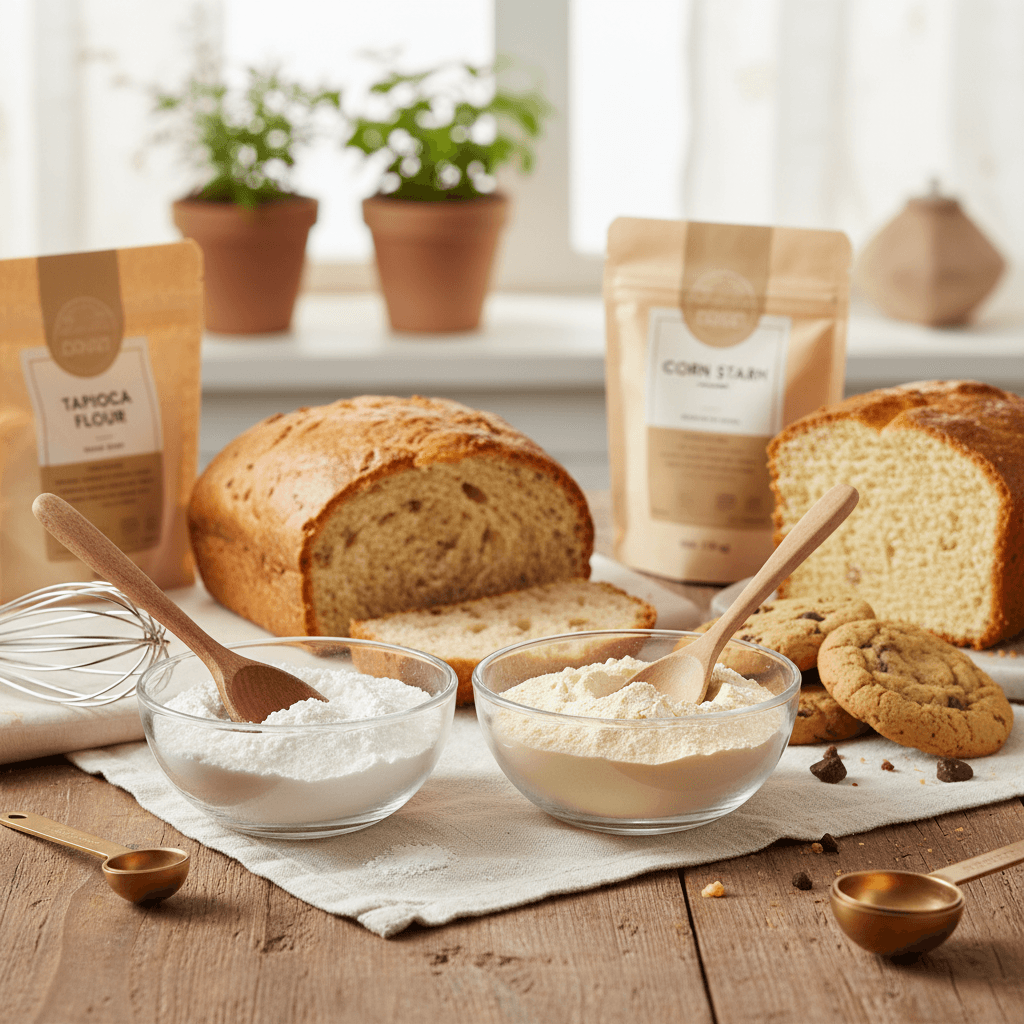
Tapioca starch and cornstarch are the two most common starches in gluten-free baking, and they are not interchangeable in every situation. Choosing the wrong one can leave you with gummy bread, crumbly cookies, or a pie filling that weeps all over the plate. Here's exactly when to reach for each starch and why it matters.
Key takeaways
- Tapioca starch creates a chewy, stretchy texture that mimics gluten's elasticity, making it ideal for breads, pizza dough, and chewy baked goods.
- Cornstarch produces a tender, crumbly texture and is better for cakes, cookies, shortbread, and delicate pastries.
- Tapioca starch browns more readily than cornstarch, giving crusts a golden color that cornstarch can't match.
- Cornstarch is the stronger thickener for fillings and custards, but it can break down if overcooked or frozen.
- Most successful gluten-free flour blends use both starches together to balance chewiness and tenderness.
- You can swap them 1:1 in small amounts (under 2 tablespoons), but larger substitutions will noticeably change texture.
How tapioca starch and cornstarch actually differ
Tapioca starch comes from the cassava root, while cornstarch comes from the endosperm of corn kernels. That origin difference matters because it changes how each starch behaves when it absorbs water and gets heated. Tapioca starch has a higher amylopectin content, which is the branched starch molecule responsible for stretch and chewiness. Cornstarch has more amylose, the straight-chain molecule that sets firm and creates a clean, tender crumb.
In practical terms: tapioca starch makes things stretchy and slightly glossy, while cornstarch makes things light and crisp. Neither is "better" overall. It depends entirely on what you're baking.
| Property | Tapioca starch | Cornstarch |
|---|---|---|
| Source | Cassava root | Corn kernel endosperm |
| Texture contribution | Chewy, stretchy, slightly elastic | Tender, crumbly, light |
| Browning | Browns well, golden crust | Minimal browning |
| Thickening power | Moderate, glossy finish | Strong, opaque finish |
| Freeze-thaw stability | Good (resists weeping) | Poor (can break down and weep) |
| Best for | Breads, pizza dough, chewy cookies, Brazilian cheese bread | Cakes, shortbread, pie fillings, tender muffins |
| Flavor | Neutral | Neutral, very slightly sweet |
If you want to explore both starches in depth, check out our arrowroot powder page for a third starch option that sometimes splits the difference between these two.
When to use tapioca starch in gluten-free baking
Tapioca starch is your go-to when you need chewiness, stretch, or a nice golden crust. It's the closest thing to mimicking what gluten does structurally in dough, which is why so many gluten-free pizza dough recipes rely on it heavily.
Breads and yeasted doughs
In bread baking, tapioca starch helps the dough hold gas bubbles without collapsing. Its stretchy quality gives gluten-free bread a more open crumb and helps it feel less dense. It's commonly combined with rice flour and potato starch in gluten-free bread recipes, typically making up 20-30% of the total flour blend. Without it, gluten-free bread tends to be crumbly and dry.
Chewy cookies and brownies
If you want that satisfying chew in a cookie or a fudgy pull in a brownie, tapioca starch delivers. It works especially well alongside brown rice flour, which adds a slightly nutty flavor and some body. For fudgy brownies specifically, tapioca starch helps you avoid that gummy texture that plagues so many gluten-free versions.
Anything that needs to freeze well
Tapioca starch holds up much better through freeze-thaw cycles than cornstarch. If you're making muffins for meal prep or freezing pie fillings, tapioca starch will maintain its texture after thawing instead of turning watery.
If you're building out your gluten-free pantry and want to make sure you have the right starches, flours, and binders on hand, our Confident Gluten-Free Baker Toolkit walks you through exactly what to stock and how to use each ingredient.
When to use cornstarch in gluten-free baking
Cornstarch is the better choice when you want tenderness, lightness, or a delicate crumb. It's the starch that makes gluten-free cakes taste like actual cake instead of dense bread.
Cakes and cupcakes
Cornstarch lightens the crumb of gluten-free cakes beautifully. It absorbs moisture without adding chewiness, which gives you that soft, melt-in-your-mouth texture you want in a birthday cake or layer cake. Many commercial gluten-free flour blends use cornstarch as their primary starch for exactly this reason.
Shortbread and tender cookies
For cookies where you want a snap or a sandy, tender bite, cornstarch is the right call. It creates that delicate, buttery crumble that tapioca starch simply can't replicate. If you're new to gluten-free cookie baking, our beginner cookie recipes guide covers how different starches affect your results.
Pie fillings, custards, and sauces
Cornstarch is a more powerful thickener than tapioca starch, tablespoon for tablespoon. It creates a smooth, opaque finish that's perfect for pastry cream, puddings, and fruit pie fillings. Just keep in mind that cornstarch-thickened fillings don't freeze well. If you're making a pie to freeze, switch to tapioca starch for the filling.
Best tapioca starch brands for gluten-free baking
Not all tapioca starch is created equal. Some brands are coarser, some have off-flavors, and some aren't reliably gluten-free. We cover them in detail in our tapioca flour and starch brand comparison, but here are the highlights:
| Brand | Pros | Cons |
|---|---|---|
| Bob's Red Mill Tapioca Flour | Widely available, consistent grind, certified gluten-free, affordable | Slightly coarser than some Asian brands |
| Anthony's Tapioca Starch | Very fine grind, great for smooth batters, good bulk pricing | Only available online, packaging can be flimsy |
| Expandex Modified Tapioca Starch | Specifically designed for GF bread, creates exceptional stretch and rise | More expensive, harder to find, not a 1:1 swap for regular tapioca starch |
| Otto's Cassava Flour | Whole-root flour (not just starch), adds fiber and body | Not a pure starch, behaves differently, absorbs much more liquid |
A quick note on Expandex: this is a modified tapioca starch that's been pre-gelatinized, meaning it absorbs more water and creates significantly more stretch than regular tapioca starch. If you're serious about gluten-free bread baking, it's worth trying, but you can't swap it 1:1 for regular tapioca starch. You'll need to adjust your liquid ratios.
Best cornstarch brands for gluten-free baking
Cornstarch is more standardized than tapioca starch, but you still want to check for gluten-free certification. We covered this in our potato starch and cornstarch brand comparison. Here's a quick summary:
| Brand | Pros | Cons |
|---|---|---|
| Argo Cornstarch | Grocery store staple, reliable, inexpensive | Not certified gluten-free (though corn is naturally GF) |
| Bob's Red Mill Cornstarch | Certified gluten-free, tested for cross-contamination, consistent quality | Slightly more expensive than generic brands |
| Hodgson Mill Cornstarch | Certified gluten-free, non-GMO, fine grind | Less widely available in stores |
| Anthony's Organic Cornstarch | Organic, non-GMO, very fine texture, good bulk pricing | Online only |
If you have celiac disease, we'd recommend sticking with brands that carry a certified gluten-free label. While corn itself doesn't contain gluten, cross-contamination during processing is always a possibility with non-certified products.
How to use both starches together in a flour blend
Here's the thing most gluten-free bakers eventually figure out: the best results come from using both starches together. Tapioca starch adds the chew and structure, cornstarch adds the tenderness and lightness, and together they create a balanced crumb that neither can achieve alone.
A classic gluten-free flour blend ratio looks something like this:
- 2 parts rice flour (white or brown) for body and mild flavor
- 2/3 part tapioca starch for stretch and browning
- 1/3 part cornstarch or potato starch for tenderness
You can adjust the ratio depending on what you're making. More tapioca for bread and pizza dough. More cornstarch for cakes and delicate pastries. If you'd rather skip the DIY blending, our flour blend brand comparison breaks down which commercial blends use which starches and what they're best for.
Why weighing your starches matters
Starches are notorious for packing differently depending on how you scoop them. A cup of tapioca starch can vary by 20-30 grams depending on whether you scooped it loosely or packed it down. For consistent results, we strongly recommend using a kitchen scale. It's the single biggest upgrade you can make to your gluten-free baking.
Can you substitute tapioca starch for cornstarch (and vice versa)?
Yes, but with caveats. For small amounts (1-2 tablespoons, like thickening a sauce or adding to a cookie recipe), you can swap them 1:1 without major issues. For larger amounts where the starch is a significant portion of the flour blend, the texture difference becomes very noticeable.
Here's a quick substitution guide:
| Situation | Can you swap? | What to expect |
|---|---|---|
| Thickening a sauce (1-2 tbsp) | Yes, 1:1 | Tapioca gives glossier finish; cornstarch gives more opaque finish |
| Cookie recipe (small amount) | Yes, 1:1 | Tapioca makes slightly chewier; cornstarch makes slightly more tender |
| Bread recipe (large amount) | Not recommended | Cornstarch instead of tapioca will make bread crumbly and dry |
| Cake recipe (large amount) | Not recommended | Tapioca instead of cornstarch will make cake chewy and dense |
| Frozen pie filling | Use tapioca | Cornstarch breaks down after freezing; tapioca holds up |
If you're troubleshooting a recipe that came out wrong, the starch choice might be the culprit. Our guides on dry, crumbly results and gummy centers can help you diagnose what went wrong.
What about arrowroot and potato starch?
Tapioca starch and cornstarch get the most attention, but they're not the only players. Arrowroot powder behaves similarly to tapioca starch but is slightly lighter and more neutral. Potato starch adds moisture and tenderness similar to cornstarch but with a slightly denser feel. Many advanced gluten-free bakers use all four starches depending on the application.
For most home bakers, though, keeping tapioca starch and cornstarch on hand covers 90% of what you'll need. Add them to your gluten-free baking pantry and you'll be set for just about anything.
Frequently asked questions
Is tapioca starch the same as tapioca flour?
Yes, tapioca starch and tapioca flour are the same product. Different brands use different names, but they're both the pure starch extracted from cassava root. This is different from cassava flour, which is made from the whole root and behaves very differently in recipes.
Can I use cornstarch instead of tapioca starch in gluten-free bread?
We don't recommend it for bread recipes where tapioca starch makes up a large portion of the blend. Cornstarch won't provide the stretch and elasticity that tapioca starch contributes, and your bread will likely turn out crumbly and dry. For small amounts (a tablespoon or two), the swap is fine.
Which starch is better for gluten-free pie crust?
Cornstarch is generally better for the crust itself because it creates a tender, flaky texture. However, if you're thickening a fruit pie filling that you plan to freeze, use tapioca starch because it holds up through freeze-thaw cycles. Check out our gluten-free pie crust recipes for step-by-step approaches.
Why does my gluten-free baking taste gummy when I use tapioca starch?
Too much tapioca starch can create a gummy, sticky texture. This usually happens when tapioca starch makes up more than 30-35% of your total flour blend. Try reducing the tapioca starch and replacing some of it with cornstarch or rice flour to balance the texture. Our gummy centers troubleshooting guide covers this in more detail.
Do tapioca starch and cornstarch need xanthan gum?
Starches alone don't provide the binding that gluten-free baked goods need. In most recipes, you'll still want a binder like xanthan gum, guar gum, or psyllium husk alongside your starches. The starch handles texture, while the binder handles structure. Our xanthan gum brand guide can help you pick the right one.

Written by
Co-founder, BakingSubs
Co-founder of BakingSubs, where he turns the science of ingredient substitutions into tested, reliable guidance for home bakers.
Related Posts
Bake with Confidence
See all
Confident Gluten-Free Baker Toolkit
The science-based system that replaces gluten's seven invisible jobs so your baking turns out soft, fluffy, and foolproof — every time.

Gluten-Free Recipe Vault
Instant access to our complete library of proven gluten-free recipes — no waiting, no guesswork, just results that work tonight.

Fix Your Gluten-Free Bread
Learn the 3-step formula to make bread rise and stay soft, discover why your loaves collapse, and get a tested sandwich bread recipe that actually works.