

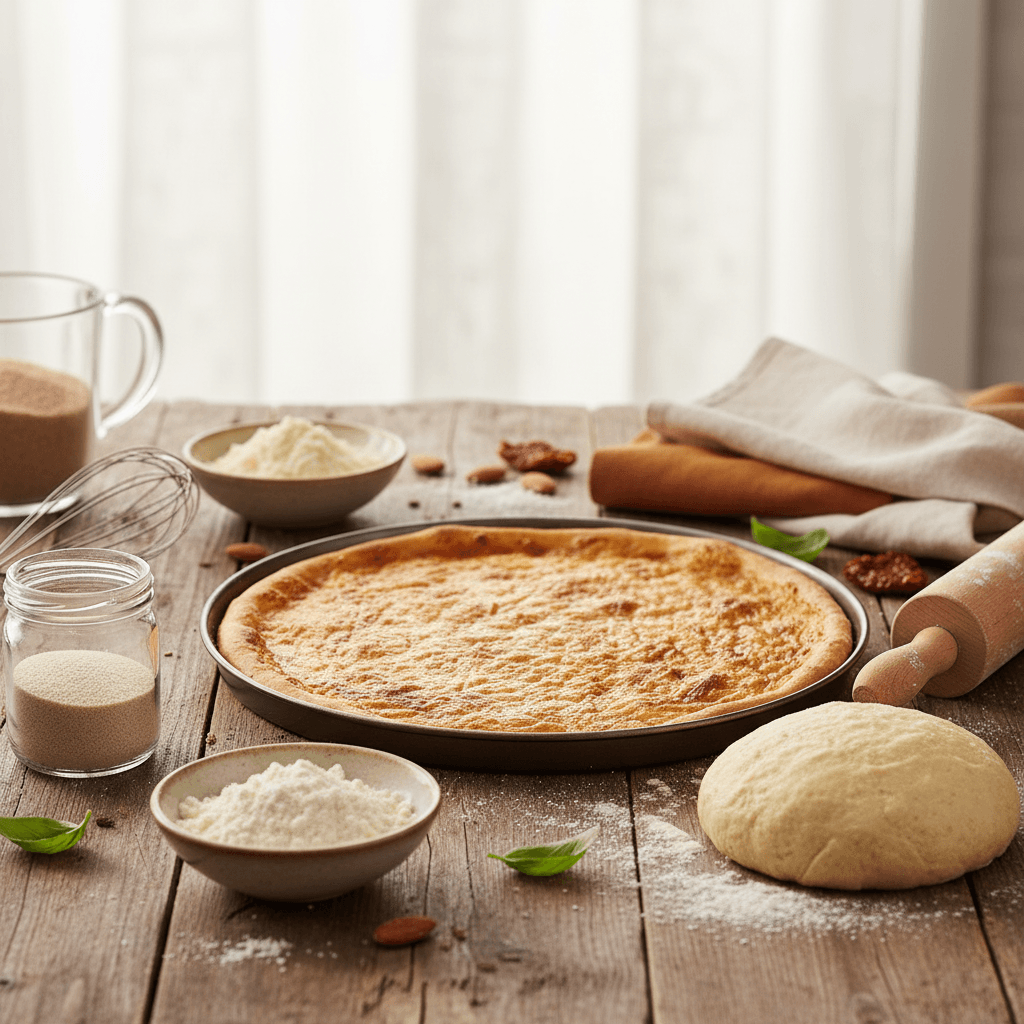
If you've tried gluten-free pizza dough before and ended up with a crumbly mess or a gummy disc that tasted like cardboard, you're not alone. The good news: gluten-free pizza dough can absolutely be great — chewy, foldable, and genuinely delicious — if you understand which approach fits your goals and why the science behind each one matters.
Key takeaways
- The best gluten-free pizza doughs use a combination of starches and flours, not a single flour alone, to mimic the chew and structure gluten normally provides.
- Psyllium husk is the single most important binder for achieving foldable, chewy gluten-free pizza crust — more effective than xanthan gum for this application.
- Hydration levels in gluten-free pizza dough are dramatically higher than wheat-based dough, often 80-100% hydration, and that's normal.
- A hot oven (475-500 degrees F) and preheated baking surface are non-negotiable for crispy results regardless of which recipe style you choose.
- Letting the dough rest for 15-30 minutes before shaping allows starches to hydrate fully and binders to activate, preventing cracking and crumbling.
Why most gluten-free pizza dough recipes fail
Most gluten-free pizza recipes fail for one of three reasons: wrong flour blend, not enough binder, or oven temperature too low. Gluten is what gives wheat pizza dough its stretch and chew, so without a deliberate replacement strategy, you end up with something that's either cracker-dry or dense and gummy.
The key insight is that gluten-free pizza dough is fundamentally a different product than wheat dough. It won't behave the same way, and that's okay. You're not rolling it out and tossing it — you're pressing or spreading it onto a pan. Once you accept that and work with the right technique for each style, the results can be legitimately excellent.
If you're still building your gluten-free baking setup, our pantry checklist covers the essential ingredients you'll want on hand before diving in.
5 gluten-free pizza dough styles that actually deliver
These five styles consistently produce results that people — including the gluten-eating people in your life — actually enjoy.
1. Psyllium husk and rice flour blend (the foldable classic)
This is the gold standard for gluten-free pizza that you can actually pick up and fold like a New York slice. The combination of brown rice flour and tapioca starch provides the base, while psyllium husk does the heavy lifting as your gluten replacement.
Why it works: Psyllium husk forms a gel network when hydrated that mimics gluten's elasticity. In pizza dough specifically, it creates a flexible matrix that holds the crust together through baking and doesn't crack when you fold it. Tapioca starch adds chewiness, while rice flour provides structure and a neutral flavor.
Typical flour blend ratio:
| Ingredient | Ratio by weight | Role |
|---|---|---|
| Brown rice flour | 50% | Structure, neutral flavor |
| Tapioca starch | 30% | Chew, stretch |
| Potato starch | 20% | Moisture, tenderness |
| Psyllium husk powder | 5-7% of flour weight | Binding, flexibility |
The hydration for this dough runs around 90-100% — meaning nearly equal weight of water to flour. That feels absurdly wet if you're used to wheat dough, but trust the process. After a 20-minute rest, the psyllium absorbs the water and the dough becomes workable.
Common mistakes: Using whole psyllium husks instead of finely ground powder (the texture will be terrible), and not letting the dough rest long enough. If your dough cracks when you spread it, it needs more hydration time. For more on choosing the right psyllium product, check our psyllium husk brand comparison — the same principles apply to pizza dough.
2. Commercial flour blend with xanthan gum (the quick weeknight option)
If you want pizza on the table in under an hour with minimal fuss, a good commercial gluten-free flour blend combined with xanthan gum is your fastest path. This approach trades some of the artisan quality of a custom blend for pure convenience.
Why it works: Commercial blends like Bob's Red Mill 1-to-1 or King Arthur Measure for Measure are already balanced with starches and flours. Adding a touch of extra xanthan gum (about 1 teaspoon per cup of blend) gives the dough enough cohesion to spread on a pan without falling apart.
Common mistakes: Using too much xanthan gum, which makes the crust rubbery and unpleasantly chewy. Also, many people skip the olive oil — fat is critical in this style because it tenderizes the crumb and helps with browning. Aim for 2-3 tablespoons per batch.
If you want to understand the differences between binders in more depth, our guide on xanthan gum vs psyllium husk vs flax breaks down when to use each one.
By the way, if you're finding that understanding flour blends and binder ratios feels overwhelming, our Confident Gluten-Free Baker Toolkit walks you through exactly how to build and customize blends for different baked goods, pizza included. It takes the guesswork out of the process.
3. Almond flour and tapioca starch (grain-free and paleo-friendly)
For those avoiding grains entirely, almond flour combined with tapioca starch produces a surprisingly good pizza crust that's nutty, satisfying, and holds toppings well.
Why it works: Almond flour brings fat and protein to the party, which means the crust browns beautifully and has a rich flavor. Tapioca starch provides the stretch and chew that almond flour alone can't deliver. An egg (or two) acts as the primary binder here, holding everything together and adding lift.
Typical ratio: About 2 parts almond flour to 1 part tapioca starch, plus 1-2 eggs and a tablespoon of olive oil. The dough is more like a thick batter than a traditional dough — you'll spread it onto parchment paper rather than shaping it by hand.
Common mistakes: Using almond meal instead of finely ground almond flour. The coarser grind produces a gritty, crumbly crust that falls apart. Our almond flour brand comparison can help you pick the right product. Also, overbaking is easy with this style since almond flour browns fast — watch it closely after 10 minutes.
4. Cauliflower crust (the low-carb option that needs technique)
Cauliflower pizza crust gets a bad reputation because most people make it wrong. Done correctly, it's crispy on the bottom, holds together when picked up, and serves as a genuinely good vehicle for toppings.
Why it works (when done right): Riced cauliflower, when properly dried, combines with egg and cheese to form a cohesion network. The egg proteins set during baking, the cheese melts and then firms up, and you get a crispy, savory base. The key word there is properly dried.
The critical step everyone skips: After ricing and microwaving or steaming the cauliflower, you must squeeze out as much water as possible. We're talking wringing it in a clean kitchen towel until your hands hurt and then squeezing some more. If you skip this, you'll get a soggy, falling-apart mess every single time.
Common mistakes: Not drying the cauliflower enough (the number one issue by far), making the crust too thick (aim for 1/4 inch maximum), and not pre-baking the crust before adding toppings. Pre-bake at 425 degrees F for 15-20 minutes until golden, then add toppings and bake another 10 minutes.
5. Yeast-risen dough with psyllium and potato starch (the artisan approach)
If you want pizza dough that actually rises, has an airy crumb with big bubbles, and tastes like real pizzeria dough, this yeast-risen approach is worth the extra time. It's the closest you'll get to traditional pizza without gluten.
Why it works: Active dry yeast produces carbon dioxide during fermentation, and psyllium husk creates a gel network strong enough to trap those gas bubbles — something xanthan gum alone struggles to do. Adding potato starch keeps the crumb tender and moist, preventing the dryness that plagues many yeast-risen GF doughs.
The process: Mix your flour blend (rice flour, tapioca starch, potato starch) with psyllium husk powder, then add warm water with activated yeast. The dough needs a 45-60 minute rise in a warm spot. It won't double in size like wheat dough — a 50% increase is a win. Shape it on an oiled sheet of parchment paper with wet hands, let it rest another 15 minutes, then bake.
Common mistakes: Killing the yeast with water that's too hot (keep it between 105-110 degrees F — an instant-read thermometer is invaluable here). Also, not preheating your baking surface. A pizza stone or inverted baking sheet preheated for at least 30 minutes makes a massive difference in bottom crispiness. If your GF bread or dough isn't rising well, our guide on how to make gluten-free bread rise properly covers the fundamentals.
Which approach is right for you
| Style | Best for | Difficulty | Time | Foldable? |
|---|---|---|---|---|
| Psyllium + rice flour blend | Best overall texture | Moderate | 60-75 min | Yes |
| Commercial blend + xanthan | Weeknight convenience | Easy | 30-45 min | Somewhat |
| Almond flour + tapioca | Grain-free/paleo | Easy | 30-40 min | No |
| Cauliflower crust | Low-carb | Moderate | 45-60 min | If thin enough |
| Yeast-risen with psyllium | Artisan quality | Advanced | 90-120 min | Yes |
Universal tips for better gluten-free pizza
Regardless of which style you choose, these principles apply across the board and will improve your results immediately.
Preheat aggressively. Gluten-free pizza needs a hotter oven than you think — 475 to 500 degrees F is ideal. A preheated pizza stone or steel makes the biggest single improvement to any GF pizza. If you don't have one, flip a heavy baking sheet upside down and preheat it for 30 minutes.
Weigh your ingredients. Gluten-free baking is far less forgiving than wheat baking when it comes to ratios. A kitchen scale eliminates the biggest source of inconsistency in your results.
Use wet hands for shaping. Gluten-free pizza dough sticks to everything. Wet your hands, wet your spatula, oil your parchment paper. This isn't optional — it's the only way to work with high-hydration GF dough without losing your mind.
Pre-bake the crust. For every style except the thinnest cauliflower crusts, pre-baking the crust for 8-12 minutes before adding sauce and toppings prevents the dreaded soggy center. This is the step that separates disappointing GF pizza from genuinely great GF pizza.
Don't overload toppings. Gluten-free crust is structurally weaker than wheat crust. Go lighter on sauce and toppings than you normally would. A thin layer of sauce and moderate cheese produces a much better result than piling everything on.
Troubleshooting common gluten-free pizza dough problems
Crust is crumbly and falls apart
This almost always means not enough binder or not enough hydration. If using psyllium, increase by 1 teaspoon and add a tablespoon more water. If using xanthan gum, make sure you're at 1 teaspoon per cup of flour blend minimum. For a deeper dive into crumbly texture issues, our dry and crumbly troubleshooting guide covers the underlying causes.
Crust is gummy in the center
Your oven isn't hot enough, the crust is too thick, or you didn't pre-bake long enough. Gluten-free starches need high heat to set properly. Make sure your oven thermometer confirms you're actually hitting 475 degrees F — most ovens run 25-50 degrees cooler than the dial says.
Crust cracks when spreading
The dough needs more hydration time. Let it rest covered for another 10-15 minutes. If it's still cracking, add water a tablespoon at a time until it becomes pliable. With psyllium-based doughs, this resting step is essential — the psyllium needs time to fully hydrate and form its gel network.
Crust doesn't brown
Brush the edges with olive oil before baking, and make sure you're baking on a preheated surface. You can also add a teaspoon of sugar to the dough — it feeds the yeast (if using) and promotes Maillard browning.
Frequently asked questions
What is the best flour for gluten-free pizza dough?
A blend of brown rice flour, tapioca starch, and potato starch produces the best overall results for gluten-free pizza dough. No single flour works well alone — you need the structure from rice flour, the chew from tapioca starch, and the tenderness from potato starch. A quality commercial blend like King Arthur Measure for Measure also works well for convenience.
Can you make gluten-free pizza dough without xanthan gum?
Yes, psyllium husk powder is actually a better binder than xanthan gum for pizza dough. It creates a more elastic, flexible dough that holds together when you pick up a slice. Use about 2 tablespoons of psyllium husk powder per 2 cups of flour blend. Our binder comparison guide explains the differences in detail.
Why is my gluten-free pizza dough so sticky?
Gluten-free pizza dough is supposed to be stickier than wheat dough — that's normal with high-hydration GF doughs. Use wet hands, oiled parchment paper, and a wet spatula to shape it. If it's so sticky it's completely unworkable, let it rest for 15-20 minutes so the psyllium or xanthan gum can absorb more moisture. Our post on making gluten-free dough less sticky has additional techniques that apply to pizza dough too.
Do you need to let gluten-free pizza dough rise?
Only if your recipe uses yeast. Many excellent gluten-free pizza doughs skip yeast entirely and rely on baking powder or no leavener at all for a thin, crispy result. Yeast-risen GF pizza dough produces a puffier, more bread-like crust with better flavor from fermentation, but it adds 45-60 minutes to the process.
Can you freeze gluten-free pizza dough?
Yes, and it freezes surprisingly well. Shape the dough on parchment paper, pre-bake for 8 minutes at 475 degrees F, cool completely, then wrap tightly and freeze for up to 3 months. When ready to use, bake from frozen at 475 degrees F — add toppings and bake for 12-15 minutes. This is a great strategy for weeknight meals.

Written by
Co-founder, BakingSubs
Co-founder of BakingSubs, where he turns the science of ingredient substitutions into tested, reliable guidance for home bakers.
Related Posts
Bake with Confidence
See all
Confident Gluten-Free Baker Toolkit
The science-based system that replaces gluten's seven invisible jobs so your baking turns out soft, fluffy, and foolproof — every time.

Gluten-Free Recipe Vault
Instant access to our complete library of proven gluten-free recipes — no waiting, no guesswork, just results that work tonight.

Fix Your Gluten-Free Bread
Learn the 3-step formula to make bread rise and stay soft, discover why your loaves collapse, and get a tested sandwich bread recipe that actually works.