

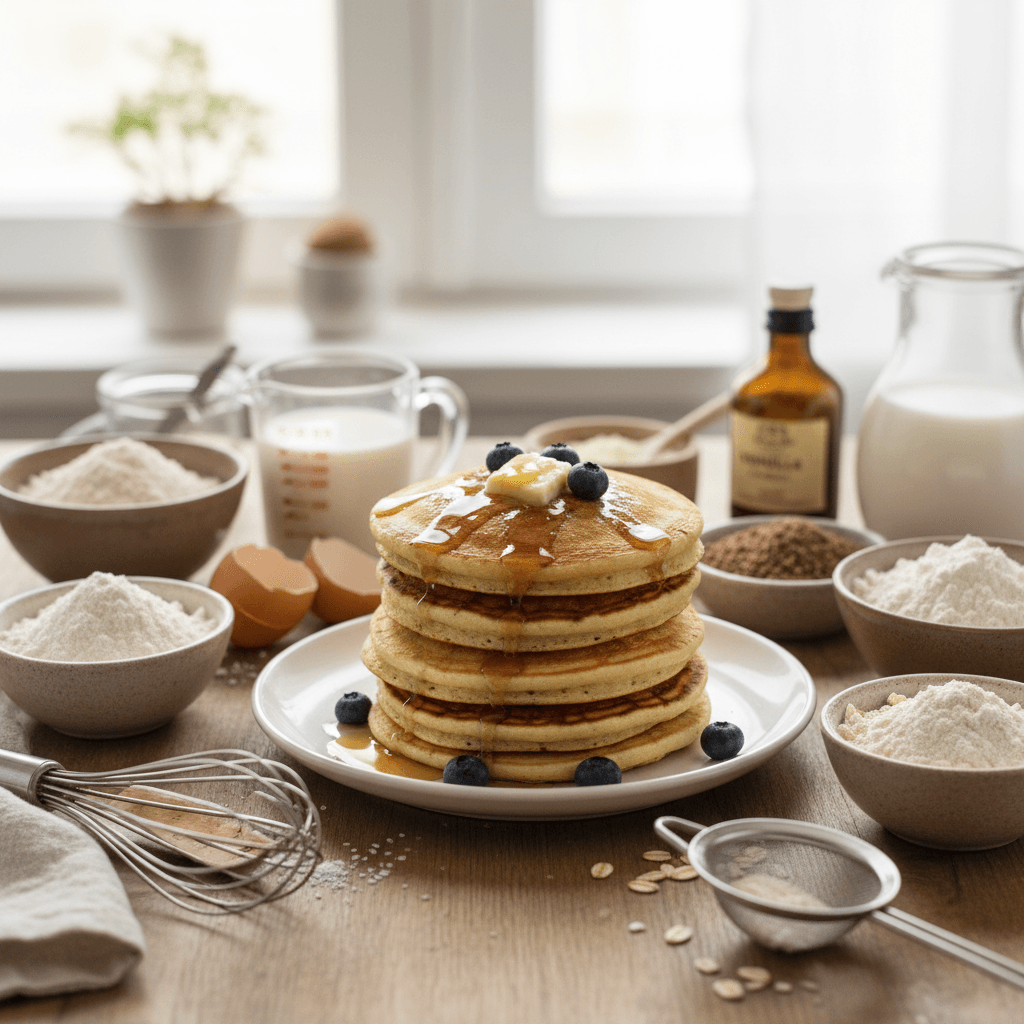
If you've been let down by flat, gummy, or cardboard-tasting gluten-free pancakes, you're not alone — and it's not your fault. Most recipes floating around online don't account for the baking science that makes GF pancakes actually fluffy. Here are five proven approaches that deliver real results, plus the science behind why they work.
Key takeaways
- The best gluten-free pancakes use a combination of light starches and protein-rich flours — not just a single flour swap.
- Separating eggs and folding in whipped whites is the single most effective technique for fluffy GF pancakes.
- Buttermilk (or a dairy-free acidic substitute) activates baking soda for extra lift and tender crumb.
- Letting your batter rest 5-10 minutes allows starches to hydrate, reducing grittiness and improving texture.
- A small amount of xanthan gum or psyllium husk prevents pancakes from falling apart on the griddle.
- Weighing your flour with a kitchen scale is critical — GF flours vary wildly in density compared to wheat flour.
1. Classic fluffy pancakes with a gluten-free flour blend
This is the easiest starting point and the approach we recommend for beginners. A well-formulated gluten-free flour blend that already contains xanthan gum does most of the heavy lifting for you. Brands like Bob's Red Mill 1-to-1 or King Arthur Measure for Measure are designed to behave like all-purpose flour in simple recipes like pancakes.
The key to making these fluffy rather than flat is technique. Use buttermilk instead of regular milk — the acidity reacts with baking soda to produce extra carbon dioxide, which means more rise. Combine that with baking powder for a double-leavening system that gives you tall, fluffy stacks.
What makes this approach work
Pre-made blends typically combine rice flour, tapioca starch, and potato starch in ratios that mimic the protein-to-starch balance of wheat flour. The xanthan gum included in most blends provides just enough structure to hold the bubbles created by your leaveners. Without it, those bubbles escape and you get flat discs.
Common mistakes and fixes
- Overmixing the batter. This is the number one mistake. Unlike wheat pancakes where a little extra mixing just develops more gluten, overmixing GF batter deflates the air your leaveners just created. Stir until just combined — lumps are fine.
- Skipping the rest. GF flours need time to absorb liquid. Let your batter sit for 5-10 minutes before cooking. It will thicken slightly and the pancakes will be less gritty.
- Griddle too hot. GF pancakes brown faster than wheat ones because of the higher starch content. Medium heat (around 325-350 degrees F) is your sweet spot. An oven thermometer or infrared thermometer can help you dial this in.
If you're just getting started with gluten-free baking and want a structured approach to understanding how flours, binders, and techniques work together, the Confident Gluten-Free Baker Toolkit walks you through exactly that — it's a great companion for building real confidence beyond just following recipes.
2. Almond flour pancakes for protein-packed fluffiness
Almond flour pancakes are naturally gluten-free, high in protein, and have a rich, almost buttery flavor that wheat pancakes can't match. They're also grain-free, making them a great option for people avoiding grains entirely.
The trick is understanding that almond flour behaves nothing like wheat flour. It's heavy, dense, and has zero starch — so you need to compensate with extra leavening and egg structure.
The best almond flour pancake formula
A solid ratio is roughly 1 cup of finely ground, blanched almond flour to 2 eggs, 2 tablespoons of milk (dairy or non-dairy), 1 tablespoon of sweetener, and 1 teaspoon of baking powder. The eggs are doing all the structural work here, so don't try to reduce them.
For the fluffiest results, separate your eggs. Whip the whites to soft peaks and fold them into the batter last. This adds air pockets that the baking powder alone can't create in such a dense flour. The difference is dramatic — we're talking the difference between a thick crepe and an actual fluffy pancake.
When shopping for almond flour, grind matters enormously. Coarse almond meal will give you a grainy, crumbly pancake. You want finely blanched almond flour for the smoothest texture.
Common mistakes and fixes
- Using almond meal instead of almond flour. These are not interchangeable. Almond meal includes the skins and is coarsely ground, leading to a gritty, heavy pancake. Check out our guide on almond flour vs coconut flour for more on how nut flours differ.
- Flipping too early. Almond flour pancakes are more fragile than wheat ones. Wait until the edges are fully set and bubbles on the surface have popped before flipping. Use a wide, thin spatula.
- Making them too large. Keep these to about 3-4 inches in diameter. Larger pancakes are nearly impossible to flip without breaking.
3. Buckwheat pancakes for earthy, old-fashioned flavor
Despite the name, buckwheat flour is completely gluten-free — it's a seed, not a wheat relative. Buckwheat pancakes have a distinctive earthy, slightly nutty flavor that pairs beautifully with maple syrup, berries, and butter. They're a traditional breakfast food in many cultures for good reason.
Buckwheat is higher in protein and fiber than most GF flours, which gives these pancakes better structure and a more satisfying chew. But used alone, buckwheat can taste bitter and produce a dense result.
The best buckwheat pancake formula
We recommend a 50/50 blend of buckwheat flour and a lighter starch like tapioca starch or potato starch. The buckwheat provides flavor and protein, while the starch lightens the texture and adds a slight chewiness. Add a quarter teaspoon of xanthan gum per cup of flour to keep everything together.
Buttermilk is especially important here — its tanginess complements buckwheat's earthiness and the acid helps tenderize the batter. If you're dairy-free, thin coconut yogurt with a splash of water works well as a substitute.
Common mistakes and fixes
- Using 100% buckwheat flour. This produces a very dense, heavy pancake with an overwhelming flavor. Always cut it with a neutral starch.
- Not sifting. Buckwheat flour clumps badly. Sift it with your starch and leaveners before adding wet ingredients. A good flour sifter makes this quick work.
- Skipping the resting time. Buckwheat absorbs liquid slowly. A 10-minute rest is essential — the batter will thicken noticeably and your pancakes will be less gritty.
4. Oat flour pancakes for a mild, crowd-pleasing option
Oat flour pancakes are one of the easiest gluten-free pancakes to make because oat flour has a mild, slightly sweet flavor that tastes almost like regular pancakes. You can make your own oat flour by blending certified gluten-free rolled oats in a blender or food processor until fine.
Oat flour is unique among GF flours because it contains beta-glucan, a soluble fiber that creates a slightly viscous batter — mimicking some of the binding properties you lose without gluten. This means oat flour pancakes hold together better than most GF pancakes even without added binders.
The best oat flour pancake formula
Use about 1.5 cups of oat flour, 1 tablespoon of sugar, 2 teaspoons of baking powder, a pinch of salt, 1 cup of milk, 1 egg, and 2 tablespoons of melted butter or oil. That's it — no xanthan gum needed. The beta-glucan in the oats does the binding work for you.
For extra fluffiness, add a tablespoon of apple cider vinegar to your milk and let it sit for 5 minutes before mixing. This creates a quick "buttermilk" that reacts with your baking powder for better lift.
Common mistakes and fixes
- Not using certified gluten-free oats. Regular oats are heavily cross-contaminated with wheat during processing. Always look for the certified gluten-free label — this is non-negotiable for anyone with celiac disease.
- Grinding oats too coarsely. Pulse until the flour is genuinely fine and powdery. Coarse bits create a porridge-like texture rather than a smooth pancake.
- Cooking on too high heat. Oat flour pancakes scorch easily because of the natural sugars in oats. Keep your griddle at medium or medium-low.
5. Cassava flour pancakes for the closest wheat-like texture
Cassava flour is one of the few single-ingredient GF flours that can produce pancakes with a texture remarkably close to traditional wheat pancakes. It's grain-free, nut-free, and has a neutral flavor that works as a near 1:1 substitute for all-purpose flour in pancake recipes.
Cassava flour is made from the whole cassava root (unlike tapioca starch, which is just the extracted starch), so it has fiber and a more complex structure. This gives pancakes better body and a soft, slightly chewy texture.
The best cassava flour pancake formula
Use 1 cup cassava flour, 1 teaspoon baking powder, half a teaspoon of baking soda, a pinch of salt, 1 egg, three-quarters cup of buttermilk, and 2 tablespoons of melted butter. No additional binders needed — cassava's natural starch content provides enough cohesion.
The critical detail with cassava flour is that it absorbs a lot of liquid. If your batter seems too thick after mixing, add milk one tablespoon at a time until it reaches a pourable consistency. You want it to flow slowly off a spoon, not plop in a lump.
Common mistakes and fixes
- Using too much flour. Cassava flour is extremely absorbent. Measuring by weight with a kitchen scale is the best way to get consistent results — 120g per cup is a good baseline.
- Confusing cassava flour with tapioca starch. These are different products from the same plant. Tapioca starch alone will give you a gummy, stretchy pancake, not a fluffy one.
- Not adjusting liquid. Cassava flour varies between brands. Always add your liquid gradually and adjust to the right batter consistency rather than dumping it all in at once.
How to choose the right approach for you
| Approach | Best for | Difficulty | Allergen notes | Flavor profile |
|---|---|---|---|---|
| GF flour blend | Beginners, quick weekday breakfasts | Easy | Check blend ingredients | Neutral, closest to wheat |
| Almond flour | Low-carb, grain-free diets | Moderate | Contains tree nuts | Rich, buttery |
| Buckwheat | Flavor-forward, traditional style | Moderate | Seed-based, nut-free | Earthy, nutty |
| Oat flour | Families, picky eaters | Easy | Must be certified GF | Mild, slightly sweet |
| Cassava flour | Grain-free, nut-free, closest to wheat | Easy-Moderate | Grain-free, nut-free | Neutral |
Universal tips for fluffier gluten-free pancakes
No matter which flour approach you choose, these techniques will improve your results every time.
Separate your eggs
Whipping egg whites to soft peaks and folding them in last is the single biggest upgrade you can make. The trapped air acts as a mechanical leavener that works alongside your chemical leaveners (baking powder and soda). Learn more about how eggs function in baking to understand why this works so well.
Use room temperature ingredients
Cold eggs and cold buttermilk slow down the chemical reactions in your leaveners. Pull everything out of the fridge 20-30 minutes before you start, or gently warm your milk to take the chill off.
Don't press down on cooking pancakes
We know it's tempting, but pressing your spatula onto a cooking pancake squeezes out all the air you just worked to create. Flip once, cook through, and leave them alone.
Keep finished pancakes warm properly
Place cooked pancakes on a wire rack set inside a sheet pan in a 200 degree F oven. Stacking them on a plate traps steam and makes the bottom ones soggy. This is the same principle behind using a cooling rack for bread — air circulation is everything.
Frequently asked questions
What is the best gluten-free flour for fluffy pancakes?
A pre-made gluten-free flour blend that includes xanthan gum is the easiest option for fluffy pancakes. For single-flour options, cassava flour produces the closest texture to wheat pancakes, while oat flour is the most forgiving for beginners.
Why are my gluten-free pancakes gummy in the middle?
Gummy centers usually mean your griddle is too hot — the outside cooks and browns before the inside sets. Lower your heat to medium (325-350 degrees F) and cook longer. Using too much tapioca starch or not enough leavener can also cause gumminess. Our guide on fixing gummy centers covers this in detail.
Do you need xanthan gum for gluten-free pancakes?
Not always. Oat flour and cassava flour pancakes hold together fine without it. Almond flour pancakes rely on eggs for structure instead. However, if you're using a rice flour-based blend that doesn't already include xanthan gum, adding a quarter teaspoon per cup of flour will prevent your pancakes from crumbling apart.
Can you make gluten-free pancakes without eggs?
Yes, but you'll need a good egg replacement strategy. A "flax egg" (1 tablespoon ground flaxseed mixed with 3 tablespoons water, rested for 5 minutes) works well for binding. For fluffiness without eggs, add an extra half teaspoon of baking powder and a splash of sparkling water. Check our vegan egg substitutes guide for more options.
How do you keep gluten-free pancakes from falling apart when flipping?
Make sure the first side is fully cooked before flipping — the edges should look set and matte, not shiny. Use a wide, thin spatula and flip confidently in one motion. If your pancakes consistently break, your batter may need more binder (try adding a quarter teaspoon of xanthan gum) or another egg for structure.

Written by
Co-founder, BakingSubs
Co-founder of BakingSubs, where he turns the science of ingredient substitutions into tested, reliable guidance for home bakers.
Related Posts
Bake with Confidence
See all
Confident Gluten-Free Baker Toolkit
The science-based system that replaces gluten's seven invisible jobs so your baking turns out soft, fluffy, and foolproof — every time.

Gluten-Free Recipe Vault
Instant access to our complete library of proven gluten-free recipes — no waiting, no guesswork, just results that work tonight.

Fix Your Gluten-Free Bread
Learn the 3-step formula to make bread rise and stay soft, discover why your loaves collapse, and get a tested sandwich bread recipe that actually works.