

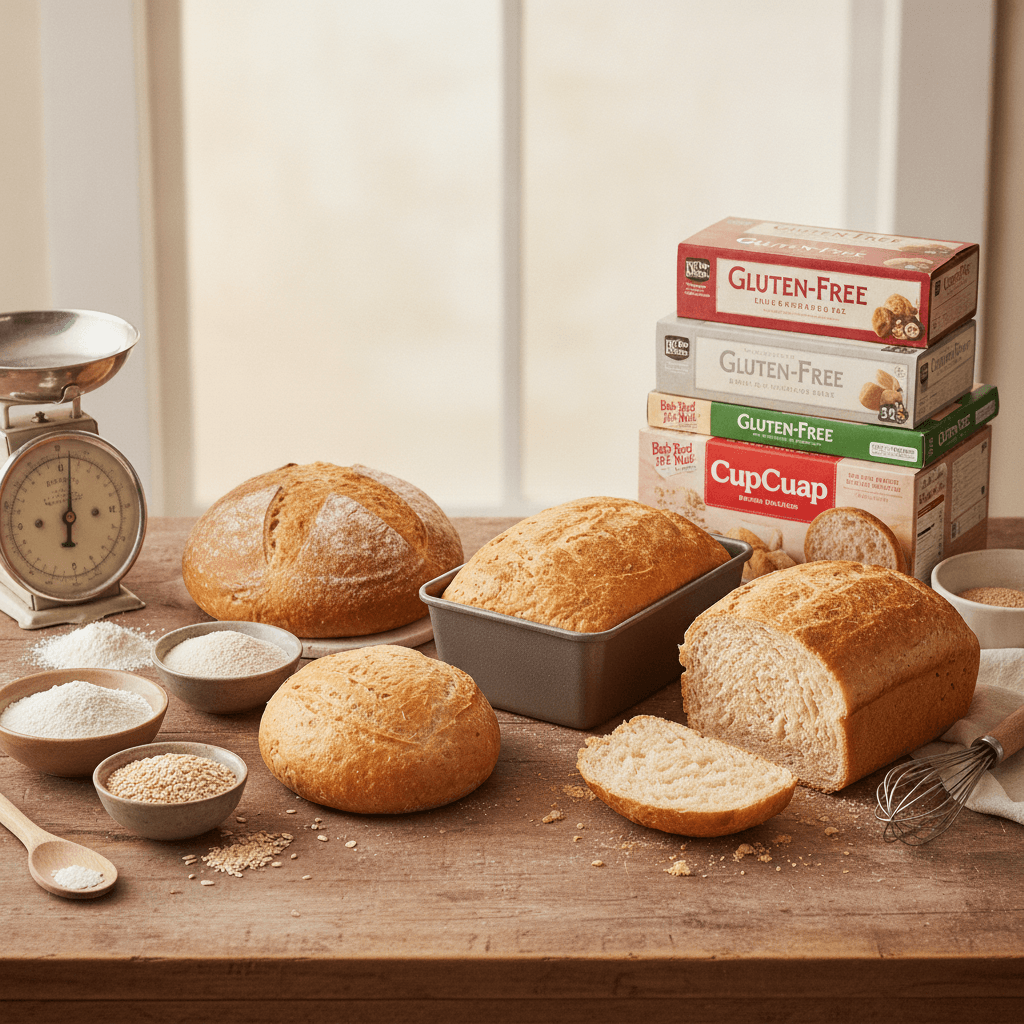
The best gluten-free bread mix brands for celiac-safe baking are King Arthur's Gluten-Free Bread and Pizza Mix, Pamela's Gluten-Free Bread Mix, and Bob's Red Mill Homemade Wonderful. King Arthur and Pamela's are GFCO-certified to under 10 ppm; Bob's is made in a dedicated gluten-free facility and batch-tested in-house. All three include xanthan gum and produce a loaf that holds together for sandwiches.
Prices checked September 2026 and vary by store.
Choosing a bread mix sounds simple until you realize that "gluten-free" on the label can mean anything from 10 ppm (GFCO-certified) to just under 20 ppm (FDA threshold). For someone with celiac disease, that difference matters. Below, we break down six widely available options by certification, facility, ingredients, and price per ounce.
Key takeaways
- GFCO certification (under 10 ppm) is the strictest widely used third-party standard in the U.S. Five of the six products here carry it; Bob's Red Mill relies on in-house ELISA batch testing in a dedicated gluten-free facility instead.
- "Certified" and "dedicated facility" are separate questions. King Arthur is GFCO-certified but says its certified products share equipment with wheat and other allergens; Bob's is not certified but is made in a dedicated facility; Cup4Cup is both.
- None of the mixes here contain dairy as an ingredient. Krusteaz carries a "may contain milk, soy" warning, and Simple Mills is almond-based, so it contains tree nuts.
- Price per ounce ranges from about $0.36 (Cup4Cup flour, bought by the 3-lb bag) to about $0.82 (Simple Mills), with the rice- and sorghum-based mixes clustered around $0.37–$0.44.
- Every mix on this list already includes xanthan gum. Adding more can over-bind the crumb and create gummy centers.
- Dedicated-facility products (Bob's Red Mill, Cup4Cup) are the safest choice for celiac bakers who react to trace contamination.
Why certification level matters more than the "gluten-free" label
The FDA allows any product testing below 20 ppm of gluten to carry a "gluten-free" label. That is the legal floor, and plenty of brands stop there. GFCO (Gluten-Free Certification Organization) requires testing below 10 ppm, with regular third-party audits. For most celiac bakers, GFCO is the baseline worth trusting.
A product labeled "gluten-free" without GFCO or another third-party seal may still be safe, but you are relying on the company's internal testing. If you are highly sensitive — reacting to amounts below 20 ppm — look for the GFCO logo or confirmation that the product is made in a dedicated gluten-free facility. Both details are in the comparison table below.
If you are new to gluten-free baking and running into texture problems, our gluten-free baking guide covers the most common issues and how to fix them.
6 best gluten-free bread mix brands compared
The table below covers the six products we evaluated. Certification, facility status, first three ingredients, and approximate price per ounce are listed for each. Cup4Cup does not sell a bread mix; we include its Multipurpose Flour because it is the blend many celiac bakers use for scratch bread and it is the only GFCO-certified, dedicated-facility option in this group. Glutino's old sandwich bread mix has been dropped from this list because we could not confirm it is still in distribution.
| Brand / Mix | Certification | Dedicated facility? | First 3 ingredients | Price per oz |
|---|---|---|---|---|
| King Arthur Gluten-Free Bread and Pizza Mix (18.25 oz) | GFCO (under 10 ppm) | No — shares equipment with wheat and other allergens per King Arthur | Rice flour, tapioca starch, potato starch | About $0.44 (about $8.00 direct) |
| Bob's Red Mill Homemade Wonderful (16 oz) | Labeled gluten-free; in-house ELISA batch testing (under 20 ppm); not GFCO | Yes (Bob's dedicated GF facility) | Whole grain sorghum flour, potato starch, cornstarch | About $0.44 (about $7.00 at Vitacost) |
| Cup4Cup Multipurpose Flour (3 lb; a flour, not a mix) | GFCO (under 10 ppm) | Yes (SQF-certified gluten-free facility) | Rice flour blend, cornstarch, tapioca flour (dairy-free formula; check the bag) | About $0.36 (about $17.50 at Walmart) |
| Pamela's Gluten-Free Bread Mix (19 oz) | GFCO (under 10 ppm); Pamela's tests to 10 ppm | Dedicated gluten-free lines; equipment shared with tree nuts, soy, eggs, milk | Sorghum flour, tapioca flour, white rice flour | Not confirmed at a stable retail price |
| Simple Mills Artisan Bread Almond Flour Mix (10.4 oz) | GFCO (under 10 ppm) | Not published | Almond flour, arrowroot, flax meal | About $0.82 (about $8.50 at Thrive Market) |
| Krusteaz Gluten Free Honey Cornbread & Muffin Mix (15 oz) | GFCO (under 10 ppm) | No — "may contain milk, soy" | Sugar, whole grain white cornmeal, degermed yellow cornmeal | About $0.37 (about $5.50 at Target) |
Checked: September 2026
King Arthur Gluten-Free Bread and Pizza Mix: best all-around for sandwich bread
King Arthur's bread mix is the one most often recommended in celiac forums, and it carries GFCO certification. The base — rice flour, tapioca starch, and potato starch — creates a neutral-tasting loaf, and the mix is enriched with the same vitamin and mineral blend King Arthur adds to its Measure for Measure flour.
The mix already includes xanthan gum, so do not add more. Over-binding is one of the most common reasons gluten-free bread comes out with a dense, gummy center. It does not contain milk as an ingredient, though King Arthur's directions call for adding milk, eggs, and oil, so the finished loaf is only dairy-free if you swap the milk.
One important caveat: King Arthur's allergen page states that its certified gluten-free products share production equipment with allergens including eggs, milk, soy, and wheat. Certification to under 10 ppm covers the finished product, but this is not a dedicated-facility mix.
An 18.25-oz box makes one loaf (or two pizza crusts). At about $8.00 direct from King Arthur, you are paying about $0.44 per ounce, which puts it in the middle of the pack.
Who should buy King Arthur
Celiac bakers who want a reliable, GFCO-certified mix that makes a soft sandwich loaf with minimal fuss. It is also a strong choice if you plan to modify the recipe — adding seeds, herbs, or extra fiber — because the base flavor is neutral enough to take additions well.
Who should skip it
Bakers who react to shared-equipment products even when certified, anyone on a tight budget who bakes more than once a week, or bakers who prefer a grain-free approach. If you need grain-free, look at Simple Mills below.
Bob's Red Mill Homemade Wonderful: dedicated facility, whole-grain base
Bob's Red Mill makes its gluten-free line in a separate, dedicated gluten-free facility in Oregon and batch-tests with an ELISA gluten assay. The Homemade Wonderful mix is not GFCO-certified — as of 2025, only Bob's oat-based bars and granolas carry that logo — but the dedicated facility is a meaningful safeguard that King Arthur does not offer.
The current formula is built on whole grain sorghum flour, potato starch, and cornstarch, with pea protein powder for structure, and it includes both xanthan gum and guar gum, so do not add any binder. It comes with a separate yeast packet, is dairy-free, and is labeled suitable for bread machines. (Older reviews may describe a garbanzo-and-fava-bean version; Bob's has since reformulated.)
At about $7.00 for a 16-oz bag at Vitacost, it works out to roughly $0.44 per ounce — about the same as King Arthur, though prices for this mix vary widely between retailers.
Because sorghum and brown-grain flours can read as slightly gritty in some loaves, letting the batter rest 15–20 minutes before baking helps; our guide on fixing gritty texture in gluten-free baking covers this.
Who should buy Bob's Red Mill
Celiac bakers who prioritize a dedicated gluten-free facility over a third-party seal, anyone who wants a dairy-free mix, and bread-machine users.
Who should skip it
Bakers who require the GFCO logo specifically, and anyone who dislikes sorghum's slightly earthy flavor.
Cup4Cup Multipurpose Flour: certified and dedicated, but a flour rather than a mix
Cup4Cup does not sell a bread mix, but its Multipurpose Flour is the blend many celiac bakers reach for when making bread from scratch, and it is the only option in this group that is both GFCO-certified and made in a dedicated gluten-free facility (an SQF-certified facility that also excludes tree nuts, peanuts, and soy). It already contains xanthan gum.
Cup4Cup reformulated the Multipurpose Flour in late 2024 to remove milk powder; the company now states all of its products are free from milk, eggs, peanuts, tree nuts, soy, wheat, sesame, fish, and shellfish. The original milk-powder formula is still sold in 2-lb bags, so dairy-free bakers should read the label. The blend is a rice flour and cornstarch base with tapioca flour and potato starch.
At about $17.50 for a 3-lb bag at Walmart, it works out to roughly $0.36 per ounce — the lowest per-ounce figure here, but you supply the yeast, sugar, and other ingredients yourself and need a recipe. Cup4Cup was developed by chef Lena Kwak at Thomas Keller's French Laundry and is designed to mimic all-purpose flour behavior, so it crosses over to cakes and pastries as well.
Comparison: Cup4Cup vs King Arthur vs Bob's Red Mill
| Feature | Cup4Cup Multipurpose Flour | King Arthur Bread and Pizza Mix | Bob's Red Mill Homemade Wonderful |
|---|---|---|---|
| Certification | GFCO (under 10 ppm) | GFCO (under 10 ppm) | In-house batch tested (under 20 ppm); not GFCO |
| Facility | Dedicated GF | Shared equipment (per King Arthur) | Dedicated GF |
| Xanthan gum included | Yes | Yes | Yes (plus guar gum) |
| Dairy-free mix | Yes (current formula; original 2-lb bags contain milk) | Yes as packaged (directions call for milk) | Yes |
| Price per oz (approx) | $0.36 | $0.44 | $0.44 |
| Best for | Scratch bread and all-purpose baking with the strictest controls | Everyday sandwich bread from a box | Dedicated-facility, dairy-free, bread-machine baking |
Pamela's Gluten-Free Bread Mix: certified, whole-grain, slightly sweet
Pamela's Gluten-Free Bread Mix is GFCO-certified, and Pamela's says its mixes and flours are made on dedicated gluten-free lines that never run wheat and are tested to its own 10 ppm standard. The equipment is shared with products containing tree nuts, soy, eggs, and milk, so this is a dedicated-gluten-free-line product rather than an allergen-free one.
The first three ingredients — sorghum flour, tapioca flour, and white rice flour — are followed by sweet rice flour, brown rice flour, millet flour, and a little cane sugar, molasses, and honey, which gives the finished loaf a faintly sweet, whole-grain flavor that some bakers love and others find distracting in savory sandwiches. The mix includes xanthan gum and a yeast packet, so no additions are needed. It is sold in 19-oz boxes and a 4-lb bag.
We could not confirm a stable single-box retail price at the time of checking (online listings ranged widely between marketplace sellers), so compare shelf prices locally; the 4-lb bag is usually the better per-ounce value if you bake regularly. Pamela's loaves are frequently praised in reviews for rising well in a standard loaf pan — a useful trait if you have had trouble with poor rise in gluten-free baking.
Simple Mills Artisan Bread: best grain-free option
Simple Mills takes a completely different approach. The first three ingredients are almond flour, arrowroot, and flax meal, followed by tapioca starch, sea salt, and baking soda — no rice flour, no corn starch, no yeast. This makes it the only grain-free mix on the list, and it is GFCO-certified.
The catch for allergy households: it is almond-based, so it contains tree nuts. Simple Mills does not publish a dedicated-facility statement for this mix.
The almond flour base produces a denser, moister, quick-bread-style loaf than rice-based yeast mixes. It is also higher in fat and protein per slice than a typical rice-flour loaf. If you are interested in boosting protein in baked goods, our guide on how to add protein without ruining texture covers the trade-offs.
At about $8.50 for a 10.4-oz box at Thrive Market (about $0.82 per ounce), Simple Mills is the most expensive option here, and the box makes a smaller loaf (12 slices or rolls) than the rice-based competitors.
Krusteaz: a budget cornbread, not a sandwich loaf
Krusteaz's Gluten Free Honey Cornbread & Muffin Mix is GFCO-certified — Krusteaz says all of its gluten-free mixes are — but its label carries a "may contain milk, soy" warning, so it is not a dedicated-facility product.
The first three ingredients — sugar, whole grain white cornmeal, and degermed yellow cornmeal — tell you this is cornbread, not a sandwich loaf. It also contains sorghum and millet flours and xanthan gum. At about $5.50 for a 15-oz box at Target (about $0.37 per ounce), it is one of the cheaper certified options, but it is not a substitute for the yeast-bread mixes above.
For celiac bakers who tolerate shared-equipment products, it is a fine occasional cornbread. If you need a sliceable sandwich bread, stick with King Arthur, Pamela's, or Bob's Red Mill.
How to pick the right mix for your situation
The "best" mix depends on three things: your sensitivity level, your budget, and what kind of bread you want.
If you have celiac disease and react to trace contamination
Prioritize dedicated facilities: Cup4Cup (certified and dedicated) or Bob's Red Mill (dedicated, in-house tested). If you want the GFCO seal specifically and are comfortable with shared equipment under a certification program, King Arthur and Pamela's both qualify.
If you are gluten-sensitive but not celiac
Any of the six will work. Simple Mills is worth trying if you prefer grain-free eating or want more protein per slice.
If you bake bread every week
Cost adds up fast. At about $7.00–$8.00 per box for Bob's or King Arthur, a weekly loaf runs roughly $30 a month. Buying Cup4Cup or Pamela's in larger bags and baking from scratch brings the flour cost per loaf down, at the expense of a little more measuring.
Common mistakes with gluten-free bread mixes
Even the best mix produces a bad loaf if you make one of these errors.
Adding xanthan gum to a mix that already contains it. Every product on this list — King Arthur, Bob's Red Mill, Cup4Cup, Pamela's, and Krusteaz — already includes xanthan gum, and Simple Mills relies on flax and almond flour instead. Doubling the binder creates a rubbery, gummy crumb that is dense in the center. Check the ingredient list before adding anything.
Under-mixing the batter. Unlike wheat bread, where over-kneading is the risk, gluten-free bread batter needs thorough mixing — usually 3 to 4 minutes with a stand mixer on medium speed. Under-mixing leaves pockets of dry starch that bake into chalky spots.
Skipping the warm rise. Most gluten-free yeast mixes need a warm environment (about 80–85°F) to rise properly. A cold kitchen can add 30–45 minutes to rise time, and if you get impatient and bake before the batter reaches the top of the pan, you get a squat, dense loaf.
Opening the oven too early. Gluten-free bread is more fragile during baking than wheat bread. Opening the oven before the 25-minute mark can cause the loaf to collapse. Use the oven light instead.
Flour weight chart: grams per cup by brand
If you are adapting a recipe rather than following the mix's included instructions, you need accurate weights. Gluten-free flour blends vary significantly in density — a cup of one brand can weigh 20–30 g more than a cup of another.
| Brand / Blend | Grams per cup (manufacturer-published) |
|---|---|
| King Arthur Measure for Measure | 120 g |
| Bob's Red Mill 1-to-1 Baking Flour | 148 g (37 g per 1/4-cup label serving) |
| Cup4Cup Multipurpose Flour | 140 g |
| Pamela's Artisan Blend | 120 g (30 g per 1/4-cup label serving) |
| Simple Mills Artisan Bread mix | Not published by manufacturer |
That 28 g difference between King Arthur (120 g) and Bob's Red Mill (148 g) per cup is large — in a 3-cup recipe it adds up to 84 g, about two-thirds of a cup of flour by King Arthur's weight. Always weigh your flour. A basic kitchen scale like the OXO Good Grips 11lb Food Scale pays for itself in saved ingredients quickly.
A note on "gluten-free" sourdough bread
Some bakers ask whether sourdough fermentation makes wheat bread safe for celiac. It does not. Fermentation with wild yeast and lactobacillus bacteria does reduce gluten content in wheat flour, but "reduced" is not "eliminated." Wheat sourdough still contains enough gluten to trigger an immune response in people with celiac disease.
If you want sourdough flavor with celiac-safe bread, look for sourdough made with gluten-free flours like brown rice flour or buckwheat flour. Several brands now sell gluten-free sourdough starters, and you can culture one at home using any gluten-free flour. The bread will have that tangy flavor without the gluten risk.
Frequently asked questions
What is the best gluten-free bread mix for celiac disease?
King Arthur's Gluten-Free Bread and Pizza Mix and Pamela's Gluten-Free Bread Mix are the top boxed picks for celiac bakers: both carry GFCO certification (under 10 ppm). If a dedicated gluten-free facility matters more to you than a seal, Bob's Red Mill Homemade Wonderful is made in one and batch-tested in-house. Cup4Cup's Multipurpose Flour is the only option here that is both GFCO-certified and made in a dedicated facility, but it is a flour, not a mix.
Is GFCO certification better than FDA gluten-free labeling?
Yes, for celiac bakers. FDA gluten-free labeling requires testing below 20 ppm, while GFCO certification requires below 10 ppm with regular third-party audits. The difference matters most for people who react to trace amounts. Products with only FDA labeling are not necessarily unsafe, but they have a higher allowable gluten threshold and no independent audit.
Why does my gluten-free bread have a gummy center?
The most common cause is too much xanthan gum. If your mix already includes xanthan (every yeast mix on this list does) and you add more, the crumb over-binds and stays wet in the center even when the crust looks done. Other causes include under-baking and too much liquid. Our gummy centers troubleshooting guide walks through each fix.
Can I use a gluten-free bread mix in a bread machine?
Usually, if the machine has a gluten-free cycle. Bob's Red Mill labels Homemade Wonderful as suitable for bread machines, and King Arthur publishes bread-machine directions for its mix (dark crust, gluten-free cycle). The key difference is that gluten-free bread batter is more like a thick cake batter than a dough ball — do not expect it to form a smooth ball during kneading. If your machine does not have a gluten-free setting, use the shortest cycle available and skip the second rise.
How do I keep gluten-free bread from going stale overnight?
Gluten-free bread stales faster than wheat bread because it lacks the gluten network that traps moisture. Slice the loaf after it cools completely (at least 2 hours), then store slices in an airtight bag with as much air pressed out as possible. For longer storage, freeze individual slices separated by parchment paper — they thaw in about 10 minutes at room temperature or 30 seconds in a microwave. Our guide on preventing quick staling covers additional methods including adding fats and hydrocolloids to the batter.

Written by
Co-founder, BakingSubs
Co-founder of BakingSubs, where he turns the science of ingredient substitutions into tested, reliable guidance for home bakers.
Related Posts
Bake with Confidence
See all
Confident Gluten-Free Baker Toolkit
The science-based system that replaces gluten's seven invisible jobs so your baking turns out soft, fluffy, and foolproof — every time.

Gluten-Free Recipe Vault
Instant access to our complete library of proven gluten-free recipes — no waiting, no guesswork, just results that work tonight.

Fix Your Gluten-Free Bread
Learn the 3-step formula to make bread rise and stay soft, discover why your loaves collapse, and get a tested sandwich bread recipe that actually works.