

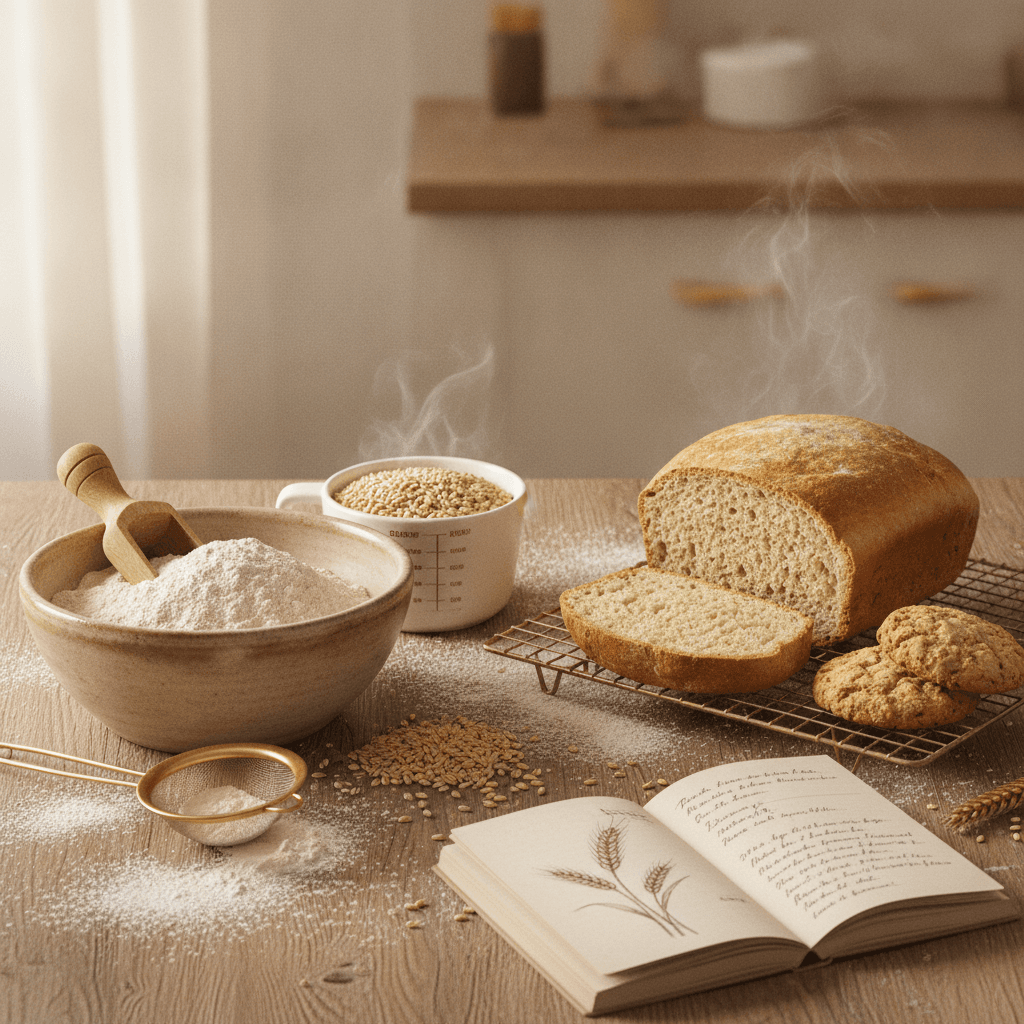
Barley flour is one of the oldest grain flours still in regular use, and it happens to carry roughly three times the fiber of all-purpose flour. That makes it an appealing swap for bakers who want more fiber without reaching for specialty ingredients. But barley flour behaves differently from white flour in almost every way that matters — and understanding those differences is the gap between a dense brick and a genuinely good baked good.
Key takeaways
Barley flour contains about 10–15g of fiber per 100g, compared to roughly 2.7g in all-purpose flour — most of it soluble beta-glucan fiber.
It contains some gluten, but not enough to build structure on its own — most bakers cap barley flour at 25–50% of the total flour weight in yeasted breads.
The flavor is malty and slightly sweet, which works well in quick breads, muffins, and pancakes but can overpower delicate pastries.
Barley flour absorbs more liquid than all-purpose flour, so batters and doughs may need an extra 1–2 tablespoons of liquid per cup of flour swapped.
It is not gluten-free — anyone with celiac disease or a wheat allergy should treat barley flour as off-limits.
What makes barley flour a high fiber flour substitute
Barley flour's fiber advantage comes primarily from beta-glucan, a soluble fiber that forms a gel-like texture when hydrated. This is the same type of fiber found in oats, and it's the reason barley flour produces a slightly sticky, moist crumb rather than the dry, crumbly texture you might expect from a "high fiber" flour. Beta-glucan is well-established in nutrition science as a soluble fiber that can contribute to heart health — the FDA has allowed a qualified health claim about it since 2006.
Compared to other high fiber flour alternatives for baking, barley flour sits in a middle ground. It's not as dramatically different from white flour as coconut flour or flaxseed meal, but it's not a seamless 1:1 swap either. Think of it as closer to whole wheat flour in behavior, with a milder flavor and a slightly gummier texture.
Barley flour contains gluten — but not the kind you're used to
This is the single most important thing to understand before you start substituting. Barley contains hordein, a type of gluten protein. However, hordein does not form the same elastic network that wheat gluten does. That means barley flour will not give you the rise, chew, or structure of wheat bread flour on its own.
If you're baking yeasted bread with barley flour, you'll still need a wheat flour base to provide structural gluten. Most bread bakers who use barley flour keep it to 25–50% of the total flour weight. Above that range, loaves tend to collapse or stay flat because the dough can't trap enough gas during fermentation.
For anyone exploring whole wheat flour substitutes, barley flour is a viable option — but it's a partial substitute, not a total replacement, in anything that depends on gluten for structure.
And to be absolutely clear: barley flour is not safe for people with celiac disease or non-celiac gluten sensitivity. It contains gluten-related proteins that trigger the same immune response as wheat. If you need a gluten-free high-fiber flour, look at options like buckwheat flour (which despite the name contains no wheat or gluten) or brown rice flour.
How barley flour changes texture, flavor, and moisture
Texture differences
The beta-glucan in barley flour absorbs water aggressively. A muffin batter made with 50% barley flour and 50% all-purpose flour will feel noticeably thicker than the same batter made entirely with all-purpose flour. If you don't compensate with extra liquid — typically 1–2 tablespoons per cup of barley flour swapped in — the result tends to be dense and dry on the outside while oddly gummy in the center.
For example, moving a banana bread from 100% all-purpose to a 30/70 barley-to-AP blend typically takes the crumb from fluffy and open to tighter, moister, and heartier. Push the ratio to 60/40, though, and the center of the loaf can stay underbaked even with extra oven time.
In general, barley flour works best as a partial substitute, and the sweet spot for most quick breads and muffins is 25–40% barley flour by weight.
Flavor profile
Barley flour has a mild, malty sweetness that's distinct from the nuttiness of whole wheat or the grassy flavor of rye. It pairs well with warm spices (cinnamon, nutmeg, cardamom), dried fruit, and brown sugar. It's less successful in recipes where you want a neutral flour flavor — vanilla cakes, sugar cookies, or delicate pastry, for example.
If you're using brown sugar or barley malt syrup as your sweetener, barley flour amplifies those caramel-malt notes in a way that feels intentional rather than off-putting. It's a natural pairing.
Moisture and shelf life
Because beta-glucan holds onto water so well, baked goods made with barley flour tend to stay moist longer than their all-purpose counterparts. A batch of barley-flour muffins will typically stay soft for 3–4 days at room temperature, compared to 1–2 days for standard muffins. The trade-off is that the exterior can feel slightly tacky if you store them in a sealed container without letting them cool completely first.
Where barley flour works as a substitute (and where it doesn't)
Application | Barley flour substitution | Result |
|---|---|---|
Muffins | Swap 25–50% of AP flour | Denser, moister crumb; malty flavor |
Pancakes and waffles | Swap up to 50% | Slightly chewier; works well |
Quick breads (banana, zucchini) | Swap 25–40% | Heartier texture; extended moisture |
Yeasted bread | Swap 25–30% max | Softer crumb; reduced rise |
Cookies (chewy style) | Swap 25–30% | Chewier, less crisp; works in oatmeal-style cookies |
Cookies (crispy/thin) | Not recommended | Cookies won't crisp properly; stay soft and dense |
Pie crust | Not recommended | Too sticky; difficult to roll; lacks flakiness |
Layer cakes | Swap 15–20% max | Slightly denser; malt flavor may clash |
Angel food / chiffon cake | Not recommended | Too heavy; collapses the foam structure |
The pattern is clear: barley flour excels in baked goods that are supposed to be dense, moist, and hearty. It struggles in anything that depends on lightness, crispness, or a neutral flavor profile.
Barley flour vs. other high fiber flour options
Barley flour isn't the only way to add fiber to baked goods. Here's how it stacks up against some common alternatives:
Flour | Fiber per 100g (approx.) | Gluten? | Best use case | Key limitation |
|---|---|---|---|---|
Barley flour | 10–15g | Yes (weak) | Muffins, quick breads, pancakes | Can't replace 100% of wheat flour in bread |
10–11g | No (but cross-contamination risk) | Cookies, pancakes, muffins | Produces crumbly texture without binders | |
35–40g | No | Low-carb baking | Absorbs 4x the liquid; requires completely different ratios | |
10–12g | Yes (strong) | Bread, muffins, all-purpose use | Bitter if over-used; strong wheat flavor | |
10g | No | Pancakes, crepes, quick breads | Earthy flavor that not everyone enjoys |
If you're comparing oat flour substitutes, barley flour is actually a reasonable stand-in — both have similar fiber content and a mild, slightly sweet flavor. The main difference is that barley flour contains gluten (making it unsuitable for celiac bakers) while oat flour is naturally gluten-free (though often processed in facilities that handle wheat).
For bakers specifically looking at high protein flour substitutes, barley flour offers moderate protein — roughly 10–13g per 100g — but it's not a standout in that category. Its real advantage is fiber, not protein.
Practical tips for substituting barley flour
Start with a conservative ratio
If you've never baked with barley flour before, begin by replacing 25% of the all-purpose flour in your recipe with barley flour. This is enough to noticeably increase the fiber content without dramatically changing the texture or flavor. Once you're comfortable with how it behaves, you can push toward 40–50% in forgiving applications like muffins or pancakes.
Add extra liquid
For every cup of barley flour you swap in, add 1–2 tablespoons of extra liquid (water, milk, or buttermilk). The exact amount depends on the recipe and the brand of barley flour — some are ground finer than others, which affects absorption. Watch the batter consistency and aim for what the original recipe looks like, not what the measurements say.
Weigh your flour
Barley flour packs differently than all-purpose flour in a measuring cup. A cup of barley flour can weigh anywhere from 120g to 148g depending on how you scoop it. Using a kitchen scale like the OXO Good Grips 11lb eliminates this variable entirely. If you're substituting by weight — replacing, say, 100g of AP flour with 100g of barley flour — your results will be far more consistent.
Don't skip the rest time
Barley flour benefits from a 15–20 minute rest after mixing. This gives the beta-glucan time to hydrate fully, which reduces the gummy texture that can show up in quick breads and muffins. Mix your batter, let it sit, then bake. The difference is noticeable — the crumb opens up slightly and the center bakes more evenly.
Store it in the fridge or freezer
Because barley flour retains more of the grain's natural oils than refined white flour, it can go rancid faster — especially in warm kitchens. An unopened bag is fine in a cool pantry, but once opened, store it in an airtight container in the fridge (up to 3 months) or freezer (up to 6 months). If it smells bitter or paint-like, it's gone off.
A contrarian take: barley flour is underrated because it's unsexy
Here's an opinion that goes against the grain (pun intended): barley flour is a better everyday high-fiber swap than most of the trendy alternatives — coconut flour, almond flour, or specialty fiber blends — for one simple reason. It behaves the most like regular flour.
Coconut flour requires you to rethink your entire recipe. Almond flour changes the fat content dramatically. Psyllium husk powder works as a fiber booster but contributes nothing to flavor or structure. Barley flour, by contrast, slots into existing recipes with relatively minor adjustments. You don't need to learn a new system. You just need to understand the limits.
The reason it doesn't get much attention is that there's no marketing machine behind it. Nobody is selling barley flour as a superfood. There's no barley flour influencer community. It's just a workhorse grain that's been around for thousands of years, quietly adding fiber and malt flavor to bread in cultures across the Middle East, Northern Africa, and Northern Europe.
If you're interested in other flour swaps that fly under the radar, the amaranth flour page covers another ancient grain worth exploring — though amaranth is gluten-free and behaves quite differently.
Common mistakes when baking with barley flour
Using it at 100% in yeasted bread. This is the most common failure. Without strong gluten from wheat flour, the dough can't hold its shape during proofing. The result is a flat, dense loaf that tastes fine but looks like a hockey puck. Keep barley flour to 25–30% of total flour weight in yeasted applications.
Not adjusting liquid. Bakers who swap barley flour cup-for-cup without adding extra liquid end up with dry, crumbly results — and then blame the flour. The flour isn't the problem; the hydration is.
Overbaking. Because barley flour holds moisture, the exterior of muffins and quick breads can look done while the center is still underbaked. Use a toothpick or instant-read thermometer (internal temp of about 200–210°F / 93–99°C for quick breads) rather than relying on visual cues alone.
Assuming it's gluten-free. This keeps coming up, possibly because barley flour is sometimes shelved near gluten-free products in health food stores. It is not gluten-free. If you need a gluten-free high-fiber option, check out our gluten-free baking guide for alternatives that actually work.
Frequently asked questions
Is barley flour gluten-free?
No. Barley contains hordein, a gluten protein that is unsafe for people with celiac disease or gluten sensitivity. If you need a gluten-free high-fiber flour, consider buckwheat flour, certified gluten-free oat flour, or sorghum flour instead.
Can I replace all-purpose flour entirely with barley flour?
In most cases, no — at least not without significant recipe changes. Barley flour works best as a partial substitute (25–50% of total flour) in muffins, pancakes, and quick breads. In yeasted breads, keep it at 25–30% to maintain enough gluten structure for proper rise. A full 100% swap is only viable in flatbreads or unleavened applications where rise doesn't matter.
How much fiber does barley flour add compared to all-purpose flour?
Barley flour contains roughly 10–15g of fiber per 100g, while all-purpose flour has about 2.7g per 100g. Swapping 50g of AP flour for 50g of barley flour in a muffin recipe adds approximately 4–6g of additional fiber per batch, depending on the specific barley flour. Most of this fiber is soluble beta-glucan.
Does barley flour change the taste of baked goods?
Yes. Barley flour has a mild, malty sweetness that's distinct from the neutral flavor of all-purpose flour. At 25% substitution, the flavor shift is subtle — most people describe it as "nuttier" or "more interesting." At 50% or above, the malt flavor becomes more prominent and works best with warm spices, dried fruit, or brown sugar.
Where can I buy barley flour?
Barley flour is available at most well-stocked grocery stores, usually in the baking aisle near specialty flours. Bob's Red Mill is one of the most widely distributed brands in the U.S. You can also find it online. Look for "whole barley flour" rather than "pearl barley flour" — whole barley flour retains the bran and therefore has higher fiber content.

Written by
Co-founder, BakingSubs
Co-founder of BakingSubs, where he turns the science of ingredient substitutions into tested, reliable guidance for home bakers.
Related Posts
Bake with Confidence
See all
Confident Gluten-Free Baker Toolkit
The science-based system that replaces gluten's seven invisible jobs so your baking turns out soft, fluffy, and foolproof — every time.

Gluten-Free Recipe Vault
Instant access to our complete library of proven gluten-free recipes — no waiting, no guesswork, just results that work tonight.

Fix Your Gluten-Free Bread
Learn the 3-step formula to make bread rise and stay soft, discover why your loaves collapse, and get a tested sandwich bread recipe that actually works.