

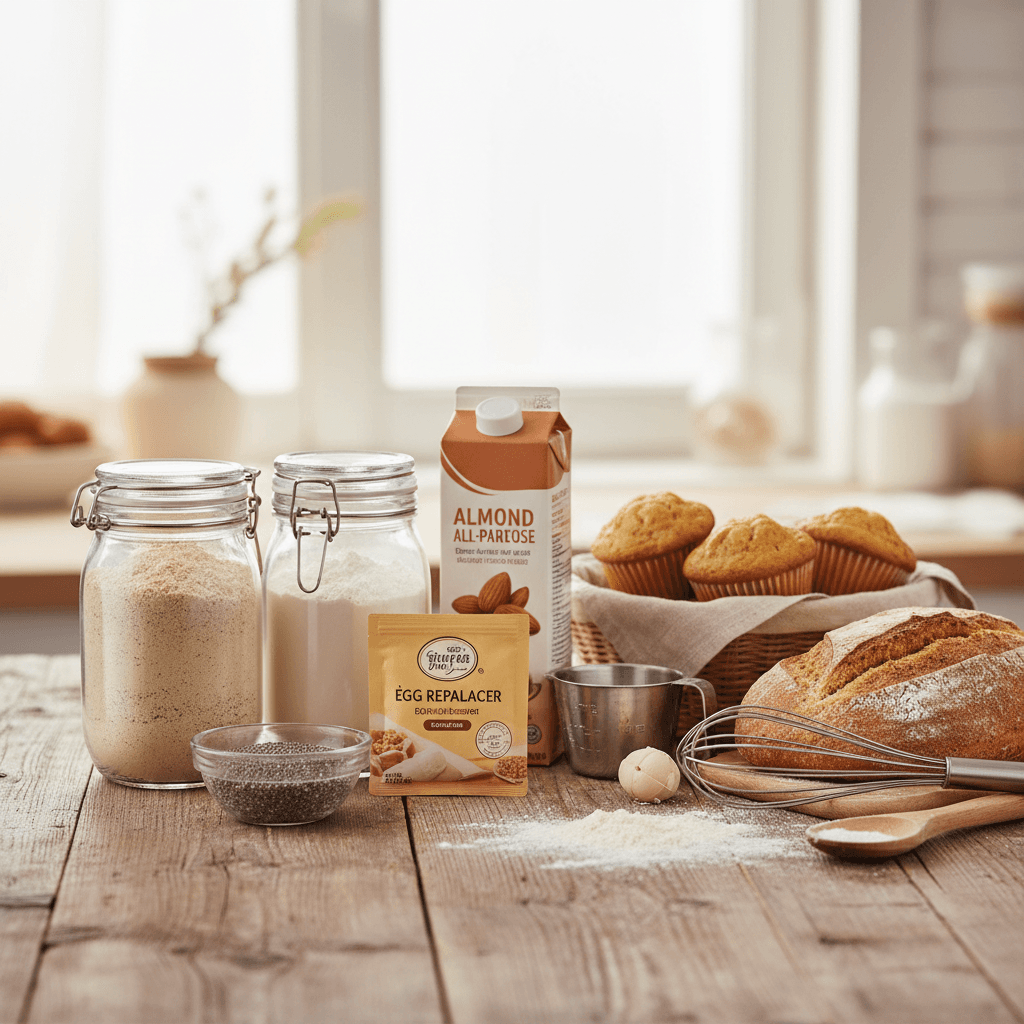
Gluten-free baking substitutes are expensive no matter how you slice it, but the price gap between store bought and homemade versions can be dramatic. We broke down the real costs, taste differences, and baking performance of the most common substitutes to help you decide where to spend and where to save.
Key takeaways
- Homemade gluten-free flour blends can cost 30-50% less than premium store bought blends, but only if you buy component flours in bulk.
- Store bought mixes win on convenience and consistency, especially for beginners who haven't dialed in their own ratios.
- Homemade dairy-free butter and milk alternatives save significant money and let you control ingredients, but shelf life is shorter.
- Egg substitutes like homemade flax eggs cost pennies compared to commercial egg replacers, with nearly identical performance in most recipes.
- The biggest savings come from making your own flour blends and binder mixes; the smallest savings come from trying to replicate specialty items like xanthan gum or baking powder at home.
Gluten-free flour blends: store bought vs homemade
Homemade gluten-free flour blends save you roughly 30-50% compared to buying a premium pre-made blend, and they give you full control over the ratio of flours and starches. But the savings only materialize if you're buying component flours strategically.
Let's look at a real comparison. A standard homemade blend might use 2 parts brown rice flour, 2/3 part arrowroot powder, and 1/3 part tapioca starch. Buying these in bulk from Bob's Red Mill or similar brands, you're looking at roughly $2.50-$3.00 per pound of finished blend.
| Flour blend | Approximate cost per pound | Notes |
|---|---|---|
| Homemade blend (bulk components) | $2.50-$3.00 | Best value; requires weighing and mixing |
| Bob's Red Mill 1-to-1 | $3.50-$4.50 | Widely available; includes xanthan gum |
| King Arthur Measure for Measure | $4.50-$5.50 | Premium performance; very consistent |
| Cup4Cup | $6.00-$7.00 | Top-tier results; highest price point |
If you bake weekly, switching from King Arthur to a homemade blend could save you $50-$80 per year. That's meaningful. But if you only bake occasionally, the convenience and tested consistency of a store bought blend like Bob's Red Mill or King Arthur might be worth the premium.
Bottom line: Make your own blend if you bake frequently and are comfortable with a kitchen scale. Stick with store bought if you want guaranteed consistency with zero effort.
Where to start if you're building your own substitutes pantry
Before we go further, if you're feeling overwhelmed by all the options for gluten-free baking, our Confident Gluten-Free Baker Toolkit walks you through exactly which ingredients to stock and how to use them. It takes the guesswork out of building a substitutes pantry from scratch.
Egg replacers: commercial products vs homemade flax and chia eggs
Homemade egg replacers are one of the easiest wins for your wallet. A single flax egg (1 tablespoon ground flaxseed plus 3 tablespoons water) costs about $0.05-$0.08, while a single serving of a commercial egg replacer like Bob's Red Mill Egg Replacer runs $0.30-$0.50.
| Egg replacer | Cost per "egg" | Best for | Limitations |
|---|---|---|---|
| Homemade flax egg | $0.05-$0.08 | Muffins, quick breads, cookies | Slight nutty flavor; won't whip |
| Homemade chia egg | $0.08-$0.12 | Same as flax; slightly more neutral | Visible specks; won't whip |
| Aquafaba (from canned chickpeas) | $0.10-$0.15 | Meringues, mousses, anything whipped | Requires canned chickpeas on hand |
| Bob's Red Mill Egg Replacer | $0.30-$0.50 | Cakes, cookies, general baking | Higher cost; convenient |
| JUST Egg | $0.50-$0.75 | Recipes needing moisture and richness | Most expensive; refrigerated |
In our experience, homemade flax eggs perform nearly identically to commercial egg replacers in muffins, quick breads, and most cookies. The one area where commercial products sometimes edge ahead is in delicate cakes where you need a very neutral flavor. For a deeper dive on egg alternatives, check out our guide to choosing egg substitutes.
Bottom line: Make your own flax or chia eggs for everyday baking. Buy a commercial replacer only if you need a completely neutral flavor or want the convenience of a pre-measured product.
Dairy-free butter: store bought brands vs homemade
Store bought dairy-free butter is one area where the premium option often wins on performance, even though homemade versions cost significantly less. A stick of Miyoko's Creamery butter runs about $4.50-$5.00 for 8 ounces, while a budget option like Earth Balance costs around $3.50. Making your own coconut oil-based butter at home costs roughly $1.50-$2.00 for the same amount.
The catch? Homemade dairy-free butter tends to behave differently in baking. It melts faster, doesn't cream as well with sugar, and can produce flatter cookies. Store bought options like Miyoko's are formulated to mimic real butter's water content and melting point, which matters enormously in pastry and pie crust.
For more on navigating dairy-free butter options, we have a full rundown in our best dairy-free butter for baking guide.
Bottom line: Homemade dairy-free butter works fine for greasing pans and simple recipes. For anything where butter is the star (pie crust, shortbread, laminated doughs), invest in a quality store bought brand.
Dairy-free milk: store bought vs homemade
Homemade dairy-free milk is one of the biggest money savers on this list. A half gallon of store bought oat milk costs $3.50-$5.00, while making your own from rolled oats costs about $0.30-$0.50 for the same amount. That's a savings of up to 90%.
For baking specifically, homemade almond milk or oat milk works perfectly well in most recipes. The main thing to watch is thickness. Store bought milks are often thinner and more consistent, while homemade versions can vary in viscosity batch to batch. If a recipe calls for buttermilk, you can make your own by adding a tablespoon of apple cider vinegar or lemon juice to a cup of either homemade or store bought milk. Learn more about how milk functions in baking to understand when these differences matter.
Bottom line: Make your own dairy-free milk for baking. It's dramatically cheaper and performs just as well in nearly every recipe.
Baking mixes: store bought vs from-scratch recipes
This is where the comparison gets interesting. A box of gluten-free cake mix from a brand like King Arthur costs $5.00-$7.00 and makes one cake. Baking that same cake from scratch using your own flour blend, sugar, eggs, and leaveners costs roughly $2.50-$4.00 in ingredients.
| Category | Store bought mix cost | From-scratch cost | Savings |
|---|---|---|---|
| Cake | $5.00-$7.00 | $2.50-$4.00 | 30-50% |
| Brownies | $4.50-$6.50 | $2.00-$3.50 | 40-55% |
| Bread | $5.00-$8.00 | $2.00-$3.50 | 50-60% |
| Pancakes/waffles | $4.00-$6.00 | $1.00-$2.00 | 50-70% |
| Cookies | $4.50-$6.00 | $2.00-$3.50 | 35-50% |
The savings from baking from scratch are consistent across categories, but the time investment is real. Mixes save you from measuring multiple flours and getting ratios wrong. If you're new to gluten-free baking and still dealing with issues like gritty texture or dry, crumbly results, a well-formulated mix can actually produce better results than a homemade attempt.
Bottom line: From-scratch baking saves 30-70% depending on the category. But if you're still learning, mixes are a smart investment in consistent results while you build your skills.
Binders: xanthan gum and guar gum
This is one category where making your own substitute doesn't really apply. Xanthan gum and guar gum are specialty ingredients that you can't replicate at home. The real savings question here is brand comparison.
A bag of Bob's Red Mill xanthan gum (8 oz) runs about $10-$13. Store brand versions or bulk options on Amazon can bring that down to $7-$9 for the same amount. Since you only use 1/4 to 1 teaspoon per recipe, even the premium option costs pennies per bake.
Bottom line: Don't stress about xanthan gum prices. A single bag lasts months of regular baking regardless of which brand you buy.
The overall cost comparison
Here's the big picture. If you bake twice a week and switch from all store bought substitutes to homemade versions where it makes sense, here's what typical annual savings look like:
| Substitute category | Annual cost (store bought) | Annual cost (homemade) | Annual savings |
|---|---|---|---|
| Flour blend | $200-$280 | $120-$160 | $80-$120 |
| Egg replacers | $50-$80 | $8-$15 | $42-$65 |
| Dairy-free milk | $180-$260 | $20-$40 | $160-$220 |
| Dairy-free butter | $100-$150 | $40-$60 | $60-$90 |
| Total | $530-$770 | $188-$275 | $342-$495 |
That's a potential savings of $350-$500 per year for a regular gluten-free baker. The biggest single win is dairy-free milk, followed by flour blends and egg replacers.
When store bought is worth the extra cost
We'd be dishonest if we said homemade always wins. There are clear situations where paying more for a store bought product is the smarter choice:
- Specialty flour blends for specific applications. A blend designed for bread baking or pasta has been tested and optimized in ways that are hard to replicate at home.
- Dairy-free butter for pastry. The formulation matters too much to wing it with coconut oil and salt.
- When you're learning. Tested mixes build your confidence and help you understand what good gluten-free results should taste and feel like before you start improvising.
- Cross-contamination concerns. Certified gluten-free products from dedicated facilities offer peace of mind that homemade versions from bulk bins cannot.
Frequently asked questions
Is it cheaper to make your own gluten-free flour blend?
Yes, making your own gluten-free flour blend typically saves 30-50% compared to buying a pre-made blend. The key is purchasing component flours like brown rice flour and tapioca starch in bulk. A homemade blend costs roughly $2.50-$3.00 per pound versus $4.50-$7.00 for premium store bought options.
Are homemade egg replacers as good as store bought?
For most baking applications, homemade flax and chia eggs perform just as well as commercial egg replacers. They work especially well in muffins, quick breads, and cookies. The main exception is recipes that need whipped egg whites, where aquafaba is a better homemade option.
What baking substitutes should I always buy store bought?
Xanthan gum, guar gum, baking powder, and dairy-free butter for pastry are all worth buying store bought. These are either impossible to make at home or require precise formulation that affects baking performance significantly.
How much money can you save making homemade gluten-free baking substitutes?
A regular gluten-free baker who makes their own flour blends, egg replacers, and dairy-free milk can save roughly $350-$500 per year compared to buying all store bought versions. The biggest savings come from homemade dairy-free milk, which can cost up to 90% less than store bought.
Do homemade gluten-free substitutes taste as good as store bought?
In most cases, homemade substitutes taste equal to or better than store bought because you can customize flavors and freshness. Homemade flour blends can be tailored to reduce the strange aftertaste that some people notice in commercial blends. The main trade-off is consistency, which improves as you get more practice.

Written by
Co-founder, BakingSubs
Co-founder of BakingSubs, where he turns the science of ingredient substitutions into tested, reliable guidance for home bakers.
Related Posts
Bake with Confidence
See all
Confident Gluten-Free Baker Toolkit
The science-based system that replaces gluten's seven invisible jobs so your baking turns out soft, fluffy, and foolproof — every time.

Gluten-Free Recipe Vault
Instant access to our complete library of proven gluten-free recipes — no waiting, no guesswork, just results that work tonight.

Fix Your Gluten-Free Bread
Learn the 3-step formula to make bread rise and stay soft, discover why your loaves collapse, and get a tested sandwich bread recipe that actually works.