

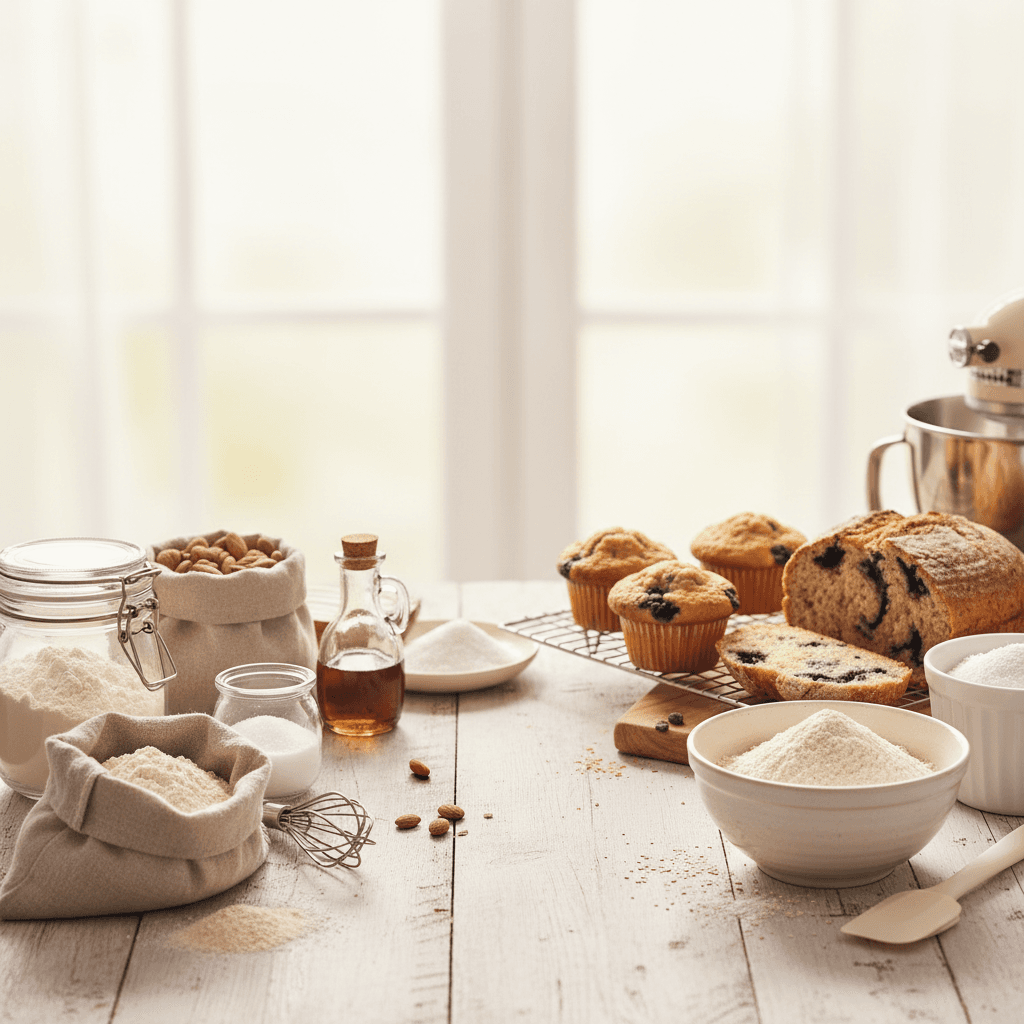
Stocking a gluten-free baking pantry can feel overwhelming — and expensive — if you don't know where to start. This guide breaks down every essential ingredient and tool across three budget tiers so you can build a pantry that fits your wallet and your baking goals.
Key takeaways
- A fully functional gluten-free baking pantry can be built for under $50 if you shop strategically at grocery stores like Walmart and Aldi.
- Mid-range products ($50–$120 total pantry cost) offer the best balance of performance, flavor, and availability — this is what most experienced gluten-free bakers actually use daily.
- Premium ingredients justify their price with finer grinds, better flavor profiles, and more consistent results, but they're not necessary for every recipe.
- Binders like xanthan gum or psyllium husk are non-negotiable in gluten-free baking — budget for them first regardless of your tier.
- Investing in a good kitchen scale matters more than upgrading any single ingredient.
- You can mix budget and premium items in the same pantry — spend more where it impacts texture and flavor most (flour and binders) and save on staples like sugar and baking powder.
How we organized these recommendations
We've broken every essential gluten-free baking ingredient and tool into seven categories: flours, sweeteners, fats, leaveners, binders, dairy alternatives, and equipment. Within each category, you'll find three tiers:
- Budget — best value, widely available at grocery stores, under $8 per item
- Mid-range — the sweet spot of quality and price
- Premium — top-tier products where the price difference delivers real, noticeable improvements
If you're just getting started with gluten-free baking, our Confident Gluten-Free Baker Toolkit walks you through exactly which ingredients to buy first and how to use them — it pairs perfectly with this guide.
Best gluten-free flours at every budget
Flour is the foundation of every bake, and it's where your budget tier matters most. The grind quality, starch ratios, and blend composition directly affect texture.
| Tier | Product | Approx. price | Best for |
|---|---|---|---|
| Budget | Bob's Red Mill 1-to-1 Baking Flour | $5–$7 / 22 oz | All-purpose baking, easy 1:1 swaps |
| Budget | Walmart Great Value Rice Flour | $3–$4 / 24 oz | Simple recipes, thickening |
| Mid-range | King Arthur Measure for Measure Flour | $8–$10 / 48 oz | Everyday baking with consistent results |
| Mid-range | Bob's Red Mill Superfine Almond Flour | $9–$12 / 16 oz | Cakes, cookies, grain-free recipes |
| Premium | Cup4Cup Multipurpose Flour | $12–$15 / 25 oz | Pastry, delicate bakes, closest to wheat texture |
| Premium | Jovial Organic Cassava Flour | $10–$13 / 24 oz | Grain-free, paleo, tortillas |
Budget pick details: Bob's Red Mill 1-to-1 is the most accessible gluten-free all-purpose blend on the market. You'll find it at Walmart, Target, Kroger, and most grocery chains. It includes xanthan gum in the blend, which saves you from buying it separately. The grind isn't as fine as premium options, so you may notice slight grittiness in delicate cakes.
Mid-range pick details: King Arthur Measure for Measure is our everyday pick. The texture is noticeably smoother than budget blends, and it performs reliably across cookies, muffins, quick breads, and pancakes. We did a detailed comparison of Bob's Red Mill vs King Arthur if you want to see how they stack up side by side.
Premium pick details: Cup4Cup was developed by a chef at Thomas Keller's restaurant, and it is built for pastries, pie crusts, and anything where a fine, tender crumb matters. Jovial's cassava flour is the gold standard for grain-free baking — it is known for behaving more like wheat flour than most other single-ingredient flours.
For recipe-specific flour recommendations, check our guides to the best gluten-free flour for cakes and best gluten-free flour for bread.
Best sweeteners for gluten-free baking at every budget
Sweeteners are one category where you can safely stay budget-friendly without sacrificing results. Sugar is sugar in most recipes — the differences show up mainly in specialty sweeteners.
| Tier | Product | Approx. price | Notes |
|---|---|---|---|
| Budget | Store-brand granulated sugar | $2–$4 / 4 lb | Works identically to name brands |
| Budget | Store-brand brown sugar (light and dark) | $2–$3 / 2 lb | Essential for cookies and quick breads |
| Mid-range | Organic Grade A Dark Maple Syrup | $10–$14 / 12 oz | Adds moisture and complex flavor |
| Mid-range | Local raw honey | $8–$12 / 16 oz | Great for breads and muffins |
| Premium | Wholesome Organic Coconut Palm Sugar | $6–$8 / 16 oz | Lower glycemic, caramel notes |
| Premium | Organic muscovado sugar | $7–$10 / 16 oz | Deep molasses flavor for specialty bakes |
Our honest advice: spend your budget dollars elsewhere and use store-brand granulated and brown sugar for 90% of your baking. Upgrade to maple syrup or coconut sugar when a recipe specifically benefits from their flavor profiles. To learn more about how different sweeteners function in baking, visit our sugar guide.
Best fats for gluten-free baking at every budget
Fat choice directly affects moisture, tenderness, and flavor. Gluten-free baked goods often need slightly more fat than their wheat counterparts to avoid dryness.
| Tier | Product | Approx. price | Best for |
|---|---|---|---|
| Budget | Store-brand unsalted butter | $3–$5 / 16 oz | Everything — the universal baking fat |
| Budget | Store-brand vegetable or canola oil | $3–$4 / 48 oz | Quick breads, muffins, cakes |
| Mid-range | Kerrygold Unsalted Butter | $4–$6 / 8 oz | Richer flavor in pastries and cookies |
| Mid-range | Miyoko's Creamery Vegan Butter | $5–$6 / 8 oz | Dairy-free baking with real butter behavior |
| Premium | Nutiva Organic Virgin Coconut Oil | $8–$12 / 15 oz | Grain-free and paleo baking |
| Premium | Organic grass-fed ghee | $10–$14 / 13 oz | High-heat baking, rich nutty flavor |
If you're baking dairy-free, we have a full breakdown of the best gluten-free dairy-free butter options with head-to-head comparisons. For most people, standard unsalted butter is the budget winner — it performs beautifully in gluten-free recipes and costs a fraction of specialty fats.
Best leaveners for gluten-free baking at every budget
Here's the good news: leaveners are inexpensive across the board, so there's less reason to stress about tiers. The key is freshness, not brand prestige.
| Tier | Product | Approx. price | Notes |
|---|---|---|---|
| Budget | Store-brand baking powder (double-acting) | $1–$2 / 8 oz | Check that it's aluminum-free if preferred |
| Budget | Arm & Hammer baking soda | $1 / 16 oz | Universal, no quality difference between brands |
| Mid-range | Rumford Aluminum-Free Baking Powder | $3–$5 / 8.1 oz | Clean taste, reliable double-acting performance |
| Mid-range | SAF Instant Yeast (Red Label) | $5–$7 / 16 oz | Best value for bread bakers — lasts months |
| Premium | SAF Gold Instant Yeast | $8–$10 / 16 oz | Designed for sweet, enriched doughs |
For gluten-free bread baking, we strongly recommend buying SAF instant yeast in the 1-pound vacuum pack rather than those tiny packets. It's dramatically cheaper per use and stays fresh for months in the freezer. If your gluten-free breads aren't rising well, our troubleshooting guide for poor rise can help you diagnose the issue.
Best binders for gluten-free baking at every budget
Binders replace the structural role of gluten, so this is the one category where we'd encourage you to spend a little more if you can. The quality difference is real.
| Tier | Product | Approx. price | Best for |
|---|---|---|---|
| Budget | Bob's Red Mill Xanthan Gum (8 oz) | $8–$11 / 8 oz | All-purpose binding, small quantities go far |
| Mid-range | Bob's Red Mill Psyllium Husk Powder | $8–$10 / 16 oz | Bread baking, adds structure and moisture retention |
| Mid-range | Bob's Red Mill Guar Gum | $6–$9 / 8 oz | Cold recipes, budget alternative to xanthan |
| Premium | Anthony's Premium Psyllium Husk Powder (Superfine) | $12–$15 / 24 oz | Bread and pizza dough — finer grind, better hydration |
If you're unsure whether to use xanthan gum or guar gum, we have a detailed xanthan gum vs guar gum comparison that covers when each one works best. The short version: xanthan gum is the safer all-around choice for beginners. Psyllium husk is the upgrade for bread bakers — it creates a more elastic, bread-like crumb that xanthan gum can't match.
Best dairy alternatives for gluten-free baking at every budget
If you're also baking dairy-free, your milk and cream replacements matter. Even if you use regular dairy, it's worth knowing the options.
| Tier | Product | Approx. price | Best for |
|---|---|---|---|
| Budget | Store-brand oat milk (unsweetened) | $2–$3 / 64 oz | General baking — neutral flavor, good body |
| Budget | Store-brand canned coconut milk | $1–$2 / 13.5 oz | Rich batters, curries, frostings |
| Mid-range | Oatly Barista Edition oat milk | $5–$6 / 32 oz | Higher fat content, better for custards and enriched doughs |
| Mid-range | Silk unsweetened cashew milk | $3–$4 / 64 oz | Neutral, creamy, works in almost everything |
| Premium | Organic full-fat coconut cream | $3–$5 / 13.5 oz | Whipped toppings, ganache, rich fillings |
For a deeper dive into how milk alternatives behave in baking, check our guide to choosing milk alternatives. In general, unsweetened oat milk is the most versatile budget-friendly option — it has enough body to mimic whole milk without adding off-flavors.
Best equipment for gluten-free baking at every budget
Tools matter more in gluten-free baking than in conventional baking because precision is everything. Gluten-free batters are less forgiving of measurement errors.
| Tier | Product | Approx. price | Why it matters |
|---|---|---|---|
| Budget | Etekcity Digital Kitchen Scale | $10–$13 | Weighing flour is the single biggest accuracy improvement |
| Budget | Basic silicone spatulas (set of 3) | $6–$8 | Essential for scraping thick GF batters |
| Mid-range | OXO Good Grips 11lb Food Scale | $25–$30 | Pull-out display, more precise, built to last |
| Mid-range | USA Pan loaf pan (1 lb) | $12–$16 | Nonstick aluminized steel — even browning for GF bread |
| Premium | KitchenAid Artisan 5-Qt Stand Mixer | $280–$350 | Handles thick GF doughs that burn out hand mixers |
| Premium | Mockmill 200 Grain Mill | $300–$350 | Mill your own fresh GF flours for best flavor and texture |
If you do nothing else, buy a kitchen scale. We cannot overstate this. Gluten-free flours vary wildly in density — a cup of almond flour weighs completely differently than a cup of rice flour. Weighing eliminates the guesswork. For bread bakers eyeing a grain mill, see our best grain mill for gluten-free flour roundup.
Gluten-free baking starter kit checklist
If you want to get baking today without overthinking it, here's the minimum viable pantry. This covers the budget tier and totals roughly $40–$50.
- Flour: Bob's Red Mill 1-to-1 Gluten Free Baking Flour (1 bag) — ~$6
- Sugar: Store-brand granulated sugar — ~$3
- Brown sugar: Store-brand light brown sugar — ~$2
- Fat: Store-brand unsalted butter — ~$4
- Oil: Store-brand canola or vegetable oil — ~$3
- Leavener: Baking powder (double-acting) — ~$2
- Leavener: Baking soda — ~$1
- Binder: Bob's Red Mill Xanthan Gum (8 oz) — ~$10
- Dairy/alt: Store-brand oat milk or regular milk — ~$3
- Eggs: One dozen large eggs — ~$3
- Scale: Etekcity Digital Kitchen Scale — ~$12
With these eleven items, you can make cookies, muffins, quick breads, pancakes, cakes, and brownies. That's a lot of baking for under $50. You can find almost everything on this list at Aldi or Walmart in a single trip.
Where to save and where to splurge
Here's our honest take on where your money makes the biggest difference:
Worth splurging on:
- Flour blend — The difference between a $5 blend and a $12 blend shows up in every single bite. Finer grinds eliminate grittiness and produce better texture. If your bakes have a gritty mouthfeel, our gritty texture troubleshooting guide explains why and how to fix it.
- Binder (especially for bread) — Superfine psyllium husk creates noticeably better bread than standard xanthan gum.
- Kitchen scale — Even a budget scale transforms your results. A mid-range one is a lifetime purchase.
Safe to go budget:
- Sweeteners — Generic granulated sugar performs identically to premium brands in baked goods.
- Leaveners — Baking soda is baking soda. Budget baking powder works fine as long as it's fresh.
- Oil — Store-brand canola oil is indistinguishable from name brands in muffins and cakes.
Frequently asked questions
What is the minimum I need to spend to start gluten-free baking?
You can build a functional gluten-free baking pantry for $40–$50 using budget-tier products from stores like Walmart and Aldi. The essentials are a 1-to-1 flour blend, xanthan gum, basic leaveners, sugar, fat, eggs, and a digital kitchen scale. With these, you can make cookies, muffins, cakes, quick breads, and pancakes.
Is expensive gluten-free flour actually better than cheap flour?
In most cases, yes — premium gluten-free flour blends use finer grinds and more carefully balanced starch ratios, which produce smoother textures and less grittiness. The difference is most noticeable in delicate bakes like cakes and pastries. For hearty recipes like brownies or banana bread, a budget blend works perfectly well.
Do I need xanthan gum for every gluten-free recipe?
Not every recipe requires it, but most do. Xanthan gum (or another binder like arrowroot powder or psyllium husk) replaces the structural role of gluten. Some flour blends like Bob's Red Mill 1-to-1 already include xanthan gum, so check your flour label before adding more. Without any binder, most gluten-free baked goods will be crumbly and fall apart.
What is the single most important tool for gluten-free baking?
A digital kitchen scale. Gluten-free flours vary dramatically in weight per cup — rice flour, almond flour, and tapioca starch all measure differently. Weighing your ingredients eliminates the most common source of failed gluten-free recipes. Even a $10 scale makes a noticeable difference in consistency.
Can I mix budget and premium ingredients in the same recipe?
Absolutely, and we'd actually recommend it. Spend more on the ingredients that impact texture most — your flour blend and binder — and save on staples like sugar, baking powder, and oil. This approach gives you near-premium results at a mid-range total cost.

Written by
Co-founder, BakingSubs
Co-founder of BakingSubs, where he turns the science of ingredient substitutions into tested, reliable guidance for home bakers.
Related Posts
Bake with Confidence
See all
Confident Gluten-Free Baker Toolkit
The science-based system that replaces gluten's seven invisible jobs so your baking turns out soft, fluffy, and foolproof — every time.

Gluten-Free Recipe Vault
Instant access to our complete library of proven gluten-free recipes — no waiting, no guesswork, just results that work tonight.

Fix Your Gluten-Free Bread
Learn the 3-step formula to make bread rise and stay soft, discover why your loaves collapse, and get a tested sandwich bread recipe that actually works.