

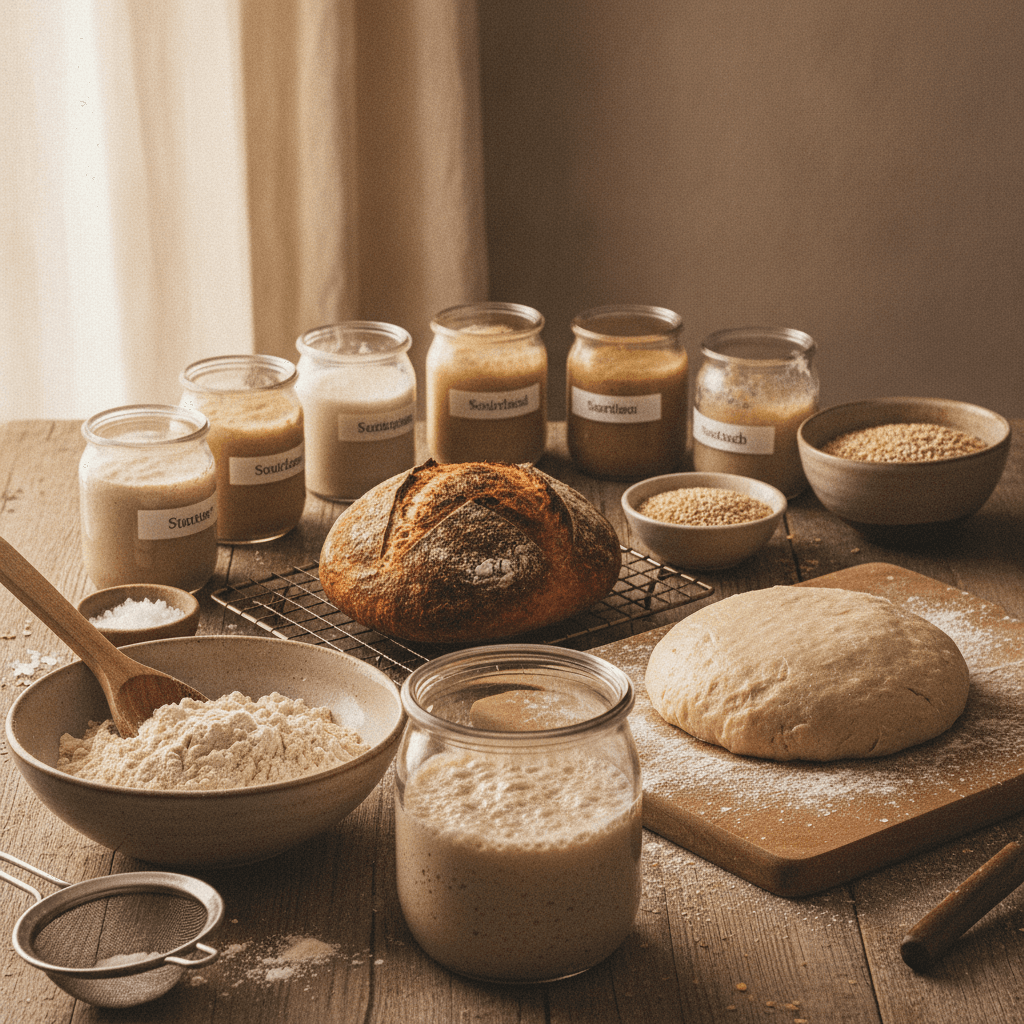
Sourdough fermentation is a partnership between wild yeast and lactic acid bacteria (LAB) that transforms flour and water into bread with complex flavor, better keeping quality, and a structure no commercial yeast can replicate. Understanding each stage of that process — and what actually drives it — gives you control over timing, sourness, and rise instead of just hoping for the best.
Key takeaways
Sourdough fermentation relies on wild yeast (primarily Saccharomyces cerevisiae and Kazachstania humilis) and lactic acid bacteria (primarily Lactobacillus species) working together in a stable ecosystem.
LAB outnumber yeast in a mature starter by roughly 100:1, which is why acidity builds faster than gas production.
Bulk fermentation temperature has more impact on flavor than almost any other variable — a 5°F shift changes the ratio of lactic to acetic acid noticeably.
The dough's pH typically drops from around 6.0 to between 3.5 and 4.0 during a full fermentation cycle, which is what gives sourdough its characteristic tang.
Fermentation partially breaks down gluten proteins and phytic acid, which is why many people who struggle with conventional bread report better tolerance with long-fermented sourdough (though this is not the same as being safe for celiac disease).
Over-fermentation is the most common home baker failure — the dough runs out of food for the organisms and collapses rather than holding its rise.
What is sourdough fermentation, exactly?
At its simplest, sourdough fermentation is the metabolic activity of wild yeast and bacteria consuming sugars in flour and producing carbon dioxide, organic acids, and ethanol as byproducts. Unlike commercial baker's yeast — which is a single cultivated strain of Saccharomyces cerevisiae — a sourdough starter contains a diverse community of organisms. A well-established starter typically harbors multiple yeast species alongside several strains of lactic acid bacteria.
The bacteria do the heavy lifting on flavor. They produce lactic acid (which tastes mild and creamy) and acetic acid (which tastes sharp and vinegary). The yeast handle most of the leavening by generating CO2 gas. Both organisms feed on the simple sugars that enzymes in the flour — primarily amylase — break down from starch.
This is fundamentally different from what happens with a packet of active dry yeast. Commercial yeast works fast and produces CO2 efficiently, but it doesn't generate the organic acids that define sourdough's flavor or its longer shelf life. A sourdough loaf's acidity inhibits mold growth, which is why a properly fermented sourdough boaf can last 4-5 days on the counter while a yeasted white loaf starts going stale in 24 hours.
The 6 stages of sourdough fermentation
Whether you're building a starter from scratch or fermenting a batch of dough, the process follows a predictable arc. Here's what happens at each stage and why it matters for your bread.
Stage 1: Enzymatic activation (0-2 hours after mixing)
The moment flour meets water, enzymes wake up. Amylase begins breaking starch chains into maltose and glucose — the sugars that yeast and bacteria will feed on. Protease starts snipping gluten-forming proteins into smaller peptides. This enzymatic activity is why autolyse (resting flour and water before adding starter) improves dough extensibility: protease has time to work before fermentation acids tighten the gluten network.
At this point, microbial activity is minimal. The organisms from your starter are adjusting to their new environment — more food, different hydration, possibly a different temperature. Think of it as a lag phase.
Stage 2: Bacterial colonization (2-4 hours)
LAB ramp up first because they reproduce faster than yeast. The dough's pH starts dropping as lactic and acetic acid accumulate. This is where temperature becomes critical:
Warmer environments (78-82°F / 25-28°C) favor homofermentative LAB, which produce primarily lactic acid. The result is a milder, more yogurt-like tang.
Cooler environments (65-70°F / 18-21°C) favor heterofermentative LAB, which produce both acetic acid and CO2 alongside lactic acid. The result is a sharper, more vinegary flavor.
This is why two bakers using identical starters and flour can get dramatically different-tasting bread. A home baker named Marcus, posting on The Fresh Loaf forum, documented baking the same formula at 78°F and 65°F over six weeks. His tasting notes consistently described the warm-fermented loaves as "mild and creamy" and the cool-fermented ones as "sharp, almost pickle-like." Temperature isn't a minor variable — it's arguably the single biggest flavor lever you have.
Stage 3: Yeast activation and gas production (3-6 hours)
Yeast populations lag behind bacteria but eventually hit their stride. CO2 production accelerates, and you start seeing the dough physically expand. The yeast are consuming maltose and glucose and producing CO2 and ethanol. That ethanol, by the way, mostly bakes off in the oven — it's not accumulating in your bread in any meaningful amount.
Here's something that surprises many bakers: the yeast in sourdough are acid-tolerant species that thrive in conditions commercial S. cerevisiae strains would struggle in. Kazachstania humilis (formerly Candida humilis), one of the most common sourdough yeasts, actually prefers the acidic environment the LAB create. The bacteria and yeast aren't competing — they've co-evolved into a symbiotic relationship where each makes conditions better for the other.
Stage 4: Peak fermentation (6-10 hours at room temperature)
This is the window most bakers are targeting for shaping. The dough has roughly doubled in volume, the gluten network is well-developed from both mechanical work and acidification, and the crumb structure is set by the gas bubbles trapped inside. The pH has typically dropped to around 4.0-4.5.
Timing this stage is the hardest skill in sourdough baking. There's no universal clock because flour protein content, hydration, starter strength, and ambient temperature all shift the timeline. A dough made with strong bread flour at 76°F might peak at 7 hours. The same dough at 68°F might need 12. And a dough made with lower-protein all-purpose flour will hit its structural limit sooner because there's less gluten to hold the gas.
Stage 5: Retardation (optional cold fermentation)
Many bakers shape their dough at peak fermentation and then move it to the refrigerator (38-42°F / 3-6°C) for 12-48 hours. This doesn't stop fermentation — it slows it dramatically. Yeast activity drops to near zero at refrigerator temperatures, but LAB continue producing acid at a reduced rate. The result is more flavor development without additional rise.
Cold retardation also makes the dough easier to score and handle. The cold firms up the fats in the flour and tightens the gluten, giving you a stiffer dough that holds its shape when you slash it. This is why most bakeries cold proof overnight — it's both a flavor tool and a scheduling tool.
Stage 6: Oven spring and the end of fermentation
When the shaped dough hits a hot oven (typically 450-500°F / 230-260°C), the yeast and bacteria get one last burst of activity before the heat kills them. CO2 expands, steam from the dough's moisture pushes outward, and the loaf can gain 20-30% additional volume in the first 10-15 minutes. This is oven spring.
The Maillard reaction and caramelization then build the crust. The organic acids that accumulated during fermentation contribute to crust color — more acidic doughs tend to brown faster. Once the internal temperature reaches about 200°F (93°C), the crumb structure is set and fermentation is permanently over.
Why sourdough fermentation breaks down gluten differently
One of the most discussed aspects of sourdough is its effect on gluten. During long fermentation, the combination of protease enzymes and acidic conditions partially hydrolyzes gluten proteins. Research published in peer-reviewed journals has shown that long-fermented sourdough (24+ hours) can reduce the amount of immunoreactive gluten peptides compared to short-fermented yeasted bread.
However — and this is critical — partial reduction is not elimination. Sourdough bread made from wheat flour, bread flour, or any gluten-containing grain is not safe for people with celiac disease. The reduction in reactive peptides may explain why some people with non-celiac gluten sensitivity report better tolerance, but that's a far cry from being gluten-free.
For bakers who need truly gluten-free bread, sourdough fermentation can still be applied to gluten-free flour blends. The flavor benefits and phytic acid reduction still apply. The structural challenges are just different — without gluten, you need alternative binders and hydration strategies. If you're working with gluten-free flours and running into texture problems, the poor rise troubleshooting guide covers the most common issues.
Phytic acid reduction: the underrated benefit
Whole grain flours contain phytic acid, an antinutrient that binds to minerals like iron, zinc, and calcium, reducing their bioavailability. Sourdough fermentation activates phytase enzymes that break down phytic acid. Studies have shown that a fermentation period of 12-24 hours can reduce phytic acid content significantly compared to a quick 2-hour yeasted rise.
This matters most if you're baking with whole grain or high-extraction flours. If you're using refined white flour, phytic acid content is already low because most of it lives in the bran. But for bakers working with whole wheat flour or other whole grain alternatives like buckwheat flour, the mineral bioavailability argument for sourdough fermentation is well-supported by the science.
The 3 most common sourdough fermentation failures
Understanding the biology helps you diagnose problems. Here are the failures that trip up home bakers most often.
Over-fermentation (the dough collapses)
If you let fermentation run too long, the yeast and bacteria exhaust their food supply. The organic acids weaken the gluten network to the point where it can't hold gas anymore. The dough deflates, feels slack and sticky, and smells strongly of alcohol or vinegar. The resulting bread will be dense, gummy, and overly sour.
The fix is simple in concept but hard in practice: learn to read your dough rather than watching the clock. A dough that has increased 75-100% in volume, shows visible bubbles on the surface and sides, and jiggles like a water balloon when you nudge the container — that's your window. Past that, you're borrowing time.
Under-fermentation (dense, tight crumb)
The opposite problem. The dough hasn't developed enough gas or acidity. The bread will be dense, heavy, and may taste bland or "yeasty" without the characteristic tang. This usually happens when the starter wasn't active enough, the dough was too cold, or the baker shaped and baked too early.
A reliable check: if your starter doesn't at least double in volume within 6-8 hours of feeding at room temperature (around 75°F / 24°C), it's not ready to leaven bread. Feed it consistently for a few more days before using it in a dough.
Wrong sourness profile
"My bread is too sour" or "my bread isn't sour enough" — both complaints come down to the lactic-to-acetic acid ratio, which you control primarily through temperature and hydration. Higher hydration and warmer temperatures push toward milder lactic acid. Lower hydration and cooler temperatures push toward sharper acetic acid. If your bread is aggressively sour and you don't want that, try fermenting at 78-80°F and using a higher-hydration starter (100% hydration, meaning equal weights flour and water).
How flour choice changes fermentation
Not all flours ferment the same way. The enzymatic activity, mineral content, and available sugars vary dramatically between flour types.
Flour type | Fermentation speed | Flavor impact | Notes |
|---|---|---|---|
Moderate | Mild tang, clean flavor | Low enzyme activity; predictable timeline | |
Fast | Earthy, more complex sourness | High enzyme activity; bran can cut gluten strands | |
Very fast | Deep, assertive sour | Extremely high enzyme activity; often over-ferments if treated like wheat | |
Moderate-fast | Nutty, slightly bitter | Gluten-free; needs structural support from binders | |
Fast | Sweet, mild | Weaker gluten than wheat; handles less fermentation time |
Rye flour deserves special attention. Its high amylase activity means starch breaks down into sugar very quickly, which accelerates fermentation. Rye-heavy doughs can over-ferment in half the time of a wheat dough at the same temperature. This is why traditional German rye breads use high-acid starters — the acidity deactivates excess amylase and prevents the crumb from turning gummy. If you've ever baked a rye loaf that came out with a wet, sticky interior, over-active enzymes during fermentation were almost certainly the cause.
Temperature, time, and the fermentation tradeoff
There's a well-known principle in sourdough baking: you can have speed or complexity, but not both at the same time. Here's how the tradeoff works in practice.
Approach | Bulk fermentation time | Temperature | Flavor profile |
|---|---|---|---|
Warm, fast | 4-6 hours | 80-85°F (27-29°C) | Mild, slightly tangy, less complex |
Room temp, standard | 8-12 hours | 70-75°F (21-24°C) | Balanced tang, moderate complexity |
Cool, slow | 12-18 hours | 60-65°F (16-18°C) | Sharp, complex, pronounced acetic acid |
Cold retard (after shaping) | 12-48 hours | 38-42°F (3-6°C) | Deepest flavor, most acidity, best crust color |
Most home bakers land somewhere in the "room temp, standard" range because it fits a normal daily schedule. But if you want to push flavor further without risking over-fermentation, the cold retard after shaping is your best tool. You get extended acid production from the bacteria without the structural risk of the yeast continuing to inflate the dough.
How sourdough fermentation affects sugar and sweetener choices
Adding sugar or other sweeteners to a sourdough changes the fermentation dynamics. Yeast can metabolize simple sugars like sucrose and glucose quickly, which can accelerate fermentation beyond what you planned for. High-sugar sourdough formulas (like sourdough cinnamon rolls or enriched breads) need careful management — often shorter bulk fermentation times or cooler temperatures to compensate.
If you're working with alternative sweeteners, the picture gets more complicated. Some sugar substitutes like erythritol and monk fruit are not fermentable — yeast and bacteria can't metabolize them. That means they won't accelerate fermentation, but they also won't contribute to browning the way real sugar does. If you're exploring this territory, the natural sweeteners guide covers which options work in baked goods and which ones cause texture problems.
A contrarian take: most home bakers over-complicate sourdough fermentation
Here's an opinion that goes against much of what you'll read in sourdough forums: obsessing over exact hydration percentages, starter ratios down to the gram, and ambient temperature to the degree is counterproductive for most home bakers. The organisms in your starter are remarkably resilient. They've survived centuries of imprecise peasant baking in wood-fired ovens with no thermometers.
The bakers who consistently produce great sourdough are the ones who learn to read their dough — how it looks, feels, and smells at each stage — rather than the ones who buy $40 pH meters and log every variable in a spreadsheet. A pH meter won't tell you when your specific dough, with your specific flour, in your specific kitchen, is ready to shape. Your hands and eyes will, once you've built the experience.
That said, understanding the science behind what's happening gives you a framework for interpreting what you see. When your dough feels slack and smells like nail polish remover, you know that's ethanol from over-fermentation, not a mysterious failure. When your crumb is dense and bland, you know the organisms didn't have enough time or warmth to do their work. The science doesn't replace intuition — it accelerates how quickly you develop it.
Frequently asked questions
How long does sourdough fermentation take?
Total fermentation time depends heavily on temperature and starter strength. At typical room temperature (70-75°F), bulk fermentation takes 8-12 hours. Adding a cold retard after shaping extends the process by another 12-48 hours. Warmer kitchens speed things up; cooler ones slow them down. The dough's appearance and feel matter more than any fixed timeline.
Does sourdough fermentation remove gluten?
Long sourdough fermentation partially breaks down gluten proteins through enzymatic activity and acidification, but it does not eliminate gluten. Bread made from wheat, rye, spelt, or barley flour still contains gluten and is not safe for people with celiac disease. Some people with non-celiac gluten sensitivity report better tolerance, but this varies individually. For a truly gluten-free option, you'd need to use gluten-free flours as the base.
Why does my sourdough bread taste too sour?
Excessive sourness usually means too much acetic acid relative to lactic acid. This happens when fermentation occurs at cooler temperatures, when the starter is very mature (fed infrequently), or when the dough is retarded for an extended period. To reduce sourness, try fermenting at a warmer temperature (78-80°F), using a young starter fed within the last 4-6 hours, and shortening or eliminating the cold retard.
Can you use sourdough fermentation with gluten-free flours?
Yes. Wild yeast and lactic acid bacteria can colonize and ferment gluten-free flours like brown rice flour, buckwheat flour, and sorghum flour. The flavor benefits and phytic acid reduction still apply. The main challenge is structure — without gluten, you need binders like psyllium husk or xanthan gum to trap the CO2 and create a workable crumb. Rise times and hydration levels will differ from wheat-based sourdough.
What is the ideal temperature for sourdough fermentation?
There is no single ideal — it depends on what flavor you want. For a balanced, moderately tangy loaf, 75-78°F (24-26°C) is a common sweet spot. For milder bread, go warmer (80-85°F). For sharper, more complex sourness, go cooler (65-70°F) or use an extended cold retard at refrigerator temperature. The "best" temperature is the one that produces the flavor profile you prefer.

Written by
Co-founder, BakingSubs
Co-founder of BakingSubs, where he turns the science of ingredient substitutions into tested, reliable guidance for home bakers.
Related Posts
Bake with Confidence
See all
Confident Gluten-Free Baker Toolkit
The science-based system that replaces gluten's seven invisible jobs so your baking turns out soft, fluffy, and foolproof — every time.

Gluten-Free Recipe Vault
Instant access to our complete library of proven gluten-free recipes — no waiting, no guesswork, just results that work tonight.

Fix Your Gluten-Free Bread
Learn the 3-step formula to make bread rise and stay soft, discover why your loaves collapse, and get a tested sandwich bread recipe that actually works.