

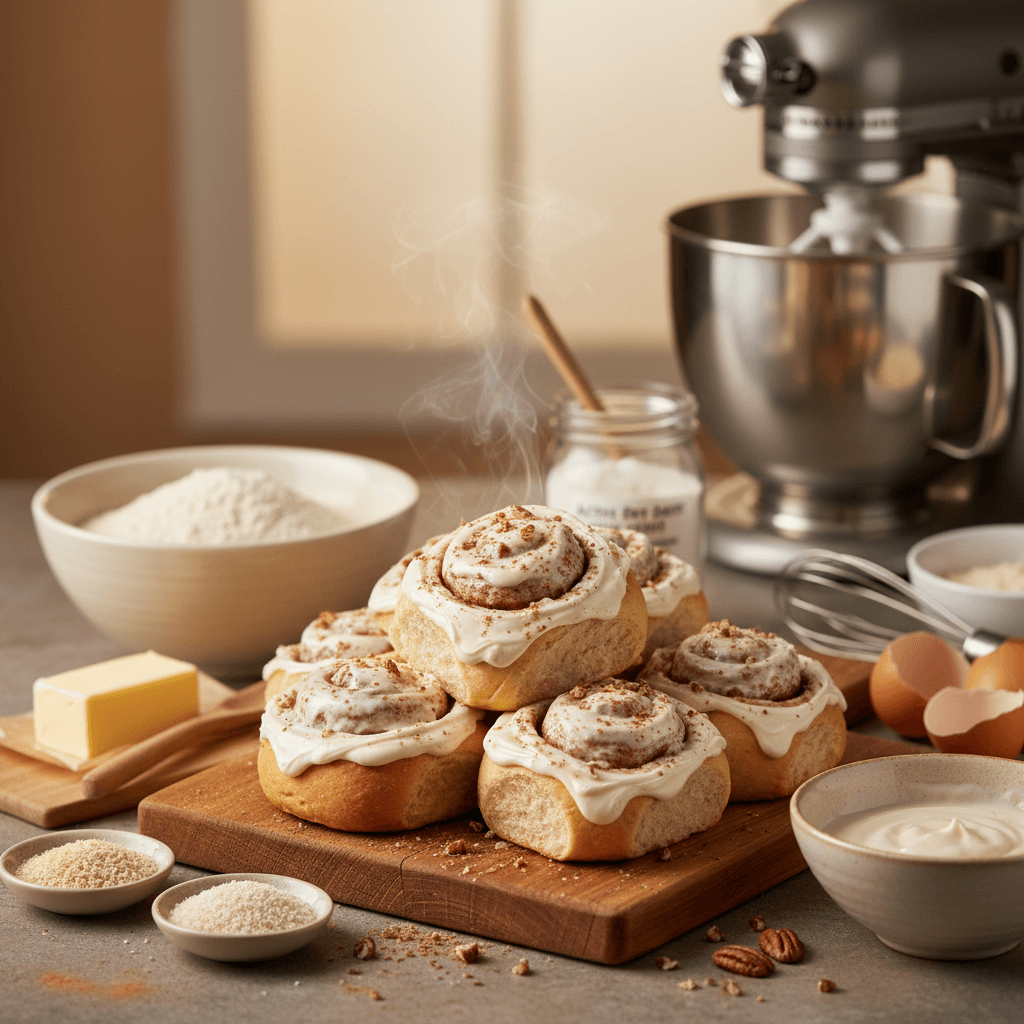
If you've tried gluten-free cinnamon rolls before and ended up with hockey pucks or gummy blobs, you're not alone. This guide breaks down five recipe approaches that actually produce soft, fluffy cinnamon rolls, explains the baking science behind each one, and helps you pick the right method for your skill level.
Key takeaways
- The best gluten-free cinnamon rolls use a combination of starches and rice flour, not a single flour, to mimic the stretch and softness of wheat dough.
- Psyllium husk is the most effective binder for yeasted cinnamon roll dough because it creates extensible structure without the gumminess xanthan gum can cause.
- A tangzhong (cooked flour paste) technique works beautifully with gluten-free flours and adds exceptional moisture retention.
- Warm proofing environments and slightly longer rise times compensate for the slower fermentation common in GF doughs.
- Cream cheese frosting isn't just tradition — the acidity and fat help mask any residual "GF taste" and add perceived richness.
Why gluten-free cinnamon rolls are tricky (and what actually fixes them)
Traditional cinnamon rolls rely on gluten development to create that signature pull-apart, pillowy texture. Gluten forms an elastic network that traps gas from yeast, stretches during rolling, and holds its shape through baking. Without it, you need a strategy to replace three separate functions: structure, extensibility, and moisture retention.
The good news is that modern gluten-free baking science gives us several reliable paths to get there. Each of the five approaches below tackles these challenges differently, so you can choose based on what ingredients you have and how much effort you want to invest.
If you're still building out your gluten-free pantry, our pantry checklist covers the seven essentials every GF baker should have on hand before tackling enriched doughs like cinnamon rolls.
Approach 1: Commercial flour blend with psyllium husk (best for beginners)
This is the most accessible method and produces reliably soft rolls. You use a quality commercial gluten-free flour blend as your base, then add psyllium husk powder as your primary binder instead of relying solely on the xanthan gum already in most blends.
Why this approach works
Commercial blends are already calibrated with a balance of rice flour, starches, and sometimes milk powder. Adding psyllium husk on top (about 2 teaspoons per 2 cups of blend) creates a gel network that mimics gluten's extensibility. This is what lets you actually roll the dough without it cracking apart. Psyllium absorbs water slowly, so the dough becomes more workable after a 10-minute rest — don't skip that step.
For the best results, choose a finely ground psyllium husk rather than whole husks. Coarse husks create visible specks and don't hydrate evenly, which leads to inconsistent texture.
Common mistakes with this method
The biggest error is adding too much flour. GF cinnamon roll dough should be noticeably stickier than wheat dough — think soft cookie dough consistency, not bread dough. If you add flour until it feels "right" by wheat standards, your rolls will be dense and dry. Use a kitchen scale and weigh your flour instead of scooping.
Another common issue: not letting the dough rest before rolling. Psyllium needs time to fully hydrate. If you roll immediately, the dough cracks. Give it at least 10 minutes covered at room temperature.
If you want a deeper understanding of how different binders perform in yeasted doughs, our guide on xanthan gum vs psyllium husk vs flax breaks down exactly when to use each one.
For a complete system that walks you through flour selection, binder ratios, and troubleshooting for projects like this, check out the Confident Gluten-Free Baker Toolkit. It takes the guesswork out of adapting any recipe.
Approach 2: Tangzhong method for extra-soft rolls
The tangzhong (also called water roux) technique involves cooking a small portion of your flour with liquid to create a paste before adding it to the rest of the dough. This is a game-changer for gluten-free cinnamon rolls because it pre-gelatinizes the starches, which dramatically increases moisture retention.
How to make a gluten-free tangzhong
Whisk together about 3 tablespoons of brown rice flour (or sweet rice flour if you can find it) with 1/2 cup of milk in a small saucepan. Cook over medium heat, stirring constantly, until it forms a thick paste — roughly 65 degrees Celsius (150 degrees Fahrenheit). Let it cool to lukewarm before adding it to your dough.
The cooked starches in the tangzhong can hold significantly more water than raw starches. This means your finished rolls stay softer longer and resist the quick staling that plagues most gluten-free baked goods.
What makes this different from just adding more liquid
Simply adding extra milk or water to your dough makes it wetter but doesn't change the starch structure. Tangzhong physically alters the starch granules so they trap and hold moisture through baking and even into the next day. It's the difference between a sponge that holds water and a puddle sitting on a counter.
Common mistakes with tangzhong cinnamon rolls
Don't add the tangzhong while it's still hot — it will kill your yeast. Let it cool to at least body temperature. Also, reduce the liquid in the rest of your recipe by the amount you used in the tangzhong, or you'll end up with batter instead of dough.
Approach 3: Custom rice flour and starch blend (best control over texture)
For bakers who want to fine-tune their results, building a custom flour blend gives you the most control. A proven ratio for cinnamon rolls is roughly 40% white rice flour, 30% tapioca starch, 20% potato starch, and 10% milk powder or sweet rice flour.
Why this ratio works for cinnamon rolls specifically
Each component plays a distinct role:
| Ingredient | Role in cinnamon rolls | What happens if you skip it |
|---|---|---|
| White rice flour | Provides structure and a neutral flavor base | Rolls lack body and collapse |
| Tapioca starch | Adds chewiness and stretch — critical for rolling | Dough cracks, texture is crumbly |
| Potato starch | Creates tenderness and moisture retention | Rolls are dry and dense |
| Milk powder or sweet rice flour | Improves browning and adds softness | Pale, bland rolls that stale quickly |
This blend, combined with psyllium husk as a binder, produces rolls with genuine pull-apart quality. The tapioca starch is doing the heavy lifting for extensibility — it's what lets you roll the dough into a rectangle without it fighting you.
Common mistakes with custom blends
Measuring by volume instead of weight is the number one cause of failure here. A cup of tapioca starch can vary by 30 grams depending on how you scoop it. Weigh everything. Also, don't substitute cornstarch for potato starch one-to-one — cornstarch produces a tighter, less tender crumb. If cornstarch is all you have, use about 15% less and add a tablespoon of extra fat to compensate.
Approach 4: Enriched dough with eggs and extra fat (the bakery-style method)
If you want cinnamon rolls that taste like they came from a bakery, lean into enrichment. This approach uses more eggs, more butter, and sometimes sour cream or cream cheese directly in the dough. The extra fat and protein create a rich, tender crumb that's harder to mess up.
The science behind enriched GF dough
Eggs serve multiple functions here: the yolks add fat and emulsifiers that keep the crumb tender, while the whites provide structure and help the rolls hold their shape. In gluten-free baking, eggs are doing even more work than usual because they're partially replacing gluten's structural role.
Adding 2-3 tablespoons of softened butter or cream cheese per cup of flour blend coats the starch granules, which slows moisture loss and creates that melt-in-your-mouth quality. The dairy also contributes to browning through the Maillard reaction, giving your rolls that golden, bakery-worthy crust.
Common mistakes with enriched dough
The main risk is over-enriching to the point where the dough can't hold its shape. If your rolls spread flat during proofing instead of rising upward, you've added too much fat relative to your structure (binder + eggs). Scale back the butter by a tablespoon or add an extra egg white for more support.
Also watch your proofing time. Enriched doughs rise more slowly because fat inhibits yeast activity. Plan for 60-90 minutes of proofing in a warm spot rather than the 30-45 minutes you might expect.
Approach 5: Hybrid yeast and baking powder leavening (the insurance policy method)
This approach uses both yeast and a small amount of baking powder for leavening. It's particularly good if you're nervous about your yeast performance or baking in a cooler kitchen where proofing is unreliable.
Why dual leavening works
Yeast provides flavor complexity and the primary rise, while baking powder acts as a safety net — it activates in the oven's heat and gives the rolls an extra boost right when they need it most. This is especially helpful in gluten-free baking because GF doughs are heavier and harder for yeast to lift alone. If your GF bread or rolls tend to have a poor rise, this dual approach often solves it.
Use about 1 teaspoon of baking powder per 2 cups of flour blend alongside your normal yeast amount. The baking powder won't make the rolls taste "quick bread-like" at this ratio — it just provides insurance.
Common mistakes with dual leavening
Don't double both leaveners thinking more is better. Too much baking powder creates a metallic, soapy taste, and too much yeast makes the rolls taste boozy and collapse after rising too fast. Stick to standard yeast amounts (about 2 1/4 teaspoons or one packet) and add baking powder conservatively.
The filling and rolling: techniques that prevent cracking
No matter which dough approach you use, the filling and rolling step is where many gluten-free cinnamon rolls fail. Here's what works:
Roll between parchment paper. GF dough sticks to everything. Place your dough on a sheet of parchment paper, top with another sheet, and roll to about 1/4-inch thickness. The parchment also makes it much easier to roll the dough into a log — just lift the edge of the bottom sheet and use it to guide the roll.
Keep the filling layer thin. A thick layer of butter, sugar, and cinnamon creates a weak plane that causes the rolls to unravel or collapse. Spread a thin, even layer and press it gently into the dough.
Use a sharp knife, not a sawing motion. Or better yet, use unflavored dental floss. Slide it under the log, cross the ends over the top, and pull to slice clean rounds without crushing them.
Don't skip the second rise. After cutting and placing your rolls in the pan, let them proof for another 30-45 minutes. This second rise is what gives you fluffy interior texture instead of dense, bready rolls.
Baking temperature and timing for soft gluten-free cinnamon rolls
Bake at 350 degrees Fahrenheit (175 degrees Celsius) for 22-28 minutes. GF cinnamon rolls benefit from a slightly lower temperature than wheat versions because the starches on the outside set faster — a hotter oven gives you a hard crust before the inside is done.
Use an oven thermometer to verify your temperature. Most home ovens run 15-25 degrees off, and that difference matters more in GF baking where the margin for error is smaller.
The rolls are done when the tops are golden brown and the internal temperature reaches 190-195 degrees Fahrenheit. If you don't have an instant-read thermometer, gently press the top of a roll — it should spring back slowly. If it feels mushy, give them another 3-5 minutes with a foil tent to prevent over-browning.
Add frosting while the rolls are still warm but not hot. This lets it melt slightly into the surface without sliding off completely.
Comparison of all five approaches
| Approach | Difficulty | Best for | Key ingredient | Softness rating |
|---|---|---|---|---|
| Commercial blend + psyllium | Beginner | First-timers, weeknight baking | Psyllium husk powder | Very good |
| Tangzhong method | Intermediate | Next-day softness, make-ahead | Cooked flour paste | Excellent |
| Custom flour blend | Intermediate | Texture perfectionists | Tapioca starch + potato starch | Excellent |
| Enriched dough | Intermediate | Bakery-style richness | Extra eggs + butter | Excellent |
| Dual leavening | Beginner | Cool kitchens, yeast anxiety | Baking powder + yeast | Very good |
Frequently asked questions
Can you make gluten-free cinnamon rolls ahead of time?
Yes. The tangzhong method and enriched dough approaches hold up best overnight. Shape and place your rolls in the pan, cover tightly with plastic wrap, and refrigerate for up to 12 hours. Pull them out 45-60 minutes before baking to come to room temperature and finish their rise. Rolls made with the tangzhong method will stay softer the next day than any other approach.
What is the best binder for gluten-free cinnamon rolls?
Psyllium husk powder is the best binder for yeasted cinnamon roll dough because it creates an extensible, stretchy network that lets you roll and shape the dough without cracking. Xanthan gum works but can make the texture slightly gummy if you use too much. For cinnamon rolls specifically, start with 2 teaspoons of psyllium husk powder per 2 cups of flour blend.
Why are my gluten-free cinnamon rolls dense and heavy?
Dense rolls usually come from too much flour (measure by weight, not volume), insufficient proofing time, or a kitchen that's too cold for the yeast to work properly. GF doughs need a warm environment — around 75-80 degrees Fahrenheit — and often take 50% longer to rise than wheat dough. If your rolls are consistently dense, try the dual leavening approach or check our guide on how to make gluten-free bread rise properly for detailed troubleshooting.
Can you freeze gluten-free cinnamon rolls?
Absolutely. Bake and frost them, then freeze individually on a sheet pan before transferring to a freezer bag. They keep for up to 3 months. Reheat in a 300-degree oven for 10-12 minutes. The tangzhong and enriched dough versions freeze and reheat with the least texture loss.
What gluten-free flour blend works best for cinnamon rolls?
A blend that contains both rice flour and tapioca starch performs best. Bob's Red Mill 1-to-1 and King Arthur Measure for Measure are both solid options — you can read our full flour blend comparison for detailed rankings. Whichever blend you choose, add psyllium husk powder for the best rolling and shaping results.

Written by
Co-founder, BakingSubs
Co-founder of BakingSubs, where he turns the science of ingredient substitutions into tested, reliable guidance for home bakers.
Related Posts
Bake with Confidence
See all
Confident Gluten-Free Baker Toolkit
The science-based system that replaces gluten's seven invisible jobs so your baking turns out soft, fluffy, and foolproof — every time.

Gluten-Free Recipe Vault
Instant access to our complete library of proven gluten-free recipes — no waiting, no guesswork, just results that work tonight.

Fix Your Gluten-Free Bread
Learn the 3-step formula to make bread rise and stay soft, discover why your loaves collapse, and get a tested sandwich bread recipe that actually works.