

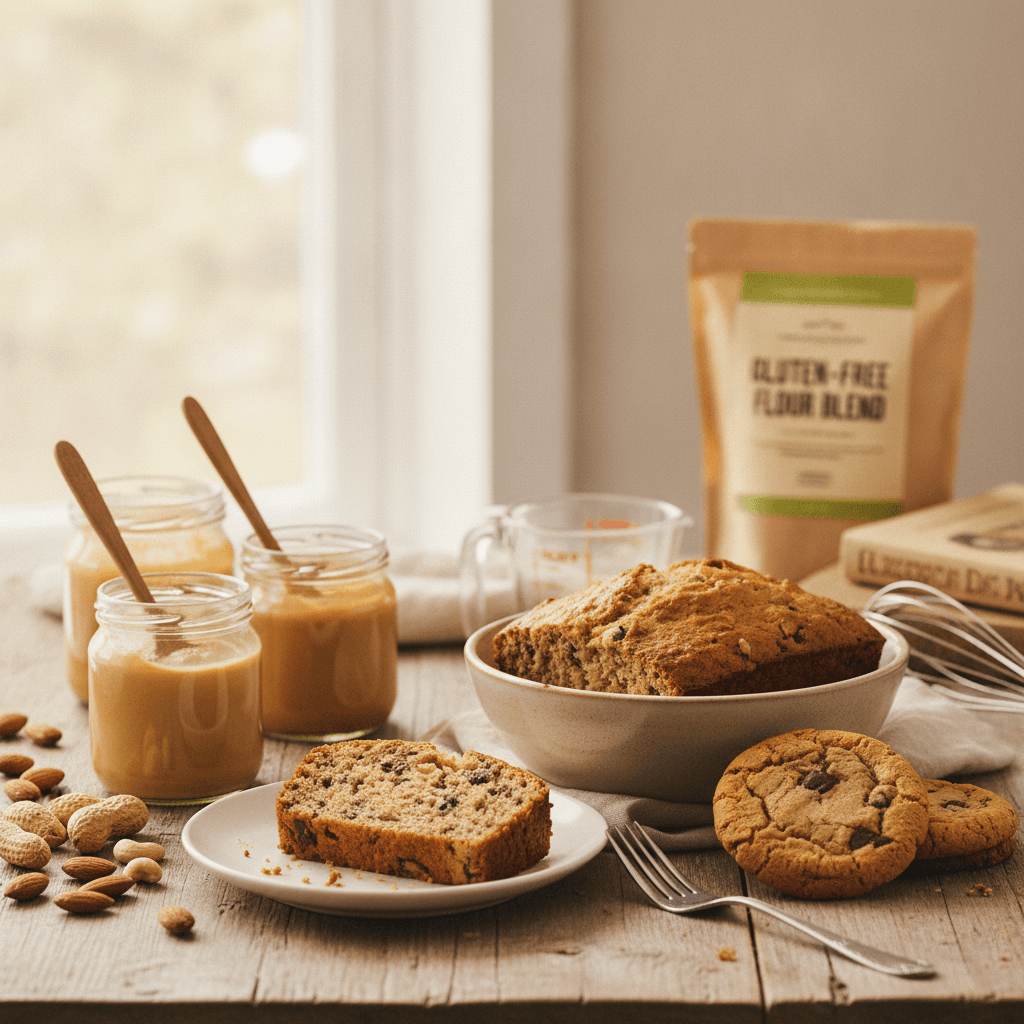
Nut butter can replace oil in many baked goods, but the swap is not as simple as a 1:1 scoop. Fat content, protein levels, and grind texture all vary between nut butters, and each one changes your crumb, moisture, and rise differently. Here is what actually works, what fails, and how to adjust.
Key takeaways
Most nut butters contain roughly 45–55% fat by weight, compared to oil's 100%, so you need to adjust ratios and expect a denser result.
Almond butter and cashew butter are the most reliable oil replacements in muffins, quick breads, and brownies — but not in recipes that need a light, airy crumb.
The standard starting ratio is roughly 3 parts nut butter for every 2 parts oil called for (by volume), though this varies by brand and grind.
Nut butters add protein, which tightens structure — expect chewier cookies and denser cakes compared to oil-based versions.
Peanut butter works well in brownies and cookies but brings a strong flavor that overpowers delicate baked goods like vanilla cake.
Chunky nut butters and nut butters with added sugar or salt introduce variables that make consistent results harder to achieve.
Why nut butter behaves differently from oil
Oil is 100% fat. It coats flour particles, limits gluten development (or starch bonding in gluten-free baking), and keeps crumb tender. Nut butter, on the other hand, is a mixture of fat, protein, fiber, and a small amount of carbohydrate. A typical almond butter runs about 50% fat, 21% protein, and 6% fiber by weight.
That protein and fiber matter. Protein absorbs liquid and sets during baking, creating a tighter crumb. Fiber holds moisture but also adds density. The net effect: nut butter gives you a richer, chewier, heavier texture than oil does. That can be a benefit in brownies and cookies, but it is a problem in angel food cake or chiffon.
There is also the issue of emulsification. Oil disperses evenly through batter with minimal mixing. Nut butters — especially natural ones where the oil separates — need more thorough mixing to distribute fat evenly. Under-mixed batter can bake unevenly, with dry pockets next to greasy ones.
Which nut butters work best as oil substitutes
Not all nut butters perform equally. Here is a comparison of the most common options and where they work.
Fat content (approx.) | Flavor impact | Best applications | Worst applications | |
|---|---|---|---|---|
~50% | Mild, slightly sweet | Muffins, brownies, banana bread | White cake, meringue-based items | |
Cashew butter | ~46% | Very mild, creamy | Quick breads, blondies, pancakes | Laminated doughs, light sponges |
~50% | Strong, distinctive | Cookies, brownies, chocolate cake | Vanilla cake, scones, anything where peanut flavor clashes | |
Sunflower seed butter | ~51% | Earthy, slightly bitter | Nut-free muffins, oat bars | Light-colored batters (can turn green due to chlorogenic acid reacting with baking soda) |
Tahini (sesame) | ~50% | Nutty, savory | Brownies, chocolate cookies, savory breads | Fruit-forward cakes, vanilla cookies |
Cashew butter is the most neutral-tasting option, which makes it the easiest drop-in for recipes where you do not want added flavor. Almond butter is a close second and tends to be easier to find in a smooth, unsweetened form.
The ratio that actually works
A common starting point is to use 3 tablespoons of smooth, unsweetened nut butter for every 2 tablespoons of oil the recipe calls for. This accounts for the lower fat percentage while keeping the batter moist enough.
However, this is a guideline, not a rule. Here is why:
Brand variation matters. A jar of natural almond butter from one brand may have noticeably more oil separation than another. Stir thoroughly before measuring.
Drippy vs. thick. "Drippy" natural nut butters (the kind that pour easily) are higher in surface oil and behave more like oil in batter. Thick, dense nut butters act more like a paste and add more structure. If your nut butter is very thick, you may need to add 1–2 tablespoons of liquid (water or milk) to compensate.
Recipe type changes the math. In a dense brownie, you can often do a straight 1:1 swap by volume and still get good results. In a lighter muffin, the 3:2 ratio or even adding a tablespoon of oil back alongside the nut butter prevents the crumb from getting too tight.
One approach that works well for gluten-free baking: replace half the oil with nut butter and keep the other half as oil. This gives you the flavor and protein benefits of nut butter while maintaining enough pure fat to keep the crumb tender. Gluten-free batters already tend toward dryness and crumbliness — a common problem — so preserving some liquid fat helps.
5 swaps that work
1. Almond butter in banana bread and muffins
Banana bread is forgiving. It is already dense and moist, so the extra protein from almond butter tightens the crumb slightly without making it tough. The mild almond flavor complements banana well. Use the 3:2 ratio or go 1:1 if you like a fudgier loaf.
If you are baking gluten-free banana bread with almond flour, adding almond butter on top of almond flour can push the almond flavor to the point where it overpowers the banana. In that case, cashew butter is a better choice.
2. Peanut butter in brownies
Brownies are one of the easiest places to swap nut butter for oil. The dense, fudgy texture actually benefits from the extra protein, and chocolate masks any heaviness. If you sell brownies, a 1:1 swap of natural peanut butter for canola oil can become a premium "peanut butter fudge" version: if the swap adds roughly $0.60 per batch in ingredients, charging $3 more per box more than covers it.
The key: use natural peanut butter with no added sugar. Commercial peanut butters with added sugar and hydrogenated oils behave differently — the stabilizers change how fat distributes in the batter.
3. Cashew butter in pancakes and waffles
Pancake and waffle batters typically call for 2–3 tablespoons of oil. Swapping in cashew butter at a 1:1 ratio adds richness without changing the flavor profile much. The batter will be slightly thicker, so add a splash of milk to thin it to the right consistency. The result is a slightly denser pancake with more protein, which keeps you fuller longer.
4. Tahini in chocolate cookies
Tahini's slightly bitter, savory edge pairs well with dark chocolate. In cookie recipes that call for canola oil or vegetable oil, tahini can go in at a 1:1 ratio. The cookies will spread slightly less (more protein = more structure) and have a chewier bite. This works especially well in recipes that already use brown sugar, which adds moisture to compensate for tahini's drier texture.
5. Sunflower seed butter in nut-free baking
For anyone baking for school events or people with tree nut allergies, sunflower seed butter is the go-to. It swaps in at the same 3:2 ratio. One important caveat: sunflower seed butter contains chlorogenic acid, which reacts with baking soda and can turn your batter green. This is harmless but visually startling. Using baking powder instead of baking soda, or adding a teaspoon of lemon juice or vinegar to the batter, reduces this reaction.
2 swaps that backfire
1. Any nut butter in angel food cake or chiffon cake
These cakes rely on whipped egg whites for nearly all of their structure and lift. Oil is used in chiffon cake specifically because it stays liquid at room temperature and does not weigh down the foam. Nut butter is heavy, thick, and full of protein that competes with the egg proteins for moisture. The result is a collapsed, dense cake that bears no resemblance to what you were trying to make. There is no ratio adjustment that fixes this — nut butter simply cannot do what oil does in foam-based cakes.
2. Chunky nut butter in anything
Chunky nut butter introduces irregular pieces of nut into the batter, which creates inconsistent texture and uneven baking. The nut pieces toast at a different rate than the surrounding crumb, sometimes burning before the center is done. If you want nut pieces in your baked goods, use smooth nut butter as the fat replacement and fold in chopped nuts separately — that way you control the size and distribution.
How nut butter changes texture, rise, and browning
Texture
Expect a denser, chewier result compared to oil. The protein in nut butter creates a tighter crumb structure. In cookies, this means more chew and less snap. In cakes, it means a heavier, moister slice. Whether this is a positive or negative depends entirely on what you are making.
Rise
Nut butter adds weight to the batter, which can reduce rise — especially in recipes that rely on chemical leaveners rather than whipped eggs. If your recipe already has a tendency toward poor rise, adding nut butter may make it worse. Consider increasing baking powder by about 25% (for example, going from 1 teaspoon to 1 1/4 teaspoons) to compensate.
Browning
Nut butters contain protein and natural sugars that accelerate Maillard browning. Your baked goods will brown faster on the outside. Reduce oven temperature by about 15–25 degrees Fahrenheit (roughly 10–15 degrees Celsius) and check for doneness a few minutes earlier than the original recipe suggests. This is especially important for cookies, which can go from golden to burnt in a narrow window.
Tips for getting a clean swap
Always use smooth, unsweetened nut butter. Added sugar changes moisture balance. Added salt throws off flavor. Hydrogenated oils change how fat behaves in the oven.
Stir natural nut butter thoroughly before measuring. The oil that separates to the top is part of the fat content you need. Scooping from the bottom gives you a drier, more protein-heavy paste that will make your baked goods tougher.
Measure by weight if possible. A tablespoon of drippy almond butter weighs less than a tablespoon of thick almond butter. Weighing gives you consistency. A reliable kitchen scale removes the guesswork.
Room temperature nut butter mixes better. Cold nut butter straight from the fridge is stiff and clumps in batter. Let it sit out for 20–30 minutes before baking, or microwave it for 10–15 seconds to soften.
Pair with other moisture sources. If you are worried about dryness, combine the nut butter swap with a moisture-adding ingredient. Mashed banana or applesauce both add moisture and natural sweetness that complement nut butter well.
A contrarian take: sometimes the "healthier" swap costs you more than you think
Nut butter as an oil substitute is often framed as a health upgrade — more protein, more fiber, more nutrients. And that is technically true. But here is what rarely gets mentioned: the calorie difference is negligible. Almond butter has about 98 calories per tablespoon. Canola oil has about 124 calories per tablespoon. When you use more nut butter to compensate for its lower fat content (the 3:2 ratio), the calorie difference per serving shrinks to almost nothing.
The real reason to use nut butter as an oil substitute is flavor and texture, not calorie reduction. If you are baking for someone who wants a richer, chewier result with nutty depth, nut butter is a genuine improvement. If you are swapping purely to cut calories, you will be disappointed by the math.
For bakers who are actually trying to reduce fat in baked goods, Greek yogurt as a butter substitute or applesauce as an oil substitute are more effective at cutting total fat and calories — though each comes with its own texture tradeoffs.
Nut butter swaps in gluten-free baking: extra considerations
Gluten-free baked goods already struggle with crumbliness, dryness, and poor structure because there is no gluten network to hold things together. Nut butter can actually help here — its protein provides some binding that partially compensates for the missing gluten. But it can also make gummy centers worse if you use too much, because the extra protein traps moisture in the middle of the crumb.
If you are working with almond flour or coconut flour, keep in mind that almond flour is already high in fat and protein. Adding almond butter on top of almond flour concentrates those properties further. Coconut flour, which absorbs a lot of liquid, pairs better with nut butter because the nut butter's fat helps offset coconut flour's drying effect.
A practical approach for gluten-free muffins or quick breads: replace half the oil with nut butter, keep the other half as oil, and add a flax egg or chia egg if the recipe does not already include eggs. The combination gives you binding from the nut butter protein, moisture from the oil, and additional structure from the flax or chia gel.
Frequently asked questions
Can you replace oil with nut butter in a box cake mix?
Yes, but expect a denser cake. Box mixes are formulated for a specific fat-to-dry ratio, and nut butter changes that balance. Use the 3:2 ratio (3 tablespoons nut butter for every 2 tablespoons oil called for) and add 1–2 tablespoons of water or milk to thin the batter. Reduce oven temperature by about 15 degrees Fahrenheit and check doneness a few minutes early, since the extra protein browns faster.
Does nut butter work as a butter substitute or only as an oil substitute?
Nut butter can replace both oil and butter, but the mechanics differ. Oil and nut butter are both liquid or semi-liquid fats, so the swap is more straightforward. Butter contributes water content (butter is roughly 80% fat and 15–20% water) and creates flaky layers in pastry through a process nut butter cannot replicate. For cookies, brownies, and quick breads, nut butter can replace butter. For pie crust, croissants, or puff pastry, it cannot. See our guide on avocado as a butter substitute for another option that handles some of those applications better.
Which nut butter has the mildest flavor for baking?
Cashew butter is generally the mildest and most neutral-tasting option. It blends into batters without adding a noticeable nutty flavor, making it the best choice for vanilla cakes, sugar cookies, or any recipe where you want the original flavor to come through. Almond butter is a close second but has a slightly more pronounced taste.
Will nut butter make my cookies spread less?
Usually, yes. Nut butter's protein content creates more structure in the dough, which resists spreading during baking. Oil-based cookie doughs tend to spread more because oil is 100% fat with no structural protein. If you want your cookies to spread as much as the original recipe intended, flatten the dough balls slightly before baking or add an extra tablespoon of liquid to the dough.
Is nut butter safe for people with nut allergies?
No. Nut butters are made from tree nuts or peanuts and are not safe for anyone with a nut allergy. For a nut-free alternative that behaves similarly, sunflower seed butter is the closest substitute, though it can cause green discoloration in recipes that use baking soda. Soy nut butter is another option but is less widely available and has a different fat profile.

Written by
Co-founder, BakingSubs
Co-founder of BakingSubs, where he turns the science of ingredient substitutions into tested, reliable guidance for home bakers.
Related Posts
Bake with Confidence
See all
Confident Gluten-Free Baker Toolkit
The science-based system that replaces gluten's seven invisible jobs so your baking turns out soft, fluffy, and foolproof — every time.

Gluten-Free Recipe Vault
Instant access to our complete library of proven gluten-free recipes — no waiting, no guesswork, just results that work tonight.

Fix Your Gluten-Free Bread
Learn the 3-step formula to make bread rise and stay soft, discover why your loaves collapse, and get a tested sandwich bread recipe that actually works.