

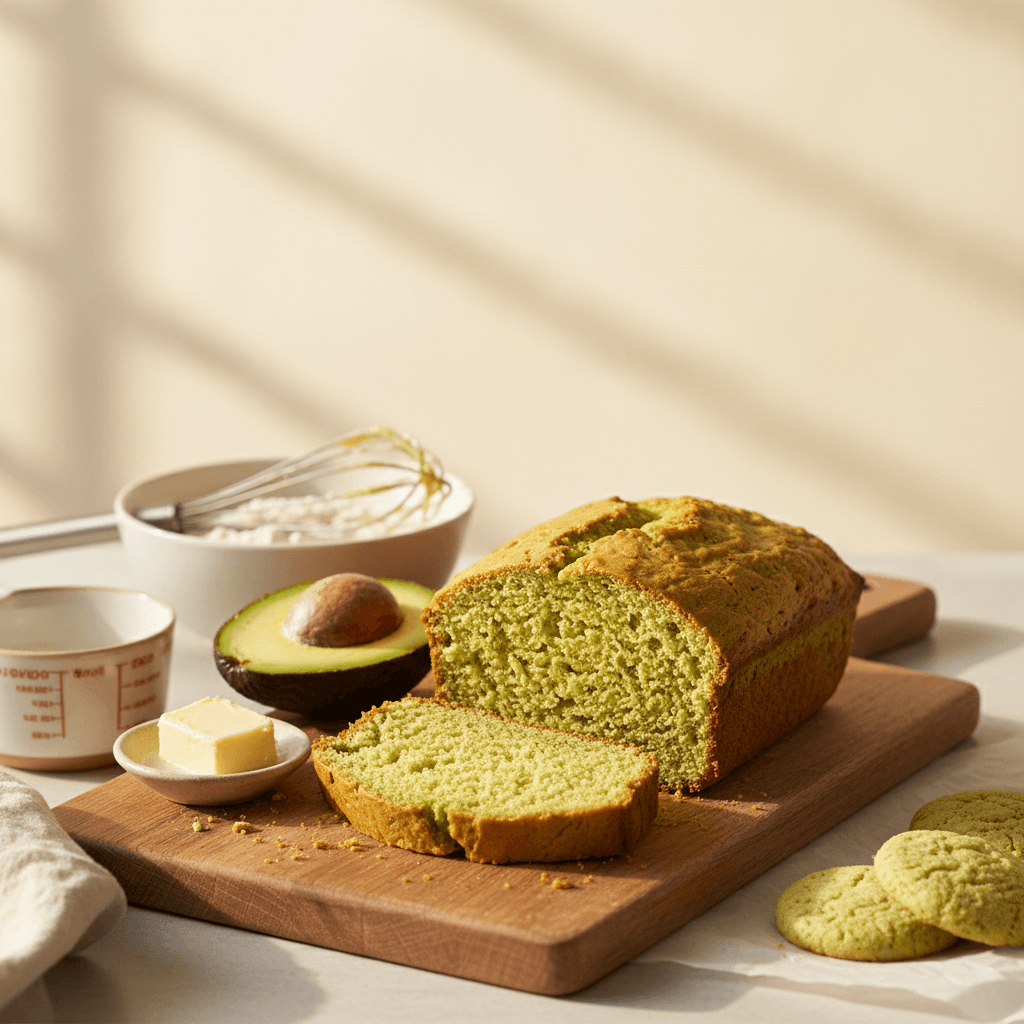
Swapping avocado for butter sounds almost too good to be true — a whole food, dairy-free fat that mashes smooth and bakes into brownies. It does work, but not the way butter works, and the differences catch people off guard. Here's what actually changes when you make the swap, and how to adjust so nothing falls flat.
Key takeaways
- Ripe avocado can replace butter at a 1:1 ratio by volume in most quick breads, muffins, and brownies, but the texture and flavor profile will shift noticeably.
- Avocado contains roughly half the fat of butter by weight and significantly more water, which affects crumb structure, browning, and spread.
- Cookies and pie crusts are the hardest categories for this swap — the lack of solid fat at room temperature means less flakiness and more cake-like results.
- Color is a real issue: avocado tints batter green, so darker batters (chocolate, spice) hide it best.
- Combining avocado with a small amount of coconut oil can recover some of the richness and structure that pure avocado batters lack.
Why avocado works as a butter substitute at all
Butter's primary job in baking is to provide fat, which coats flour proteins, traps air during creaming, and carries flavor. Avocado is one of the fattiest fruits available — roughly 15% fat by weight — so it can partially fill that role. Its creamy, smooth texture when ripe also lets it blend into batters without leaving chunks, which is more than you can say for some other whole-food fat swaps.
But the fat composition is different. Butter is about 80% fat and roughly 15% water. Avocado is closer to 15% fat and 73% water. That gap matters. You're introducing a lot more moisture and a lot less fat per gram, which changes how the crumb sets, how much the baked good browns, and how long it stays fresh on the counter. Understanding these differences is the key to making the substitution work instead of just hoping for the best.
The standard avocado-to-butter ratio
The most commonly cited ratio is 1:1 by volume — so one cup of mashed avocado replaces one cup of butter. This is a reasonable starting point for moist, dense baked goods like brownies and banana bread. For lighter items like cakes, many bakers find that using about three-quarters of the butter amount in avocado, then adding a tablespoon of oil to compensate for the lower fat content, gives better results.
| Baked good | Recommended avocado amount | Notes |
|---|---|---|
| Brownies | 1:1 (full replacement) | Works well — the dense, fudgy texture hides the swap |
| Muffins | 1:1 or 3/4 + oil | May need 1 tbsp extra oil for richness |
| Quick breads | 1:1 | Banana bread and zucchini bread are strong candidates |
| Cakes | 3/4 avocado + 2 tbsp oil per cup of butter | Full replacement can make crumb gummy |
| Cookies | Half avocado, half butter or coconut oil | Full replacement eliminates spread and crispness |
| Pie crust | Not recommended | Needs solid fat for flakiness — avocado can't deliver |
If you're also reducing sugar in the same recipe, keep in mind that sugar affects moisture retention and browning independently of fat. Pulling both levers at once can lead to dry, pale results. Our post on low-sugar baking substitutes that actually fix texture covers that side of the equation.
5 things that change when you swap avocado for butter
1. Color
This is the most visible difference. Avocado turns batter a noticeable green, and it doesn't bake out. In a chocolate brownie made with cocoa powder, the green is completely hidden. In a vanilla cake, it's front and center. If color matters for your finished product — say, you're selling decorated sugar cookies — this swap is a tough sell unless you're working with chocolate, spice, or deeply colored batters.
2. Browning and crust formation
Butter contains milk solids (casein and whey proteins) that participate in the Maillard reaction, producing golden-brown crusts and nutty, toasted flavors. Avocado doesn't have those proteins. Baked goods made with avocado tend to look paler on top and lack that characteristic buttery crust. You can partially compensate by brushing the top with a thin layer of milk or cream before baking, or by bumping the oven temperature up slightly for the last few minutes.
3. Texture and crumb
Because avocado has more water and less fat than butter, the crumb tends to be denser and more moist — sometimes crossing the line into gummy if you're not careful. This is especially true in cakes, where butter's ability to trap air during creaming is a big part of what creates a light, open crumb. Avocado doesn't cream the same way. It whips up smooth, but it doesn't hold air pockets the way cold, solid butter does.
For recipes where a dense, moist crumb is actually the goal — brownies, banana bread, some muffins — this shift works in your favor. For angel food cake or a delicate genoise, it's a deal-breaker. If you're baking gluten-free and already dealing with crumb structure challenges, adding avocado on top of a gluten-free flour blend can compound the density issue. You may want to review our guide on gummy centers in gluten-free baking if you run into that problem.
4. Flavor
Ripe avocado has a mild, slightly grassy flavor that's much less assertive than you might expect in a baked good. In chocolate recipes, it's virtually undetectable. In vanilla or lemon recipes, some people pick up on a faint vegetal note. The ripeness of the avocado matters — overripe avocados with brown spots can have a stronger, slightly off flavor that doesn't bake out. Use avocados that are ripe but still bright green inside for the most neutral taste.
5. Shelf life and storage
Butter-based baked goods can sit on the counter for a day or two without major quality loss. Avocado-based baked goods tend to lose moisture faster and can develop an unappealing grayish tinge on the surface after 24 hours, similar to how a cut avocado oxidizes. Refrigerating extends the window to about three days. Freezing works well — wrap tightly and thaw at room temperature. If you're a home baker considering this swap for products you sell, factor in the shorter counter life when planning your bake schedule.
Where this substitution shines (and where it doesn't)
The sweet spot for avocado as a butter substitute is in recipes that are already dense, moist, and strongly flavored. Think:
- Chocolate brownies and fudgy chocolate cake
- Banana bread and pumpkin bread
- Spice muffins with cinnamon, ginger, or cardamom
- Dark chocolate truffles and ganache-style fillings
The worst candidates are recipes that depend on butter's unique physical properties:
- Pie crust and puff pastry (need solid fat that melts in layers)
- Buttercream frosting (needs butter's ability to whip and hold structure)
- Shortbread and butter cookies (the flavor is butter)
- Croissants and laminated doughs (solid fat creates distinct layers)
For cookies specifically, a 50/50 split between avocado and coconut oil gives better results than either alone. The coconut oil provides the solid fat that helps cookies hold their shape and develop crisp edges, while the avocado contributes moisture and a softer center.
How to pick and prep avocado for baking
Not all avocados are created equal for baking purposes. Here's what to look for:
Variety: Hass avocados are the standard choice. Their higher fat content (compared to Florida or Fuerte varieties) and creamier texture make them blend more smoothly into batters. A large Hass avocado yields roughly half a cup of mashed flesh, so plan accordingly.
Ripeness: You want avocados that yield to gentle pressure but aren't mushy. The flesh should be uniformly bright green with no brown streaks. Brown spots indicate oxidation and can introduce bitter, off flavors.
Prep: Mash the avocado thoroughly with a fork until no lumps remain, or blend it in a food processor for an even smoother result. Lumps of avocado in batter don't break down during baking — they just sit there as odd green pockets in your finished product.
For muffins, a useful technique is to puree the avocado with the liquid ingredients in a food processor first, then fold in the dry. Blending the avocado into the wet ingredients rather than creaming it like butter sidesteps the air-incorporation problem entirely and produces a consistently dense, moist muffin — a good option for dairy-free chocolate muffins.
Combining avocado with other fats for better results
Pure avocado replacement works in forgiving recipes, but for anything that needs more structure or richness, blending avocado with another fat source closes the gap. Here are the most practical combinations:
| Combination | Best for | Why it works |
|---|---|---|
| 75% avocado + 25% coconut oil | Muffins, quick breads | Coconut oil adds richness and helps with browning |
| 50% avocado + 50% coconut oil | Cookies | Restores some solid-fat structure for shape and crispness |
| 75% avocado + 25% avocado oil | Cakes | Boosts total fat without adding dairy; keeps it vegan |
| 50% avocado + 50% applesauce | Ultra-low-fat muffins | Cuts fat further but increases moisture — reduce other liquids |
If you're going fully dairy-free and also want to avoid eggs, check our guide on vegan egg substitutes to find pairings that work alongside avocado without creating a soggy mess.
A contrarian take: avocado isn't always the healthiest swap
A lot of the enthusiasm around avocado as a butter substitute comes from the assumption that it's automatically healthier. And on paper, avocado does have a better fatty acid profile — mostly monounsaturated fat versus butter's saturated fat. But here's the thing: because avocado has so much less fat per volume than butter, you sometimes end up compensating by adding oil, extra eggs, or other fats to get the texture right. By the time you've patched the recipe, the total fat and calorie count may not be dramatically different from the original.
The real advantage of avocado isn't necessarily fewer calories — it's the ability to bake dairy-free with a whole food instead of margarine or shortening. If dairy avoidance is the goal, avocado is a genuinely useful tool. If calorie reduction is the goal, you might get more mileage from reducing the total fat in the recipe and accepting a slightly different texture, rather than doing a 1:1 swap with a different fat source.
Tips for avoiding common avocado-baking mistakes
- Don't over-mix. Avocado batters can become gummy if overworked. Mix until just combined, the same way you'd handle any quick bread batter.
- Don't skip the leavener check. Because avocado adds extra moisture, your baking powder or baking soda needs to be fresh and properly measured. Stale leavener plus extra moisture equals a flat, dense brick.
- Don't use underripe avocado. It won't mash smooth, and the flavor is bitter and astringent. If your avocado is hard, let it ripen at room temperature for a day or two before baking with it.
- Don't expect the same oven time. The extra moisture in avocado batter often means baked goods need an additional 3-5 minutes in the oven. Use the toothpick test rather than relying on the timer alone.
- Don't store at room temperature for more than a day. Avocado-based baked goods oxidize and stale faster than butter-based ones. Refrigerate or freeze what you won't eat within 24 hours.
Frequently asked questions
Can you taste avocado in baked goods?
In most cases, the avocado flavor is very mild and gets masked by other ingredients. Chocolate, spices, and banana are especially good at hiding it. In plain vanilla recipes, some people notice a faint grassy or vegetal note, but it's subtle. Using ripe (not overripe) Hass avocados minimizes any off flavors.
Does avocado make baked goods green?
Yes. Avocado tints batter green, and the color doesn't bake out. This is a non-issue in chocolate recipes where cocoa powder dominates the color. For lighter batters, the green is visible in the finished product. There's no reliable way to eliminate the color without adding artificial dye.
Is avocado a good butter substitute for cookies?
It's a partial substitute at best. Cookies rely on solid fat for spread control, crisp edges, and structure. Avocado is soft at room temperature, so cookies made with 100% avocado tend to be cakey rather than crisp. A 50/50 blend of avocado and coconut oil gives better results. For more on the avocado ingredient page, see our full substitution guide.
Can you use avocado as a butter substitute in gluten-free baking?
You can, but proceed carefully. Gluten-free batters already tend toward dense, gummy textures because they lack the protein network that gluten provides. Adding avocado — which is higher in moisture and lower in fat than butter — can amplify those issues. If you go this route, consider adding a tablespoon of oil to boost fat content, and make sure your leavening is fresh. Our guide on dry, crumbly gluten-free bakes covers related troubleshooting.
How do you store baked goods made with avocado instead of butter?
Refrigerate them. Avocado-based baked goods oxidize faster than butter-based ones and can develop a grayish surface within 24 hours at room temperature. Wrapped tightly and refrigerated, they stay good for about three days. For longer storage, freeze individual portions in airtight containers or freezer bags and thaw at room temperature when ready to eat.

Written by
Co-founder, BakingSubs
Co-founder of BakingSubs, where he turns the science of ingredient substitutions into tested, reliable guidance for home bakers.
Related Posts
Bake with Confidence
See all
Confident Gluten-Free Baker Toolkit
The science-based system that replaces gluten's seven invisible jobs so your baking turns out soft, fluffy, and foolproof — every time.

Gluten-Free Recipe Vault
Instant access to our complete library of proven gluten-free recipes — no waiting, no guesswork, just results that work tonight.

Fix Your Gluten-Free Bread
Learn the 3-step formula to make bread rise and stay soft, discover why your loaves collapse, and get a tested sandwich bread recipe that actually works.