

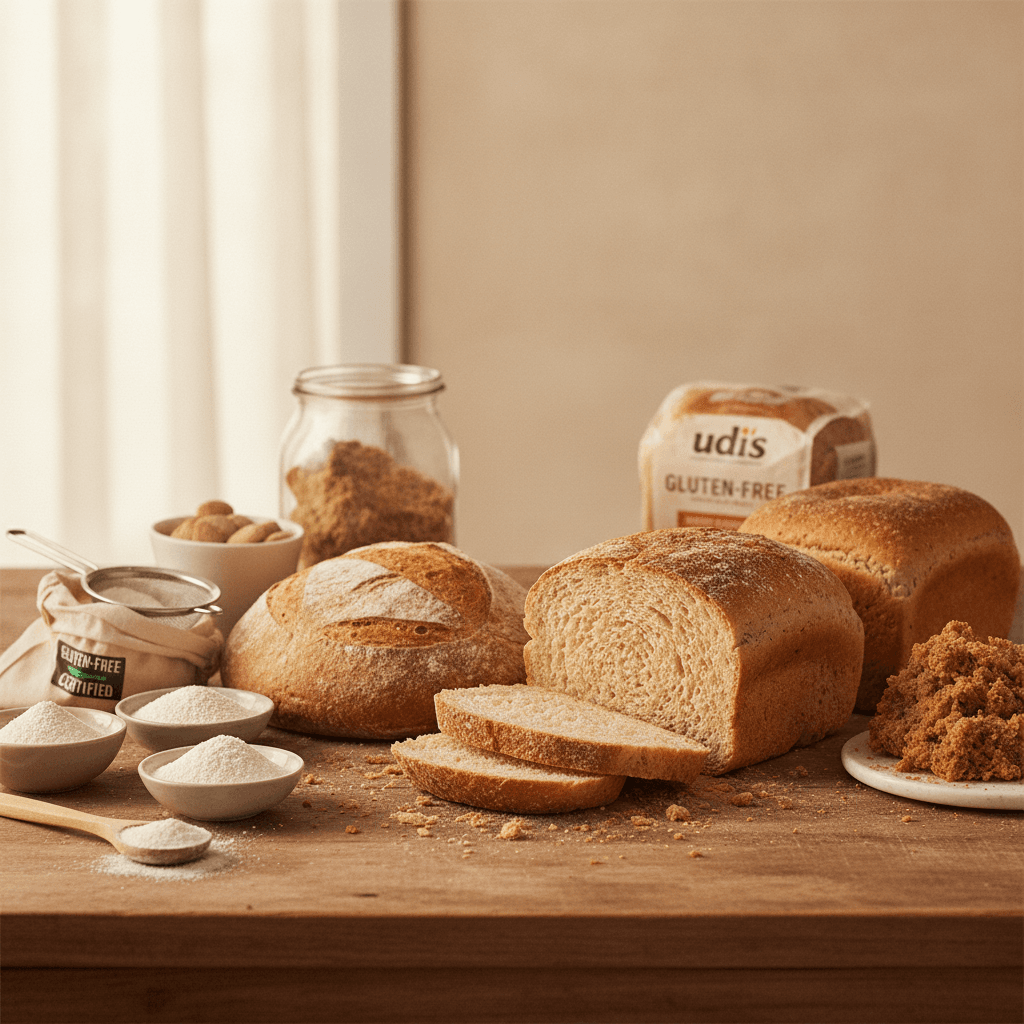
Schar is one of the most widely available gluten-free bread brands in the U.S. We ranked every Schar bread currently listed on Schar's U.S. site using ingredient quality, fiber per slice, price per ounce, availability, and published customer reviews. The Artisan Baker line lands at the top; the par-baked Ciabatta and the Hamburger Buns come last mainly because they cost the most per ounce and serve narrower uses. Below is the full ranking with certification details, ingredient breakdowns, and how Schar stacks up against Canyon Bakehouse and Udi's.
Prices checked September 2026 and vary by store.
Key takeaways
- Schar says all of its bakeries are dedicated gluten-free facilities and that it tests raw ingredients and finished products to below 5 ppm of gluten. Its U.S. site does not display the GFCO mark, so treat Schar bread as labeled gluten-free and confirm certification on the package.
- Every sliced Schar loaf sold in the U.S. is now built on a rice-flour sourdough plus corn starch and rice starch, with psyllium seed husk as the main binder. First three ingredients of the Artisan Baker White: water, corn starch, sourdough (rice flour, water).
- All of Schar's sliced loaves contain soy protein. If you avoid soy, the Hamburger Buns (which only list a "may contain" soy warning) are the only bread on this list without soy as an ingredient.
- At about $0.39 per ounce at Walmart, Schar's Artisan Baker White costs more per ounce than Canyon Bakehouse's 24-oz Heritage Style Honey White (about $0.32) and slightly less than Udi's 12-oz Delicious Soft White (about $0.41).
- Schar's old Hearty White and original Multigrain loaves no longer appear on Schar's U.S. site; the current sliced lineup is the three Artisan Baker loaves, two Deli Style loaves, and an XL Sandwich Bread that was out of stock at the time of checking.
- Canyon Bakehouse and Udi's both carry the GFCO mark (tested to under 10 ppm); Canyon also bakes in a dedicated gluten-free facility.
What makes Schar different from other gluten-free bread brands
Schar (Dr. Schär on some packaging) is an Italian company that has specialized in gluten-free food since 1981. Its breads are produced in dedicated gluten-free facilities, including a plant in Swedesboro, New Jersey that serves the U.S. market. That matters if you have celiac disease and worry about cross-contamination during production.
One important distinction: Schar's U.S. site describes its facilities as dedicated gluten-free and says it tests to below 5 ppm, which is stricter than both the FDA's 20 ppm labeling threshold and GFCO's 10 ppm certification limit. What Schar does not show on its U.S. product pages is a third-party certification mark such as GFCO. If you specifically want a GFCO-certified loaf, Canyon Bakehouse and Udi's both carry that seal.
Most Schar breads rely on a base of water, corn starch, rice-flour sourdough, and rice starch, bound with psyllium seed husk and modified cellulose. This gives them a softer, more neutral crumb than brands that lean heavily on brown rice or sorghum flour, though it also means the plain loaves are relatively low in protein and fiber (about 2 g of fiber per 29 g slice in the Artisan Baker White and Multigrain).
Every Schar bread loaf, ranked
We ranked each product on ingredient quality (fiber, whole grains, seeds), price per ounce, package size, availability on Schar's U.S. site, and published customer ratings. This ranking is not based on our own taste testing. Package weights and direct prices come from schaer.com; the Walmart price for the Artisan Baker White is included because it is the loaf most stores stock.
1. Artisan Baker White Bread
This is Schar's flagship loaf and the one you are most likely to find in a regular grocery store. It is the largest sliced loaf Schar sells in the U.S. (14.1 oz), it has the lowest retail price per ounce of any Schar bread, and its neutral flavor makes it the most versatile for sandwiches and toast. The current recipe is made with a rice-flour sourdough, which reviewers describe as softer and less crumbly than Schar's older white loaves.
- First three ingredients: Water, corn starch, sourdough (rice flour, water)
- Certification: Labeled gluten-free; Schar tests to under 5 ppm; confirm certification on the package
- Facility: Dedicated gluten-free facility
- Allergens: Contains soy; may contain sesame. Egg-free, dairy-free
- Fiber: 2 g per 29 g slice
- Price per ounce: About $0.39 (about $5.50 for 14.1 oz at Walmart; $7.49 direct from schaer.com)
2. Artisan Baker Multigrain Bread
Same 14.1-oz loaf size and same direct price as the White, with sunflower seeds, flax seeds, buckwheat flour, and quinoa flour added. It is the highest-rated Schar loaf on Schar's own site (4.5 stars across more than 1,000 reviews at the time of checking). If you want a Schar bread with more character than plain white but do not want a seed-heavy loaf, this is the one.
- First three ingredients: Water, sourdough (rice flour, water), rice starch
- Certification: Labeled gluten-free; Schar tests to under 5 ppm; confirm certification on the package
- Facility: Dedicated gluten-free facility
- Allergens: Contains soy; may contain sesame. Egg-free, dairy-free
- Fiber: 2 g per 29 g slice
- Price per ounce: About $0.53 direct from schaer.com ($7.49 for 14.1 oz); typically less in stores
3. Artisan Baker 10 Grains and Seeds Bread
The most ingredient-dense loaf in the lineup: sunflower, pumpkin, flax, and chia seeds plus millet, quinoa, buckwheat, and amaranth flours. It has the most fiber of the three Artisan Baker loaves (3 g per slice) at the same size and direct price. Schar notes the recipe was updated, and it remains listed as in stock on the U.S. site.
- First three ingredients: Water, corn starch, sourdough (rice flour, water)
- Certification: Labeled gluten-free; Schar tests to under 5 ppm; confirm certification on the package
- Facility: Dedicated gluten-free facility
- Allergens: Contains soy; may contain sesame. Egg-free, dairy-free
- Fiber: 3 g per 29 g slice
- Price per ounce: About $0.53 direct from schaer.com ($7.49 for 14.1 oz)
4. Deli Style Sourdough
Schar's Deli Style Bread is a rice-flour sourdough with buckwheat and sorghum flours, sold as a small 8.5-oz loaf of thick deli-size slices. It is vegan and labeled low FODMAP, and each 48 g slice has 4 g of fiber, double the Artisan Baker loaves. It ranks below the Artisan Baker line only because the small loaf pushes the price per ounce well above the sliced sandwich loaves.
- First three ingredients: Corn starch, water, sourdough (rice flour, water)
- Certification: Labeled gluten-free; Schar tests to under 5 ppm; confirm certification on the package
- Facility: Dedicated gluten-free facility
- Allergens: Contains soy; may contain sesame. Vegan, dairy-free
- Fiber: 4 g per 48 g slice
- Price per ounce: About $0.70 direct from schaer.com ($5.99 for 8.5 oz)
5. Deli Style Sourdough Seeded
The seeded version of the Deli Style loaf adds flax, sunflower, and chia seeds to the same sourdough base. It has the most fiber per slice of any Schar bread (5 g per 50 g slice). Like the plain Deli Style, it is a small 8.8-oz loaf, so it costs more per ounce than the Artisan Baker line.
- First three ingredients: Corn starch, water, sourdough (rice flour, water)
- Certification: Labeled gluten-free; Schar tests to under 5 ppm; confirm certification on the package
- Facility: Dedicated gluten-free facility
- Allergens: Contains soy; may contain sesame. Egg-free, dairy-free
- Fiber: 5 g per 50 g slice
- Price per ounce: About $0.68 direct from schaer.com ($5.99 for 8.8 oz)
6. Ciabatta Rolls
These are par-baked rolls (four 50 g rolls per 7-oz package) that you finish in a hot oven; Schar's baking guidance is roughly 8 to 10 minutes at about 400 degrees F, so check the package. Finishing them in the oven gives a genuinely crisp crust, which is rare in gluten-free bread, and reviewers often use them as burger buns or for small sandwiches. They rank here because the per-ounce price is the highest in the lineup and they need an oven.
- First three ingredients: Water, corn starch, corn flour
- Certification: Labeled gluten-free; Schar tests to under 5 ppm; confirm certification on the package
- Facility: Dedicated gluten-free facility
- Allergens: Contains soy; may contain sesame. Vegan, dairy-free
- Fiber: 3 g per roll
- Price per ounce: About $0.89 direct from schaer.com ($6.29 for 7 oz, 4 rolls)
7. Hamburger Buns
Four 75 g buns per 10.6-oz package, made on the same rice-flour sourdough base. They are vegan and, unlike the sliced loaves, do not list soy protein as an ingredient (only a "may contain" warning), which makes them the pick for soy-avoiders. Reviewers commonly recommend toasting the cut sides before assembling a burger. They rank last simply because buns are a narrower use than a sandwich loaf, not because of any ingredient shortfall.
- First three ingredients: Water, corn starch, sourdough (rice flour, water)
- Certification: Labeled gluten-free; Schar tests to under 5 ppm; confirm certification on the package
- Facility: Dedicated gluten-free facility
- Allergens: May contain sesame and soy. Vegan, egg-free, dairy-free
- Price per ounce: About $0.56 direct from schaer.com ($5.99 for 10.6 oz, 4 buns)
What to skip (or at least double-check)
- XL Sandwich Bread. Schar's newest large-slice loaf (280 g) was listed as out of stock on the U.S. site when we checked, so we did not rank it. If it shows up in your store, note that it swaps some corn starch for potato starch and, like the other loaves, contains soy protein.
- Hearty White and the original Multigrain. These older loaves no longer appear on Schar's U.S. site. Many older reviews describing Schar bread as small, dry, and crumbly are about these discontinued products, not the current Artisan Baker line.
- Any sliced Schar loaf if you avoid soy. Every sliced loaf above lists soy protein as an ingredient.
How Schar compares to Canyon Bakehouse and Udi's
These are the three brands you will find in most U.S. grocery stores' gluten-free bread sections. Here is how they compare on the factors that matter most.
| Factor | Schar | Canyon Bakehouse | Udi's |
|---|---|---|---|
| Certification | Labeled gluten-free; company tests to under 5 ppm; no GFCO mark shown on U.S. site | GFCO certified (under 10 ppm) | GFCO certified (under 10 ppm) |
| Dedicated GF facility | Yes (company statement) | Yes (Johnstown, Colorado) | Not stated by the company |
| Typical first 3 ingredients | Water, corn starch, sourdough (rice flour, water) | Water, brown rice flour, tapioca flour | Water, pea starch, modified tapioca starch |
| Slice size (best loaf) | Standard, 29 g slices (Artisan Baker, 14.1-oz loaf) | Large-sliced (Heritage Style, 24-oz loaf) | Smaller (Delicious Soft White, 12-oz loaf; an 18-oz version is also sold) |
| Approximate price per ounce | About $0.39 (Artisan Baker White, Walmart) | About $0.32 (Heritage Style Honey White, Walmart) | About $0.41 (Delicious Soft White, Walmart) |
| Allergen notes | Contains soy; egg-free, dairy-free | Contains eggs; free of dairy, nuts, and soy | Contains egg whites; no dairy or soy ingredients |
| Best for sandwiches | Artisan Baker White | Heritage Style Honey White | Delicious Soft White |
| Whole grain | Seeds and some whole-grain flours in Multigrain and 10 Grains | Heritage Style is labeled 100% whole grain | Whole Grain and Multigrain varieties available |
The biggest differentiator is certification and facility transparency. Canyon Bakehouse offers both a GFCO seal and a dedicated gluten-free bakery. Udi's carries the GFCO seal but does not publish a dedicated-facility statement. Schar publishes the strictest internal testing threshold of the three (under 5 ppm) and states its facilities are dedicated, but does not show a third-party mark on its U.S. product pages.
On ingredients, Schar is the starch-forward option (corn starch, rice starch, rice-flour sourdough), Canyon is the whole-grain option (brown rice and sorghum flours, with eggs for structure), and Udi's current formula leans on pea starch and modified tapioca starch with egg whites. Which one tastes best is a matter of preference; published reviews generally rank Canyon's Heritage Style and Schar's Artisan Baker loaves above Udi's for sandwich use.
Who should buy Schar bread
- People with celiac disease or gluten sensitivity who are comfortable with a dedicated-facility, under-5-ppm company standard rather than a third-party seal
- Anyone who needs an egg-free gluten-free bread; every Schar loaf here is egg-free, and the Deli Style loaves, Ciabatta, and Hamburger Buns are vegan
- Anyone who prefers a neutral bread flavor that will not compete with fillings
- Shoppers who want a shelf-stable loaf rather than a frozen one
- Shoppers who want par-baked options like the Ciabatta Rolls for a crispy crust
Who should skip Schar bread
- People who avoid soy: all sliced Schar loaves contain soy protein
- Shoppers who specifically require a GFCO seal on the package; Canyon Bakehouse and Udi's both carry it
- People who want a whole-grain-forward loaf with higher protein; Schar's starch-heavy formulas do not deliver that, and Canyon's Heritage Style is labeled 100% whole grain
- Bakers looking for a gluten-free bread they can make at home; if you are interested in baking your own, check our guide on avoiding gummy centers in gluten-free baking and our brown rice flour page for flour blend tips
- Anyone on a tight budget who goes through bread quickly: at about $5.50 for a 14.1-oz loaf at Walmart, a two-sandwich-a-day household will go through roughly two loaves a week, or about $11 a week
Tips for getting the best results from Schar bread
Gluten-free bread in general benefits from a few handling tricks, and Schar is no exception.
Toast it. Most gluten-free sandwich breads improve with a minute or two in a toaster, and reviewers consistently say the same about Schar. The dry, crumbly texture that plagues many GF breads is partly a moisture-distribution issue, and toasting resets the crust-to-crumb contrast.
Store it in the freezer. Schar sells its sliced loaves shelf-stable (not frozen), but once you open the package, freeze what you will not eat within a couple of days. GF bread stales faster than wheat bread because it lacks the gluten network that traps moisture. Portioning the loaf into small freezer bags and pulling out a few slices at a time works well; slices thaw quickly at room temperature or can go straight into the toaster from frozen.
Do not microwave it. Microwaving GF bread tends to turn it rubbery and gummy. If you need to warm it quickly, use a skillet over medium heat for about a minute per side.
A note on Schar sourdough and celiac safety
We get this question a lot: is sourdough bread safe for celiac disease? The answer depends entirely on what flour the sourdough is made with. Traditional sourdough made with wheat flour is not safe for celiac disease. Long fermentation does reduce gluten content, but it does not eliminate it, and wheat sourdough still contains enough gluten to trigger an immune response in people with celiac disease.
Schar's sourdough breads are safe in this respect because the "sourdough" in the ingredient list is made from rice flour and water, and the rest of the loaf uses gluten-free starches and flours. The tang comes from fermenting gluten-free grains, not from a wheat-based starter. This is an important distinction that gets lost in the "is sourdough gluten-free" conversation.
Other brands making genuinely gluten-free sourdough-style breads include Canyon Bakehouse (which sells a gluten-free Sour-Dough loaf) and some local bakeries that use dedicated GF sourdough starters with buckwheat flour or brown rice flour bases.
Why Schar's ingredient list matters for home bakers
If you bake gluten-free bread at home, studying Schar's ingredient list can teach you something. Schar leans on corn starch and rice starch rather than whole-grain flours for the bulk of the loaf, which produces a softer, whiter crumb than blends heavy in brown rice flour, which can be gritty. For structure, Schar uses psyllium seed husk plus modified cellulose (a cellulose-based binder that mimics some of gluten's structural role), and a rice-flour sourdough for flavor and keeping quality.
Home bakers typically use xanthan gum or psyllium husk as their binder. If your homemade GF bread is coming out dense or crumbly, the binder ratio is often the issue. A common starting point is 1 teaspoon of xanthan gum per cup of GF flour blend for sandwich bread, or about 6 g of psyllium husk powder per 100 g of flour if you prefer a psyllium-based approach. Our guide to fixing poor rise in gluten-free baking covers this in more detail.
Checked: September 2026
Frequently asked questions
Is Schar bread GFCO certified?
Schar's U.S. product pages do not display the GFCO mark. Schar states that its bakeries are dedicated gluten-free facilities and that it tests ingredients and finished products to below 5 ppm of gluten, which is stricter than the GFCO's 10 ppm limit, but that is a company standard rather than a third-party seal. Treat Schar bread as labeled gluten-free and confirm certification on the package. If you specifically need a GFCO seal, Canyon Bakehouse and Udi's both carry it.
Which Schar bread is best for sandwiches?
The Artisan Baker White Bread is Schar's best sandwich loaf on our criteria: it is the largest sliced loaf, the cheapest per ounce at retail, neutral in flavor, and egg- and dairy-free. The Artisan Baker Multigrain is a close second and is the highest-rated loaf on Schar's own site. Toast either lightly for the best texture.
Is Schar sourdough bread safe for celiac disease?
Yes. Schar's Deli Style Sourdough and its Artisan Baker loaves use a sourdough made from rice flour and water; none of them contain wheat. Traditional wheat sourdough, by contrast, is not safe for celiac disease, because fermentation reduces gluten but does not eliminate it. Always check that any sourdough bread you buy is made with GF flours, not just long-fermented wheat.
How does Schar bread compare to Canyon Bakehouse?
Canyon Bakehouse carries GFCO certification (under 10 ppm) and bakes in a dedicated gluten-free facility in Colorado; Schar states its facilities are dedicated and tests to under 5 ppm but does not show a third-party mark on its U.S. site. On ingredients, Canyon's Heritage Style loaves are whole-grain and egg-based, while Schar's are starch-forward, egg-free, and contain soy. Canyon's 24-oz Heritage Style Honey White is currently cheaper per ounce than Schar's Artisan Baker White at Walmart (about $0.32 versus $0.39), though prices vary by retailer.
Why does Schar bread last so long without refrigeration?
Schar sells its sliced loaves shelf-stable in sealed packaging that keeps the bread fresh until opened, which is why it can sit on a dry-goods shelf with a long best-by date instead of in the freezer case. Once you open the package, that protection is gone and the bread will stale within a few days at room temperature. Freeze any slices you will not eat within about 48 hours for the best results.

Written by
Co-founder, BakingSubs
Co-founder of BakingSubs, where he turns the science of ingredient substitutions into tested, reliable guidance for home bakers.
Related Posts
Bake with Confidence
See all
Confident Gluten-Free Baker Toolkit
The science-based system that replaces gluten's seven invisible jobs so your baking turns out soft, fluffy, and foolproof — every time.

Gluten-Free Recipe Vault
Instant access to our complete library of proven gluten-free recipes — no waiting, no guesswork, just results that work tonight.

Fix Your Gluten-Free Bread
Learn the 3-step formula to make bread rise and stay soft, discover why your loaves collapse, and get a tested sandwich bread recipe that actually works.