

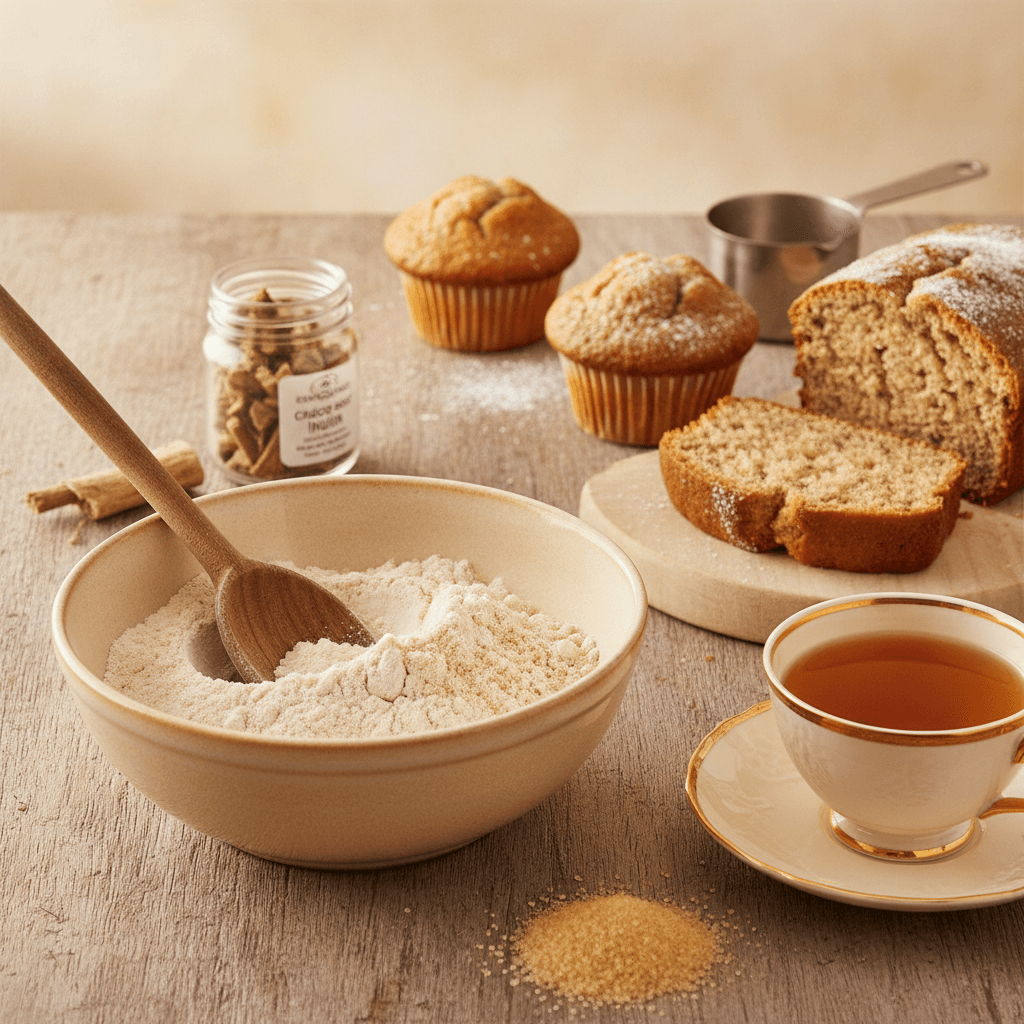
Chicory root fiber shows up on ingredient labels under names like inulin and oligofructose, and it behaves nothing like the sugar it claims to replace. Understanding what it actually does in batter and dough — and where it falls short — saves you from dense, bitter, or weirdly gummy results.
Key takeaways
- Chicory root fiber (inulin) provides about 25–35% of the sweetness of granulated sugar, so it cannot replace sugar one-to-one on sweetness alone.
- Its real strength is adding bulk, moisture retention, and a mild prebiotic fiber boost — not replicating sugar's flavor.
- Most successful uses pair chicory root fiber with a high-intensity sweetener like monk fruit or erythritol to cover the sweetness gap.
- Digestive tolerance is a genuine concern: amounts above roughly 10–15 grams per serving can cause bloating, gas, and cramping in many people.
- Chicory root fiber works best in muffins, quick breads, and soft cookies — it struggles in recipes that rely on sugar for crisp texture or caramelization.
What chicory root fiber actually is
Chicory root fiber is a soluble fiber extracted from the root of the chicory plant (Cichorium intybus). The two forms you will encounter in baking are inulin, a longer-chain fiber that forms a slightly creamy, fat-like texture, and oligofructose (sometimes called FOS), a shorter-chain version that tastes sweeter but still falls well below sugar. Both are classified as prebiotic fibers, meaning they feed beneficial gut bacteria. That is a well-established nutritional fact, but it comes with a trade-off we will get to shortly.
On a label, you might see "chicory root extract," "chicory root fiber," "inulin," or "oligofructose." They are all from the same plant, just processed to different chain lengths. Inulin typically provides around 25% of sugar's sweetness. Oligofructose lands closer to 35%. Neither comes close to tasting like sugar on its own.
Why bakers reach for it (and what it actually does well)
Sugar does at least six things in baked goods beyond making them sweet: it tenderizes gluten, retains moisture, helps with browning, creates spread in cookies, contributes to crumb structure, and enables caramelization. Chicory root fiber can handle a few of those jobs but not all of them.
Here is where it genuinely helps:
- Bulk. High-intensity sweeteners like stevia and monk fruit are hundreds of times sweeter than sugar, so you need almost none by volume. That leaves a massive gap in dry ingredient volume. Inulin fills that gap without adding significant sweetness or calories. In a low-sugar muffin, for example, inulin can serve purely as a bulking agent paired with monk fruit sweetener: the inulin is there for structure, not flavor.
- Moisture retention. Inulin is hygroscopic, meaning it pulls water from the environment and holds onto it. This helps baked goods stay soft for an extra day or two compared to recipes where sugar is simply removed with nothing replacing it.
- Mild fat-mimicking. When inulin is mixed with water, it forms a gel-like texture that can mimic some of the mouthfeel of fat. This is why you see it in reduced-fat baked goods, not just reduced-sugar ones.
- Fiber content. For bakers creating products marketed as high-fiber, inulin adds soluble fiber without the gritty texture of bran or the dense weight of high-fiber flours.
Where chicory root fiber fails as a sugar substitute
This is the part most product marketing skips. Chicory root fiber cannot do several things sugar does, and pretending otherwise leads to disappointing bakes.
It does not caramelize
Sugar caramelizes at around 160–180 degrees Celsius (320–356 degrees Fahrenheit), creating the golden-brown crust on cookies, the crackly top on brownies, and the deep flavor in caramel sauces. Inulin does not caramelize. If your recipe depends on Maillard browning or caramelization for color and flavor, chicory root fiber will leave you with a pale, flat-tasting result.
It does not cream with butter
The creaming step — beating sugar into butter to incorporate air — is a mechanical process that depends on sugar crystals cutting into fat. Inulin powder is too fine and too soft to do this. Cookies and cakes that rely on creaming for lift will come out denser if you swap in inulin without adjusting the leavening.
It does not create crispness
Crisp cookies, tuile, and brittle all depend on sugar resolidifying as it cools. Inulin stays soft. If you want a crisp sugar cookie, chicory root fiber is the wrong tool.
It is not sweet enough on its own
At roughly 25–35% of sugar's sweetness, using chicory root fiber as a standalone sugar replacement means your muffins taste like slightly sweet cardboard. Almost every successful application pairs it with a concentrated sweetener.
How to pair chicory root fiber with other sweeteners
The most common approach is using chicory root fiber for bulk and moisture, then adding a high-intensity sweetener for the actual sweet taste. Here are the pairings that show up most often in low-sugar and keto-friendly baking:
| Pairing | What inulin handles | What the sweetener handles | Best for |
|---|---|---|---|
| Inulin + erythritol | Bulk, moisture, fiber | Sweetness, some crystallization | Muffins, quick breads, soft cookies |
| Inulin + monk fruit extract | Bulk, moisture, fiber | Sweetness (no aftertaste for most people) | Cakes, pancakes, banana bread |
| Inulin + allulose | Fiber, fat-mimicking texture | Sweetness, browning, moisture | Cookies, brownies (allulose caramelizes) |
| Inulin + stevia | Bulk, moisture, fiber | Sweetness (can have bitter aftertaste) | Muffins, dense cakes — use cautiously |
The allulose pairing is worth highlighting. Allulose is one of the few sugar alternatives that actually browns and caramelizes, which compensates for inulin's biggest weakness. A combination of roughly 70% allulose and 30% inulin by weight (replacing the total sugar weight) is a reasonable starting point. The inulin stretches the allulose — which can cost $0.80–$1.20 per ounce retail — while adding fiber.
For stevia-based baking, inulin is practically mandatory as a bulking agent because stevia is so concentrated that you need something to fill the volume gap. Without it, you are trying to build a cake with tablespoons of dry ingredients instead of cups.
Digestive tolerance: the caveat nobody wants to talk about
Chicory root fiber is a FODMAP — specifically a fructan — and it ferments in the large intestine. This is the mechanism behind its prebiotic benefits, but it is also the mechanism behind its well-documented side effects: gas, bloating, abdominal cramping, and diarrhea.
Research consistently shows that tolerance varies widely between individuals, but amounts above roughly 10–15 grams per serving cause noticeable digestive distress in a significant portion of people. For context, if you replace all the sugar in a standard muffin recipe (which might call for 100–150 grams of sugar for 12 muffins), each muffin could contain 8–12 grams of inulin. That is already approaching the threshold where some people will have problems.
This is not a minor footnote. If you are baking for others — especially for sale — digestive tolerance is a real product concern. People with IBS or fructan sensitivity may react strongly to even small amounts. Labeling matters here. The FDA allows chicory root fiber to be listed as dietary fiber on nutrition labels, but that does not mean everyone can tolerate it comfortably.
A practical approach: keep inulin to no more than 5–8 grams per serving and use a different sweetener or bulking agent for the rest. This usually means inulin handles 30–50% of the sugar replacement job, not 100%.
Which baked goods work best with chicory root fiber
Not every baked good responds the same way to inulin. Here is a realistic breakdown:
Good candidates
- Muffins and quick breads. These are forgiving. They do not need creaming, they do not need crispness, and they benefit from moisture retention. Inulin paired with monk fruit or erythritol works well here. Banana-based batters are especially forgiving because the banana provides its own sweetness, moisture, and binding.
- Pancakes and waffles. The soft, moist texture that inulin creates is actually an asset in pancakes. The lack of caramelization matters less because the griddle provides surface browning through direct heat contact.
- Dense cakes and loaf cakes. Pound cake-style batters can tolerate partial inulin substitution (around 30–40% of the sugar) without major structural problems, especially when paired with a sweetener that handles the rest.
Poor candidates
- Crisp cookies. Sugar cookies, biscotti, and shortbread all depend on sugar for their snap. Inulin produces a soft, chewy result instead. If you want crisp low-sugar cookies, allulose or erythritol are better primary choices.
- Meringues and angel food cake. These rely on sugar to stabilize whipped egg whites and create structure. Inulin cannot do this.
- Caramel, toffee, and candy. No caramelization means no caramel. Full stop.
- Yeast breads. Sugar feeds yeast during fermentation. Inulin does not. If you are making low-carb bread, the sugar amount is usually small enough that removing it entirely and relying on the flour's own starches is a better approach than substituting with inulin.
Common brand forms and what to look for
Chicory root fiber is sold as a powder (most common for baking), as a syrup (sometimes labeled "chicory root fiber syrup" or "oligofructose syrup"), and as an ingredient already blended into sweetener products.
The powder form is the most versatile for home baking. It dissolves easily in liquids and blends into dry ingredients without clumping. Look for products that list inulin or chicory root fiber as the only ingredient — some blends add maltodextrin or other fillers that change the carbohydrate profile.
Several popular erythritol and monk fruit sweetener blends already contain chicory root fiber as a bulking agent. If you are using one of those, you may already be baking with inulin without realizing it. Check the ingredient list. Brands like Lakanto and Swerve use different bulking strategies — Lakanto uses erythritol plus monk fruit, while some store-brand alternatives use inulin as a cheaper filler. Knowing what is in your sweetener blend matters because it affects both texture and digestive tolerance.
A contrarian take: chicory root fiber is a better fat replacer than sugar replacer
Here is an opinion that goes against most of the marketing: chicory root fiber's strongest baking application is not replacing sugar at all. It is replacing fat.
When inulin is hydrated — mixed with water at roughly a 2:1 or 3:1 water-to-inulin ratio — it forms a white, creamy gel that mimics the mouthfeel of fat in baked goods. This gel can replace 25–50% of the butter or oil in muffins, quick breads, and soft cakes without dramatically changing texture. The result is a lower-calorie product that still feels rich.
This is how the commercial food industry has used inulin for decades — in reduced-fat ice cream, yogurt, and baked goods. Home bakers trying to use it primarily as a sugar substitute are fighting against its strengths. If you want to reduce sugar, pair inulin with a real sweetener. If you want to reduce fat, inulin can do more of the heavy lifting on its own. For more on replacing sugar with other ingredients, understanding what each substitute actually does well — and what it does not — is the key to avoiding flat, gummy, or flavorless results.
Practical tips for using chicory root fiber in baking
- Start at 25–30% replacement. Replace no more than a quarter to a third of the sugar with inulin on your first attempt. This keeps sweetness recognizable and digestive load manageable.
- Always pair with a sweetener. Inulin alone is not sweet enough. Choose a natural sweetener that complements your recipe's needs — allulose for browning, monk fruit for clean sweetness, erythritol for bulk and mild cooling effect.
- Reduce liquid slightly. Inulin absorbs water. If your batter seems thinner than expected, that is normal — but if it seems too thick, add liquid a tablespoon at a time. The hygroscopic nature means it will pull moisture from other ingredients.
- Do not overbake. Without sugar's caramelization cues, it is harder to tell when inulin-containing baked goods are done. They will not brown as much on top. Use an internal temperature check (around 93–96 degrees Celsius / 200–205 degrees Fahrenheit for most quick breads) rather than relying on color.
- Label clearly if selling. If you are baking for customers, list chicory root fiber or inulin on your ingredient label. People with IBS or fructan intolerance need to know it is there. This is not optional — it is both an ethical and, in many jurisdictions, a legal requirement.
Chicory root fiber vs. other sugar substitutes at a glance
| Substitute | Sweetness vs. sugar | Provides bulk? | Browns/caramelizes? | Digestive concerns? |
|---|---|---|---|---|
| Chicory root fiber (inulin) | 25–35% | Yes | No | Yes, above 10–15g |
| Erythritol | 60–70% | Yes | No | Mild (better tolerated than inulin for most) |
| Allulose | 70% | Yes | Yes | Moderate at high amounts |
| Monk fruit extract | 150–200x | No (needs bulking agent) | No | Minimal |
| Stevia extract | 200–300x | No (needs bulking agent) | No | Minimal |
| Date paste | ~65–70% | Yes | Yes (slightly) | Minimal |
This comparison makes the case clearly: chicory root fiber is a supporting player, not a lead. It fills the bulk role that high-intensity sweeteners cannot, but it needs a partner for sweetness and often for browning too.
Frequently asked questions
Can chicory root fiber replace sugar completely in baking?
No. Chicory root fiber provides only about 25–35% of sugar's sweetness, does not caramelize, and cannot cream with butter. It works best as a partial replacement — typically 25–40% of the sugar — paired with a high-intensity sweetener like monk fruit or erythritol to cover the sweetness gap. For more on how choosing sugar alternatives works, understanding each substitute's strengths and limits is essential.
How much chicory root fiber is safe to eat per serving?
Digestive tolerance varies, but most sources suggest keeping intake below 10–15 grams per serving to avoid bloating, gas, and cramping. People with IBS or fructan sensitivity may need to stay well below that threshold. Start with smaller amounts and adjust based on tolerance.
Is chicory root fiber keto-friendly?
Generally yes. Inulin is a soluble fiber that is not digested or absorbed in the small intestine, so it does not raise blood sugar the way sucrose does. Most keto frameworks count it as fiber rather than net carbs. However, it is often paired with other sweeteners in commercial blends, so check the full ingredient list of whatever product you are using.
Does chicory root fiber work in gluten-free baking?
It can. Inulin's moisture-retention properties are actually helpful in gluten-free baking, where dryness and quick staling are common problems. It will not replace the structural role of xanthan gum or psyllium husk, but it can improve texture and shelf life when used alongside those binders.
What is the difference between inulin and oligofructose from chicory root?
Both come from chicory root, but inulin has longer fiber chains and is less sweet (about 25% of sugar's sweetness), while oligofructose has shorter chains and is slightly sweeter (about 35%). Inulin forms a creamier gel when hydrated, making it better for fat replacement. Oligofructose dissolves more easily and works better when you want a bit more sweetness without adding a second sweetener.

Written by
Co-founder, BakingSubs
Co-founder of BakingSubs, where he turns the science of ingredient substitutions into tested, reliable guidance for home bakers.
Related Posts

Bake with Confidence
See all
Confident Gluten-Free Baker Toolkit
The science-based system that replaces gluten's seven invisible jobs so your baking turns out soft, fluffy, and foolproof — every time.

Gluten-Free Recipe Vault
Instant access to our complete library of proven gluten-free recipes — no waiting, no guesswork, just results that work tonight.

Fix Your Gluten-Free Bread
Learn the 3-step formula to make bread rise and stay soft, discover why your loaves collapse, and get a tested sandwich bread recipe that actually works.