

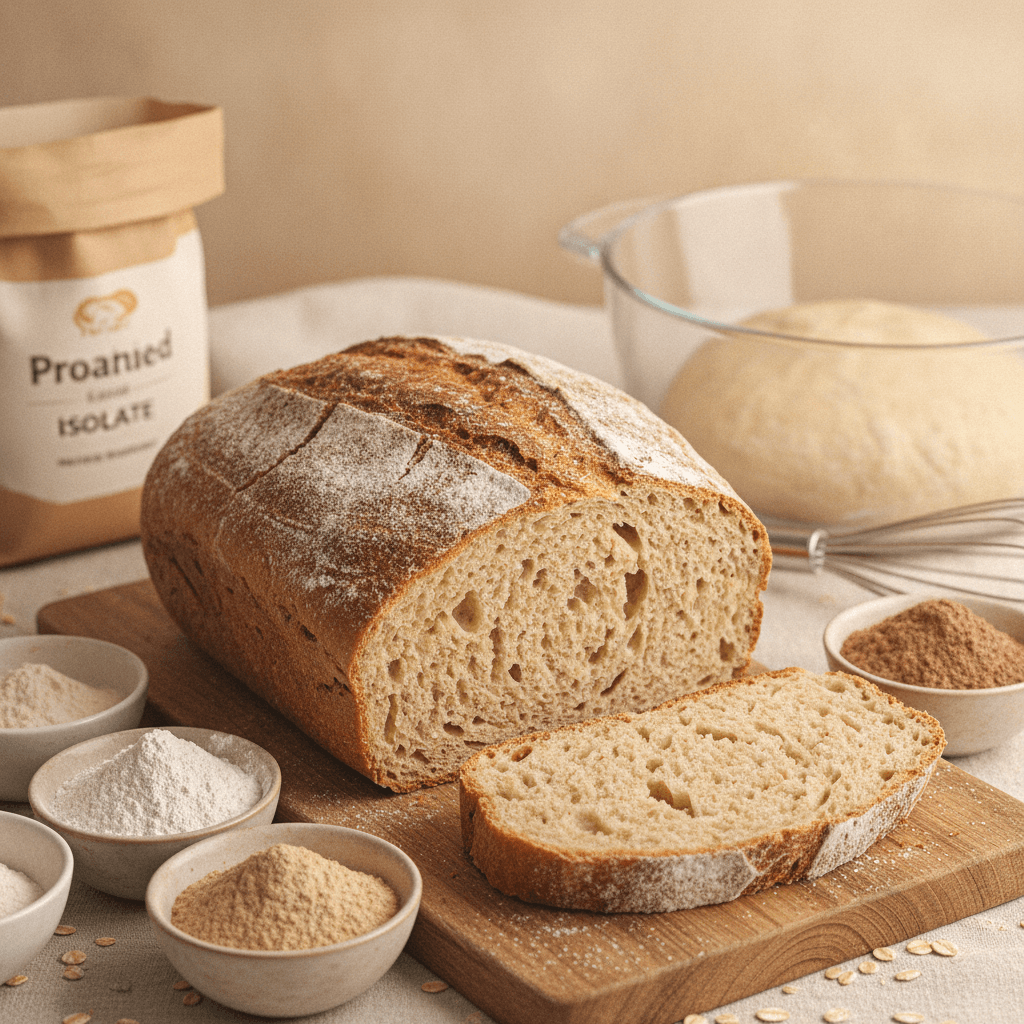
Most protein powders make terrible bread. They soak up liquid like a sponge, turn rubbery at 20% flour replacement, and leave a bitter aftertaste from sweeteners that were never designed for a 375°F oven. We compared 10 popular powders specifically for bread baking and ranked them so you can skip the failures.
Here is our ranked verdict, the comparison data, and the troubleshooting fixes for the three most common protein bread problems.
Key takeaways
Unflavored whey isolate (Isopure, Naked Whey) is the safest pick for bread. It absorbs roughly 1.2x its weight in liquid, browns well, and works at up to 25% flour replacement without turning rubbery.
Casein powder absorbs the most liquid of any protein type (about 1.8x its weight) and produces a denser, chewier crumb. Cap it at 15% or the loaf will crater.
Collagen peptides add almost no structure. They dissolve into the dough and contribute protein on paper but do not help rise, browning, or crumb. See our deep dive on collagen powder in baking for the full picture.
Sweetened powders (sucralose, stevia, monk fruit) behave very differently at oven temperatures. Sucralose survives heat best. Stevia can turn metallic. Monk fruit holds up well but adds caramel color.
The single biggest mistake is replacing too much flour. Stay at or below 20% replacement by weight for your first test batch, regardless of protein type.
Our ranked verdict (best to worst for bread)
We ranked these based on four criteria: crumb texture at 20% flour replacement, liquid absorption predictability, browning behavior, and sweetener heat stability (for flavored versions). Unflavored versions always score higher because you control the variables.
Isopure Unflavored Whey Protein Isolate - 25g protein per scoop, zero sweeteners, clean browning. Our top pick for bread.
Naked Whey Unflavored - 25g protein per scoop, minimal ingredients, slightly more dairy flavor than Isopure.
Anthony's Whey Protein Isolate (Unflavored) - 27g protein per scoop, budget-friendly at about $0.60/serving, performs nearly identically to Naked Whey.
Bulk Supplements Whey Protein Isolate - 27g protein per scoop, unflavored, sold in bulk bags that bring cost down to roughly $0.45/serving.
Optimum Nutrition Gold Standard (Vanilla) - 24g protein per scoop, uses sucralose which survives oven heat. Slight vanilla sweetness that works in sandwich bread.
Legion Whey+ (Unflavored) - 22g protein per scoop, naturally sweetened versions use stevia. Stick with unflavored for bread.
Orgain Organic Plant-Based Protein - 21g protein per scoop, pea and rice blend, grainier texture. Best plant option for bread but cap at 15%.
Ghost Whey Protein - 25g protein per scoop, heavily flavored with sucralose. The artificial flavor intensifies when baked. Not recommended for bread.
Ryse Loaded Protein - 25g protein per scoop, sucralose-sweetened. Similar issue to Ghost: flavor compounds concentrate during baking.
Vital Proteins Collagen Peptides - 20g protein per scoop, but collagen does not form structure. It dissolves into liquid and contributes zero to crumb. Ranked last for bread specifically.

Isopure Zero Carb 100% Pure Whey Isolate Protein Powder, Gluten Free, with Vitamins, Unflavored, 25g Protein Per Serving, 1 Lb, 16 Servings (Packaging May Vary)
Check price on Amazon →Why protein type matters more than brand
The protein source determines 80% of your bread's outcome. Brand differences within the same protein type are minor compared to the gap between, say, whey isolate and collagen peptides. Here is what actually happens in the oven with each type.
Whey protein (isolate and concentrate)
Whey denatures between 160°F and 180°F, which means it sets into a firm gel well before your bread finishes baking. This is exactly what you want: it creates structure similar to gluten, trapping gas bubbles and giving the crumb some spring. Whey isolate absorbs about 1.2x its weight in liquid. So if you swap 30g of flour for 30g of whey isolate, you need to add roughly 36ml of extra water to compensate. Whey browns beautifully through the Maillard reaction because it is rich in lysine. Expect a deeper golden crust than a standard flour loaf.
The ceiling for whey in bread is about 25% of total flour weight. Beyond that, the crumb turns dense and rubbery because denatured whey forms a tighter protein network than gluten does. Past about 25%, crumb firmness climbs sharply. That is the cliff.
For a deeper look at how protein powder interacts with flour, see our guide on protein powder as flour replacement in baking.
Casein protein
Casein forms micelles that trap water aggressively. It absorbs about 1.8x its weight in liquid, nearly 50% more than whey. This makes doughs very stiff if you do not add extra hydration. The crumb it produces is chewier and denser, closer to a bagel than a sandwich loaf. Some bakers like this for flatbreads and pizza dough, but for a standard protein bread loaf, casein alone is too heavy.
Cap casein at 15% of flour weight. Above that, the center of the loaf tends to crater as it cools because the dense protein matrix contracts. Casein also browns faster than whey, so drop your oven temperature by 15°F or the crust will over-darken before the center sets.
Egg white protein
Egg white protein powder behaves similarly to whey but sets even firmer. It produces an airy, almost sponge-cake-like crumb in bread, which sounds appealing until you realize it also dries out faster. Egg white protein absorbs about 1.4x its weight in liquid. The maximum replacement before rubberiness is around 20%. It browns moderately and has a neutral flavor when unflavored. If you have used egg white substitutes for high protein baking, you already know the dryness trade-off.
Collagen peptides
Collagen is the protein powder that looks great on the label and disappoints in the oven. Collagen peptides are hydrolyzed, meaning the protein chains are broken into very short fragments. They dissolve completely in liquid and do not gel, set, or form any kind of structural network. Your bread will have more protein per slice on a nutrition label, but the crumb will be identical to (or worse than) a loaf with no protein added. Collagen also absorbs very little liquid, about 0.3x its weight, so it throws off hydration in the other direction. We covered this in detail in our post on collagen powder in baking as a flour supplement. The short version: collagen is not a flour replacement. It is a protein supplement you dissolve into the liquid portion of your recipe.
Plant-based blends (pea, rice, hemp)
Plant proteins are grittier than whey because the particles do not hydrate as smoothly. Pea protein isolate absorbs about 1.5x its weight in liquid and can taste slightly beany if used above 15%. Rice protein is milder but contributes almost no structure. The best plant option for bread is a pea-rice blend like Orgain, which balances texture and flavor. Cap plant blends at 15% of flour weight. They brown less than whey because they contain fewer reactive amino acids. If you are exploring other plant-based flour alternatives, our guide on chickpea flour as a high protein flour substitute covers a complementary approach.
For hemp protein specifically, we have a full breakdown in our hemp protein powder in baking guide.
Comparison table: 10 protein powders for bread baking
Brand | Type | Protein/scoop | Liquid absorption (relative to flour) | Max flour replacement | Browning | Sweetener | Sweetener survives oven? | Buy |
|---|---|---|---|---|---|---|---|---|
Isopure Unflavored | Whey isolate | 25g | 1.2x | 25% | Deep golden | None | N/A | |
Naked Whey Unflavored | Whey concentrate | 25g | 1.2x | 25% | Deep golden | None | N/A | |
Anthony's Unflavored | Whey isolate | 27g | 1.2x | 25% | Deep golden | None | N/A | |
Bulk Supplements Unflavored | Whey isolate | 27g | 1.2x | 25% | Deep golden | None | N/A | |
Optimum Nutrition Vanilla | Whey blend | 24g | 1.3x | 20% | Golden-brown | Sucralose | Yes, stable to 450°F | |
Legion Whey+ Unflavored | Whey isolate | 22g | 1.2x | 25% | Deep golden | None (flavored uses stevia) | Stevia turns metallic above 350°F | |
Orgain Plant-Based | Pea + rice | 21g | 1.5x | 15% | Pale, less Maillard | Stevia can turn bitter; erythritol recrystallizes | ||
Ghost Whey | Whey blend | 25g | 1.3x | 15% | Golden-brown | Sucralose | Yes, but artificial flavors intensify | |
Ryse Loaded Protein | Whey blend | 25g | 1.3x | 15% | Golden-brown | Sucralose | Yes, but cereal flavors turn cloying | |
Vital Proteins Collagen | Collagen peptides | 20g | 0.3x | 10% (no structure) | Minimal | None | N/A |
Unflavored vs. vanilla: which one do you actually need?
Unflavored. Almost always unflavored. Here is why.
Flavored protein powders contain sweeteners, natural and artificial flavors, and sometimes coloring agents. When you bake at 350°F to 400°F for 30 to 45 minutes, those compounds behave unpredictably. Sucralose is heat-stable up to about 450°F, so it survives bread baking without breaking down. But the artificial vanilla, cookie dough, or cereal flavors that come with it concentrate as moisture evaporates. A powder that tastes mildly sweet in a shake can taste aggressively sweet and artificial in bread.
Stevia is the worst offender. It develops a metallic, bitter edge above 350°F. If your recipe calls for a long bake (like a thick sandwich loaf), stevia-sweetened powders will leave a noticeable off-taste. Monk fruit extract is more stable and does not turn bitter, but it caramelizes slightly and darkens the crumb more than expected.
If you want sweetness in your protein bread, add it separately with ingredients you can control. A tablespoon of honey or maple syrup gives you predictable flavor without the risk of concentrated artificial taste. If you are keeping sugar low, allulose is heat-stable and does not crystallize the way erythritol or xylitol can.
The one exception: Optimum Nutrition Gold Standard Vanilla uses sucralose and a relatively restrained vanilla flavor that works in lightly sweetened sandwich bread. But even then, you are better off with unflavored and adding your own vanilla extract (about 1 tsp per loaf).
How much liquid to add when replacing flour with protein powder
This is where most protein bread recipes fail. Protein powder absorbs more liquid than flour, and the amount varies by type. If you do not compensate, you get a dry, crumbly loaf that stales within hours.
Here is the rule of thumb: for every 30g of flour you replace with protein powder, add extra liquid equal to the difference in absorption.
Whey isolate: Add 6ml extra water per 30g of powder (absorbs 1.2x vs. flour's ~1.0x)
Casein: Add 24ml extra water per 30g of powder (absorbs 1.8x)
Egg white protein: Add 12ml extra water per 30g of powder (absorbs 1.4x)
Plant blend: Add 15ml extra water per 30g of powder (absorbs 1.5x)
Collagen: Reduce liquid by about 20ml per 30g of powder (absorbs only 0.3x)
Weigh your ingredients. Protein bread is not forgiving of volume measurements. A kitchen scale like the OXO Good Grips 11lb is essential here. If you are scaling a recipe up or down, use our recipe scaler to keep ratios accurate.
Troubleshooting the 3 most common protein bread failures
These are the three problems that fill baking forums and Reddit threads. Each one has a specific cause and a specific fix.
Dryness (bread crumbles apart or stales within hours)
Cause: Not enough liquid to compensate for protein powder's higher absorption. This is the number one failure, and it typically happens when flour is swapped for whey isolate without adding any extra water.
Fix: Follow the liquid adjustment numbers above. Additionally, add 1 tablespoon of oil or melted butter per 30g of protein powder. Fat coats the protein strands and slows moisture loss. Storing the loaf in a sealed bag immediately after cooling also helps, since protein bread loses moisture faster than regular bread.
Rubberiness (dense, bouncy, chewy crumb)
Cause: Too much protein powder relative to flour. Denatured protein forms a tight, elastic network that mimics overworked gluten. This typically shows up above 25% replacement with whey or above 15% with casein.
Fix: Reduce the percentage. If you need more protein per slice, increase the number of slices (make a larger loaf) rather than increasing the concentration. You can also add 1 to 2 tablespoons of a starch like arrowroot or tapioca starch per 30g of protein to interrupt the protein network and soften the crumb. This is the same principle behind using starch in gluten-free baking to prevent gumminess.
Cratering (loaf sinks in the center as it cools)
Cause: The protein matrix contracts as it cools, pulling the center of the loaf downward. This happens most often with casein and with any protein powder used above 20%. It also happens when the loaf is underbaked in the center because the dense protein crumb takes longer to set than a standard flour crumb.
Fix: Bake 5 to 10 minutes longer than a standard bread recipe at the same temperature. Use an instant-read thermometer and pull the loaf when the center hits 205°F to 210°F. Let it cool completely in the pan for 15 minutes before turning it out. This gives the protein structure time to set without collapsing. If you are using casein, drop your oven temperature by 15°F and extend bake time by 10 to 12 minutes.
Contrarian take: you probably do not need 30g of protein per slice
Most protein bread recipes online try to maximize protein per serving, pushing replacement ratios to 30% or higher. This produces bread that technically hits 20g+ protein per slice but tastes like a protein bar pressed into loaf shape. We think that is the wrong goal.
A better approach: replace 15% to 20% of flour with unflavored whey isolate, which gives you about 8g to 12g of protein per slice in a standard sandwich loaf. That is roughly double what regular bread provides, and the bread still tastes and feels like bread. Pair it with a high-protein filling (egg salad, turkey, nut butter) and your sandwich hits 35g+ protein without any texture compromise.
The bakers who succeed with protein bread long-term are the ones who prioritize a loaf they actually want to eat over a loaf that wins on macros alone.
Equipment that makes protein bread easier
Protein bread is more sensitive to measurement errors than standard bread. These tools reduce the variables.
Kitchen scale: The OXO Good Grips 11lb Food Scale handles both grams and ounces and has a pull-out display so you can see the readout under a mixing bowl.
Instant-read thermometer: A ThermoPro instant-read thermometer tells you when the center of the loaf has actually set. Do not guess with protein bread.
Loaf pan: A standard 9x5 inch USA Pan loaf pan with a nonstick coating works well. Protein bread sticks more than regular bread because of the higher sugar and protein content on the surface, so a quality nonstick pan matters.
Stand mixer: Protein powder clumps if you do not mix it thoroughly. A KitchenAid Artisan with the dough hook on speed 2 for 4 minutes incorporates protein powder more evenly than hand mixing.
How to add protein to baked goods beyond bread
If you are interested in adding protein to cookies, muffins, pancakes, or other baked goods, we have a comprehensive guide on how to add protein to baked goods without ruining texture. The flour replacement ceilings and liquid adjustments differ by bake type, so it is worth reading the specific guidance for whatever you are making.
Frequently asked questions
Can you use flavored protein powder in bread?
You can, but unflavored almost always produces better results. Flavored powders contain sweeteners and flavor compounds that concentrate during baking. Sucralose-sweetened powders (like Optimum Nutrition Gold Standard) hold up the best. Stevia-sweetened powders often develop a metallic bitterness above 350°F. If you use flavored powder, reduce any added sweetener in the recipe by about 50% to avoid an overly sweet loaf.
How much protein powder can you substitute for flour in bread?
For whey isolate, the safe ceiling is 25% of total flour weight. For casein, stay at or below 15%. For plant-based blends, 15% is the limit before grittiness becomes noticeable. For egg white protein, 20% works. Going above these thresholds causes rubberiness, cratering, or both. Always add extra liquid to compensate for protein powder's higher absorption rate.
Why does my protein bread taste bitter?
The most common cause is stevia or stevia-blend sweeteners in the protein powder. Stevia's steviol glycosides break down at oven temperatures and produce a metallic, bitter aftertaste. Switch to an unflavored powder or one sweetened with sucralose. If you are already using unflavored powder, the bitterness may come from over-browning. Protein-enriched doughs brown faster due to the Maillard reaction, so reduce your oven temperature by 10°F to 15°F.
Is collagen protein powder good for baking bread?
No. Collagen peptides dissolve into liquid and provide zero structural support in bread. Your loaf will have more protein on the nutrition label, but the crumb, rise, and texture will not benefit. Collagen is better used in no-bake applications, smoothies, or stirred into coffee. For bread, use whey isolate or egg white protein instead. We explain why in our collagen powder in baking guide.
Do you need to add extra liquid when using protein powder in bread?
Yes, always. Protein powder absorbs more liquid than flour. Whey isolate needs about 6ml of extra water per 30g of powder swapped. Casein needs about 24ml per 30g. Skipping this step is the number one reason protein bread turns out dry and crumbly. Weigh your ingredients with a kitchen scale and adjust liquid incrementally until the dough feels tacky but not sticky.

Written by
Co-founder, BakingSubs
Co-founder of BakingSubs, where he turns the science of ingredient substitutions into tested, reliable guidance for home bakers.
Related Posts
Bake with Confidence
See all
Confident Gluten-Free Baker Toolkit
The science-based system that replaces gluten's seven invisible jobs so your baking turns out soft, fluffy, and foolproof — every time.

Gluten-Free Recipe Vault
Instant access to our complete library of proven gluten-free recipes — no waiting, no guesswork, just results that work tonight.

Fix Your Gluten-Free Bread
Learn the 3-step formula to make bread rise and stay soft, discover why your loaves collapse, and get a tested sandwich bread recipe that actually works.