
Sourdough Starter as Baking Powder Substitute: Why It Only Works Sometimes (and What Changes When It Does)
Can sourdough starter replace baking powder? It works in bread and pancakes but fails in cakes and cookies. Learn which baked goods work, which don't, and why.

Malik
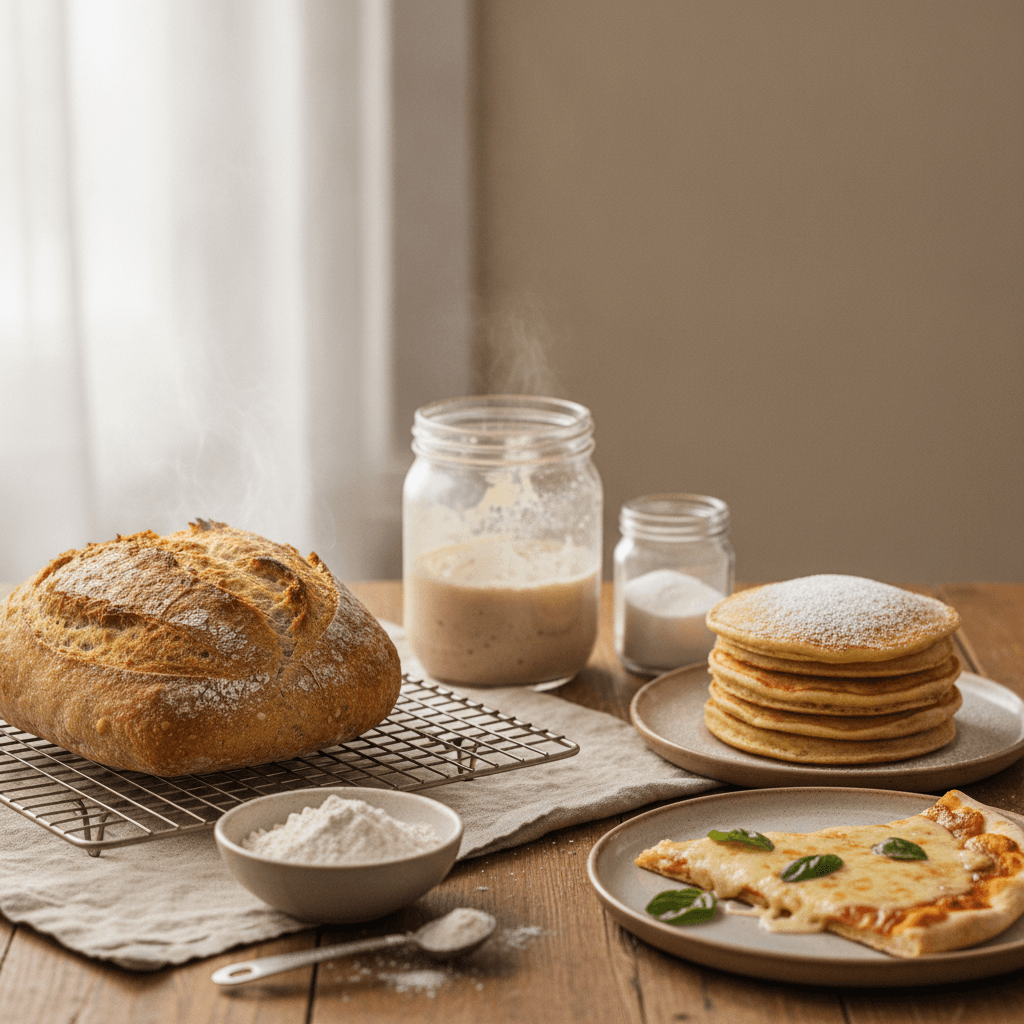
Sourdough starter can leaven baked goods without baking powder, but it does not work as a simple 1:1 swap. The fermentation process, the timing, and the types of baked goods that respond well to starter are all fundamentally different from chemical leavening. Here is what actually changes when you make the switch, and where it falls apart.
Key takeaways
- Sourdough starter produces CO2 through fermentation, which is a slower and weaker leavening force than the instant chemical reaction of baking powder.
- It works well in breads, pancakes, waffles, and some flatbreads — but poorly in cakes, muffins, and quick breads that depend on fast, aggressive rise.
- Using starter as a leavener means adding significant flour and water to your recipe, which changes hydration, structure, and bake time.
- The acid in sourdough starter reacts with baking soda, creating a hybrid approach that often outperforms using starter alone.
- Fermentation time ranges from 4 to 12 hours depending on ambient temperature and starter activity, compared to zero wait time with baking powder.
- Sourdough-leavened goods have a distinct tangy flavor profile that is not always desirable in sweet baked goods.
How sourdough starter leavens differently than baking powder
Baking powder is a chemical leavener. It contains a base (usually sodium bicarbonate) and one or two acids (like cream of tartar or sodium aluminum sulfate). When it contacts liquid and heat, those components react almost instantly, producing carbon dioxide gas that inflates the batter. The whole process takes minutes.
Sourdough starter leavens through biological fermentation. Wild yeast and lactic acid bacteria in the starter consume sugars in the flour and produce CO2 as a byproduct. This is the same process that makes bread dough rise, but it is dramatically slower — typically requiring hours of bulk fermentation before the dough or batter is ready to bake.
The practical difference matters more than the science. Baking powder gives you a predictable, fast, strong lift that works in thin batters and delicate crumbs. Sourdough starter gives you a slower, gentler lift that works best in doughs and thick batters that can trap gas over a long fermentation window. If your recipe depends on getting into the oven within 5 minutes of mixing — like most muffins and quick breads — sourdough starter alone will not produce enough gas in time.
Where sourdough starter actually works as a leavener
Sourdough starter performs well as a primary leavener in a specific set of baked goods. The common thread is that these items can tolerate (or benefit from) a long fermentation period and do not require an extremely light, airy crumb.
Breads and rolls
This is the obvious one. Traditional sourdough bread uses starter as the sole leavener, and the long fermentation — often 8 to 12 hours for a cold retard — develops both flavor and structure. Dinner rolls, sandwich loaves, and sourdough bread for sale all rely on this approach. The gluten network in wheat-based bread doughs is strong enough to trap the slowly produced CO2.
Pancakes and waffles
Sourdough discard pancakes are popular precisely because the batter sits overnight, fermenting gently, and then gets cooked on a hot griddle where the remaining gas expands quickly. The result is a tender pancake with a slight tang. Many bakers still add a pinch of baking soda at the last minute before cooking — the acid in the fermented batter reacts with the soda for an extra lift. That hybrid approach is arguably the most reliable way to use starter in a quick-bread-style application.
Flatbreads and pizza dough
Naan, focaccia, and pizza dough all work well with sourdough starter because they do not need a towering rise. A 4- to 6-hour room-temperature fermentation is usually enough to develop flavor and a modest open crumb.
Crackers
Sourdough crackers use discard starter and do not need any leavening at all — the tang is the point, and the texture is meant to be flat and crisp.
Where sourdough starter fails as a baking powder replacement
The substitution breaks down in recipes that depend on chemical leavening for their fundamental structure.
Cakes
A standard layer cake recipe calls for 1 to 2 teaspoons of baking powder and goes into the oven within minutes of mixing. The quick gas production inflates the batter before the structure sets in the oven. Replacing that with sourdough starter means the batter would need to sit for hours, during which the gluten (or starch structure in gluten-free baking) would develop unevenly, fats could separate, and the final texture would be dense and gummy rather than light and tender.
Muffins and quick breads
The entire category of "quick breads" exists because chemical leaveners eliminated the need for yeast fermentation. Banana bread, zucchini bread, and blueberry muffins all depend on baking powder or baking soda for their rise. Swapping in sourdough starter produces a denser, heavier product with a sour note that clashes with the sweet flavor profile. Some bakers do make sourdough muffins, but they typically still include baking soda to compensate.
Cookies
Cookies use small amounts of leavener for spread and texture — typically 1/2 to 1 teaspoon of baking soda or baking powder. The leavener also affects browning and crispness. Sourdough starter adds too much liquid, changes the flour ratio, and does not produce enough gas in the short bake time (10 to 14 minutes) to replicate the effect. If you are exploring cookie substitutions, leavener swaps are among the trickiest to get right.
Biscuits and scones
These rely on baking powder for their characteristic flaky lift. Some sourdough biscuit approaches exist, but they universally add baking soda to the dough right before baking. The starter provides flavor and some acid, but the soda does the heavy lifting for rise.
The hybrid approach: sourdough starter plus baking soda
This is the method that experienced sourdough bakers actually use when adapting quick-bread recipes. Instead of replacing baking powder entirely, they use the acid in sourdough starter to react with baking soda.
Here is the logic: baking powder is essentially baking soda plus acid in one package. Sourdough starter is naturally acidic (pH typically between 3.5 and 4.5). So if you add sourdough starter to a batter and then add baking soda, the acid-base reaction produces CO2 — similar to what baking powder does, but with the added flavor and texture benefits of fermentation.
A common ratio referenced in sourdough baking communities is 1/4 teaspoon of baking soda per 1 cup (about 227g) of active sourdough starter. This neutralizes some of the sourness while providing a quick burst of lift. The exact amount varies based on how acidic the starter is, which depends on how recently it was fed and the ambient temperature during fermentation.
This hybrid method works reasonably well for pancakes, waffles, some quick breads, and even certain cake recipes that have been specifically developed for sourdough. It does not work as a blind substitution in any recipe — the added flour and water from the starter still need to be accounted for.
How sourdough starter changes your recipe beyond leavening
Replacing baking powder with sourdough starter is not just a leavening swap. The starter itself is a mixture of flour and water (typically at a 1:1 ratio by weight), plus the microbial culture. Adding 1 cup of starter to a recipe adds roughly 113g of flour and 113g of water. That changes everything.
| Factor | Baking powder | Sourdough starter |
|---|---|---|
| Leavening speed | Immediate (minutes) | Slow (4–12 hours) |
| Added flour/water | None | Significant — must adjust recipe |
| Flavor impact | Neutral to slightly metallic | Tangy, complex, slightly sour |
| Texture effect | Light, predictable crumb | Chewier, more irregular crumb |
| Shelf life of baked good | Standard | Often longer due to acid content |
| Precision required | Measure and mix | Must manage starter activity and timing |
The hydration change is the one that catches most bakers off guard. If a muffin recipe calls for 2 cups of all-purpose flour and 1 cup of milk, and you add 1 cup of sourdough starter, you have just added another cup of flour and another cup of water on top of what the recipe already calls for. The batter will be completely different unless you reduce the original flour and liquid accordingly.
Flavor is the other major shift. Sourdough's tang works beautifully in bread, pizza, and savory applications. It can work in chocolate-based baked goods where the cocoa masks the sourness. But in a delicate vanilla cake or a lightly sweetened scone, the sour flavor can be unwelcome. Bakers who want the digestive benefits of fermentation without the tang sometimes use a "young" starter — one that has been fed recently and has not developed much acidity yet — but this also means less acid available to react with baking soda.
Getting the timing right
Timing is the single biggest variable when using sourdough starter as a leavener. An active starter that was fed 4 to 6 hours ago and has roughly doubled in volume will produce the most gas. A starter straight from the refrigerator, or one that has been sitting unfed for days, will leaven weakly or not at all.
For overnight fermentation (pancakes, waffles, some doughs), mix the batter in the evening and leave it at room temperature. At 70°F (21°C), expect 8 to 12 hours of fermentation. At 78°F (26°C), it may be ready in 4 to 6 hours. If your kitchen runs cold — below 65°F (18°C) — fermentation slows dramatically, and you may need 14 to 16 hours.
A baker named Rachel, who sells sourdough pancake mix at farmers markets in Oregon, reportedly uses a 12-hour overnight ferment at 68°F and adds 1/4 teaspoon of baking soda per batch right before cooking. She has described the baking soda step as non-negotiable for getting the pancakes fluffy enough that customers actually buy them again.
Why some bakers prefer sourdough leavening despite the hassle
Given all the limitations, why bother? Several reasons come up consistently in baking communities:
- Flavor complexity. Fermentation produces organic acids and aromatic compounds that chemical leaveners simply cannot replicate. Sourdough bread has a depth of flavor that quick breads do not.
- Using discard. Maintaining a sourdough starter produces discard — unfed starter that would otherwise be thrown away. Using it in pancakes, waffles, and crackers reduces waste. This is probably the most common reason home bakers experiment with starter as a leavener in non-bread applications.
- Longer shelf life. The lower pH of sourdough-leavened baked goods can inhibit mold growth, which is well-documented in food science literature. Sourdough bread commonly stays fresh longer than bread leavened with commercial yeast alone.
- Avoiding aluminum. Some baking powders contain sodium aluminum sulfate, and some bakers prefer to avoid it. Aluminum-free baking powders exist (brands like Rumford and Clabber Girl's aluminum-free version are widely available), so this is not a strong reason on its own, but it comes up.
The contrarian take here: for most home bakers, using sourdough starter as a baking powder substitute is more trouble than it is worth. The flavor and texture changes are significant, the timing adds hours to the process, and the results in quick-bread applications are almost always inferior unless you also add baking soda — at which point you are not really replacing chemical leavening, just supplementing it. Where sourdough starter shines is in applications that were designed for it: bread, pizza, and fermented batters. Trying to force it into a muffin recipe is like using a protein powder as a flour replacement — technically possible in narrow circumstances, but not a general-purpose swap.
Troubleshooting common problems
Batter did not rise at all
The starter was likely inactive. Check that it passes the float test (a spoonful floats in water) before using it as a leavener. If it sinks, feed it and wait 4 to 6 hours until it doubles before trying again.
Result is too sour
The fermentation went too long, or the starter was very mature (unfed for a long time) when mixed in. Use a recently fed starter and shorten the fermentation time. Adding a small amount of baking soda also neutralizes some acidity.
Result is dense and gummy
This is a hydration problem. The extra water from the starter made the batter too wet. Reduce the liquid in the original recipe by roughly the amount of water the starter contributes. If you are working with gummy centers in gluten-free baking, the problem compounds because gluten-free flours absorb water differently.
Result is flat but tastes fine
The starter provided flavor through fermentation but not enough gas. Add 1/4 teaspoon of baking soda per cup of starter to get the chemical lift that fermentation alone cannot provide in a short bake.
A quick reference for which baked goods work
| Baked good | Starter as sole leavener? | Starter + baking soda? | Notes |
|---|---|---|---|
| Bread (wheat) | Yes | Not needed | The classic use case; 8–12 hour ferment |
| Pizza dough | Yes | Not needed | 4–6 hour ferment works well |
| Pancakes | Marginal | Yes — recommended | Overnight ferment, add soda before cooking |
| Waffles | Marginal | Yes — recommended | Same approach as pancakes |
| Muffins | No | Sometimes | Dense results; needs recipe redesign |
| Layer cakes | No | Rarely | Structure suffers; not recommended |
| Cookies | No | No | Too much added liquid, too little rise |
| Biscuits | No | Yes — essential | Starter adds flavor; soda provides lift |
| Crackers | N/A | N/A | No leavening needed; uses discard for flavor |
| Quick breads | No | Sometimes | Results vary widely; expect denser crumb |
What about gluten-free sourdough starters?
Gluten-free sourdough starters — made with brown rice flour, buckwheat flour, or sorghum flour — do ferment and produce CO2. However, without gluten to trap the gas, the leavening effect is weaker. Gluten-free sourdough bread typically requires xanthan gum or psyllium husk to provide structure, and many gluten-free sourdough recipes still include baking powder as a backup leavener.
If you are baking gluten-free and considering dropping baking powder in favor of a gluten-free starter, expect even more limitations than in wheat-based baking. The poor rise issues common in gluten-free baking are amplified when you remove chemical leavening entirely. For most gluten-free applications, baking powder remains the more reliable choice, and starter is better used as a flavor and texture enhancer alongside it rather than as a replacement.
Frequently asked questions
Can I use sourdough discard instead of active starter as a leavener?
Sourdough discard — the unfed portion removed before feeding — has very little leavening power because the yeast has consumed most of the available sugars and is relatively dormant. Discard works well for flavor in pancakes, crackers, and flatbreads, but it will not produce enough CO2 to leaven bread or other risen baked goods on its own. For leavening, use active starter that has been fed within the last 4 to 8 hours and has visibly doubled in size.
How much sourdough starter replaces 1 teaspoon of baking powder?
There is no reliable direct conversion. Baking powder produces gas instantly and predictably, while sourdough starter produces gas slowly over hours and the amount varies based on the starter's activity, temperature, and age. Recipes that use sourdough starter as a leavener are typically developed from scratch rather than converted from baking-powder recipes. If you want a quick lift in a fermented batter, add 1/4 teaspoon of baking soda per cup of starter rather than trying to calculate a starter-to-baking-powder ratio.
Does sourdough starter make baked goods healthier than baking powder?
Fermentation can reduce phytic acid in whole grain flours, which may improve mineral availability. Some people also report that sourdough-fermented bread is easier to digest than quick-rise bread. However, these effects depend on fermentation time, flour type, and individual tolerance. Baking powder itself is generally recognized as safe in normal baking quantities. The health differences between the two leavening methods are modest for most people and should not be the primary reason to choose one over the other.
Can I make a sourdough starter quickly if I am out of baking powder?
No. A sourdough starter takes a minimum of 5 to 7 days to establish from scratch, and it often takes 2 to 3 weeks before it is reliably active enough to leaven bread. If you are out of baking powder right now, a faster substitute is 1/4 teaspoon of baking soda plus 1/2 teaspoon of cream of tartar (or lemon juice or apple cider vinegar) per teaspoon of baking powder needed. That combination replicates the acid-base reaction of baking powder without any fermentation time.
Will sourdough starter work in a boxed cake mix?
Boxed cake mixes already contain leavening agents blended into the dry mix. Adding sourdough starter on top of that would add excess liquid and flour, throwing off the carefully calibrated ratios. Removing the built-in leavener is not practical since it is premixed with the other dry ingredients. For boxed mixes, stick with the instructions on the package. Sourdough starter is better suited to from-scratch recipes where you control every ingredient.

Written by
Co-founder, BakingSubs
Co-founder of BakingSubs, where he turns the science of ingredient substitutions into tested, reliable guidance for home bakers.
Related Posts
Bake with Confidence
See all
Confident Gluten-Free Baker Toolkit
The science-based system that replaces gluten's seven invisible jobs so your baking turns out soft, fluffy, and foolproof — every time.

Gluten-Free Recipe Vault
Instant access to our complete library of proven gluten-free recipes — no waiting, no guesswork, just results that work tonight.

Fix Your Gluten-Free Bread
Learn the 3-step formula to make bread rise and stay soft, discover why your loaves collapse, and get a tested sandwich bread recipe that actually works.