

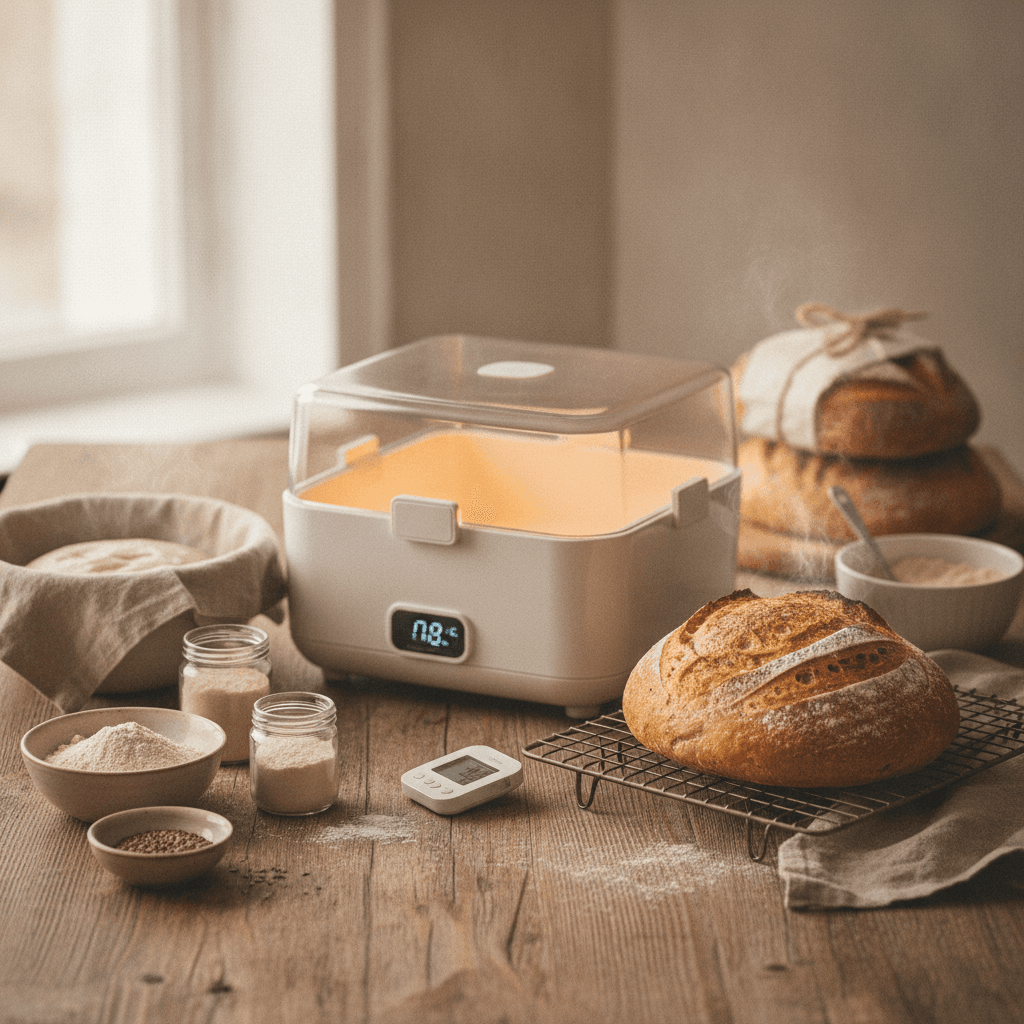
The Brod & Taylor Folding Proofer & Slow Cooker is the strongest all-around pick for home bakers who sell bread, thanks to its 70–195°F range, 3-year warranty, 200W heating plate, and ability to double as a slow cooker. Budget-conscious bakers should look at the GIYUDOT or Wnfou, which cover standard proofing temperatures at a fraction of the cost. Below, we rank eight active proofing boxes and two passive containers on published specs — no taste tests, no invented reviews.
Key takeaways
- The Brod & Taylor FP-105 is the only proofing box here with a manufacturer-confirmed 3-year warranty and multi-function capability up to 195°F.
- For dedicated bread proofing (sourdough at 80–86°F, commercial yeast at 75–79°F), every active box on this list covers the needed range — the differences show up in timer length, heating zones, and build quality.
- Fabric-bodied proofers (GIYUDOT, GEOYLE, InnovifyHub) fold flat for storage and are easier to transport to a farmers market, but none publish wattage or warranty details.
- Cottage food equipment rules vary by state — Michigan and Georgia explicitly do not require NSF-rated equipment, but some farmers markets impose their own requirements regardless of state law.
- Passive containers like the Brod & Taylor 6L Proofing Container and Hans Grill trays hold dough but provide zero temperature control, making them poor choices for anyone who needs consistent proofing in a cold kitchen.
- A DIY seedling heat mat plus Inkbird ITC-308 controller runs under $80 total but is not a purpose-built food appliance, and wrapping the mat in insulation can cause overheating per the VIVOSUN mat manual.
Comparison table: 8 active proofing boxes ranked on specs
| Product | Temp range | Timer | Heating zones | Dimensions (in) | Materials | Warranty | Price tier | Buy |
|---|---|---|---|---|---|---|---|---|
| Brod & Taylor FP-105 | 70–195°F | Not confirmed | 1 (base plate) | 18 × 14.5 × 10 (open); folds to 2.75 in | Reinforced polypropylene, aluminum plate & tray | 3-year limited | Premium ($249) | Check price → |
| Wnfou Electric Proofing Box | 68–131°F | 99 hours | 3-sided | Not confirmed | Not confirmed | Not confirmed | Budget | Check price → |
| InnovifyHub XL Proofing Box | 50–130°F | 24 hours | 3-sided (NTC sensor) | Not confirmed | Not confirmed | Not confirmed | Budget–mid | Check price → |
| Uoxfill Proofing Box | 50–122°F | 48 hours (4-hr auto shutoff) | 3 (front, back, bottom) | Not confirmed | Not confirmed | Not confirmed | Budget–mid | Check price → |
| GIYUDOT 12-inch Proofing Box | 50–113°F | 48 hours | 3 (front, back, bottom) | 15.75 × 11.8 × 11.8 | 5-layer fabric insulation, waterproof interior, acrylic window | Not confirmed | Mid-range | Check price → |
| GEOYLE 30L Proofer | 32–122°F | 96 hours | Not confirmed | Not confirmed | Oxford fabric, 4-layer insulation | Not confirmed | Mid-range | Check price → |
| GEOYLE 20L Proofer | Listed as 0–122°F (likely display range only) | 96 hours | Not confirmed | 10.6 × 10.6 × 10.6 | Oxford fabric | Not confirmed | Budget–mid | Check price → |
| Cozy Bread Mat + Box Kit | Not confirmed (thermostat-controlled mat) | Not confirmed | Mat only (10 × 21 in) | Mat: 10 × 21 | Heating mat + insulated cube | Not confirmed | Mid-range | Check price → |
"Not confirmed" means the manufacturer has not published that spec on their product page or Amazon listing in a way we could verify. We chose not to guess.
How we ranked these
We ranked on six verifiable criteria drawn from manufacturer product pages and Amazon listings: temperature range (wider is better for multi-use), timer length, number of heating zones, build materials, warranty length, and portability (folded size and weight). We did not test any of these products. We did not factor in Amazon star ratings, which are susceptible to review manipulation. Where a manufacturer did not publish a spec, we marked it "not confirmed" rather than pulling numbers from unattributed review sites.
Our top pick: Brod & Taylor Folding Proofer & Slow Cooker

The Brod & Taylor FP-105 wins on specs that no other box here matches. Its 70–195°F range covers humid bread proofing (calibrated for 70–95°F) and extends into slow-cook territory. The 200W aluminum base plate draws roughly 0.06 kWh per hour at a 75°F setting according to the manufacturer (it cycles on about 30% of the time). That is about $0.01 per hour at roughly $0.17/kWh, near the U.S. residential average, so a 4-hour proof costs about $0.04 in electricity.
The 3-year limited warranty (with product registration) is the longest confirmed warranty in this group. The unit weighs 9.5 lbs and folds to 18 × 14.5 × 2.75 inches — thin enough to slide between a counter and a wall, though heavier than any fabric proofer here.
One real limitation: the interior measures 14.75 × 12.5 inches, so a standard half sheet pan (13 × 18 inches) will not fit. Standard bread pans, bannetons, and quarter sheet pans do fit. If you bake gluten-free bread and rely on specific pan sizes, measure before buying.
The multi-function angle matters for home bakers trying to justify equipment costs. According to the manufacturer, the same unit works for yogurt making and chocolate tempering. If you sell sourdough from home, you already know how finicky fermentation timing can be — a dedicated proofer removes one variable from your production schedule.
Proofing temperature guidance from Brod & Taylor
The manufacturer recommends these temperatures for different dough types:
- Sourdough: 80–86°F
- Commercial yeast breads: 75–79°F
- Sweet and butter-enriched doughs: ≤80°F
- Rye: 80–86°F
One important detail: the Brod & Taylor heats by radiant heat from the base plate, not by warming the air. Sticking a thermometer inside to measure air temperature will not reflect the actual dough temperature. The manufacturer notes that covering a container or adding water to the aluminum tray raises food temperature further.
Also, this is a heating-only device. It cannot cool below ambient room temperature and is calibrated for rooms at 65–70°F. If your kitchen sits at 85°F in summer, the proofer cannot bring dough down to 75°F.
Best budget pick: Wnfou Electric Bread Proofing Box
A budget-priced option, the Wnfou covers 68–131°F with 3-sided heating and includes a water tray for humidity. Its 99-hour timer is the longest in this group. For a home baker doing overnight cold-retard recoveries or long bulk ferments, a multi-day timer means you can set it and walk away.
The tradeoff: we could not confirm wattage, warranty, or exact dimensions from the manufacturer. If you are selling at a farmers market and need documentation for your equipment, the lack of published specs could be a headache.
Best for sourdough and long ferments: GIYUDOT 12-inch Proofing Box
The GIYUDOT hits the sweet spot between the Brod & Taylor's build quality and the Wnfou's price. Its 50–113°F range covers every standard bread proofing temperature (sourdough at 80–86°F, commercial yeast at 75–79°F). The 48-hour timer handles overnight and weekend proofs. Three heating zones (front, back, bottom) and 5-layer fabric insulation should provide more even heat distribution than a single-zone base plate — though without published wattage, we cannot compare energy draw.
The manufacturer claims the box reaches its set temperature in 5–7 minutes. The manufacturer lists external dimensions of 15.75 × 11.8 × 11.8 inches and an interior of about 12 × 12 × 12 inches. An acrylic viewing window lets you check dough progress without opening the box and losing heat.
The 113°F ceiling is the key limitation. That is fine for bread proofing but rules out chocolate tempering, yogurt making, or any application above 113°F. If you only need a proofer — not a multi-function tool — this limitation is irrelevant.
Larger capacity options: GEOYLE 20L and 30L
The GEOYLE line offers two sizes. The 30L model has 4-layer Oxford fabric insulation, a 32–122°F range, and a 96-hour timer — second only to the Wnfou's 99 hours. The 20L model measures 10.6 × 10.6 × 10.6 inches (a cube) and lists a temperature range of 0–122°F, though that lower bound is almost certainly a display range rather than a cooling capability, since these are heating-only devices.
Both fold flat for storage or transport. If you bake for a wholesale account and need to proof multiple batches, the 30L gives you more room. However, neither model has confirmed wattage, warranty, or heating zone details from the manufacturer.
Other options worth knowing about
InnovifyHub Extra Large Proofing Box
The InnovifyHub covers 50–130°F with 3-sided heating, an NTC sensor, and a 24-hour timer with beep alert. It includes a storage bag and toggles between °C and °F. The 24-hour timer is the shortest among active proofers here, which could be limiting for long sourdough ferments. No confirmed dimensions, materials, or warranty from the manufacturer.
Uoxfill Folding Proofing Box
The Uoxfill covers 50–122°F with 3 heating zones (front, back, bottom) and a 48-hour timer. It includes a hygrometer — a useful addition for monitoring humidity without opening the box. The listing also advertises a 4-hour auto shut-off alongside the 48-hour timer without explaining how the two interact, so confirm with the seller before relying on it for overnight proofs.
Cozy Bread Proofing Mat and Insulation Box Kit
This is not a self-contained heated box — it is a thermostat-controlled heating mat (10 × 21 inches) paired with an insulated cube. The manufacturer claims a 1–2 minute warm-up time. If you already have a container or banneton setup you like, a mat system gives you flexibility. But it is a less controlled environment than a fully enclosed heated box.
Passive containers: Brod & Taylor 6L and Hans Grill trays
The Brod & Taylor Proofing Container holds up to 3000g of dough in a 6L BPA-free, dishwasher-safe container with translucent walls and volume markings. At roughly 4 inches tall, it will not accommodate tall dough crowns. It has no heating element — you need a warm kitchen or an external heat source.
The Hans Grill Pizza Dough Proofing Box (2-pack) is a stackable set of BPA-free plastic trays with covers. Also passive, with no heating element. These are dough containers, not proofing environments. They work if your kitchen stays at 75–80°F naturally; otherwise, they are just storage.
The DIY option: seedling heat mat plus Inkbird ITC-308
A seedling heat mat paired with an Inkbird ITC-308 temperature controller (±1°C / ±2°F sensor accuracy) runs under $80 total. This is the cheapest way to get thermostat-controlled proofing. But it is not a purpose-built food appliance. The VIVOSUN mat manual explicitly warns against wrapping the mat in insulation, which can cause overheating. If you are operating under cottage food laws, using a gardening product for food production could raise questions during an inspection — even in states like Michigan and Georgia that do not require NSF-rated equipment.
Which proofing box fits which home bakery situation
The right proofing box depends on what you bake, how much you bake, and where you sell. Here is a breakdown by scenario:
Selling sourdough from home (5–20 loaves per week)
The Brod & Taylor or GIYUDOT both cover the 80–86°F sourdough range. Steady temperature control matters here because sourdough fermentation is sensitive to even small temperature swings. If you are pricing sourdough for profit, consistent proofing reduces waste from over- or under-proofed loaves. Hypothetically, a baker producing 15 loaves per week at $9 each who loses 2 loaves weekly to inconsistent proofing is losing $936 per year.
Farmers market vendor who needs portability
Fabric-bodied proofers (GIYUDOT, GEOYLE, InnovifyHub) fold flat and weigh less than the 9.5 lb Brod & Taylor. If you prep dough at home and want to proof on-site at a market, a foldable fabric box is easier to transport. Note that cottage food rules vary by state — some states require all preparation to happen in your registered home kitchen. In LA County, California, for example, all equipment and ingredients must be stored and used within the home, with no preparation allowed in garages, backyards, or sheds.
Gluten-free bread production
Gluten-free doughs are notoriously finicky about temperature. Without gluten's structural network, poor rise is one of the most common problems. A proofing box with reliable temperature control helps compensate. Any active proofer on this list will work, but if you are also making low-carb breads with alternative flours, note that the GIYUDOT, Uoxfill and InnovifyHub can be set as low as 50°F while the Brod & Taylor starts at 70°F, which matters if a recipe calls for a slower, cooler proof.
High-volume production (30+ loaves per week)
None of these boxes are commercial proofing cabinets. The largest option here is the GEOYLE 30L, which might hold two standard loaf pans at most. If you are doing 30+ loaves per week, you will likely need multiple boxes or a commercial retarder-proofer. At that volume, you may also be outgrowing cottage food — transitioning to a full-time operation usually means different equipment requirements.
Cottage food equipment rules: what you need to know
Equipment requirements for cottage food operations vary significantly by state. A few examples from published state guidance:
- Michigan: Cottage food operators are not required to meet NSF standards for equipment used to manufacture cottage food products (Michigan MDARD).
- Georgia: Same — no NSF equipment requirement for cottage food operators (Georgia Department of Agriculture).
- Minnesota: Cottage food can be produced in a home kitchen with annual registration, required training, and an exam. Sales cap of $78,000 per year (Minnesota Department of Agriculture).
- Washington State: Requires a Master Business License, approved water source, and Food Worker's Card, plus local zoning compliance (Washington State Department of Agriculture).
- LA County, California: All equipment and ingredients must be stored and used within the home — no garages, backyards, or sheds (LA County Department of Public Health).
Some farmers markets require vendors to hold a food establishment license even when the state exempts cottage food operations, according to the Association of Food and Drug Officials (AFDO). Check your state's rules and your market's vendor requirements before investing in equipment. Our cottage food laws guide covers the basics, and we have state-specific posts for New York and Pennsylvania.
A contrarian take: most home bakers do not need a proofing box
Here is an opinion that runs against the grain of every "best proofing box" list: if your kitchen stays between 70–80°F for most of the year, a proofing box is a solution to a problem you do not have. Bread has been proofed on countertops for thousands of years. A proofing box becomes genuinely valuable in three situations: (1) your kitchen is consistently below 68°F, (2) you need repeatable timing for production baking where even 30-minute variations throw off your schedule, or (3) you are doing long sourdough ferments and want precise temperature control to hit a specific flavor profile. If none of those apply, a large mixing bowl with a damp towel works fine — and that $249 could go toward better packaging or accounting software that actually moves your business forward.
Worked example: electricity cost per proof
The Brod & Taylor is the only box here with a published power consumption figure, so we can only do this math for that unit:
- Power draw at 75°F setting: approximately 0.06 kWh per hour (manufacturer spec: 200 W, on about 30% of the time)
- U.S. residential electricity rate: about $0.17 per kWh (U.S. EIA 2025 average, approximate)
- Cost per hour: 0.06 × $0.17 = about $0.01
- Cost for a 4-hour proof: roughly $0.04
- Cost for a 12-hour overnight proof: roughly $0.12
Even proofing daily for a year (365 × 4-hour proofs), you are looking at about $15 in electricity. This is a negligible operating cost for any home bakery budget.
Frequently asked questions
What temperature should I set my proofing box for sourdough bread?
Brod & Taylor recommends 80–86°F for sourdough and 75–79°F for commercial yeast breads. Sweet and butter-enriched doughs should stay at or below 80°F. Rye doughs proof well at 80–86°F. These ranges apply regardless of which proofing box you use — the chemistry of yeast fermentation does not change based on the brand.
Can I use a bread proofing box for gluten-free dough?
Yes. Gluten-free doughs benefit from consistent temperature control because they lack gluten's structural network, making them more sensitive to poor rise from temperature fluctuations. Any active proofing box covering 75–85°F will work. If you are baking with gluten-free bread flour, follow the flour manufacturer's proofing temperature recommendations when available.
Do cottage food laws require NSF-certified proofing equipment?
Not in every state. Michigan and Georgia explicitly state that cottage food operators are not required to meet NSF standards for equipment. However, rules vary significantly — Washington State requires a Food Worker's Card and approved water source, and some farmers markets impose their own equipment requirements. Always check your state's cottage food laws and your market's vendor guidelines.
Is the Brod & Taylor proofing box worth $249 for a home bakery?
It depends on your production volume and kitchen conditions. If you bake 15+ loaves per week in a kitchen that drops below 68°F regularly, the consistent proofing and 3-year warranty justify the cost. If you bake occasionally in a warm kitchen, a budget option like the Wnfou or even a damp towel over a bowl will get the job done. The Brod & Taylor's multi-function capability (slow cooker, yogurt maker) adds value if you will actually use those features.
Can a bread proofing box cool dough below room temperature?
No. Every proofing box in this comparison is a heating-only device. None can cool dough below ambient room temperature. The Brod & Taylor is calibrated for rooms at 65–70°F. If your kitchen is 85°F in summer and you need dough at 75°F, you need a refrigerator or a commercial retarder, not a proofing box. Cold-retarded dough coming out of the fridge needs an extra hour or more per pound (approximately 500g) to come up to proofing temperature, according to Brod & Taylor.
Sources
- Brod & Taylor — Folding Proofer & Slow Cooker product page
- Amazon — Brod & Taylor Folding Proofer listing (ASIN B01MEEH0SE)
- GIYUDOT — 12-inch Folding Bread Proofing Box product page
- Amazon — GIYUDOT Folding Bread Proofing Box listing (ASIN B0DGFBRZP9)
- The Sweet and Simple Kitchen — Best Bread Proofing Boxes
- JayArr Bread — Best Proofing Cabinet for Home Baker
- KitchPrep — Best Bread Proofer
- Michigan MDARD — Cottage Food Operations Information
- Georgia Department of Agriculture — Cottage Food FAQ
- Minnesota Department of Agriculture — Cottage Food Law Guidance
- LA County Department of Public Health — Cottage Food Operations Guide
- Washington State Department of Agriculture — Cottage Food
- AFDO — Cottage Foods Regulatory Guidance for Best Practices

Written by
Co-founder, BakingSubs
Co-founder of BakingSubs, where he turns the science of ingredient substitutions into tested, reliable guidance for home bakers.
Related Posts
Best Bakery Display Case for Farmers Markets: 6 Options Compared on Specs, Not Sales Pitches
Best Low Carb Bread Brands (2026): 8 Compared by Net Carbs, Ingredients, and Price
Best Keto Buns, Bagels, and English Muffins: 10 Products Compared by Net Carbs and Ingredients
Bake with Confidence
See all
Confident Gluten-Free Baker Toolkit
The science-based system that replaces gluten's seven invisible jobs so your baking turns out soft, fluffy, and foolproof — every time.

Gluten-Free Recipe Vault
Instant access to our complete library of proven gluten-free recipes — no waiting, no guesswork, just results that work tonight.

Fix Your Gluten-Free Bread
Learn the 3-step formula to make bread rise and stay soft, discover why your loaves collapse, and get a tested sandwich bread recipe that actually works.