

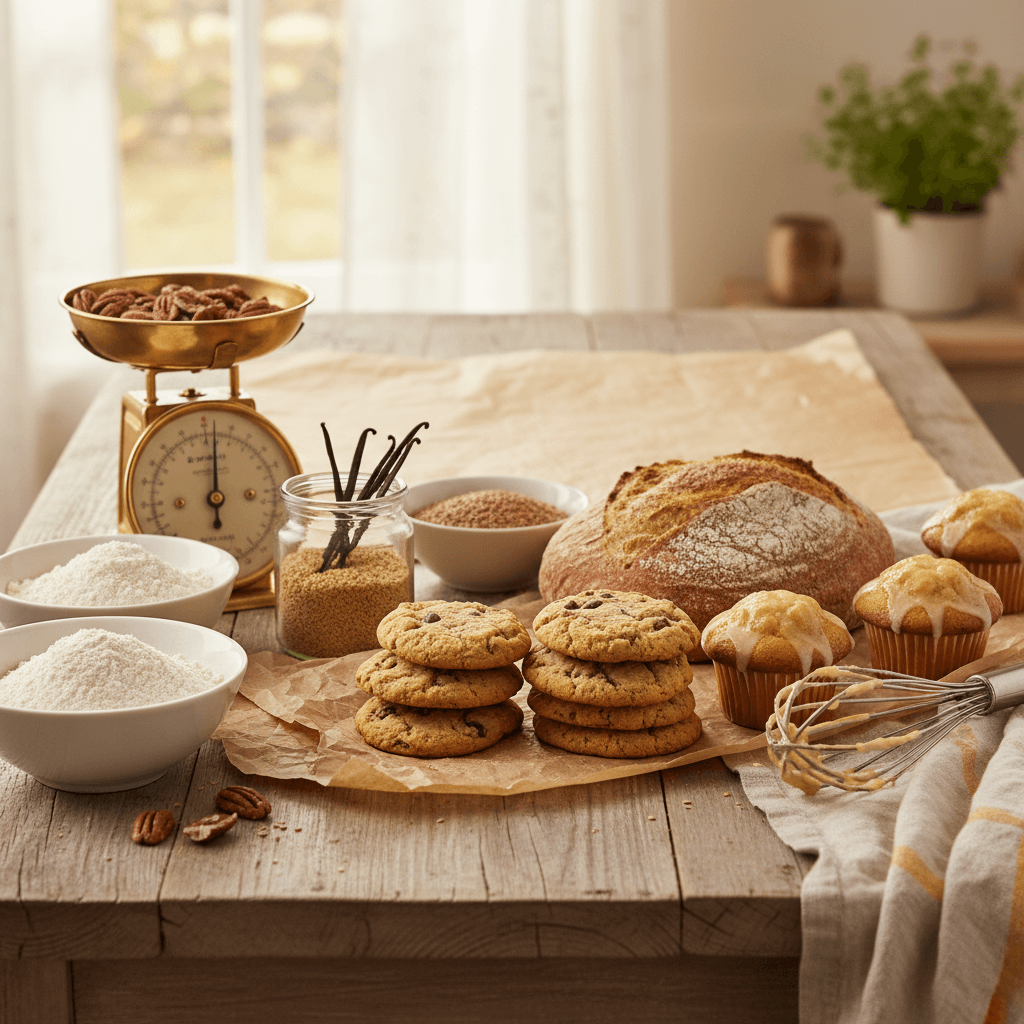
You want to know if home baking can actually pay the bills — or at least cover more than your flour budget. We're going to break down real income ranges, which products make the most money, and why gluten-free home bakers have a significant pricing advantage.
Key takeaways
- Side-hustle home bakers typically earn $500 to $2,000 per month, while those treating it as a full-time business can reach $3,000 to $6,000 per month.
- Profit margins vary wildly by product — decorated cookies and specialty cakes can hit 60-70% margins, while bread often sits at 30-40%.
- Gluten-free bakers command a 30-50% pricing premium because customers expect to pay more and have fewer alternatives.
- Ingredient costs are only part of the equation — your time, packaging, and delivery expenses dramatically affect what you actually take home.
- Customer retention is the real income driver. Repeat orders from loyal customers are far more profitable than constantly finding new ones.
- Most home bakers undercharge in their first year, which makes the business feel unsustainable before it has a chance to work.
Realistic income ranges for home bakers
Most home bakers fall into one of three income tiers, and where you land depends on how many hours you work, what you sell, and how well you price your products.
| Level | Monthly revenue | Monthly take-home (after costs) | Hours per week |
|---|---|---|---|
| Casual side hustle | $500 - $1,200 | $250 - $750 | 5 - 12 |
| Serious side hustle | $1,200 - $3,000 | $750 - $2,000 | 12 - 25 |
| Full-time replacement | $3,000 - $6,000+ | $2,000 - $4,500+ | 25 - 40 |
These numbers are based on cottage food operations and home-based bakery permits in most US states. If you're in a state with no sales cap (like Texas or Utah), the ceiling is higher. If you're in a state that caps annual cottage food sales at $25,000 or $50,000, that directly limits your revenue.
Here's the honest part: most home bakers who quit do so in the first six months, and the number one reason is underpricing. They charge what feels "fair" instead of what covers their actual costs plus a real hourly wage. We'll get into that below.
Which baked goods have the best profit margins
Not all baked goods are created equal when it comes to profitability. The items that take the most skill and the least raw ingredient cost tend to have the best margins.
| Product | Typical margin | Why |
|---|---|---|
| Decorated sugar cookies | 60 - 70% | Low ingredient cost, high perceived value from decoration skill |
| Specialty cakes (custom, tiered) | 55 - 70% | Customers pay for design and skill, not just ingredients |
| Cupcakes (decorated) | 50 - 65% | Small batch size, high per-unit pricing |
| Brownies and bars | 50 - 60% | Simple to batch, low ingredient cost, easy to package |
| Muffins and scones | 45 - 55% | Quick to produce, good for weekly subscription models |
| Artisan bread | 30 - 45% | Time-intensive, lower price tolerance from customers |
| Pies | 35 - 50% | Seasonal demand, moderate ingredient cost |
The key insight here is that your labor is the biggest hidden cost. A loaf of bread might only use $2 in ingredients, but if it takes you 4 hours of active and passive time from start to finish, your effective hourly rate can drop below minimum wage unless you price it at $10 or more. Decorated cookies, on the other hand, use pennies of dough and icing — the customer is paying for your artistry.
If you're just getting started and want to keep your equipment investment reasonable, our guide to affordable baking tools for beginners covers everything you need without overspending on gear you don't need yet.
Why gluten-free home bakers have a pricing advantage
Gluten-free bakers can charge 30-50% more than conventional home bakers, and customers not only accept it — they expect it. Here's why this niche is one of the most profitable in the cottage food world.
First, gluten-free customers are used to paying premium prices. A loaf of gluten-free bread at the grocery store already costs $6 to $9. A homemade loaf that actually tastes good? They'll happily pay $10 to $14. The price anchoring is already done for you.
Second, the competition is thin. In most areas, there are zero dedicated gluten-free home bakers. People with celiac disease or gluten sensitivity can't just walk into any bakery and buy a cupcake. When they find someone who bakes safely for them, they become fiercely loyal customers who order regularly and refer everyone they know.
Third, ingredient costs are higher for gluten-free baking — almond flour, tapioca starch, and specialty blends cost more than all-purpose wheat flour. But the pricing premium more than compensates for this. Where a conventional baker might have 50% margins on cookies, a gluten-free baker selling the same volume can hit 55-65% margins because the price ceiling is so much higher.
If you're exploring gluten-free baking for a home business, our gluten-free baking guide covers the fundamentals of working with alternative flours and avoiding the most common texture problems.
Want a structured path to building a gluten-free baking business that actually generates consistent income? The free Home Bakery Pro masterclass walks you through getting from your first order to stable, repeatable revenue — taught by a home baker who built a full-time income in 3 months. Watch the free masterclass here.
The real costs most home bakers forget to count
Revenue means nothing if you're not tracking what actually goes out the door. Here are the costs that catch new home bakers off guard and quietly destroy their margins.
Ingredient cost is only the beginning
Most bakers calculate ingredient cost per recipe and stop there. But you also need to account for packaging (boxes, bags, labels, tissue paper), delivery costs (gas, insulated bags), platform fees if you sell through a marketplace, and any permits or insurance your state requires. For gluten-free bakers, there's the additional cost of maintaining a dedicated pantry free from cross-contamination.
Your time has a dollar value
This is where the math gets uncomfortable. If you spend 3 hours making and decorating a dozen cookies and sell them for $36, your ingredient cost might be $8 and packaging $3. That leaves $25 — which sounds great until you realize you just paid yourself about $8 per hour. Now factor in the time you spent communicating with the customer, shopping for ingredients, and cleaning up.
The home bakers who reach $3,000 to $6,000 per month have figured out how to batch efficiently, streamline their menu, and price their time at $25 to $40 per hour minimum.
How to actually calculate your pricing
Use this formula as a starting point for every product you sell:
(Ingredient cost + Packaging cost) x 3 = Minimum price
That 3x multiplier covers your labor, overhead, and profit. For specialty items like custom cakes or gluten-free products, multiply by 3.5 to 4x. If the resulting price feels "too high," that's usually a sign you've been undercharging — not that the formula is wrong.
Here's a real example. A batch of 12 gluten-free chocolate chip cookies costs roughly $6 in ingredients (using brown rice flour, butter, chocolate chips, eggs, sugar) and $2 in packaging. That's $8 total cost. At 3.5x, your price is $28 per dozen, or about $2.35 per cookie. For gluten-free cookies, that's completely reasonable — most customers will pay $3 per cookie without blinking.
What separates home bakers who make real money from those who burn out
After talking with dozens of home bakers and analyzing what works, the patterns are clear. The bakers who build sustainable income do these things differently:
- They keep a tight menu. Instead of offering 30 items, they perfect 5-8 products and become known for them. This reduces waste, speeds up production, and makes shopping predictable.
- They build repeat customers, not one-time orders. Weekly bread subscriptions, monthly cookie boxes, and standing holiday orders create predictable revenue. Chasing new customers every week is exhausting and expensive.
- They raise prices early and often. The bakers who started at "friends and family" pricing and never raised it are the ones who quit. The ones who priced for profit from day one are still baking.
- They invest in the right equipment at the right time. A second oven or a commercial mixer pays for itself when you're turning away orders because you can't produce fast enough. Our guide to professional baking equipment worth the investment covers which upgrades actually move the needle.
- They niche down. The most profitable home bakers we've seen specialize — gluten-free birthday cakes, vegan French macarons, sourdough bread only. Specialization lets you charge more and attract the right customers.
A realistic timeline for building home bakery income
Let's be honest about how long this takes. Here's what a realistic ramp-up looks like for someone who's serious but starting from scratch:
| Month | What's happening | Expected revenue |
|---|---|---|
| 1 - 2 | Getting permits, perfecting recipes, test batches for friends and family | $0 - $200 |
| 3 - 4 | First real orders, building word of mouth, establishing pricing | $200 - $800 |
| 5 - 8 | Repeat customers forming, refining menu, improving efficiency | $800 - $2,000 |
| 9 - 12 | Consistent weekly orders, possible wholesale accounts, holiday rush | $1,500 - $3,500 |
| Year 2+ | Optimized operations, loyal customer base, potential full-time income | $2,500 - $6,000+ |
Some bakers move faster. Some move slower. The variable that matters most isn't talent — it's consistency. The bakers who show up every week, deliver on time, and treat it like a business (not a hobby that sometimes makes money) are the ones who hit full-time income.
The bottom line on home baking income
Home baking can absolutely generate real income — from a meaningful side hustle to a full-time living. But it's not passive, it's not easy, and it requires treating pricing, time management, and customer retention as seriously as you treat your recipes. Gluten-free and specialty bakers have a genuine advantage because the demand is high, the competition is low, and customers are willing to pay premium prices for products they can trust.
If you're still reading this, you're probably the kind of person who can actually make it work — because you're doing the research instead of just jumping in with wishful thinking.
Ready to build a home bakery that actually pays you?
Want to see the exact path from first order to stable income? This free masterclass is taught by a home baker who built a full-time income in 3 months — and shows you how to get consistent repeat customers without relying on social media.
Watch the free Home Bakery Pro masterclass here
Frequently asked questions
Can you make a living as a home baker?
Yes, but it takes most home bakers 9 to 18 months to replace a full-time income. Realistic full-time earnings range from $3,000 to $6,000 per month, depending on your state's cottage food laws, your product mix, and how efficiently you produce. The bakers who succeed treat it as a business from day one, with proper pricing and a focus on repeat customers.
What baked goods are most profitable to sell from home?
Decorated sugar cookies and custom cakes consistently have the highest profit margins (60-70%) because customers are paying for skill and design, not just ingredients. Brownies, bars, and cupcakes are also strong performers. Bread tends to have lower margins due to the time investment. Gluten-free versions of any product can command 30-50% higher prices.
How much should home bakers charge for gluten-free products?
A good starting point is 3.5 to 4 times your total cost (ingredients plus packaging). Gluten-free customers are accustomed to paying premium prices — a dozen gluten-free cookies at $28 to $36 is standard, and custom gluten-free cakes regularly sell for $50 to $100+. Don't anchor your pricing to conventional baked goods. Your ingredient costs are higher, and your expertise in safely handling allergen-free baking has real value.
Do you need a license to sell baked goods from home?
In most US states, you need to operate under a cottage food law or obtain a home bakery permit. Requirements vary widely — some states have no sales caps and minimal regulation, while others require kitchen inspections, food handler certifications, or limit your annual revenue. Check your state's specific cottage food laws before you start selling.
How do home bakers get their first customers?
Most successful home bakers start with their personal network — friends, family, coworkers, neighbors, and local community groups. Word of mouth from satisfied customers is the most powerful growth channel. Farmers markets, local Facebook groups, and community events are also effective. The key is delivering an excellent product consistently so that every customer becomes a referral source.

Written by
Co-founder, BakingSubs
Co-founder of BakingSubs, where he turns the science of ingredient substitutions into tested, reliable guidance for home bakers.
Related Posts
Gluten-Free Flour Weight Chart: Grams per Cup for 9 Major Brands (and Why the Spread Is Over 20%)
Best Low Carb Tortillas (2026): 6 Brands Compared by Net Carbs
Best Sugar-Free Cake Mix and Brownie Mix (2026): 14 Options Ranked by Net Carbs, Sweetener, and Price
Bake with Confidence
See all
Confident Gluten-Free Baker Toolkit
The science-based system that replaces gluten's seven invisible jobs so your baking turns out soft, fluffy, and foolproof — every time.

Gluten-Free Recipe Vault
Instant access to our complete library of proven gluten-free recipes — no waiting, no guesswork, just results that work tonight.

Fix Your Gluten-Free Bread
Learn the 3-step formula to make bread rise and stay soft, discover why your loaves collapse, and get a tested sandwich bread recipe that actually works.