

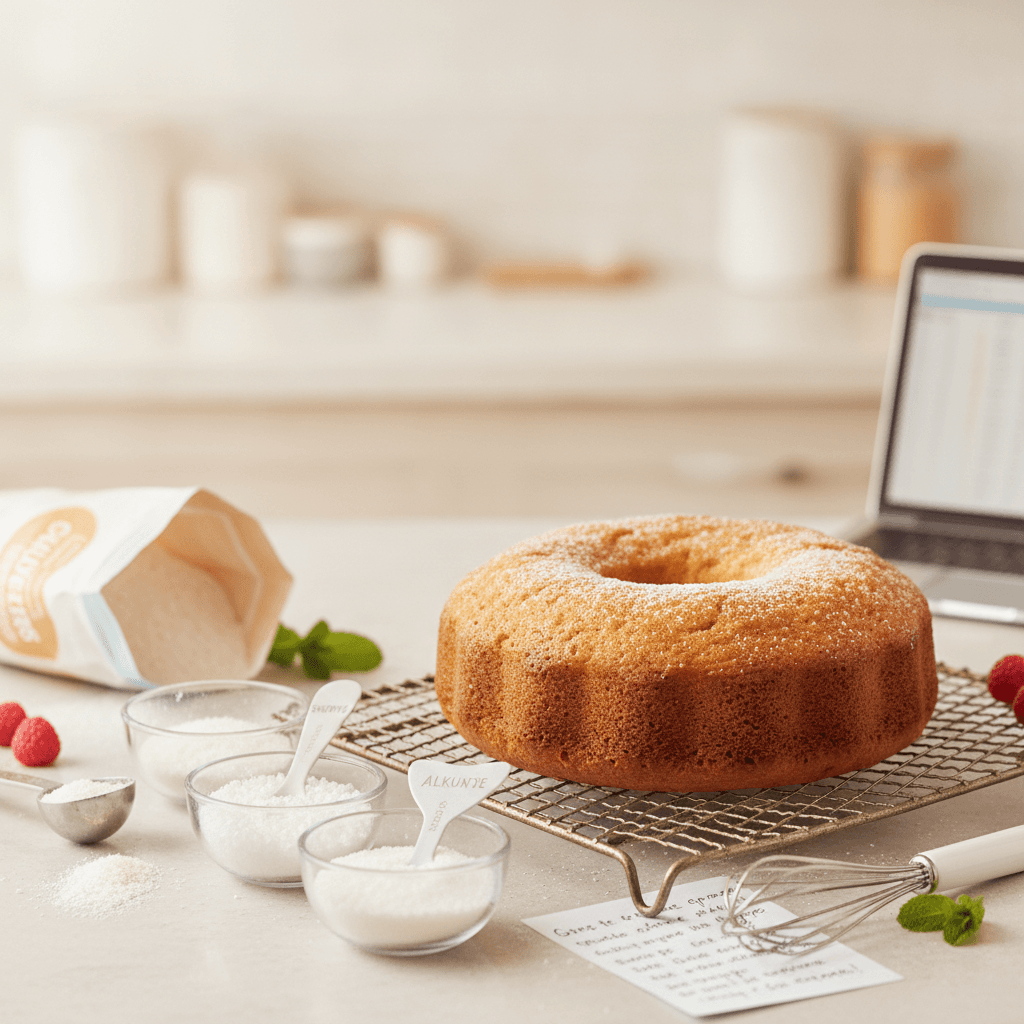
Swerve is an erythritol-based sweetener that measures 1:1 with sugar, contains 0 calories and 0 net carbs per serving, and is one of the most widely available sugar substitutes for baking. It works well in cookies and cakes but has a documented cooling aftertaste and a tendency to recrystallize in frostings and glazes — two trade-offs that matter depending on what you bake.
Key takeaways
- Swerve Granular's label shows 0 calories and 0g net carbs per 2-teaspoon (8g) serving: 8g total carbohydrate, made up of 6g erythritol and 2g allulose, both of which are subtracted to reach the net-carb figure.
- Swerve says it measures cup-for-cup like sugar. Since a December 2023 reformulation, Swerve Granular lists erythritol, allulose, natural flavor and xanthan gum. Older bags and many reviews still show the original erythritol, oligosaccharides and natural flavors formula.
- Erythritol recrystallizes as it cools, which means frostings, glazes, and no-bake fillings can turn gritty as they sit. This is a chemistry-driven limitation, not a brand-specific flaw.
- Swerve is labeled non-GMO, which Swerve says means it does not require a bioengineered food disclosure. Its ingredient label contains no stevia, aspartame or other high-intensity sweeteners.
- A 2016 study in the American Journal of Physiology – Endocrinology and Metabolism (Wölnerhanssen et al.) found that 75g of erythritol did not affect blood glucose or insulin in 10 lean and 10 obese adults. That finding is consistent with Swerve's "non-glycemic" claim.
Swerve vs Lakanto vs Wholesome Allulose: comparison table
This table compares Swerve Granular, Lakanto Classic Monkfruit Sweetener, and Wholesome Sweeteners Allulose — three of the most common sugar-free baking sweeteners — on verifiable label and product data.
| Criteria | Swerve Granular | Lakanto Classic | Wholesome Allulose |
|---|---|---|---|
| Primary sweetening ingredient | Erythritol + allulose | Erythritol + monk fruit extract | Allulose |
| Calories per teaspoon | 0 | 0 | 0 (FDA allows 0 at <5 cal) |
| Net carbs per teaspoon | 0g | 0g | 0g |
| Sugar alcohols per teaspoon | About 3g (label: 6g erythritol per 2-tsp serving) | 4g | 0g (allulose is a rare sugar, not a sugar alcohol) |
| Sweetness vs sugar (manufacturer claim) | 1:1 | 1:1 | 70% as sweet as sugar |
| Glycemic impact (manufacturer claim) | Non-glycemic | Zero glycemic | No glycemic impact |
| Non-GMO Project Verified | No (labeled non-GMO) | Yes | Yes |
| Keto / low-carb certified | Not stated (labeled keto friendly) | Not stated (labeled keto friendly) | Keto Certified |
| Formats available | Granular, Confectioners, Brown, Bake Mix | Granular, Golden, Powdered, Liquid Drops | Granular, Liquid |
| Cooling aftertaste (chemistry-predicted) | Moderate — erythritol has a measured endothermic dissolution | Moderate — same erythritol base; monk fruit may partially mask it | Minimal — allulose does not have erythritol's endothermic effect |
| Recrystallization risk | High — erythritol crystallizes as baked goods cool | High — same erythritol base | Low — allulose stays dissolved and hygroscopic |

Swerve Ultimate Sugar Replacement Sweetener, Granular Sugar Substitute, Zero Calorie, Keto Friendly, Zero Sugar, Non-Glycemic, Gluten Free, 12 ounces
Check price on Amazon →How we ranked these
We compared these three sweeteners on criteria anyone can verify without tasting: label nutrition (calories, net carbs, sugar alcohols), ingredient list, certifications (Non-GMO Project, USDA Organic, etc.), available formats (granular, confectioners, brown, liquid), and price tier. We also note chemistry-predicted behavior — for example, erythritol's well-documented endothermic dissolution, which produces a cooling sensation on the tongue, and its tendency to recrystallize at room temperature. We did not taste-test any of these products and have not baked with them.
What is Swerve actually made of?
Swerve Granular's current ingredient label, per the manufacturer, lists erythritol, allulose, natural flavor and xanthan gum. Swerve added allulose and xanthan gum in a December 2023 reformulation. The original formula was erythritol, oligosaccharides and natural flavors, so older bags and older reviews show that list. Erythritol, still the first ingredient, is a sugar alcohol that Swerve makes by fermenting glucose from corn, and it provides the bulk. Swerve says the allulose improves browning and the xanthan gum gives batters a smoother consistency.
Erythritol on its own is only about 60–70% as sweet as sucrose, so pure erythritol — which you can buy from brands like NOW Foods — takes more than a cup to match 1 cup of sugar's sweetness. Swerve's blend is formulated to measure cup-for-cup like sugar, so it solves that math for you.
Where Swerve works well in baking
Erythritol-based sweeteners perform best in recipes that are served warm or that have enough fat and moisture to slow recrystallization. Based on ingredient chemistry (not personal testing), Swerve is a strong candidate for:
- Cookies — particularly drop cookies eaten within a day or two. The fat in butter or oil helps keep erythritol dissolved. If you're adapting a sugar cookie recipe, expect slightly less spread because erythritol doesn't melt and flow the way sucrose does.
- Cakes and muffins — the crumb structure traps moisture, which delays crystallization. Swerve's Confectioners variety works for dustings, though not for poured glazes (see below).
- Quick breads — banana bread, zucchini bread, and pumpkin bread all have enough moisture to help slow erythritol's recrystallization.
If you're new to sugar-free baking and running into dry or crumbly results, our guide on common healthy baking mistakes that ruin texture covers the most frequent causes.
Where Swerve struggles (and what to use instead)
Erythritol's recrystallization is not a defect in Swerve specifically — it is a physical property of the molecule. This creates problems in three categories:
- Frostings and buttercreams — a Swerve-based frosting will often feel smooth when freshly made but turn grainy as it sits at room temperature. The confectioners version slows this slightly but does not eliminate it.
- Glazes and syrups — poured glazes harden into a chalky, crystalline coating. This is where allulose performs significantly better because it remains hygroscopic and does not crystallize.
- Hard candies and caramels — erythritol cannot form a stable glass the way sucrose does, so brittles and toffees fail entirely.
For frostings and glazes, allulose-based sweeteners are the better chemistry match. Our allulose brand comparison covers more options ranked on label data.
Swerve's four formats explained
Granular
The flagship product. Measures 1:1 with granulated sugar. Works in any recipe where sugar is creamed with butter or dissolved in liquid. Label: 0 cal and 0g net carbs per 2-teaspoon serving, with 6g erythritol and 2g allulose.
Confectioners
A powdered version designed to replace powdered sugar. The finer grind dissolves faster, which makes it better for frostings than the granular — though it does not eliminate the recrystallization issue. Useful for dusting finished baked goods.
Brown
Swerve Brown is formulated to mimic the flavor and moisture profile of brown sugar. Swerve lists erythritol, prebiotic oligosaccharides, vegetable glycerin, fruit juice concentrate (for color) and natural flavors in it, and says it added allulose to the Brown formula in 2023. It measures 1:1 with packed brown sugar. Useful in recipes where brown sugar's flavor matters — oatmeal cookies, spice cakes, barbecue glazes.
Baking mixes
Swerve also sells sugar-free baking mixes that, per Swerve, are made with almond flour, coconut flour, tapioca flour and Swerve sweetener, and are gluten free and grain free. These are convenience products, not a standalone sweetener.
The cooling aftertaste: why it happens and how significant it is
Erythritol has a negative heat of solution — when it dissolves on your tongue, it absorbs heat, creating a cooling sensation. This is a measurable thermodynamic property (approximately -43 cal/g, per food chemistry references), not a subjective opinion. The effect is more noticeable in products with less fat and less competing flavor. Chocolate, coffee, and cinnamon-heavy recipes mask it more effectively than vanilla or plain sugar cookie recipes.
Lakanto pairs erythritol with monk fruit extract (mogrosides). Whether monk fruit meaningfully reduces the perceived cooling is subjective and not something we can verify from label data alone. Allulose avoids the issue entirely because it is a rare sugar, not a sugar alcohol, and has no endothermic dissolution effect.
For a deeper look at how different sweeteners behave in baking and which texture changes catch bakers off guard, that guide covers erythritol alongside several other common swaps.
Who should buy Swerve
- Bakers who want a simple 1:1 sugar swap — no conversion math, no adjusting ratios. You replace 1 cup of sugar with 1 cup of Swerve.
- Keto and low-carb bakers tracking net carbs — 0g net carbs per serving is as low as it gets. Erythritol is generally accepted on keto protocols because it does not raise blood glucose or insulin (per the 2016 Wölnerhanssen study mentioned above).
- Home bakery owners selling sugar-free goods — Swerve is widely recognized by customers, which reduces the "what is this?" friction. If you're costing recipes for a home bakery, compare per-ounce prices on the bag sizes you would actually buy.
- People who need multiple formats — granular, confectioners, and brown in one brand means consistent flavor across a recipe lineup.
Who should skip Swerve
- Anyone making frostings, glazes, or caramels as their primary use — erythritol's recrystallization will frustrate you. Allulose is the better molecule for these applications.
- Bakers sensitive to cooling aftertaste — if you've tried pure erythritol and disliked the cooling sensation, Swerve will produce the same effect. Consider monk fruit blends with less erythritol content, or switch to allulose.
- Anyone with digestive sensitivity to sugar alcohols — while erythritol is generally better tolerated than xylitol or maltitol (because most of it is absorbed in the small intestine and excreted unchanged in urine, according to human kinetics studies), some people still report bloating at higher doses. A typical cookie recipe using 1 cup of Swerve (about 192g) contains roughly 144g of erythritol, based on the label's 6g of erythritol per 8g serving. Across 24 cookies, that is about 6g per cookie.
- Bakers who need sugar-level browning — erythritol does not undergo Maillard browning. Swerve says the allulose added in 2023 improves browning, but erythritol is still most of the blend, so expect lighter color than with sugar. For deep browning, a pure allulose sweetener browns faster than sugar.
Cost comparison: Swerve vs allulose per recipe
Exact retail prices fluctuate, so here is a worked example using typical mid-range pricing to show relative cost. This is a hypothetical calculation, not a quote from a specific retailer.
Say you are making a batch of 24 sugar-free chocolate chip cookies that calls for 1 cup (approximately 192g) of sweetener:
| Sweetener | Approximate price per oz (mid-range) | Grams needed for 1 cup | Ounces needed | Estimated cost per batch |
|---|---|---|---|---|
| Swerve Granular | $0.56 | 192g | 6.8 oz | $3.81 |
| Wholesome Allulose | $0.72 | ~256g (1⅓ cups, per Wholesome's conversion) | 9.0 oz | $6.48 |
The allulose cost is higher for two reasons: it is priced at a premium tier per ounce, and you need approximately 1.3 cups to match 1 cup of sugar's sweetness (since allulose is only about 70% as sweet). Swerve's 1:1 ratio and lower price per ounce make it the most budget-friendly option per batch.
If you're running a home bakery and selling sugar-free cookies at $3.50 each, the sweetener cost difference between Swerve and allulose is about $2.67 per 24-cookie batch — roughly $0.11 per cookie. Small per unit, but it adds up. At 10 batches per week, that is $26.70 in weekly margin.
How Swerve affects recipe chemistry
Sugar does more than sweeten — it provides moisture retention, tenderizes gluten, feeds yeast, and enables browning. Swerve handles some of these functions but not all:
- Moisture retention: Erythritol is not hygroscopic. Unlike sugar, it does not pull water from the air to keep baked goods moist. Expect erythritol-sweetened baked goods to stale faster than sugar-based versions. Our guide on sugar's functions in baking explains why this matters.
- Gluten tenderizing: Sugar competes with gluten proteins for water, which limits gluten development and keeps cakes tender.
- Yeast feeding: Erythritol does not ferment. Yeast cannot metabolize it. If your recipe relies on sugar to feed yeast (bread, cinnamon rolls, brioche), you will need to add a small amount of real sugar — typically 1–2 teaspoons — or use a different rising strategy.
- Browning: Erythritol does not brown. Swerve says its added allulose helps, but expect paler results than with sugar. Some bakers brush an egg wash on top for color, or add a teaspoon of molasses (which does add some sugar and carbs).
For more on choosing between different sugar alternatives and their trade-offs, that guide walks through the decision tree.
Swerve and digestive tolerance: what the research says
Human studies have found that erythritol is rapidly absorbed in the small intestine and excreted in urine without being metabolized. A 1996 kinetics study in healthy adults recovered about 78% of the dose unchanged in urine within 24 hours. This means it largely bypasses the large intestine, where sugar alcohols like xylitol and maltitol cause gas and bloating by fermenting with gut bacteria.
However, a 2023 study published in Nature Medicine found an association between higher blood erythritol levels and increased risk of cardiovascular events in an observational cohort. This study did not prove causation and has been debated in the scientific community. The FDA has said the observational studies cited in the paper did not establish a causal link between erythritol and those effects, and that it continues to monitor erythritol. If you have cardiovascular concerns, this is worth discussing with a healthcare provider — we are not in a position to make medical recommendations.
For a broader comparison of erythritol vs xylitol in baking, including digestive tolerance differences, that post covers six key differences.
Frequently asked questions
Is Swerve sweetener safe for people with diabetes?
Swerve contains erythritol, which did not raise blood glucose or insulin in a 2016 study of 20 adults published in the American Journal of Physiology – Endocrinology and Metabolism. However, individual responses can vary, and anyone managing diabetes should consult their healthcare provider before making dietary changes.
Can you substitute Swerve 1:1 for sugar in any recipe?
Swerve measures 1:1 with sugar by volume, but it does not replicate all of sugar's functions. It will not feed yeast, caramelize, or retain moisture the way sucrose does. For cookies, cakes, and quick breads, a straight 1:1 swap usually works. For frostings, yeast breads, and caramels, you will need to adjust the recipe or choose a different sweetener like allulose.
Why does Swerve make my frosting gritty?
Erythritol tends to recrystallize as it cools. In frostings and glazes that sit at room temperature, this can produce a gritty or sandy texture. Using the Confectioners version slows the process but does not prevent it. For smooth frostings that stay creamy, allulose is a better choice because it does not crystallize.
Does Swerve have a cooling aftertaste?
Yes. Erythritol has a negative heat of solution (approximately -43 cal/g), which means it absorbs heat when it dissolves on your tongue, creating a cooling sensation. This is a measurable physical property, not subjective. It is more noticeable in lightly flavored recipes and less noticeable in chocolate, coffee, or heavily spiced baked goods.
How does Swerve compare to Lakanto for baking?
Both use erythritol as the primary bulking agent, so they share the same recrystallization and cooling-aftertaste characteristics. Lakanto adds monk fruit extract (mogrosides), while current Swerve Granular adds allulose instead. On label data, they are very similar: both show 0 calories and 0g net carbs. Prices vary by retailer and bag size, so compare per-ounce cost before choosing. The choice between them comes down to whether you prefer the monk fruit addition or Swerve's allulose. For a broader view, our best sugar substitute for baking roundup compares more options.

Written by
Co-founder, BakingSubs
Co-founder of BakingSubs, where he turns the science of ingredient substitutions into tested, reliable guidance for home bakers.
Related Posts
Best Sugar-Free Cake Mix and Brownie Mix (2026): 14 Options Ranked by Net Carbs, Sweetener, and Price
Lakanto Monk Fruit Sweetener Review: 0g Net Carbs, but Worth the Premium Price?
Best Allulose Syrup Brands (2026): 5 Compared by Label, Certifications, and Price
Bake with Confidence
See all
Confident Gluten-Free Baker Toolkit
The science-based system that replaces gluten's seven invisible jobs so your baking turns out soft, fluffy, and foolproof — every time.

Gluten-Free Recipe Vault
Instant access to our complete library of proven gluten-free recipes — no waiting, no guesswork, just results that work tonight.

Fix Your Gluten-Free Bread
Learn the 3-step formula to make bread rise and stay soft, discover why your loaves collapse, and get a tested sandwich bread recipe that actually works.