

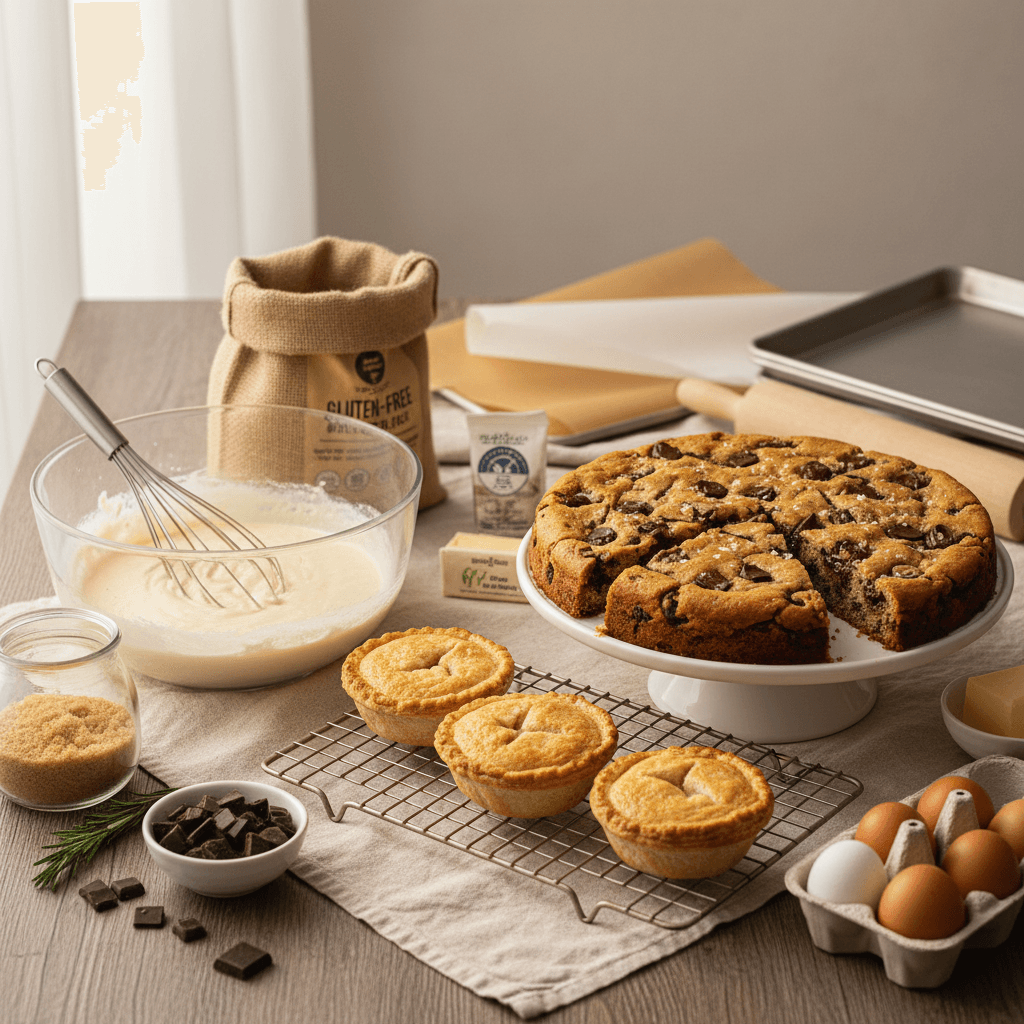
Baking gluten-free for a crowd is a different challenge than making a single loaf or a dozen cookies. Scaling up introduces problems with texture, timing, and cross-contamination that can turn a great recipe into a disappointing one. Here's everything you need to know to pull it off confidently, whether you're feeding 20 people at a potluck or 100 at an event.
Key takeaways
- Weigh all ingredients by grams when scaling gluten-free recipes — volume measurements become wildly inaccurate at larger quantities.
- Choose recipes that hold up well at room temperature, like brownies, sheet cakes, and cookie bars, rather than delicate items that stale quickly.
- Prevent cross-contamination by dedicating tools and workspace, especially when baking alongside gluten-containing items.
- Scale recipes by no more than 3x at a time to avoid leavening and hydration problems unique to gluten-free batters.
- Make-ahead strategies like freezing and par-baking save your sanity on event day.
- Test your scaled recipe at least once before the actual event — gluten-free batters don't always behave predictably at larger volumes.
Why gluten-free baking doesn't scale the same way
Gluten-free batters behave differently from wheat-based ones when you multiply a recipe. Without the gluten network that provides structure and tolerance, small changes in hydration, mixing time, or leavening ratios become much more noticeable at scale. A recipe that works perfectly as a single batch can turn out gummy, flat, or dry when tripled.
The main culprit is that gluten does seven distinct jobs in baking, and gluten-free blends rely on a patchwork of starches, gums, and proteins to cover those roles. That patchwork is more sensitive to ratio changes. Xanthan gum, for example, can go from perfectly chewy to slimy if you scale it up linearly without adjusting. Leaveners like baking powder also behave differently in larger volumes of batter because the gas has farther to travel before the structure sets.
The good news: once you understand these quirks, scaling gluten-free baking is totally manageable. You just need a slightly different approach than you'd use with wheat flour.
Best gluten-free recipes to bake for a crowd
Not every gluten-free recipe is a good candidate for crowd baking. The best choices are items that hold their texture at room temperature, don't require precise timing to serve, and can be made in sheet pans or large batches. Here are the categories that work best:
| Recipe type | Why it works for crowds | Watch out for |
|---|---|---|
| Brownies and blondies | Dense, forgiving, easy to cut and serve | Can overbake if pans are too thin |
| Sheet cakes | One pan feeds 24-48 people, frosts easily | Gluten-free cakes stale faster — frost day-of |
| Cookie bars | No individual shaping, consistent results | May need extra binder at scale |
| Muffins and quick breads | Portion-controlled, freeze well | Batter can't sit long — bake immediately |
| Scones | Can be shaped ahead and frozen unbaked | Require cold fat — work quickly |
| Banana bread / pumpkin bread | Moist, flavorful, holds up at room temp | Dense batters take longer to bake through in large pans |
Items to avoid for crowd baking include anything with delicate meringue, layered pastries, or recipes that require precise oven spring like artisan bread. Those are better reserved for smaller batches where you can give each one individual attention.
If you're still building confidence with gluten-free techniques, our complete beginner's guide to gluten-free baking covers the fundamentals you'll want to have down before scaling up.
How to scale gluten-free recipes without ruining the texture
The safest approach is to scale a gluten-free recipe by no more than 2x or 3x at a time. Beyond that, you're better off making multiple batches rather than one giant one. Here's why, and how to do it right.
Always weigh your ingredients
This is non-negotiable when baking at scale. A cup of brown rice flour can weigh anywhere from 120g to 160g depending on how you scoop it. Multiply that inconsistency by 4x and you could be off by an entire cup of flour. Use a kitchen scale for everything, including liquids. If you're baking for crowds regularly, a food scale rated for commercial baking is worth the investment.
Adjust leavening carefully
When doubling or tripling a recipe, reduce leavening to about 75-80% of the mathematically scaled amount. So if your original recipe calls for 2 teaspoons of baking powder, a tripled batch should use about 4.5-5 teaspoons instead of the full 6. Too much leavening causes the batter to rise fast and then collapse, which is an even bigger problem in gluten-free baking because there's no gluten network to hold the structure.
Don't over-mix at larger volumes
Bigger batches spend more time in the mixer, which means more activation of xanthan or guar gum and more degassing of leaveners. Mix your dry and wet ingredients separately, then combine them just until incorporated. If you're using a stand mixer, keep it on low speed and stop as soon as streaks of flour disappear.
Watch your hydration
Gluten-free flours absorb water at different rates, and those differences compound at scale. If your batter looks significantly thicker or thinner than the original recipe, adjust with a tablespoon of liquid or starch at a time. This is another reason to always do a test batch at your scaled quantity before the big day.
How to prevent cross-contamination when baking gluten-free for a crowd
Cross-contamination is the biggest safety concern when baking gluten-free for others, especially if you're working in a kitchen that also handles wheat flour. For someone with celiac disease, even trace amounts of gluten can cause a reaction.
Here's a practical checklist:
- Dedicate your workspace. Clean all surfaces with soap and water (not just a wipe-down) before starting. Flour dust settles everywhere.
- Use separate tools. Wooden spoons, cutting boards, and anything porous can harbor gluten. Use dedicated gluten-free tools or stick to non-porous materials like silicone and stainless steel.
- Don't share ovens simultaneously. If you're baking gluten-free and gluten-containing items, bake the gluten-free items first, before any wheat flour is airborne.
- Label everything clearly. When serving, mark gluten-free items with clear signage. Don't rely on people remembering which platter is which.
- Use dedicated serving utensils. One shared knife between a wheat cake and a gluten-free cake defeats the entire purpose.
For a deeper dive into what makes gluten-free baking tricky and how to troubleshoot common problems, our gluten-free learning hub covers everything from gritty textures to poor rise.
If you're finding that crowd-size baking is becoming a regular thing for you — potlucks, events, orders from friends — you might want to check out the free Home Bakery Pro masterclass. It walks you through getting consistent orders and building a sustainable home bakery, which is exactly where this kind of skill leads.
Make-ahead strategies for gluten-free crowd baking
Trying to bake everything on the day of an event is a recipe for stress. Gluten-free baked goods actually freeze remarkably well, so take advantage of that.
What to freeze and when
| Item | Freeze as | How far ahead | Thaw method |
|---|---|---|---|
| Brownies and bars | Baked, uncut, wrapped tightly | Up to 3 months | Room temp, 2-3 hours |
| Muffins | Baked, individually wrapped | Up to 2 months | Room temp, 1-2 hours or 15 sec microwave |
| Sheet cakes | Baked layers, unfrosted, wrapped | Up to 2 months | Fridge overnight, frost day-of |
| Cookie dough | Portioned balls on sheet pan | Up to 3 months | Bake from frozen, add 1-2 minutes |
| Scones | Shaped, unbaked on sheet pan | Up to 2 months | Bake from frozen, add 3-5 minutes |
| Quick bread loaves | Baked, wrapped whole | Up to 2 months | Room temp, 3-4 hours |
Day-of assembly tips
Plan to do frosting, glazing, and cutting on the day you're serving. Gluten-free baked goods tend to stale faster than their wheat counterparts, so exposing cut surfaces to air shortens their window. Frost sheet cakes right before transport, cut brownies at the venue, and keep everything covered until serving time.
How to build a gluten-free flour blend for large batches
If you're baking at volume, buying pre-made gluten-free flour blends gets expensive fast. Mixing your own blend in bulk saves money and gives you more control over flavor and texture. A solid all-purpose blend typically uses a ratio of about 2 parts whole grain flour, 2/3 part starch, and 1/3 part protein-rich flour.
We have a detailed breakdown of homemade gluten-free flour blend ratios that actually work, including variations for different recipe types. When mixing large batches, whisk your blend thoroughly — we're talking 2-3 minutes of whisking — to ensure even distribution of starches and gums throughout.
For crowd baking, flours like brown rice flour and buckwheat flour offer great flavor depth that helps your baked goods stand out. If you're looking for a milder, more neutral base, comparing brown rice flour to white rice flour can help you decide which direction to go.
Serving and presentation tips for gluten-free crowd baking
How you present and serve gluten-free baked goods matters almost as much as how you bake them. Here are the details that make a real difference:
- Cut uniform portions. Use a ruler or scoring guide to mark your sheet pan before cutting. Nothing looks more professional than evenly sized brownies or cake squares.
- Label allergens clearly. List the specific flours and major allergens (nuts, dairy, eggs) on your signage. People with multiple food sensitivities will appreciate the transparency.
- Serve from the pan or a dedicated platter. Don't transfer gluten-free items to a surface that previously held wheat-based foods.
- Include individual portions when possible. Muffins, individually wrapped cookies, or cupcakes eliminate the shared-utensil problem entirely.
- Keep backup stock covered. If you've made extra, keep it wrapped and bring it out as platters empty rather than putting everything out at once.
Frequently asked questions
Can you double a gluten-free recipe without changing anything?
You can safely double most gluten-free recipes, but you should reduce the leavening to about 75-80% of the doubled amount to prevent collapse. Always weigh ingredients rather than using volume measurements, and don't increase mixing time — over-mixing activates gums excessively and degasses the batter.
What are the best gluten-free baked goods to make for a large group?
Brownies, sheet cakes, cookie bars, and muffins are the best choices for crowd baking because they hold up at room temperature, portion easily, and freeze well for make-ahead prep. Avoid delicate items like layered pastries or artisan breads that require individual attention.
How do you keep gluten-free baked goods fresh for an event?
Bake items in advance and freeze them tightly wrapped, then thaw at room temperature on the day of the event. Do all frosting, glazing, and cutting day-of, and keep items covered until serving to prevent quick staling, which is a common issue with gluten-free bakes.
How do you prevent cross-contamination when baking gluten-free for others?
Clean all surfaces thoroughly, use dedicated non-porous tools, and bake gluten-free items before any wheat flour is used in the kitchen. At serving time, label everything clearly and use separate serving utensils for gluten-free and gluten-containing items.
Is it cheaper to make your own gluten-free flour blend for large batches?
Yes, mixing your own blend from individual flours like rice flour, tapioca starch, and potato starch typically costs 30-50% less than buying pre-made blends, especially at the volumes needed for crowd baking. Check out our homemade gluten-free flour blend guide for tested ratios.

Written by
Co-founder, BakingSubs
Co-founder of BakingSubs, where he turns the science of ingredient substitutions into tested, reliable guidance for home bakers.
Related Posts
Gluten-Free Flour Weight Chart: Grams per Cup for 9 Major Brands (and Why the Spread Is Over 20%)
Best Low Carb Tortillas (2026): 6 Brands Compared by Net Carbs
Best Sugar-Free Cake Mix and Brownie Mix (2026): 14 Options Ranked by Net Carbs, Sweetener, and Price
Bake with Confidence
See all
Confident Gluten-Free Baker Toolkit
The science-based system that replaces gluten's seven invisible jobs so your baking turns out soft, fluffy, and foolproof — every time.

Gluten-Free Recipe Vault
Instant access to our complete library of proven gluten-free recipes — no waiting, no guesswork, just results that work tonight.

Fix Your Gluten-Free Bread
Learn the 3-step formula to make bread rise and stay soft, discover why your loaves collapse, and get a tested sandwich bread recipe that actually works.