

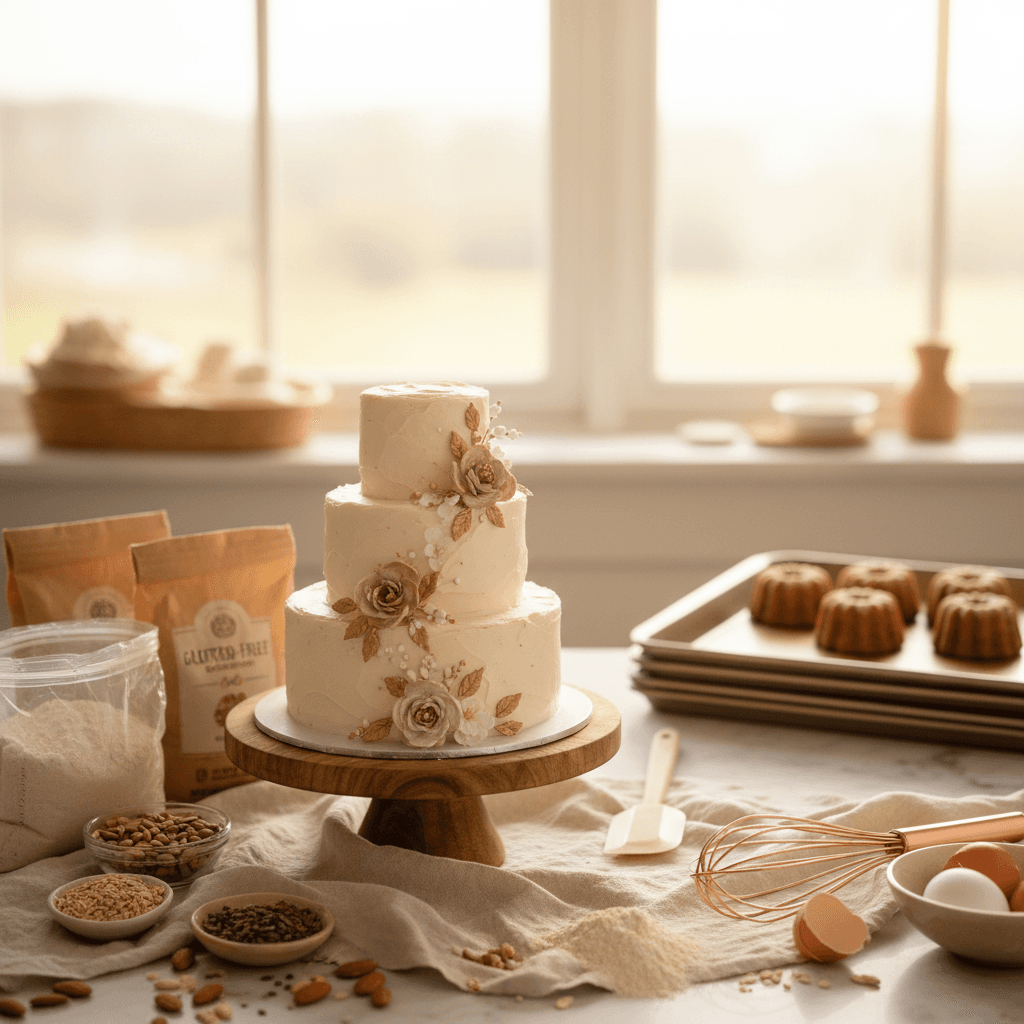
Gluten-free wedding cakes are one of the highest-margin products you can sell from a home bakery, and almost nobody is doing them well. Here's how to build a gluten-free wedding cake business from home that commands premium prices and generates referrals on autopilot.
Key takeaways
- Gluten-free wedding cakes typically command 30-50% higher prices than standard wedding cakes because so few bakers offer them reliably.
- The celiac and gluten-free community is fiercely loyal — one great wedding cake can generate dozens of referrals through support groups and word of mouth.
- You don't need a commercial kitchen to start in most states — cottage food laws in many areas allow wedding cake sales from home.
- Cross-contamination prevention is your biggest differentiator and the reason couples will choose you over a conventional bakery that "also does gluten-free."
- Building relationships with wedding planners, venues, and local celiac support groups creates a steady pipeline of high-value orders.
- Starting with tasting boxes and smaller celebration cakes lets you build a portfolio before committing to full-scale wedding production.
Why gluten-free wedding cakes are a premium opportunity
The math on gluten-free wedding cakes is compelling. A standard three-tier wedding cake from a home baker might sell for $300-$600 depending on your market. A gluten-free version of the same cake routinely sells for $450-$900 or more. That premium exists because demand far outstrips supply — couples with celiac disease or gluten sensitivity struggle to find bakers they trust for the most important cake of their lives.
This isn't a niche where you need to apologize for higher prices. Gluten-free customers already expect to pay more for specialty products, and they understand why. Your ingredients cost more, your process requires more care, and the peace of mind you provide is genuinely worth a premium. When someone has spent years getting sick from cross-contamination at restaurants and bakeries, finding a dedicated gluten-free baker feels like striking gold.
The loyalty factor is enormous. The gluten-free community is tight-knit. Local celiac support groups, gluten-free Facebook groups, and online forums are where people share recommendations constantly. One bride who raves about your cake becomes a referral engine that no amount of Instagram marketing can match. A single recommendation in a local celiac support group can go a long way toward filling a wedding season calendar.
If you haven't already mapped out the basics of running a home bakery, our complete guide to starting a gluten-free home bakery covers the foundational steps you'll want in place before taking on wedding orders.
What you need to know about legality and licensing
Before you accept your first wedding cake order, you need to understand the legal landscape in your state. Cottage food laws vary dramatically — some states allow home bakers to sell cakes with virtually no restrictions, while others cap annual revenue, require specific labeling, or prohibit certain product types.
Wedding cakes can be a gray area in some states because they're often delivered to a venue rather than sold directly to the customer at your home. Check whether your state's cottage food law covers delivery and off-site sales. If it doesn't, you may need a home bakery license or a food handler's permit. Our state-by-state license requirements guide breaks down exactly what you need.
Insurance is another consideration that becomes more important with wedding cakes. A $50 batch of cookies going wrong is one thing. A wedding cake that doesn't show up or collapses at the venue is a potential liability nightmare. Even basic home bakery insurance — usually $200-$400 per year — gives you and your clients peace of mind. We cover the details in our home bakery insurance guide.
If you're serious about building this into a real income stream, our free Home Bakery Pro masterclass walks you through the business side — from getting consistent orders to building sustainable income without relying on social media. Check out the free masterclass here.
How to price gluten-free wedding cakes from a home bakery
Pricing is where most home bakers leave money on the table. Gluten-free wedding cakes should be priced higher than conventional cakes, and you should never feel the need to justify that difference defensively. Instead, communicate the value clearly.
Start with your actual ingredient costs. Gluten-free flour blends, almond flour, and specialty starches like arrowroot powder cost significantly more than all-purpose flour. A bag of quality gluten-free flour blend can run 3-5 times the price of conventional flour. That cost difference is real and your pricing should reflect it.
Here's a framework for building your wedding cake prices:
| Cost component | Standard cake | Gluten-free cake |
|---|---|---|
| Flour and starches per tier | $3-5 | $10-18 |
| Binders (xanthan gum, psyllium, etc.) | $0 | $2-5 |
| Additional testing/sourcing time | Minimal | 1-2 hours per recipe |
| Cross-contamination prevention | None | Dedicated tools, extra cleaning |
| Typical per-serving price | $4-7 | $7-12 |
When you factor in your time, overhead, and the specialized knowledge required, a three-tier gluten-free wedding cake serving 75-100 guests should start at $500-$600 minimum in most markets, and $800-$1,200 is completely reasonable in metro areas. Our complete pricing guide for home bakers walks through the math in detail.
When a couple asks why your cake costs more than a conventional bakery, don't apologize. Explain it simply: "I use premium gluten-free ingredients that cost three to five times more than conventional flour, and I maintain a dedicated gluten-free kitchen to ensure there's zero risk of cross-contamination. That level of care and quality is what you're investing in." Most couples will nod and move on — they've been dealing with this reality their entire gluten-free lives.
Mastering gluten-free cake recipes that hold up at weddings
A wedding cake needs to do things a regular cake doesn't. It needs to be structurally sound enough to stack multiple tiers, hold up for hours at room temperature, travel without crumbling, and still taste incredible. Gluten-free cakes have specific challenges in all of these areas, but they're completely solvable.
Structure is your biggest technical challenge. Without gluten providing that elastic protein network, your cakes need alternative structural support. A blend of brown rice flour, a starch like tapioca or arrowroot, and a binder like xanthan gum gives you a crumb that's sturdy enough to stack. If you're getting crumbly results, our guide to fixing dry, crumbly gluten-free bakes will help you troubleshoot.
Moisture management matters more for wedding cakes than for any other product you'll make. Gluten-free cakes tend to stale faster than conventional cakes, which is a real problem when a cake needs to look and taste perfect hours after leaving your kitchen. Adding moisture-retaining ingredients — an extra egg yolk, a tablespoon of sour cream, or a simple syrup soak after baking — makes a dramatic difference. Our quick staling troubleshooting page covers the science behind this.
Here are the recipe principles that work for gluten-free wedding cakes:
- Use a tested flour blend consistently. Don't switch blends between testing and the actual cake. Different blends absorb moisture differently and will change your results.
- Weigh everything. Cup measurements introduce too much variability for a cake this important. Invest in a good kitchen scale.
- Add structure with eggs. Most reliable gluten-free wedding cake recipes use one extra egg compared to conventional recipes. The protein helps compensate for the missing gluten network.
- Let layers cool completely before stacking. Gluten-free cakes are more fragile when warm. Give them at least 2 hours, or bake the day before and wrap tightly.
- Use dowels and cake boards between every tier. Never trust buttercream alone to support upper tiers on a gluten-free cake.
Preventing cross-contamination: your biggest selling point
This is where you separate yourself from every conventional bakery that claims they "can do gluten-free." Couples with celiac disease have been burned before. They've ordered "gluten-free" cakes from bakeries that use the same mixers, the same pans, and the same workspace for wheat flour. That's not safe, and your potential clients know it.
If you're running a dedicated gluten-free home kitchen — meaning no wheat flour enters your workspace at all — that's an incredibly powerful selling point. Lead with it in every conversation. Put it on your website. Mention it in your tasting consultations. "My kitchen is 100% gluten-free. There is no wheat flour in my home bakery, period." That sentence alone will close sales.
If your home kitchen isn't fully dedicated to gluten-free baking yet, consider making the switch. The startup cost is relatively low — you mainly need to replace porous items like wooden spoons, cutting boards, and silicone baking mats that may have absorbed gluten. Our home bakery kitchen setup guide covers the equipment and layout considerations.
Document your cross-contamination prevention practices and be ready to share them with clients. Couples planning a wedding where guests have celiac disease will ask detailed questions, and having clear, confident answers builds trust instantly.
How to find gluten-free wedding cake clients
Marketing gluten-free wedding cakes is different from marketing general baked goods. You're targeting a specific community, and the most effective channels are ones that generic marketing advice completely ignores.
Local celiac support groups
Nearly every metro area has a celiac support group, and many of them have active Facebook groups or email lists. Introduce yourself, offer to bring samples to a meeting, or sponsor a small event. These groups are goldmines for referrals because members actively ask each other for trusted gluten-free vendor recommendations. When someone in the group gets engaged, your name will come up.
Gluten-free Facebook groups and online communities
Search for local and regional gluten-free Facebook groups. Many allow small business posts on specific days. Share photos of your work, offer tasting boxes, and be genuinely helpful when people ask questions about gluten-free baking. Building trust in these communities pays dividends for years.
Wedding planners and venue coordinators
Most wedding planners have been asked about gluten-free cake options and have no good answer. Reach out to local planners with a professional one-page overview of your services, pricing range, and — critically — your cross-contamination prevention practices. Offer to send a complimentary tasting box. One planner relationship can generate 3-5 wedding cake orders per year.
Health food stores and nutritionist offices
Local health food stores often have community bulletin boards. A well-designed business card or flyer in a store that sells gluten-free products puts you directly in front of your target market. Similarly, nutritionists and dietitians who work with celiac patients are natural referral partners. Offer them a tasting box and ask if they'd be willing to keep your cards in their office.
Tasting boxes as a sales tool
Create a "wedding tasting box" that you can ship or deliver locally. Include 4-6 small cake samples in your most popular flavors, a card explaining your process and cross-contamination practices, and pricing information. Charge $30-$50 for the box and credit it toward the final cake order. This converts inquiries into bookings at a much higher rate than photos alone.
Building your wedding cake portfolio from scratch
You need beautiful photos before couples will trust you with their wedding cake. Here's how to build a portfolio quickly without waiting for paid orders:
- Bake practice cakes for friends and family events. Birthdays, anniversaries, and engagement parties are perfect opportunities to create tiered cakes and photograph them.
- Offer 2-3 deeply discounted cakes. Find couples in your local gluten-free community who are getting married and offer a significant discount in exchange for professional-quality photos and a testimonial.
- Invest in one good photo session. Bake your three best cake designs, set them up with simple props and natural lighting, and take dozens of photos. You can use these across your website, social media, and marketing materials for months.
- Start with smaller celebration cakes. Two-tier cakes for intimate weddings and elopements are easier to execute and still photograph beautifully. The elopement and micro-wedding market has exploded, and these couples still want a special cake.
Scaling from occasional orders to a full wedding season
A fully booked wedding season can transform your home bakery income. Most wedding cake bakers in the gluten-free niche can realistically handle 2-4 cakes per month during peak season (May through October) while working from a home kitchen. At $600-$1,000 per cake, that's $1,200-$4,000 per month in seasonal revenue from wedding cakes alone.
To build toward a full season, start booking 6-12 months in advance. Wedding planning timelines work in your favor here — couples typically book their cake 6-9 months before the wedding, which gives you predictable income and plenty of time to plan production.
Pair your wedding cake business with other high-margin gluten-free products during the off-season. Holiday pies, custom birthday cakes, and dessert tables for events keep revenue flowing year-round. Our guide to the most profitable gluten-free items to sell breaks down which products deliver the best margins.
Frequently asked questions
How much should I charge for a gluten-free wedding cake from a home bakery?
A three-tier gluten-free wedding cake serving 75-100 guests should start at $500-$600 in most markets, with $800-$1,200 being reasonable in metro areas. Price per serving typically ranges from $7-$12. Your ingredients cost 3-5 times more than conventional flour, and your specialized knowledge and cross-contamination prevention justify the premium. Our home bakery pricing guide walks through the full calculation.
Can I sell wedding cakes from home under cottage food laws?
In many states, yes — but it depends on your specific state's cottage food regulations. Some states have revenue caps, delivery restrictions, or labeling requirements that affect wedding cake sales. A few states require a separate home bakery license for higher-revenue operations. Check our cottage food laws guide for your state's specific rules.
What flour blend works best for gluten-free wedding cakes?
A blend of brown rice flour, tapioca starch, and potato starch in roughly a 2:1:1 ratio, plus xanthan gum as a binder, gives you the best combination of structure and flavor for tiered cakes. Almond flour added at about 25% of the total flour weight adds moisture and richness. The key is testing your specific blend thoroughly before committing to a wedding order.
How do I convince couples my gluten-free cake will taste as good as a regular cake?
Tasting boxes are your most powerful sales tool. Offer a curated box of 4-6 cake samples for $30-$50, credited toward the final order. Let the cake speak for itself. Most couples are pleasantly surprised by how good modern gluten-free cake recipes taste, especially when made by someone who specializes in gluten-free baking rather than treating it as an afterthought.
Do I need special equipment to make gluten-free wedding cakes at home?
You need the same basic equipment as any wedding cake baker — a stand mixer, quality cake pans, turntable, offset spatulas, dowels, and cake boards. The difference is that all of your equipment should be dedicated to gluten-free use only. If you've previously used items with wheat flour, porous tools like wooden spoons and silicone mats should be replaced. Our home bakery equipment list covers everything you need.
Ready to turn your gluten-free baking skills into real income?
You already know how to bake gluten-free. The missing piece is turning that into consistent orders and real income. Our free Home Bakery Pro masterclass shows you exactly how — without relying on social media.

Written by
Co-founder, BakingSubs
Co-founder of BakingSubs, where he turns the science of ingredient substitutions into tested, reliable guidance for home bakers.
Related Posts
Bake with Confidence
See all
Confident Gluten-Free Baker Toolkit
The science-based system that replaces gluten's seven invisible jobs so your baking turns out soft, fluffy, and foolproof — every time.

Gluten-Free Recipe Vault
Instant access to our complete library of proven gluten-free recipes — no waiting, no guesswork, just results that work tonight.

Fix Your Gluten-Free Bread
Learn the 3-step formula to make bread rise and stay soft, discover why your loaves collapse, and get a tested sandwich bread recipe that actually works.