

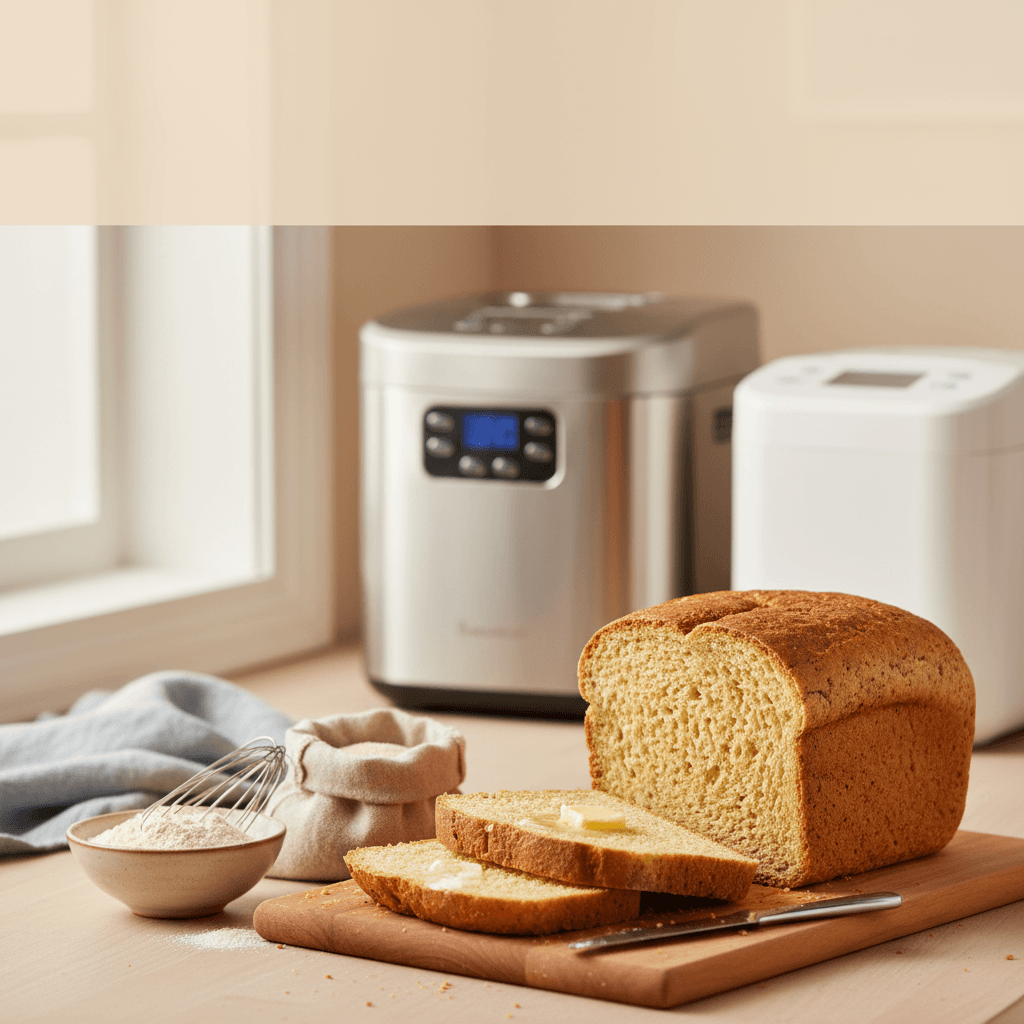
Finding a bread machine that handles gluten-free dough well is harder than it should be. Most machines are designed for wheat bread, and the difference in batter consistency, rise time, and bake temperature means a standard cycle usually produces a dense, gummy brick. We researched the top options so you can skip the trial and error and get straight to a machine that delivers real, sliceable gluten-free bread.
Key takeaways
- A dedicated gluten-free cycle with a single knead and longer rise is the most important feature to look for in a bread machine.
- The Zojirushi BB-PDC20 is the best overall gluten-free bread machine in 2026 thanks to its dual paddles, precise temperature control, and horizontal pan.
- Budget-friendly options like the Hamilton Beach 29885 and Cuisinart CBK-200 still produce good gluten-free bread if you adjust timing manually.
- Horizontal pan machines tend to produce more even crumb structure with gluten-free batters than vertical pan designs.
- Weighing your flour with a reliable food scale matters more with a bread machine than with almost any other baking method.
- A good homemade flour blend often outperforms store-bought mixes in bread machines because you can control starch ratios.
Why gluten-free bread needs a different kind of machine
Gluten-free bread batter behaves nothing like wheat dough. There is no gluten network to develop, so the aggressive kneading cycles on standard bread machines actually deflate the batter and break down the structure your binders are trying to create. A proper gluten-free cycle uses a single, shorter mix followed by a longer, gentler rise and a carefully timed bake.
The other critical factor is heat distribution. Gluten-free loaves are prone to gummy centers if the machine does not maintain consistent, even heat throughout the bake. Machines with thicker pans and heating elements on multiple sides handle this much better than cheap single-element designs.
If you are still building your gluten-free baking foundation, our Confident Gluten-Free Baker Toolkit walks you through flour blends, binder ratios, and troubleshooting so you understand exactly why your bread machine loaves succeed or fail. It pairs perfectly with machine baking because the science is the same.
Why most "gluten-free" bread machine settings fail
The gluten-free setting on most bread machines is essentially a shortened wheat bread cycle with one rise instead of two. That sounds reasonable in theory, but it misses the mark on almost every detail that matters for GF dough.
Wheat bread dough develops gluten through vigorous kneading. Gluten-free dough has no gluten to develop — it relies on binders like xanthan gum and psyllium husk to create structure. Aggressive kneading actually breaks down that structure, and most machines knead GF dough the same way they'd knead wheat dough. The result? Dense, gummy, or collapsed bread.
The other major issue is rise time. GF doughs often need a longer, warmer rise than what a standard gluten-free cycle provides. If the machine moves to baking before the dough has properly risen, you end up with a brick. We've written extensively about how to make gluten-free bread rise properly, and the same principles apply in a bread machine.
What you actually need is a machine that lets you control — or at least significantly customize — the kneading intensity, rise duration, and bake temperature independently.
How we picked
We evaluated bread machines based on five criteria that matter specifically for gluten-free baking:
- Gluten-free cycle quality -- Does the machine have a dedicated cycle, and does it actually differ from the standard cycle in meaningful ways (single knead, extended rise, adjusted bake temp)?
- Pan shape and size -- Horizontal pans produce a more traditional loaf shape. We also considered 1-pound, 1.5-pound, and 2-pound capacities.
- Heat distribution -- Even baking from all sides prevents the gummy center problem.
- Ease of cleaning -- Gluten-free batters are sticky. Non-stick quality and removable paddles matter.
- Value -- Price relative to how well it handles gluten-free recipes.
The 7 best gluten-free bread machines for 2026
1. Zojirushi BB-PDC20 Virtuoso Plus -- best overall
The Zojirushi BB-PDC20 Virtuoso Plus is the best gluten-free bread machine you can buy in 2026. Its horizontal pan produces a loaf shape that actually looks like sandwich bread, and the dual kneading paddles ensure thorough, even mixing without the over-kneading that destroys gluten-free structure.

The dedicated gluten-free cycle uses a single knead, an extended rise, and a bake temperature well suited to a tall loaf with an open crumb. Even interior heating helps prevent the gummy center issue, and the non-stick pan coating helps sticky rice flour batters release cleanly.
The downside is the price. At around $350-$380, it is the most expensive option on this list. But if you bake gluten-free bread regularly, the consistency pays for itself in ingredients you will not waste.
2. Breville BBM800XL Custom Loaf -- best for customization
The Breville BBM800XL gives you more control over individual cycle phases than any other machine on this list. You can adjust knead time, rise time, and bake temperature independently, which is incredibly powerful for dialing in a specific gluten-free recipe.
It has a dedicated gluten-free setting out of the box, but the real value is the custom cycle programming. Once you find your perfect timing for a particular flour blend, you can save it and replicate it every time. The collapsible paddle design also means fewer holes in the bottom of your loaf.
The pan is vertical, which produces a taller, narrower loaf. Some people prefer this, but it can lead to slightly uneven baking with very wet gluten-free batters.
3. Zojirushi BB-HAC10 Home Bakery Mini -- best compact option
The Zojirushi BB-HAC10 is perfect if you are baking for one or two people and do not need a full 2-pound loaf. It makes a 1-pound loaf, which is actually ideal for gluten-free bread since it stales faster than wheat bread and smaller loaves mean less waste.
It shares the same excellent heat distribution and gluten-free cycle design as its bigger sibling. The single paddle does a solid job with the smaller batter volume. At around $200, it is a more accessible entry point into Zojirushi quality.
4. Cuisinart CBK-200 Convection -- best mid-range
The Cuisinart CBK-200 stands out in the $150-$180 range because of its convection fan. That fan circulates hot air around the loaf, which significantly improves crust development and reduces the risk of underbaked centers -- two of the biggest problems with gluten-free bread machines.
It has a gluten-free cycle, though it is not as refined as the Zojirushi. The knead phase runs a bit long for some recipes, so you may want to check on the batter and stop the cycle manually if it looks over-mixed. The vertical pan produces a standard loaf shape.
5. Hamilton Beach 29885 -- best budget pick
The Hamilton Beach 29885 is the best gluten-free bread machine under $100. It has a dedicated gluten-free setting that actually works -- the cycle uses a shorter knead and longer rise compared to the standard white bread cycle.
The trade-off at this price is build quality. The pan coating is thinner and may start to show wear after a year of heavy use. The heating is adequate but not as even as the premium options, so you may occasionally get a slightly denser bottom crust. For the price, though, it is a solid choice.
6. Panasonic SD-R2550 -- best for artisan-style loaves
The Panasonic SD-R2550 uses a unique temperature sensor system that monitors the internal bread temperature throughout baking and adjusts the heat in real time. This is exceptionally helpful for gluten-free bread, where the difference between perfectly baked and gummy can come down to just a few degrees.
The gluten-free cycle is well-designed, and the crust options (light, medium, dark) give you good control over the final result. The horizontal pan shape is a plus. Availability can be inconsistent in the US since Panasonic bread machines are more popular in Europe and Japan, but they are worth tracking down.
7. KBS Large 17-in-1 -- best large capacity budget option
The KBS Large 17-in-1 offers a 2-pound capacity and a gluten-free cycle at a budget-friendly price point around $80-$100. The ceramic-coated pan is a nice touch at this price and handles sticky gluten-free batters better than the typical non-stick coatings on budget machines.
The gluten-free cycle is basic but functional. The viewing window lets you monitor the batter without opening the lid and losing heat, which is important during the rise phase. It will not match the consistency of the Zojirushi, but it is a solid entry point if you want to try bread machine baking before committing to a bigger investment.
Quick comparison of all 7 machines
| Machine | Price range | Pan shape | Loaf size | GF cycle | Best for |
|---|---|---|---|---|---|
| Zojirushi BB-PDC20 | $350-$380 | Horizontal | 2 lb | Excellent | Best overall |
| Breville BBM800XL | $250-$300 | Vertical | 2.5 lb | Good + custom | Customization |
| Zojirushi BB-HAC10 | $190-$220 | Horizontal | 1 lb | Excellent | Small households |
| Cuisinart CBK-200 | $150-$180 | Vertical | 2 lb | Good | Mid-range value |
| Hamilton Beach 29885 | $70-$100 | Vertical | 2 lb | Good | Budget pick |
| Panasonic SD-R2550 | $280-$330 | Horizontal | 1.5 lb | Excellent | Artisan quality |
| KBS Large 17-in-1 | $80-$100 | Vertical | 2 lb | Basic | Large capacity budget |
What to look for in a gluten-free bread machine
Dedicated gluten-free cycle
This is non-negotiable. A proper gluten-free cycle should have a single, short knead phase (5-10 minutes), one rise (not two like wheat bread), and a bake phase that runs slightly longer at a slightly lower temperature. If a machine only has a standard cycle, you will need to babysit it and manually adjust timing, which defeats the purpose of a bread machine.
Pan shape: horizontal vs. vertical
Horizontal pans produce a loaf that looks like what you would buy at a bakery -- wider, flatter, with more even slices. Vertical pans produce a taller, narrower loaf that can sometimes bake unevenly because the center is farther from the heating elements. For gluten-free baking, horizontal pans generally perform better.
Heat distribution
Look for machines with heating elements on the bottom and sides, or convection fans. Single-element machines (heat only from the bottom) are the most likely to produce loaves with gummy centers and overdone bottom crusts.
Non-stick pan quality
Gluten-free batters are stickier than wheat dough. A good non-stick coating makes the difference between a loaf that slides out cleanly and one that tears apart when you try to remove it. Ceramic coatings tend to hold up better over time than standard non-stick.
Tips for better gluten-free bread machine results
Even the best machine will not save a bad recipe or poor technique. Here are the things that make the biggest difference:
- Weigh your flour. Cup measurements are wildly inconsistent with gluten-free flours because they vary so much in density. A good food scale is essential.
- Use room temperature ingredients. Cold eggs and milk slow down the yeast and lead to a poor rise. Take everything out 30 minutes before you start.
- Do not skip the xanthan gum or psyllium husk. These binders replace the structural role of gluten. Without them, your loaf will crumble. Check our guide on what gluten does in baking to understand why this matters.
- Check the batter after 5 minutes of mixing. Open the lid and scrape down the sides with a spatula. Gluten-free batter tends to cling to the corners and not incorporate fully.
- Remove the loaf immediately after baking. Leaving it in the machine lets condensation build up, which makes the crust soggy and can turn the crumb gummy.
- Blend your own flour mix. Our homemade gluten-free flour blend recipe gives you control over the starch-to-whole-grain ratio, which directly affects bread texture.
Best flour blends for bread machine baking
The flour blend you use matters as much as the machine. For bread machine loaves, you want a blend with a higher starch ratio than you would use for cakes or cookies -- roughly 60-70% starch to 30-40% whole grain flour.
A reliable starting point is a blend of brown rice flour, arrowroot starch, and tapioca starch. For a heartier flavor, swap some of the brown rice flour for sorghum flour or millet flour. Both add a mild, slightly sweet flavor that works beautifully in sandwich bread.
If you are new to building your own blends, start with our complete beginner's guide to gluten-free baking to understand how different flours and starches interact.
Buying one as a present? Our gifts for bakers guide sorts picks by budget, from stocking stuffers to splurges.
Frequently asked questions
Can you make gluten-free bread in a regular bread machine?
Yes, but results are much better with a machine that has a dedicated gluten-free cycle. A regular cycle kneads too aggressively and uses a double rise designed for gluten development, which deflates gluten-free batter. If your machine only has standard cycles, look for one that lets you program custom cycle times so you can shorten the knead and use a single rise.
Why is my gluten-free bread machine bread gummy in the middle?
Gummy centers usually come from insufficient heat reaching the center of the loaf, too much liquid in the recipe, or removing the bread too late and letting condensation soak back in. Machines with convection fans or multi-sided heating elements reduce this problem significantly. You can also try reducing your liquid by 1-2 tablespoons. Our guide on fixing gummy centers covers this in detail.
Is the Zojirushi bread machine worth it for gluten-free bread?
For most people who bake gluten-free bread regularly, yes. The Zojirushi BB-PDC20 is our top pick on this list, built for an even crumb, good rise, and a loaf shape that works for sandwiches. If you are baking once a week or more, the cost per loaf drops quickly compared to buying store-bought gluten-free bread, which often runs $7-$9 per loaf.
What size bread machine is best for gluten-free bread?
A 1.5 to 2-pound capacity works well for most households. Gluten-free bread stales faster than wheat bread, so baking a smaller loaf more frequently gives you better results than baking a large loaf that goes stale before you finish it. If you are baking for just one or two people, the 1-pound Zojirushi BB-HAC10 is an excellent choice.
Do I need xanthan gum for bread machine gluten-free bread?
You need some kind of binder, and xanthan gum is the most common choice for bread machine recipes. Psyllium husk powder is a popular alternative that some bakers prefer because it creates a slightly more elastic crumb. Most bread machine recipes call for about 1 teaspoon of xanthan gum per cup of gluten-free flour. Without a binder, the loaf will crumble and fall apart when sliced.
Can I use regular bread recipes in a bread machine and just swap in gluten-free flour?
No — this almost never works. Gluten-free dough behaves completely differently from wheat dough. It's more like a thick batter than a traditional dough, and it needs different hydration levels, binders, and rise times. Always use recipes specifically developed for gluten-free bread machines. Our guide on substituting all-purpose flour in gluten-free baking explains the key differences.
How do I prevent gluten-free bread from collapsing in a bread machine?
Collapsed GF bread in a bread machine usually means the dough over-rose and then couldn't hold its structure, or the binder ratio was off. Make sure you're using enough xanthan gum or psyllium husk, that your yeast is fresh, and that the rise cycle isn't too long for your recipe. Avoid opening the lid during rising, as the temperature drop can cause collapse. We cover this in detail in our post on why gluten-free bread collapses and how to prevent it.

Written by
Co-founder, BakingSubs
Co-founder of BakingSubs, where he turns the science of ingredient substitutions into tested, reliable guidance for home bakers.
Related Posts
Bake with Confidence
See all
Confident Gluten-Free Baker Toolkit
The science-based system that replaces gluten's seven invisible jobs so your baking turns out soft, fluffy, and foolproof — every time.

Gluten-Free Recipe Vault
Instant access to our complete library of proven gluten-free recipes — no waiting, no guesswork, just results that work tonight.

Fix Your Gluten-Free Bread
Learn the 3-step formula to make bread rise and stay soft, discover why your loaves collapse, and get a tested sandwich bread recipe that actually works.