

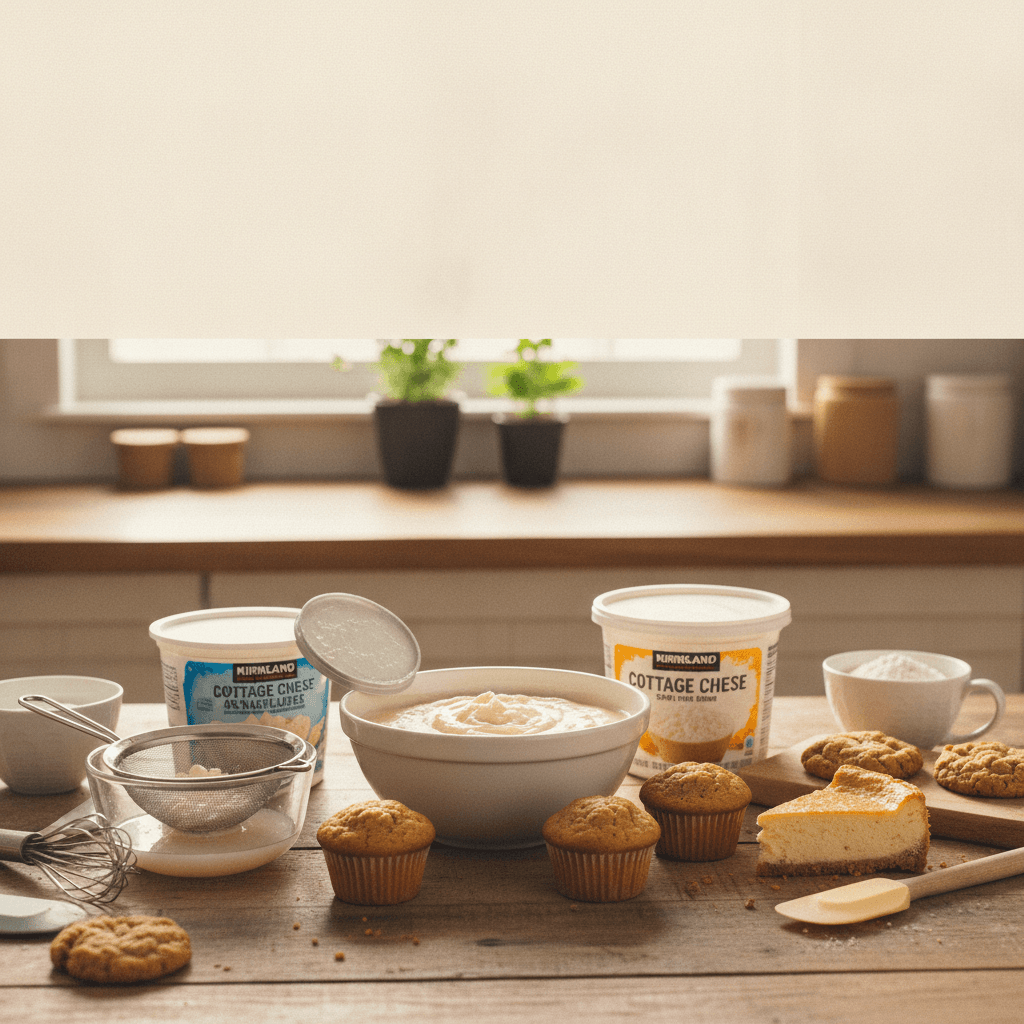
Good Culture 4% whole milk cottage cheese is our top pick for baking. It has the highest protein per serving of the widely available brands (14g per 100g), has small curds that blend smooth easily, and carries just enough fat to keep muffins, pancakes, and cakes moist without making them greasy. If you want the short answer and nothing else: grab Good Culture at Whole Foods or Target, blend it for 30 seconds, and use it cup-for-cup wherever a recipe calls for cottage cheese.
But brand choice is only half the story. Fat percentage, curd size, and water content all change how your bake turns out. We compared nine brands on protein, fat, curd size, and water content to see which ones are most likely to perform and which ones can leave you with grainy, wet, or flat results.
Key takeaways
Good Culture 4% is the best all-around cottage cheese for baking: 14g protein per 100g, blends smooth, and suits muffins, cakes, and pancakes.
Full-fat (4%) cottage cheese outperforms low-fat in baked goods because the fat replaces some of the oil or butter, keeping crumb tender without extra liquid.
Curd size matters less than you think if you blend before adding to batter. Large-curd brands like Daisy and Breakstone's can still blend smooth with an immersion blender; they just take a little longer than small-curd brands like Friendship.
Nancy's and Kalona are cultured, which adds a slight tang similar to yogurt or buttermilk. That tang works well in pancakes and quick breads but can clash with delicate vanilla cakes.
Draining cottage cheese through a fine mesh sieve for 10 minutes removes roughly 15 to 20% of total weight as whey, which prevents soggy bottoms in denser bakes like banana bread.
Kirkland (Costco) offers the best price per ounce at roughly $0.14/oz, but its higher water content means you may need to drain it before baking.
Why cottage cheese brand matters in baking
Not all cottage cheese is the same product. The protein content ranges from 10g to 14g per 100g depending on brand and fat level. Water content varies by as much as 8 percentage points. Some brands use guar gum or locust bean gum as stabilizers, which thicken the whey and change how much free liquid ends up in your batter.
When you are using cottage cheese as a protein boost in baked goods, those differences compound. A brand with 12g protein and 82% water behaves very differently from one with 14g protein and 76% water. The first one will make your muffins wetter and flatter. The second one will give you a tighter, more structured crumb.
9 brands compared: protein, fat, curd size, and blendability
We looked at nine cottage cheese brands that are widely available across the US. All values below are for the full-fat (4%) version unless noted. Protein and fat are per 100g.
Brand | Protein per 100g | Fat % | Curd size | Approx. water content | Blends smooth? | Where to buy |
|---|---|---|---|---|---|---|
Good Culture 4% | 14g | 4% | Small | ~76% | Yes, small curd | Whole Foods, Target, Walmart |
Daisy 4% | 12g | 4% | Large | ~79% | Yes, with longer blending | Walmart, Target, Kroger |
Breakstone's 4% | 11g | 4% | Large | ~80% | Needs longer blending | Walmart, Target, most grocery chains |
Nancy's Organic 4% | 13g | 4% | Small | ~77% | Yes, small curd | Whole Foods, Sprouts, some Targets |
Friendship 4% | 13g | 4% | Small | ~78% | Yes, small curd | Walmart, ShopRite, regional Northeast |
Kalona SuperNatural 4% | 12g | 4% | Medium | ~79% | Yes, medium curd | Whole Foods, natural food co-ops |
Muuna 4% | 13g | 4% | Small | ~77% | Yes, small curd | Target, Walmart, some Whole Foods |
Trader Joe's 4% | 12g | 4% | Small | ~79% | Yes, small curd | Trader Joe's only |
Kirkland (Costco) 4% | 11g | 4% | Large | ~82% | Drain first, then blend longer | Costco only |
A few things jump out. Good Culture and Muuna have the lowest water content and highest protein, which means less free liquid in your batter. Kirkland is by far the cheapest at roughly $0.14 per ounce (a 3 lb tub runs about $6.49 at Costco), but it carries the most water and needs draining before baking. Breakstone's and Daisy are the easiest to find in any grocery store in the country, but their large curds and higher water content mean you need a bit more prep.
Nancy's and Kalona are both cultured with live probiotics. The probiotics do not survive the oven, but the culturing process creates lactic acid that gives a noticeable tang. That tang pairs well with recipes that already call for buttermilk or yogurt, like buttermilk pancakes or pumpkin muffins where you are cutting oil.
Our top pick and why
Good Culture 4% whole milk cottage cheese wins for three reasons. First, 14g of protein per 100g is the highest in our lineup, meaning you get more structural protein per cup of batter. Second, its low water content (~76%) means you rarely need to drain it. Third, it uses minimal ingredients (milk, cream, salt, live cultures) with no gums or stabilizers, which gives you more control over the final texture.
The main downside is price. Good Culture runs about $5.49 for a 16 oz container at Target, compared to $3.29 for the same size of Daisy. If you bake in volume or you are scaling a recipe for a crowd, Kirkland from Costco is the budget play. Just plan to drain it for 10 minutes through a fine mesh sieve before you start.
Runner-up: Muuna 4%. Almost identical specs to Good Culture (13g protein, ~77% water), small curds that blend easily, and is increasingly available at Target and Walmart. Muuna also makes single-serve cups, which is convenient if you only need a small amount for one batch.
How to prep cottage cheese for baking
No matter which brand you pick, you almost always want to blend cottage cheese before adding it to batter. Unblended curds create pockets of protein that do not distribute evenly, and those pockets can turn rubbery in the oven.
Blending methods ranked
An immersion blender is the fastest option. Stick it right into the measuring cup, pulse for 20 to 30 seconds, and you are done. No extra dishes.
A full-size blender works too, but most blenders need at least 1 cup of volume to engage the blades properly. If you are only using half a cup, the cottage cheese just sits under the blades and spins without blending.
A food processor is the best choice if you are also processing other wet ingredients (like ricotta, eggs, or pumpkin puree) in the same batch. The wide bowl distributes everything evenly.
A fork or whisk will break up small curds from brands like Good Culture or Muuna, but it will not fully smooth out large-curd brands like Daisy or Kirkland. If a fork is all you have, stick with small-curd cottage cheese.
When to drain (and when not to)
Drain cottage cheese when you are making dense bakes: banana bread, pound cake, thick protein bars. These recipes cannot absorb extra whey, and the excess moisture settles to the bottom, creating a soggy layer.
Do not drain when you are making pancakes, waffles, or thin batters. Those recipes need the liquid, and draining will make the batter too thick to spread.
To drain: set a fine mesh sieve over a bowl, add the cottage cheese, and let it sit for 10 minutes. You will lose about 2 to 3 tablespoons of whey per cup. Save that whey for smoothies or discard it.
What fat percentage to use
For baking, 4% (full-fat) cottage cheese is almost always the right call. The fat serves the same role as butter or oil in your recipe: it coats flour proteins, tenderizes gluten, and carries flavor. When you use 2% or fat-free, you lose that tenderizing effect, and your baked goods come out drier and tougher.
There is one exception. If a recipe specifically calls for fat-free cottage cheese and compensates with extra oil or butter elsewhere, follow the recipe. Some high-protein pancake recipes, for example, use fat-free cottage cheese for the protein and add a tablespoon of olive oil or melted coconut oil separately for the fat.
From a numbers perspective, 1 cup of 4% cottage cheese contains about 5g of fat total. That is roughly equivalent to 1 teaspoon of butter. So cottage cheese is not replacing a lot of fat on its own. It is contributing moisture, protein, and a small amount of fat that keeps things from getting chalky.
Best uses for cottage cheese in baking
Cottage cheese works best in recipes where moisture and protein are welcome but structure comes from something else (flour, eggs, or both). Here is where it shines and where it struggles.
Where it works well
Muffins and quick breads: Replace up to half the liquid (milk or buttermilk) with blended cottage cheese. You will get a higher protein count and a slightly denser, more satisfying crumb.
Pancakes and waffles: Blend cottage cheese directly into the batter. A 1:1 swap for milk works in most recipes. The protein helps the pancakes hold together on the griddle.
Cheesecake: Blend cottage cheese until perfectly smooth and use it as a partial substitute for cream cheese (up to 50%). It cuts calories and adds tang without sacrificing texture.
Protein bars and baked oatmeal: Cottage cheese acts as the binder and moisture source. Combined with oats and protein powder, it creates a dense, chewy bar.
Where it struggles
Delicate sponge cakes: The extra protein and moisture weigh down a sponge. You lose volume and get a gummy layer at the bottom.
Laminated doughs: Croissants and puff pastry need precise fat layers. Cottage cheese adds uncontrolled moisture that destroys lamination.
Meringue-based desserts: The fat in cottage cheese deflates whipped egg whites. Keep it away from anything that relies on meringue for structure.
Troubleshooting cottage cheese in baking
Grainy texture in the finished bake
This happens when curds are not fully broken down before mixing into batter. Large-curd brands (Daisy, Breakstone's, Kirkland) are the usual culprits. The fix is simple: blend the cottage cheese for at least 30 seconds with an immersion blender before adding it to your recipe. If you already blended and the texture is still grainy, the issue is likely the brand's casein structure. Switch to Good Culture or Muuna, whose small curds break down more easily.
Excess moisture and soggy bottoms
If your muffins or bread have a wet, dense layer at the bottom, the cottage cheese released too much whey during baking. This is most common with Kirkland and Breakstone's, which have higher water content (80 to 82%). Two fixes: drain the cottage cheese for 10 minutes before blending, or reduce other liquids in the recipe by 2 tablespoons per cup of cottage cheese used. For more on managing moisture when swapping wet ingredients, see our guide on using zucchini as a fat substitute, which covers the same draining principles.
Curdling or separating at high heat
Cottage cheese proteins (primarily casein) can curdle when exposed to temperatures above 350F/175C for extended periods, especially in thin batters with high acidity. This shows up as tiny white specks or a grainy mouthfeel in the finished product. To prevent it: keep oven temperature at or below 350F for cottage cheese-heavy recipes, add the cottage cheese to room-temperature batter (not cold), and avoid combining it with large amounts of acidic ingredients like lemon juice or vinegar in the same step. If your recipe needs acid, add it separately and fold gently at the end.
How cottage cheese compares to other dairy swaps
Cottage cheese is not the only high-protein dairy you can bake with. Here is how it stacks up against the most common alternatives.
Ingredient | Protein per 100g | Fat per 100g | Best for | Biggest limitation |
|---|---|---|---|---|
Cottage cheese (4%) | 11 to 14g | 4g | Muffins, pancakes, cheesecake | Needs blending; can curdle at high heat |
Greek yogurt (full fat) | 9g | 5g | Cakes, quick breads, scones | More acidic; can over-tenderize gluten |
Ricotta (whole milk) | 8g | 10g | Cheesecake, pasta bakes, pancakes | Higher fat, lower protein; heavier crumb |
6g | 34g | Frosting, cheesecake, pound cake | Very high fat; not a protein source | |
Skyr | 11g | 0 to 2g | Protein pancakes, smoothie bakes | Very thick; can make batter too stiff |
Cottage cheese wins on protein-to-fat ratio. If your goal is adding protein without adding a lot of fat, it beats every other dairy option on this list. Greek yogurt is the closest competitor, but it has about 30% less protein per 100g and more acidity, which can change how baking soda reacts in your recipe. For a deeper look at dairy alternatives and how they function in batter, check out our guide to milk functions in baking.
Frequently asked questions
Can you substitute cottage cheese for ricotta in baking?
Yes, blended cottage cheese works as a 1:1 substitute for ricotta in most baked recipes, including lasagna, stuffed shells, and cheesecake. You get more protein and less fat. The only adjustment: blend the cottage cheese until completely smooth, because ricotta has a naturally finer grain. Drain the cottage cheese first if the recipe is dense or low-moisture, like a baked ziti filling.
Do you need to blend cottage cheese before baking with it?
Almost always, yes. Unblended cottage cheese leaves visible curd pockets in your batter that turn rubbery during baking. The exception is recipes that intentionally want a chunky, textured result, like some savory bread loaves. For everything else, 20 to 30 seconds with an immersion blender is enough. Learn more about cottage cheese in baking on our cottage cheese ingredient page.
What is the best cottage cheese for protein pancakes?
Good Culture 4% or Muuna 4% are the best choices for protein pancakes. Both have 13 to 14g of protein per 100g, small curds that blend smoothly, and have low enough water content that your pancakes hold together on the griddle without spreading. If you are also adding protein powder, use full-fat cottage cheese so the extra fat counteracts the dryness that protein powder adds.
Does cottage cheese make baked goods taste sour?
Standard cottage cheese (Daisy, Breakstone's, Good Culture, Kirkland) does not add a noticeable sour flavor. Cultured brands like Nancy's and Kalona have a mild tang from lactic acid fermentation, similar to buttermilk. In sweet bakes like muffins or cake, that tang is usually masked by sugar. In plain or lightly sweetened recipes like flatbreads, you may notice it.
Can you use low-fat cottage cheese instead of full-fat for baking?
You can, but expect a drier, slightly tougher crumb. Low-fat (2%) cottage cheese has about half the fat of full-fat (4%), and that missing fat means less tenderizing in your bake. If you use 2%, add 1 teaspoon of oil or melted butter per cup of cottage cheese to compensate. Fat-free cottage cheese is the hardest to bake with because it has the highest water content and no fat at all, which often produces a gummy texture.

Written by
Co-founder, BakingSubs
Co-founder of BakingSubs, where he turns the science of ingredient substitutions into tested, reliable guidance for home bakers.
Related Posts

Bake with Confidence
See all
Confident Gluten-Free Baker Toolkit
The science-based system that replaces gluten's seven invisible jobs so your baking turns out soft, fluffy, and foolproof — every time.

Gluten-Free Recipe Vault
Instant access to our complete library of proven gluten-free recipes — no waiting, no guesswork, just results that work tonight.

Fix Your Gluten-Free Bread
Learn the 3-step formula to make bread rise and stay soft, discover why your loaves collapse, and get a tested sandwich bread recipe that actually works.