
Name brand vs store brand baking ingredients: 12 head-to-head matchups and where premium is worth it
We compared 12 baking ingredients head-to-head — name brand vs store brand. See which are worth the splurge and where cheap wins in taste, texture, and results.

Malik
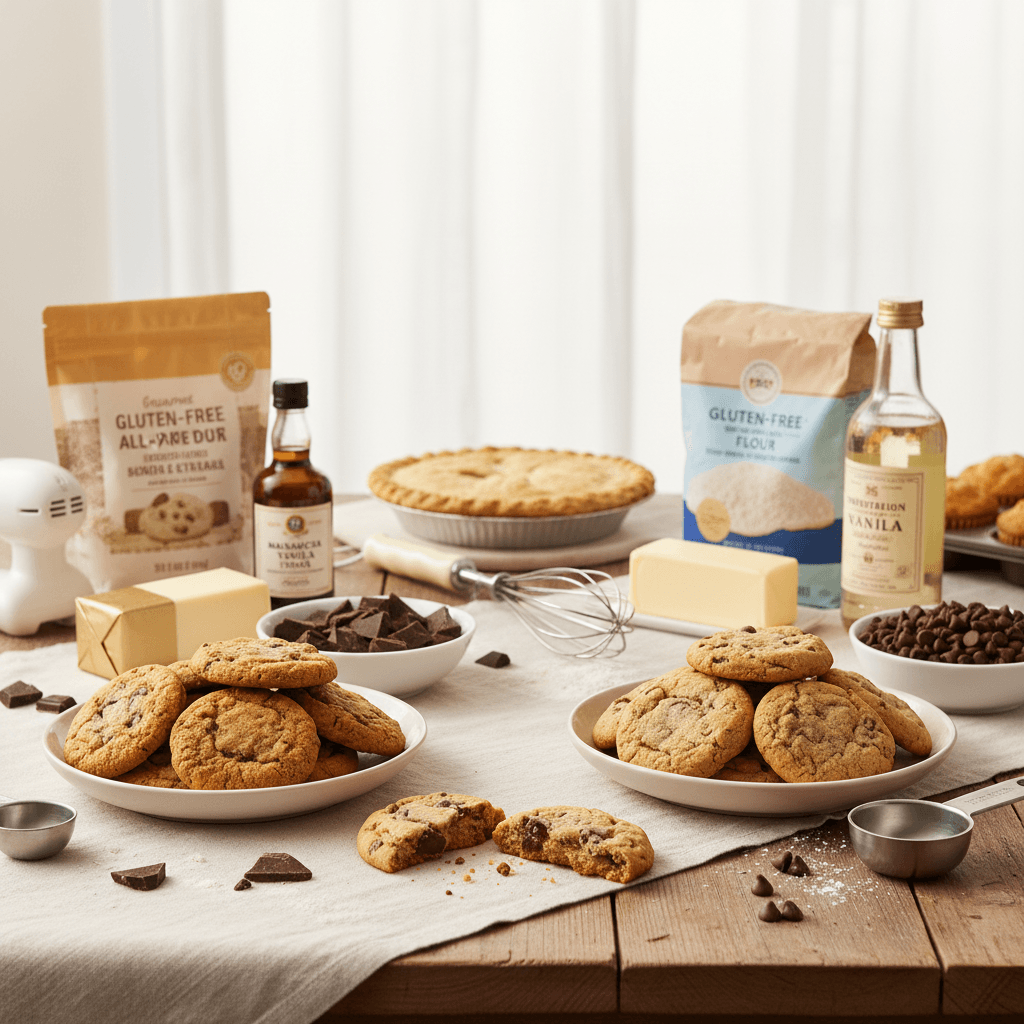
Does it actually matter whether you grab the name brand or the store brand when stocking your baking pantry? We compared 12 common baking ingredients head-to-head — composition, price, and how each behaves in baking — to find out where premium is worth it and where cheap wins.
Key takeaways
- Store brand all-purpose flour, granulated sugar, and baking soda perform the same as name brands in everyday baking.
- Butter is the one ingredient where the premium brand (Kerrygold) makes a noticeable difference in flavor and texture, especially in shortbread and pie crust.
- Vanilla extract is worth the splurge on name brand or pure extract — imitation versions from any brand tend to fall flat in uncooked or lightly baked applications.
- Store brand chocolate chips often use more wax and less cocoa butter, resulting in a noticeably different melt and mouthfeel.
- For gluten-free flour blends, brand matters significantly because formulations vary widely — this is not a category where generic substitutions work well.
- Overall, you can save 30-40% on your baking pantry by going store brand on staples and reserving premium spending for butter, vanilla, and chocolate.
How we compared name brand vs store brand baking ingredients
We kept things simple and practical. For each ingredient, we compared the name brand against the store brand on composition (protein content, butterfat, cocoa butter, pure vs imitation), price, and how those differences typically show up in taste, texture, and baking performance.
We focused on widely available store brands (Great Value, Kirkland Signature, Good & Gather, Kroger) against popular name brands (King Arthur, Kerrygold, Ghirardelli, Nielsen-Massey).
If you're building out a gluten-free baking pantry and want to know which investments actually pay off, our Confident Gluten-Free Baker Toolkit walks you through exactly what to stock and where to save.
All-purpose flour: King Arthur vs Great Value
Store brand wins on value, and there is no meaningful difference in baking performance for everyday recipes. In sugar cookies or a basic yellow cake, expect results that are virtually indistinguishable in rise, crumb, and flavor.
King Arthur does have a slightly higher protein content (11.7% vs roughly 10-11% for Great Value), which can matter for bread baking. But for cookies, cakes, muffins, and quick breads, Great Value performs just fine.
Bottom line: Save your money and go store brand for all-purpose flour unless you're making artisan bread where protein content is critical.
| Category | King Arthur | Great Value |
|---|---|---|
| Price per 5 lb bag | ~$5.50 | ~$2.50 |
| Protein content | 11.7% | ~10-11% |
| Cookie performance | Excellent | Excellent |
| Cake performance | Excellent | Excellent |
| Bread performance | Slightly better structure | Good |
Gluten-free flour blends: Bob's Red Mill vs store brand blends
Name brand wins here, and it is not close. Gluten-free flour blends are not interchangeable the way conventional flours are. Each brand uses a different ratio of rice flour, starches, and binders, and those differences show up dramatically in your finished bake.
Between Bob's Red Mill 1-to-1 Baking Flour and a Great Value gluten-free blend, Bob's Red Mill is the safer choice for pancakes and muffins, with better odds of good rise, a tender crumb, and less of that gritty texture that plagues lower-quality blends.
If you want to compare specific blends in more detail, we did a full breakdown in our Bob's Red Mill vs King Arthur gluten-free flour comparison.
Bottom line: Do not go generic on gluten-free flour blends. The formulation differences are too significant, and a bad blend will ruin your bake.
Butter: Kerrygold vs Kirkland Signature vs store brand
Premium butter wins in applications where butter is the star ingredient, but store brand is perfectly fine for most everyday baking. This is the most interesting matchup because the answer is so recipe-dependent.
The difference depends on how much the butter is on display. In chocolate chip cookies, it is subtle — all three make good cookies, though Kerrygold's higher butterfat can add slightly richer flavor. In buttercream, Kerrygold tends to be creamier and more flavorful. The biggest gap is in shortbread, where butter is essentially the only flavor, so a premium butter like Kerrygold stands out most.
Kirkland Signature lands solidly in the middle. It is a good quality butter at a reasonable price, and for most baking it is the sweet spot. If you are also exploring dairy-free butter alternatives, the brand differences become even more pronounced.
| Category | Kerrygold | Kirkland Signature | Store brand |
|---|---|---|---|
| Price per lb | ~$5.00 | ~$3.50 | ~$3.00 |
| Butterfat content | ~82% | ~80% | ~80% |
| Chocolate chip cookies | Excellent | Very good | Good |
| Shortbread | Excellent | Good | Acceptable |
| Buttercream | Excellent | Very good | Good |
Bottom line: Use Kerrygold for butter-forward recipes like shortbread, pie crust, and buttercream. Use Kirkland Signature or store brand for everything else.
Granulated sugar: name brand vs store brand
Sugar is sugar. Store brand wins on price, and there is no meaningful difference between Domino, C&H, Great Value, and Kroger brand granulated sugar, whether in meringue, caramel, or a basic vanilla cake.
This makes sense chemically — granulated sugar is pure sucrose regardless of brand. The only thing to watch for is grain size consistency, and major store brands are perfectly fine. If you want to learn more about how sugar functions in baking beyond sweetness, the differences that matter are between types of sugar, not brands.
Bottom line: Always buy store brand brown sugar and granulated sugar. There is zero reason to pay more.
Vanilla extract: Nielsen-Massey vs McCormick vs store brand imitation
Pure vanilla extract wins decisively over imitation, and premium pure extract has a slight edge in uncooked applications. This is one of the most debated ingredient matchups, and the answer is fairly clear.
In baked goods like cookies and cake, McCormick pure vanilla and Nielsen-Massey are nearly identical. Both are noticeably better than store brand imitation vanilla, which tends to have a slightly harsh, one-dimensional flavor. However, in buttercream frosting and no-bake cheesecake — where the vanilla is not cooked — Nielsen-Massey's more complex, rounded flavor can justify its higher price.
Store brand imitation vanilla is acceptable in heavily spiced recipes (like gingerbread or pumpkin bread) where vanilla plays a supporting role. But in anything where vanilla is a primary flavor, it falls short.
| Category | Nielsen-Massey | McCormick Pure | Store brand imitation |
|---|---|---|---|
| Price per oz | ~$3.00 | ~$1.50 | ~$0.30 |
| Baked cookies | Excellent | Excellent | Acceptable |
| Buttercream | Excellent | Very good | Flat, chemical note |
| No-bake desserts | Excellent | Very good | Poor |
Bottom line: Buy McCormick Pure Vanilla Extract as your everyday vanilla. Splurge on Nielsen-Massey for special-occasion no-bake desserts and frostings. Skip imitation unless you are on a very tight budget and baking heavily spiced goods.
Chocolate chips: Ghirardelli vs Kirkland vs Great Value
Premium chocolate chips make a noticeable difference in both flavor and texture.
Ghirardelli chips have the best flavor (deeper, more complex chocolate taste) and the smoothest melt. Kirkland Signature chocolate chips are a strong second — good flavor, decent melt, and a much better price. Great Value chocolate chips tend to be waxier, with a less satisfying snap and a flatter chocolate flavor.
The differences are most obvious in chocolate chip cookies and brownies, where the chocolate is front and center. In a recipe like banana bread where chocolate chips are mixed in, the gap narrows. For more on getting the best brownie results, check out our best gluten-free flour for brownies guide.
Bottom line: Ghirardelli is worth it for cookies and brownies. Kirkland Signature is the best value pick if you have a Costco membership. Store brand chips are fine for mix-ins where chocolate is not the star.
Baking soda and baking powder: does brand matter?
Brand does not matter for baking soda or baking powder. Store brand wins on price every time. Baking soda is pure sodium bicarbonate regardless of who packages it. Arm & Hammer, Great Value, and Kroger brand are interchangeable in biscuits or a chocolate cake.
For baking powder, the only thing to check is whether you are getting double-acting (which you almost certainly are — virtually all brands sold in the US are double-acting). Rumford, Clabber Girl, and store brands all perform the same.
Bottom line: Always go store brand for leaveners. This is free money back in your pocket.
Eggs: conventional vs pasture-raised vs store brand
Pasture-raised eggs have richer yolks and slightly better flavor in custards and egg-forward bakes, but conventional store brand eggs work perfectly well in most recipes.
Custards show the biggest difference — pasture-raised eggs such as Vital Farms give a richer color and a more complex flavor. A sponge cake comes out slightly more golden with premium eggs. In chocolate chip cookies, the difference is hard to notice. If you are interested in baking without eggs entirely, that is a different conversation — check our gluten-free egg-free baking guide for those swaps.
Bottom line: Use pasture-raised eggs for custards, quiche, and egg-forward pastries. Use store brand conventional eggs for cookies, cakes, and recipes where eggs play a structural role.
Cocoa powder: Hershey's vs Ghirardelli vs store brand
Mid-range name brand cocoa wins this category. Ghirardelli unsweetened cocoa powder is our pick — deeper flavor, richer color, and smoother texture in brownies and chocolate cake. Hershey's Natural is solid and reliable. Store brand cocoa tends to be lighter in color and weaker in chocolate flavor.
The differences are most dramatic in recipes that use a lot of cocoa, like brownies. In a recipe where cocoa is just one of many flavors (like a spice cake with a tablespoon of cocoa), the brand matters much less.
Bottom line: Ghirardelli cocoa powder is the best value for serious chocolate flavor. Hershey's is a fine backup. Skip store brand cocoa if chocolate is the main event.
The complete name brand vs store brand verdict
Here is our summary of every matchup, so you can make quick decisions at the store.
| Ingredient | Winner | Savings if you go store brand | Does it matter? |
|---|---|---|---|
| All-purpose flour | Store brand | ~50% | No (except artisan bread) |
| Gluten-free flour blend | Name brand | N/A — do not substitute | Yes, significantly |
| Butter (everyday baking) | Store brand / Kirkland | ~15-30% | Minimal |
| Butter (butter-forward recipes) | Kerrygold | N/A — worth the splurge | Yes |
| Granulated sugar | Store brand | ~30% | No |
| Brown sugar | Store brand | ~30% | No |
| Vanilla extract | McCormick Pure (everyday) / Nielsen-Massey (special) | N/A | Yes — skip imitation |
| Chocolate chips | Ghirardelli or Kirkland | Kirkland saves ~30% vs Ghirardelli | Yes |
| Baking soda | Store brand | ~40% | No |
| Baking powder | Store brand | ~40% | No |
| Eggs (everyday baking) | Store brand | ~50% | No |
| Cocoa powder | Ghirardelli | N/A — worth it | Yes |
How to build a smart baking pantry on a budget
Based on these comparisons, here is the strategy that gives you the best results for the least money. Go store brand on sugar, leaveners, and all-purpose flour. Spend the savings on quality butter (for the recipes that need it), real vanilla extract, good chocolate chips, and quality cocoa powder.
If you are shopping at specific stores, we have detailed guides for finding the best deals on baking ingredients at Walmart, Aldi, and Amazon. Each guide breaks down the best values aisle by aisle.
The most important thing is knowing which ingredients actually impact your final result and which are chemically identical regardless of packaging. Now you know — and your wallet will thank you.
Frequently asked questions
Is store brand flour the same quality as King Arthur?
For most baking purposes, yes. Store brand all-purpose flour performs identically to King Arthur in cookies, cakes, and quick breads. The main difference is protein content — King Arthur is slightly higher at 11.7%, which can give better structure in yeast breads. For everyday baking, store brand is a perfectly smart choice.
Does expensive butter really make a difference in baking?
It depends on the recipe. In butter-forward bakes like shortbread, pie crust, and buttercream, premium European-style butter like Kerrygold makes a noticeable difference in flavor and texture due to its higher butterfat content. In chocolate chip cookies or banana bread, the difference is minimal and store brand works great.
Are store brand chocolate chips as good as Ghirardelli?
Generally no. Store brand chocolate chips tend to use more wax and less cocoa butter, which results in a waxier texture and flatter chocolate flavor. Ghirardelli and Kirkland Signature chips are both better picks than store brands, especially in cookies and brownies where chocolate is the main flavor.
Is imitation vanilla extract okay for baking?
Imitation vanilla is acceptable in heavily spiced baked goods where vanilla plays a minor role. However, in recipes where vanilla is a primary flavor — like sugar cookies, buttercream, or custard — pure vanilla extract produces noticeably better results. The price difference per recipe is usually just pennies, so we recommend pure extract as your default.
Which baking ingredients should I always buy name brand?
Based on these comparisons, the ingredients worth spending more on are butter (for butter-forward recipes), vanilla extract (always buy pure), chocolate chips, cocoa powder, and gluten-free flour blends. Everything else — sugar, baking soda, baking powder, conventional flour, and eggs for everyday baking — can safely be store brand with no loss in quality.

Written by
Co-founder, BakingSubs
Co-founder of BakingSubs, where he turns the science of ingredient substitutions into tested, reliable guidance for home bakers.
Related Posts
Bake with Confidence
See all
Confident Gluten-Free Baker Toolkit
The science-based system that replaces gluten's seven invisible jobs so your baking turns out soft, fluffy, and foolproof — every time.

Gluten-Free Recipe Vault
Instant access to our complete library of proven gluten-free recipes — no waiting, no guesswork, just results that work tonight.

Fix Your Gluten-Free Bread
Learn the 3-step formula to make bread rise and stay soft, discover why your loaves collapse, and get a tested sandwich bread recipe that actually works.