

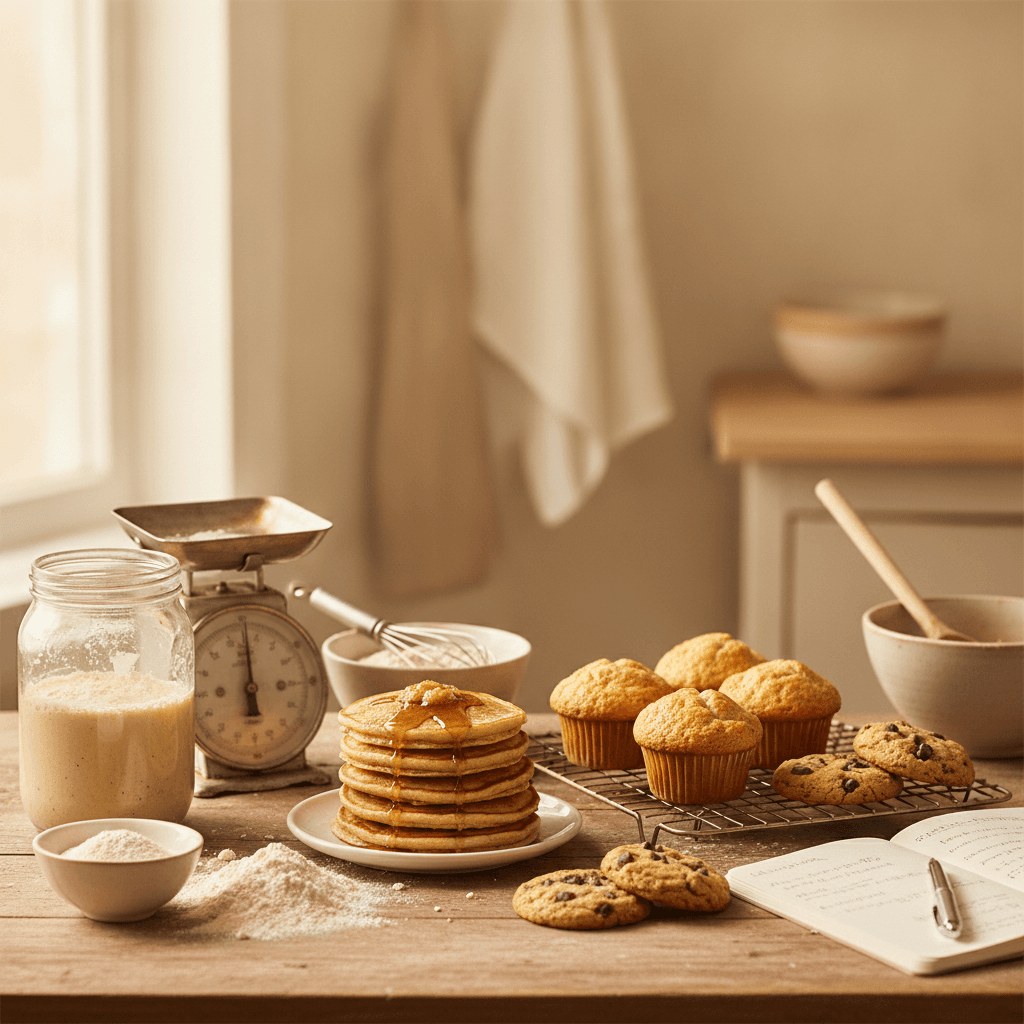
Sourdough starter can do more than make bread. It can add tang, improve texture, and extend shelf life in pancakes, muffins, cakes, pizza dough, and even cookies — but only if you account for the flour and water it brings along.
Here's how to incorporate sourdough starter into virtually any bake without throwing off hydration, leavening, or structure.
Key takeaways
Active sourdough starter is roughly 50% flour and 50% water by weight (assuming a 1:1 feeding ratio), so every 100g of starter replaces about 50g of flour and 50g of liquid in your recipe.
For most non-bread bakes, replacing 15–25% of the flour weight with starter adds flavor without destabilizing structure.
Sourdough starter alone rarely provides enough lift for quick breads, muffins, or cakes — keep your baking powder or baking soda in the recipe.
Discard (unfed starter) works well in recipes where you don't need fermentation-based rise, like pancakes, waffles, and crackers.
The acidity of sourdough starter can interact with chemical leaveners, so small adjustments to baking soda may be needed.
What sourdough starter actually is (and why it matters for substitution math)
Sourdough starter is a living culture of wild yeast and lactic acid bacteria maintained by regular feedings of flour and water. The standard home baker's starter is fed at a 1:1:1 ratio — equal parts starter, flour, and water by weight. That means the starter itself, at any given point, is approximately half flour and half water.
This is the single most important fact for adapting recipes. When you add 120g of starter to a muffin batter, you're also adding roughly 60g of flour and 60g of water. If you don't subtract those amounts from the recipe's existing flour and liquid, you'll end up with a batter that's too wet and a crumb that's gummy or dense.
A baker named Rachel, who sells sourdough-based pastries at a farmers market in Portland, describes the math this way: "I treat every 100 grams of starter as 50 grams of all-purpose flour and 50 grams of water. Once I started doing that, my conversions stopped failing."
How much starter to add (and why 20% is the sweet spot for most bakes)
The right amount of starter depends on what you're baking and how much sourdough flavor you want. Here's a general framework based on the total flour weight in your original recipe:
Bake type | Starter amount (% of total flour weight) | Flavor impact | Notes |
|---|---|---|---|
Pancakes / waffles | 30–50% | Moderate to strong tang | Can use discard; no fermentation needed |
Muffins / quick breads | 15–25% | Mild tang | Keep chemical leaveners in the recipe |
Cakes | 10–20% | Subtle complexity | Higher amounts risk dense crumb |
Cookies | 15–25% | Mild tang, chewier texture | Reduce liquid; may need extra 5–10 min chill |
Pizza dough | 20–30% | Moderate tang | Can replace commercial yeast entirely with longer rise |
Pie crust | 10–15% | Very subtle | Reduce water carefully; dough gets sticky fast |
For most bakers trying this for the first time, 20% of the flour weight is a reliable starting point. That's enough to taste the sourdough character without fundamentally changing the recipe's balance.
A concrete example with muffins
Say your muffin recipe calls for 240g of all-purpose flour and 180g of milk. You want to add sourdough starter at 20% of the flour weight.
20% of 240g = 48g of starter. But let's round up to 50g for easier math.
That 50g of starter contains roughly 25g flour and 25g water. So you'd adjust the recipe to:
Flour: 240g minus 25g = 215g
Milk: 180g minus 25g = 155g
Starter: 50g
Everything else — sugar, eggs, fat, leavening — stays the same. The total weight of the batter is unchanged, which means your bake time and pan size stay the same too.
Active starter vs. discard: when to use each
This distinction matters more than most sourdough guides acknowledge.
Active starter is starter that has been recently fed (typically 4–8 hours prior) and is at or near its peak — bubbly, domed, and full of active yeast. Use active starter when you want fermentation to contribute to the rise. This is essential for yeasted breads and pizza dough where you're relying on the starter as the primary or sole leavener.
Discard is unfed starter that's been sitting in the fridge, often for days. The yeast activity is low, but the flavor compounds (lactic and acetic acids) are still present — sometimes even more concentrated. Discard is ideal for recipes that already use chemical leaveners: pancakes, muffins, waffles, crackers, and quick breads.
The practical difference: if you use discard in a bread recipe that has no commercial yeast or baking powder, the dough may not rise at all, or it may take 18–24 hours to show any movement. If you use active starter in a pancake batter, it works fine — you're just wasting good starter when discard would do the same job.
How sourdough acidity interacts with chemical leaveners
Sourdough starter is acidic, typically falling between pH 3.5 and 4.5. This acidity has real consequences when your recipe includes baking soda or baking powder.
Baking soda requires an acid to activate. Sourdough starter provides that acid. If your original recipe already has an acid source (buttermilk, yogurt, vinegar, brown sugar), adding sourdough starter increases the total acidity. This can cause the baking soda to react too quickly, producing gas before the batter sets in the oven. The result: a flat bake with a soapy aftertaste from unreacted baking soda.
The fix is straightforward. If you're adding sourdough starter to a recipe that already contains an acid plus baking soda, consider reducing the baking soda by about 1/4 teaspoon for every 100g of starter added. This isn't an exact science — it depends on your starter's specific acidity — but it prevents the most common failures.
Baking powder is less affected because it contains its own acid. Double-acting baking powder releases gas in two stages (once when wet, once when heated), so the extra acidity from starter has a smaller impact. In most muffin and cake recipes that use baking powder, you can add starter without adjusting the leavener at all.
Adjusting hydration without guesswork
The flour-and-water math above handles most of the hydration adjustment, but there are edge cases that trip people up.
Stiff starters. Not all starters are maintained at 100% hydration (1:1 flour to water). Some bakers keep a stiff starter at 60–65% hydration, meaning more flour than water. If that's you, your 100g of starter might contain roughly 62g flour and 38g water instead of 50/50. Adjust accordingly.
Whole grain starters. Starters fed with whole wheat flour or rye flour absorb more water than those fed with white flour. A whole wheat starter at 100% hydration will feel thicker and contribute slightly less free water to your batter. If your batter seems dry after adding a whole grain starter, add liquid back 1 tablespoon at a time.
Recipes with very little liquid. Pie crusts and some cookie doughs have minimal liquid. Adding even 50g of starter introduces 25g of water, which can make the dough unworkably sticky. In these cases, keep the starter addition to 10–15% of flour weight and chill the dough for at least 30 minutes before rolling or shaping.
Why sourdough starter improves shelf life
Baked goods made with sourdough starter tend to stay fresh longer than their conventional counterparts. This is well-documented in food science literature. The organic acids produced during fermentation — primarily lactic acid and acetic acid — lower the pH of the final product, which inhibits mold growth and slows staling.
This is one of the reasons sourdough bread historically kept better than quick-rise commercial bread. The same principle applies to muffins, pancakes (if you're making them ahead), and other baked goods. A sourdough-based banana bread, for example, often stays moist a day or two longer than one made without starter.
If you sell baked goods and want to extend shelf life without additives, incorporating sourdough starter is one of the more straightforward approaches. Bakers who sell at farmers markets often use this as a practical advantage — products that last through Saturday and Sunday without going stale.
Sourdough starter in gluten-free baking: what changes
Gluten-free sourdough starters exist and work well, but they behave differently from wheat-based starters. A starter made with brown rice flour or buckwheat flour will culture the same types of wild yeast and bacteria, but the lack of gluten means the fermentation gases don't get trapped as effectively.
In practice, this means:
Gluten-free sourdough starter provides flavor and acidity but contributes less structural rise than a wheat starter.
You'll almost always need a binding agent — xanthan gum, psyllium husk, or flaxseed meal — to provide the structure that gluten would normally handle.
The hydration math still applies, but gluten-free flours absorb water at wildly different rates. Gluten-free baking already demands careful hydration management, and adding starter makes it even more important to weigh ingredients rather than measure by volume.
If your gluten-free bake is turning out with a gummy center or poor rise, the starter itself probably isn't the cause — those are common gluten-free issues that exist with or without sourdough. But the extra liquid from the starter can make gummy textures worse if you haven't adjusted the recipe.
The contrarian take: not every bake benefits from sourdough
There's a tendency in the baking community to treat sourdough starter as a universal upgrade. It isn't.
Delicate cakes — angel food, chiffon, genoise — rely on whipped egg foam for structure. Adding starter introduces extra weight, liquid, and acidity that can deflate the foam. The tang also clashes with the light, clean flavor profile these cakes are built around.
Heavily sweetened bakes like caramel brownies or fudge cookies already have complex flavor profiles. A small amount of sourdough tang can get lost entirely, making the effort pointless, or it can create an odd savory note that doesn't complement the sweetness.
Laminated doughs (croissants, puff pastry) can incorporate sourdough starter, but it requires significant experience with lamination. The extra moisture from starter can compromise the butter layers, and the acidity can affect gluten development in ways that make the dough harder to roll.
The honest assessment: sourdough starter works best in rustic, hearty bakes — breads, pizza, pancakes, muffins, scones, crackers, and simple cookies. For anything architectural or foam-based, proceed with caution or skip it.
A step-by-step process for converting any recipe
Decide how much starter to add. Use the table above. For a first attempt, aim for 20% of the recipe's total flour weight.
Calculate the flour and water in that starter. For a 100% hydration starter, divide the starter weight in half. Half is flour, half is water.
Subtract from the recipe. Reduce the recipe's flour by the flour portion and the recipe's liquid by the water portion.
Check leavening. If the recipe uses baking soda and already has an acid, consider reducing the soda by about 1/4 teaspoon per 100g of starter. If it uses baking powder only, leave it alone.
Choose active or discard. Use active starter for yeast-risen bakes. Use discard for everything else.
Mix and assess. The batter or dough should look and feel similar to the original. If it's too wet, add flour 1 tablespoon at a time. If it's too dry, add liquid 1 tablespoon at a time.
Bake at the same temperature and time. Sourdough starter doesn't usually change bake time or temperature for quick breads and cakes. For yeasted doughs, expect a longer rise — sometimes 2 to 3 times longer than with commercial yeast.
Common mistakes that ruin sourdough-adapted bakes
Not weighing ingredients
Volume measurements are unreliable for sourdough adaptation. A "cup" of starter can weigh anywhere from 200g to 280g depending on how active it is and how you scoop it. Use a kitchen scale. A basic OXO Good Grips food scale costs under $30 and eliminates the most common source of error.
Using dead starter
If your starter hasn't been fed in weeks and smells strongly of acetone or alcohol, it's stressed. It'll still add acidity and flavor, but the flavor may be harsh and vinegary rather than pleasantly tangy. Feed it twice over 24 hours before using it, even if you're planning to use discard — a recently fed-and-discarded starter tastes better than one that's been neglected for a month.
Skipping the hydration adjustment
This is the number one reason sourdough pancakes turn into sourdough soup and sourdough muffins come out gummy. The starter is not a free addition — it replaces flour and liquid that are already in the recipe.
Expecting instant tang
If you mix sourdough discard into a muffin batter and bake it immediately, the tang will be subtle at best. For more pronounced sourdough flavor in non-bread bakes, let the batter rest in the refrigerator for 8–12 hours before baking. The extended contact time allows the acids to develop and permeate the batter. This works especially well for pancake and waffle batters.
Frequently asked questions
Can I use sourdough starter instead of yeast in any bread recipe?
Yes, but the rise time increases significantly. A recipe that takes 1–2 hours with commercial active dry yeast may take 6–12 hours with sourdough starter alone, depending on the starter's activity level and the ambient temperature. The general conversion is to replace the yeast with 60–100g of active starter per 300g of flour, then subtract the starter's flour and water from the recipe totals.
Does sourdough starter replace baking powder or baking soda?
Not in quick breads, muffins, or cakes. Sourdough starter's wild yeast works too slowly to leaven a batter that goes straight into the oven. Keep your chemical leaveners in the recipe. The starter is there for flavor, texture, and shelf life — not for lift in non-yeasted bakes.
How do I know if my sourdough starter is active enough to use?
An active starter should double in volume within 4–8 hours of feeding. The float test — dropping a small spoonful into water to see if it floats — is a commonly cited indicator, though it's not perfectly reliable for all starter consistencies. If your starter is bubbly, domed, and smells yeasty-sour (not like nail polish remover), it's ready.
Can I add sourdough starter to a boxed cake mix?
You can, but the results are modest. Boxed mixes are heavily optimized for specific ratios of liquid, fat, and leavener. Adding 50–75g of discard and reducing the water by about 25–35g is the safest approach. The tang will be very subtle, but you may notice a slightly moister crumb and longer freshness.
Will sourdough starter make my baked goods taste sour?
Not necessarily. The level of sourness depends on the starter's age, feeding schedule, and how long the batter ferments before baking. A well-fed, recently refreshed starter produces a mild, almost buttery tang. An underfed starter or an overnight-fermented batter will taste noticeably more sour. You have control over the flavor intensity through these variables.

Written by
Co-founder, BakingSubs
Co-founder of BakingSubs, where he turns the science of ingredient substitutions into tested, reliable guidance for home bakers.
Related Posts

Bake with Confidence
See all
Confident Gluten-Free Baker Toolkit
The science-based system that replaces gluten's seven invisible jobs so your baking turns out soft, fluffy, and foolproof — every time.

Gluten-Free Recipe Vault
Instant access to our complete library of proven gluten-free recipes — no waiting, no guesswork, just results that work tonight.

Fix Your Gluten-Free Bread
Learn the 3-step formula to make bread rise and stay soft, discover why your loaves collapse, and get a tested sandwich bread recipe that actually works.