

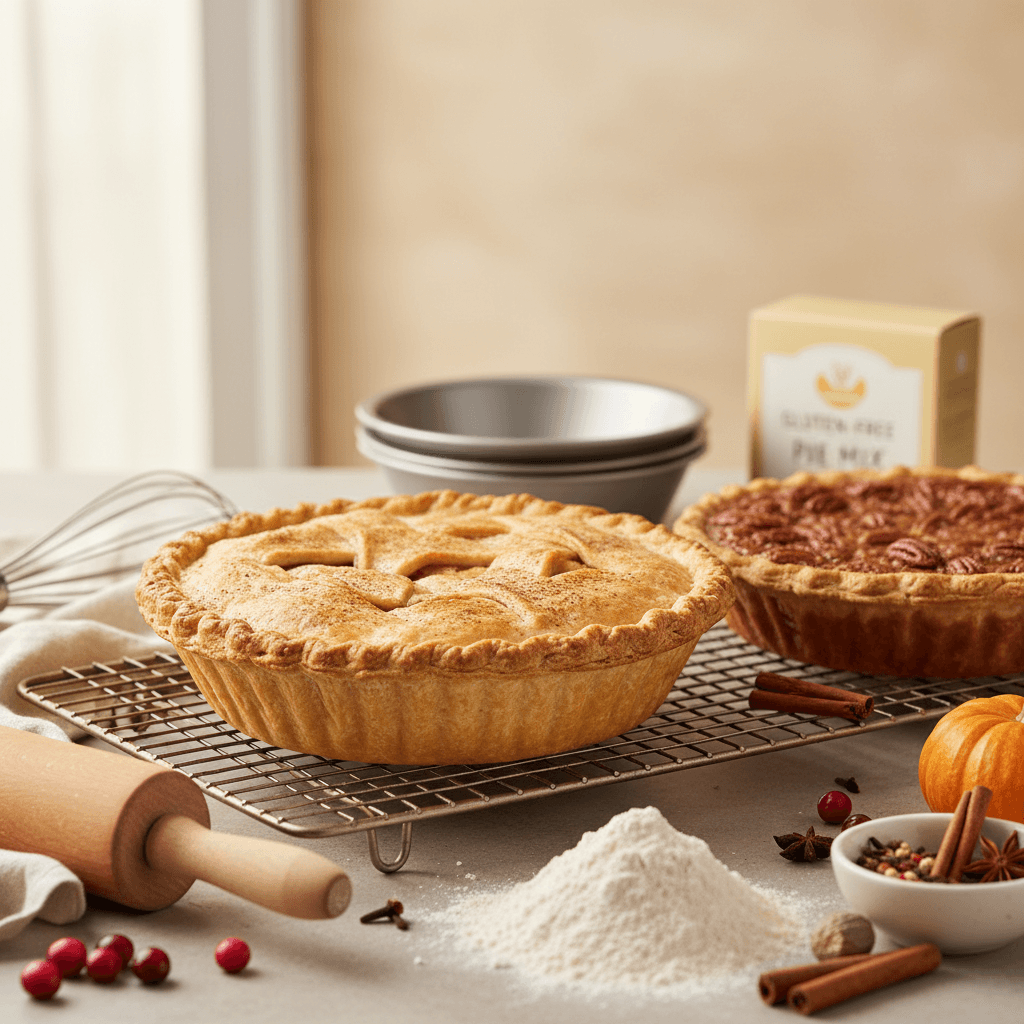
Thanksgiving without pie isn't really Thanksgiving, and having celiac disease or a gluten sensitivity shouldn't change that. Whether you want to bake from scratch, adapt Grandma's famous recipe, or just grab a reliable mix off the shelf, this guide covers every path to a gluten-free pie that earns its place on the holiday table.
Key takeaways
- Most classic Thanksgiving pie fillings (pumpkin, pecan, sweet potato) are naturally gluten-free — the crust is the only part that needs adapting.
- A good gluten-free pie crust depends on the right flour blend and keeping everything cold; we recommend blends that combine rice flour, tapioca starch, and a small amount of xanthan gum.
- Store-bought gluten-free pie crust mixes and frozen crusts have improved dramatically — several options now rival homemade in taste and texture.
- If you're ordering mixes or specialty flours online, place your order by early November to ensure delivery before Thanksgiving.
- You can convert almost any traditional family pie recipe to gluten-free by swapping the crust and thickener — our substitution guides walk you through each ingredient.
Why the crust is the only real challenge
Here's the good news: most Thanksgiving pie fillings are already gluten-free. Pumpkin pie filling is essentially pumpkin puree, eggs, sugar, cream, and spices. Pecan pie is pecans, eggs, butter, and corn syrup. The filling isn't the problem — it's the crust.
A traditional pie crust gets its flaky, tender structure from gluten in wheat flour. Without gluten, crusts can turn crumbly, tough, or sandy. But with the right flour blend and technique, you can make a gluten-free crust that's genuinely flaky. The key is using a blend of flours and starches — typically brown rice flour for structure, arrowroot powder or tapioca starch for elasticity, and a touch of xanthan gum to bind everything together. If your crusts have been turning out dry or crumbly, our guide on fixing dry, crumbly gluten-free bakes is worth a read before pie day.
If you're new to gluten-free baking or want a structured approach to mastering these techniques, the Confident Gluten-Free Baker Toolkit walks you through flour blends, troubleshooting, and recipe conversion step by step — perfect timing before the holidays.
Best homemade gluten-free pie crust recipe
This is a simple gluten-free crust built for flakiness, easy rolling, and a sturdy base under any filling.
Ingredients
- 1 1/4 cups gluten-free all-purpose flour blend (we like Bob's Red Mill 1-to-1 or King Arthur Measure for Measure)
- 1 tablespoon granulated sugar
- 1/2 teaspoon salt
- 1/2 teaspoon xanthan gum (omit if your flour blend already includes it)
- 1/2 cup (1 stick) cold unsalted butter, cubed
- 3-4 tablespoons ice water
- 1 teaspoon apple cider vinegar
Method
- Whisk together the flour blend, sugar, salt, and xanthan gum in a large bowl.
- Cut in the cold butter using a pastry cutter or your fingers until the mixture looks like coarse crumbs with some pea-sized pieces remaining.
- Add the apple cider vinegar to 3 tablespoons of ice water. Drizzle over the flour mixture, stirring with a fork until the dough just comes together. Add the last tablespoon of water only if needed.
- Flatten the dough into a disk, wrap in plastic, and refrigerate for at least 30 minutes.
- Roll out between two sheets of parchment paper. Gluten-free dough is more fragile, so parchment is your best friend here.
- Transfer to your pie plate, trim and crimp the edges, and fill as desired.
For a blind-baked crust (needed for custard pies), prick the bottom with a fork, line with parchment and pie weights, and bake at 375 degrees F for 15 minutes. Remove the weights and bake another 5-7 minutes until lightly golden.
Pro tips for flaky gluten-free crust
- Keep everything cold. Cold butter creates steam pockets that make flaky layers. If the dough gets warm while rolling, slide the whole parchment sheet onto a baking tray and refrigerate for 10 minutes.
- Don't overwork the dough. Without gluten, you don't need to worry about toughness from overmixing, but you do want those butter pieces to stay intact.
- Vinegar matters. It tenderizes the dough and helps prevent that gritty texture common in gluten-free crusts. Check our guide on fixing gritty gluten-free texture for more tricks.
Classic gluten-free Thanksgiving pie fillings
Once you have your crust sorted, these fillings are naturally gluten-free or easy to adapt.
Pumpkin pie
Traditional pumpkin pie is essentially gluten-free already. Use one 15-ounce can of pumpkin puree (not pumpkin pie filling, which may contain additives), 3/4 cup sugar, 1 teaspoon cinnamon, 1/2 teaspoon ginger, 1/4 teaspoon cloves, 1/2 teaspoon salt, 2 large eggs, and one 12-ounce can of evaporated milk. Pour into your blind-baked crust and bake at 425 degrees F for 15 minutes, then reduce to 350 degrees F for 40-50 minutes until set. The classic Libby's recipe on the back of their canned pumpkin works perfectly in a gluten-free crust.
Pecan pie
Pecan pie filling is naturally gluten-free. Some recipes call for a tablespoon of flour as a thickener — simply swap it for arrowroot powder or cornstarch at a 1:1 ratio. Use 1 cup corn syrup, 1/2 cup brown sugar, 3 eggs, 1/3 cup melted butter, 1 teaspoon vanilla, and 1 1/2 cups pecan halves. Pour into an unbaked gluten-free crust and bake at 350 degrees F for 60-70 minutes.
Apple pie
Apple pie filling is gluten-free, but traditional recipes often use all-purpose flour to thicken the juices. Replace it with 2 tablespoons of arrowroot powder or tapioca starch. Toss with sliced apples, sugar, cinnamon, nutmeg, and a squeeze of lemon juice. You'll need a top crust or crumble topping — for a crumble, combine gluten-free oats, brown sugar, butter, and a handful of almond flour for a nutty, crisp topping.
Sweet potato pie
Like pumpkin pie, sweet potato pie is naturally gluten-free. Roast 2 pounds of sweet potatoes, mash them smooth, and mix with 3/4 cup sugar, 2 eggs, 1/2 cup milk or cream, 1/4 cup melted butter, 1 teaspoon vanilla, 1 teaspoon cinnamon, and 1/2 teaspoon nutmeg. Pour into a blind-baked gluten-free crust and bake at 350 degrees F for 45-55 minutes.
How to adapt your family's traditional pie recipes to gluten-free
Converting a beloved family recipe feels risky, but it's simpler than you might think. In most cases, you only need to change one or two ingredients.
| Original ingredient | Gluten-free swap | Notes |
|---|---|---|
| All-purpose flour (crust) | GF 1-to-1 flour blend | Use a blend with xanthan gum included, or add 1/2 tsp per cup |
| All-purpose flour (filling thickener) | Arrowroot powder or tapioca starch | Use same amount; arrowroot gives a clearer finish |
| Graham cracker crust | GF graham crackers or GF cookie crumbs | Kinnikinnick and Schar both make certified GF graham crackers |
| Cookie crumb crust (Oreo, etc.) | GF sandwich cookies | Glutino or GF Oreos work well |
| Breadcrumb topping | GF panko or crushed GF cereal | Toast first for best crunch |
Our all-purpose flour substitution guide has detailed ratios and tips for every type of swap. The key principle: swap the flour, keep everything else the same, and your family's recipe will taste like it always has.
Make it easy: best store-bought gluten-free pie crusts and mixes
Not everyone wants to make crust from scratch, and that's perfectly fine. These store-bought options are solid shortcuts.
Ready-to-use frozen pie crusts
| Product | Type | Best for | Notes |
|---|---|---|---|
| Wholly Wholesome GF Pie Shells | Frozen, 2-pack | All pies | Flaky, buttery, closest to homemade |
| Mi-Del GF Pie Crust | Graham-style, ready-made | Cream pies, cheesecake | Great no-bake option |
| Schar Shortcrust Pastry | Frozen dough | All pies, tarts | Rollable dough, very versatile |
The Wholly Wholesome GF Pie Shells are our top frozen pick — handy to keep in the freezer through November for heavy fillings like pumpkin and pecan. For a graham cracker-style crust (think pumpkin cheesecake or key lime pie), the Mi-Del GF Pie Crust is a solid grab-and-go option.
Pie crust mixes (just add butter and water)
If you want something between fully homemade and fully store-bought, these mixes give you a from-scratch feel with less measuring.
- King Arthur Gluten Free Pie Crust Mix — Our top pick. Makes a flaky, easy-to-roll crust. One box makes two crusts.
- Bob's Red Mill GF Pie Crust Mix — Widely available in grocery stores.
- Cup4Cup Gluten Free Pie Crust Mix — Premium option developed by a former Thomas Keller pastry chef.
Timing: when to order
If you're ordering specialty mixes or frozen crusts online, place your order by the first week of November to be safe. Shipping delays are common around the holidays, and gluten-free products can sell out quickly. If you're buying from a local grocery store, check stock by mid-November — many stores increase their GF inventory for the holidays but can still run out of popular items.
Complete store-bought gluten-free pies worth buying
Sometimes the easiest path is the best one. These fully baked pies ship to your door or can be found at major grocery stores.
- Katz Gluten Free Pumpkin Pie — Ships frozen. Certified gluten-free, dairy-free, and nut-free. Order by mid-November for Thanksgiving delivery.
- Trader Joe's Gluten Free Pumpkin Pie — Seasonal item, available in stores starting early November. Affordable. Check your local store's availability early.
- Three Bakers Pumpkin Pie — Another solid frozen option available online. Certified gluten-free with a flaky crust.
For anyone dealing with multiple food allergies at the table, these pre-made options can be a lifesaver. Check labels carefully — some are also dairy-free and nut-free, which matters when you're hosting a crowd.
Tips for gluten-free pie success on Thanksgiving day
A few practical tips that make the difference between a good gluten-free pie and a great one:
- Bake your pies the day before. Pumpkin, pecan, and sweet potato pies all taste better after resting overnight in the fridge. This also frees up oven space on the big day.
- Use a glass or ceramic pie plate. These conduct heat more evenly than metal, which helps gluten-free crusts bake through without burning the edges.
- Shield the edges. Gluten-free crusts can brown faster than wheat crusts. Use a pie shield or strips of foil around the edges for the first half of baking.
- Weigh your flour. Gluten-free flours vary wildly in density. A cup of almond flour and a cup of rice flour weigh completely different amounts. A kitchen scale removes the guesswork — the OXO Good Grips 11lb Food Scale is a dependable pick.
- Prevent cross-contamination. If you're baking alongside wheat-based dishes, use separate utensils, cutting boards, and rolling pins. Flour dust travels. Our gluten-free baking guide covers safe kitchen practices in detail.
A note for the holidays
It's no fun to sit at a holiday table where everyone else is eating pie and you can't have any. Or to watch someone politely push aside the "special" dessert because it just doesn't taste the same. Gluten-free Thanksgiving pie doesn't have to be a consolation prize. With the right crust and the same fillings everyone loves, your pie can be the one people fight over — and nobody needs to know it's gluten-free unless you tell them.
If you're baking for someone with celiac disease or a gluten sensitivity this year, the fact that you're here reading this means a lot. It really does.
Frequently asked questions
Can I use a regular pie recipe with gluten-free flour?
Yes, in most cases you can substitute a 1-to-1 gluten-free flour blend directly for all-purpose flour in pie crust recipes. The filling usually needs no changes at all. Check our all-purpose flour substitution guide for specific ratios and tips to ensure the best texture.
What is the best gluten-free flour for pie crust?
A pre-made 1-to-1 gluten-free flour blend works best for pie crust because it combines multiple flours and starches for balanced texture. King Arthur Measure for Measure and Bob's Red Mill 1-to-1 are both reliable choices. Avoid using a single flour like almond flour or rice flour alone — they won't give you the right structure.
Are store-bought gluten-free pie crusts any good?
Yes, store-bought options have improved significantly. Wholly Wholesome frozen pie shells and King Arthur's pie crust mix both produce crusts that rival homemade. They're a great option when you're short on time or baking multiple pies for a crowd.
How do I keep my gluten-free pie crust from falling apart?
The most common reasons for crumbly gluten-free crust are too little moisture and missing xanthan gum. Make sure your flour blend includes xanthan gum (or add 1/2 teaspoon per cup of flour), use ice-cold water, and let the dough rest in the fridge for at least 30 minutes before rolling. Rolling between parchment paper also prevents cracking. See our dry and crumbly troubleshooting guide for more help.
Can I make gluten-free pie crust ahead of time and freeze it?
Absolutely. Gluten-free pie dough freezes beautifully for up to 3 months. Wrap the disk of dough tightly in plastic wrap, then place in a freezer bag. You can also roll it out, fit it into your pie plate, and freeze it right in the plate. Thaw overnight in the fridge before filling and baking.

Written by
Co-founder, BakingSubs
Co-founder of BakingSubs, where he turns the science of ingredient substitutions into tested, reliable guidance for home bakers.
Related Posts
Bake with Confidence
See all
Confident Gluten-Free Baker Toolkit
The science-based system that replaces gluten's seven invisible jobs so your baking turns out soft, fluffy, and foolproof — every time.

Gluten-Free Recipe Vault
Instant access to our complete library of proven gluten-free recipes — no waiting, no guesswork, just results that work tonight.

Fix Your Gluten-Free Bread
Learn the 3-step formula to make bread rise and stay soft, discover why your loaves collapse, and get a tested sandwich bread recipe that actually works.