

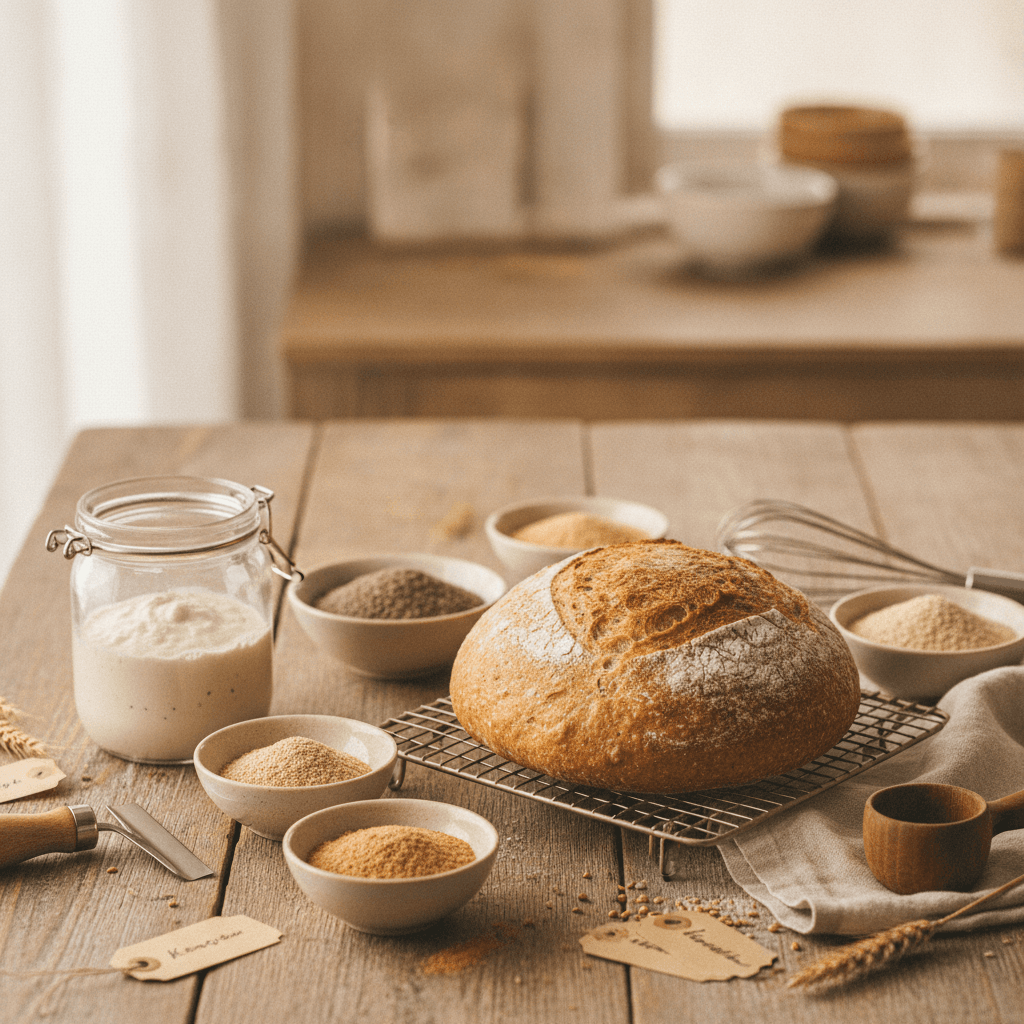
Whole grain flours and sourdough are a natural pairing. The long fermentation breaks down phytic acid, improves mineral availability, and develops flavor complexity you can't get from a quick-rise loaf. But swapping whole grain flour into a sourdough formula designed for white flour is where most bakers run into dense, gummy, or barely-risen results. Here's what's actually happening and how to work with it.
Key takeaways
Whole grain flours ferment faster than white flour because the bran and germ provide extra nutrients and enzymes to wild yeast and bacteria.
Hydration needs increase significantly — most whole grain sourdoughs need 75–90% hydration compared to 65–72% for white flour sourdoughs.
Bran particles physically cut gluten strands, so even high-protein whole wheat flour produces a weaker dough structure than bread flour at the same protein level.
Bulk fermentation times should typically be shortened by 20–30% compared to white flour formulas to avoid over-fermentation.
Blending whole grain flour with a portion of bread flour (often 30–50% whole grain) is the most reliable starting point for bakers new to whole grain sourdough.
Autolyse periods of 30–60 minutes help whole grain flours fully hydrate before mixing begins, reducing grittiness and improving crumb.
Why whole grain flours ferment differently than white flour
Whole grain flours contain the bran, germ, and endosperm of the grain kernel. White flour is mostly endosperm. That difference matters enormously in sourdough because the bran and germ carry minerals, enzymes, and sugars that feed wild yeast and lactic acid bacteria far more aggressively than refined flour does.
The practical result: a whole grain sourdough dough can peak 20–30% faster than the same formula made with white flour at the same temperature. For example, a 100% whole wheat loaf can over-proof in about 3.5 hours at 78°F — the same timeline that might barely get a white flour loaf through bulk fermentation. If you're used to timing your bakes around white flour schedules, whole grain will catch you off guard.
Amylase activity is also higher in whole grain flours. These enzymes break starches into sugars, which speeds up fermentation even further. This is especially pronounced in fresh-milled flour, where the enzymes haven't degraded during storage.
The hydration problem nobody warns you about
Bran absorbs water aggressively. A whole wheat flour can absorb 10–20% more water than all-purpose flour of similar protein content. If you use the same hydration percentage you'd use for a white flour sourdough, your whole grain dough will feel stiff, tear during shaping, and bake into a brick.
Most successful whole grain sourdough bakers work at 78–90% hydration, depending on the grain. Compare that to a typical white flour sourdough at 68–72%. The difference is dramatic — and it's not optional.
Flour type | Typical sourdough hydration range | Notes |
|---|---|---|
65–72% | Standard baseline for most formulas | |
78–85% | Bran absorbs significantly more water | |
80–90% | No gluten; needs binding support | |
Whole spelt flour | 70–76% | Gluten is more fragile; handle gently |
Whole rye flour | 80–90% | Pentosans absorb water heavily; very sticky dough |
85–95% | Gluten-free; requires binder for structure |
A practical starting point: add 10g of water per 100g of flour over your usual white flour hydration, then adjust from there. The dough should feel tacky but workable, not dry or crumbly.
How bran destroys gluten structure (and what to do about it)
Even if your whole wheat flour has 14% protein — the same as strong bread flour — the resulting dough will be weaker. The sharp edges of bran particles physically shear gluten strands as the dough is mixed and folded. Think of it like trying to stretch a rubber band with tiny razor blades embedded in it.
This is why a 100% whole wheat sourdough loaf almost never achieves the open, airy crumb of a white flour loaf. That's not a failure — it's physics. But there are strategies to work with it:
Sifting and scalding the bran
Some bakers sift whole grain flour to separate the bran, then scald the bran with boiling water before adding it back to the dough. Scalding softens the bran's sharp edges, reducing gluten damage. The bran is typically soaked for at least 30 minutes, though overnight is common. This technique is especially popular in Japanese whole wheat bread baking (tangzhong-adjacent methods).
Extended autolyse
Mixing flour and water and letting the dough rest for 30–60 minutes before adding salt and starter gives the bran time to fully hydrate. This reduces its abrasiveness and gives gluten proteins a head start on forming networks. For 100% whole grain doughs, some bakers extend the autolyse to 2–4 hours, though this risks early enzymatic breakdown in very fresh flour.
Blending with white flour
The most common approach for bakers who want whole grain flavor without sacrificing rise: blend whole grain flour with bread flour. A 30–50% whole grain blend gives noticeable flavor depth and nutritional benefits while maintaining enough gluten structure for a good oven spring. Going above 50% whole grain noticeably changes the crumb — denser, more closed, and moister.
6 whole grain flours that work in sourdough (and how each one behaves)
Not all whole grain flours behave the same in sourdough. Protein content, gluten quality, enzyme activity, and flavor all vary dramatically. Here's a practical breakdown.
1. Whole wheat flour
The most common whole grain choice. Whole wheat flour has moderate to high protein (typically 12–14%) and contains functional gluten, so it can be used at 100% in sourdough with the right technique. The flavor is nutty and slightly bitter, which long fermentation mellows significantly. It ferments fast — expect bulk fermentation to run about 25% shorter than white flour at the same temperature.
2. Whole spelt flour
Spelt is an ancient wheat relative with a more delicate gluten structure. It develops quickly during mixing but tears easily if overworked. Spelt sourdough tends to be more extensible (stretchy) but less elastic (doesn't spring back), so gentle handling is essential. It produces a milder, slightly sweet flavor compared to whole wheat. Hydration should be kept lower than whole wheat — around 70–76% — because spelt dough can go slack fast.
3. Whole rye flour
Rye is a different animal entirely. Its proteins don't form gluten the way wheat does. Instead, rye doughs rely on pentosans (a type of soluble fiber) for structure. Pentosans absorb enormous amounts of water, which is why rye doughs are notoriously sticky. A 100% rye sourdough produces a dense, moist, deeply flavored loaf — think German-style pumpernickel or Danish rugbrod. Most bakers blend rye at 20–40% with wheat flour for a more manageable dough.
4. Whole einkorn flour
Einkorn is the oldest cultivated wheat variety. Its gluten is weaker than modern wheat, and the flour has a distinctive golden color from high carotenoid content. Einkorn sourdough has a rich, buttery flavor but limited oven spring. It works best in flatbreads, pancakes, and lower-rise loaves. Hydration should be moderate — einkorn absorbs less water than whole wheat.
5. Buckwheat flour
Buckwheat is not wheat at all — it's a pseudocereal, completely gluten-free. Using it in sourdough requires either blending with wheat flour or adding a binder like psyllium husk for structure. Buckwheat has an assertive, earthy flavor that pairs well with the tang of sourdough. At 20–30% of a wheat-based formula, it adds complexity without overwhelming the loaf. At 100%, expect a very dense, pancake-like crumb unless you're specifically making buckwheat flatbread or crumpets.
6. Whole khorasan (Kamut) flour
Khorasan wheat has high protein (often 14–15%) and a buttery, almost sweet flavor. Its gluten is moderate in strength — better than spelt or einkorn but not as resilient as modern bread wheat. It works well at 50–100% in sourdough, though 100% khorasan loaves tend to spread more than they rise. The flour has a natural golden hue that gives bread a warm color.
Feeding your starter with whole grain flour
Many sourdough bakers maintain their starter on all-purpose flour but switch to whole grain flour for a feeding or two before baking. The logic is sound: whole grain flour provides more nutrients and a more diverse microbial food source, which can make the starter more vigorous before it goes into the dough.
Whole rye flour is especially popular as a starter feed because its high enzyme activity and mineral content produce a very active, bubbly culture. Even a single feeding of whole rye before baking can noticeably increase starter activity compared to white flour alone.
One caveat: if you normally feed your starter with white flour and suddenly switch to 100% whole grain, the starter may behave unpredictably for a few feedings as the microbial community adjusts. Gradual transition — mixing increasing proportions of whole grain into your usual feed over 3–4 feedings — produces more consistent results.
Why fresh-milled whole grain flour changes everything
There's a growing movement among home sourdough bakers toward milling flour at home using countertop grain mills. Fresh-milled whole grain flour behaves differently from store-bought whole grain flour in several important ways:
Higher enzyme activity. Enzymes in the germ begin degrading the moment flour is milled. Store-bought flour has had weeks or months for enzyme activity to decline. Fresh flour ferments faster and more vigorously.
More volatile flavor compounds. The oils in the germ oxidize quickly after milling. Fresh flour has a sweeter, more complex flavor; older flour can taste flat or slightly rancid.
Less predictable absorption. Fresh flour may hydrate differently than aged flour, so hydration adjustments are needed more frequently.
If you're interested in milling your own flour for sourdough, expect a learning curve. The same grain can produce noticeably different dough behavior depending on how fine the mill grinds it. Coarser grinds absorb water more slowly and produce a grittier crumb; finer grinds hydrate faster and give a smoother texture.
A common recommendation is to let fresh-milled flour rest for 24–48 hours before using it in sourdough. This allows some of the most aggressive enzyme activity to calm down, making fermentation more predictable. However, some bakers prefer the vigor of truly fresh flour and simply shorten their fermentation times to compensate.
Common mistakes with whole grain sourdough
Most failures with whole grain sourdough come from treating it like white flour sourdough with a different flavor. It's not. Here are the mistakes that cause the most grief:
Using the same hydration as white flour
Already covered above, but it's the single most common error. If your whole grain sourdough is dense and tight-crumbed, insufficient hydration is the first thing to check.
Over-fermenting the dough
Because whole grain flour ferments faster, using the same bulk fermentation schedule as white flour almost guarantees over-proofing. The dough will feel slack and jiggly, and the finished loaf will be flat with a gummy crumb. If you're seeing gummy centers in your whole grain sourdough, shortened fermentation is worth trying before changing anything else.
Skipping the autolyse
Whole grain flour genuinely needs time to hydrate before active mixing. Skipping the autolyse means the bran never fully softens, leading to a grittier crumb and weaker gluten development. Even 30 minutes makes a measurable difference.
Overworking spelt or einkorn doughs
These ancient grains have fragile gluten that develops fast and breaks down with continued mixing. Two or three sets of stretch-and-folds are usually sufficient. More than that can leave the dough slack and unrecoverable.
Expecting white flour crumb from 100% whole grain
A 100% whole grain sourdough will never have the open, hole-filled crumb of a white flour country loaf. That's not a defect. A well-made whole grain loaf has a tighter, more even crumb that's better for sandwiches and toasting anyway. Adjusting expectations is part of the process.
Whole grain sourdough and gluten-free baking
For bakers avoiding gluten, whole grain sourdough is still possible — but it requires a fundamentally different approach. Gluten-free whole grains like brown rice, buckwheat, amaranth, and teff can all be fermented with a sourdough culture. The starter itself can be maintained on gluten-free flour.
The challenge is structure. Without gluten, these doughs need binders — psyllium husk powder and flax gel are the most common — and they're typically baked in loaf pans rather than free-formed on a baking stone. The fermentation still provides the same flavor benefits and phytic acid reduction, but the texture and handling are completely different from wheat-based sourdough. If you're exploring gluten-free baking, sourdough fermentation is one of the more rewarding approaches for whole grain flavor.
For bakers looking at high-fiber flour alternatives, many of the same whole grains used in sourdough — buckwheat, amaranth, teff — appear on that list. Sourdough fermentation can actually improve the digestibility of these high-fiber flours by partially breaking down the fiber and anti-nutrients during the long ferment.
A contrarian take: you don't need 100% whole grain to get the benefits
There's a strong current in the baking community that pushes toward 100% whole grain as the ideal. But here's the thing: a sourdough loaf made with 30% whole grain and 70% bread flour still delivers significantly more flavor, fiber, and mineral availability than a 100% white flour loaf. And it's dramatically easier to handle, shape, and bake well.
Chasing 100% whole grain often leads to frustration, especially for bakers who are newer to sourdough. A 30–50% whole grain blend is where most bakers find the sweet spot between nutrition, flavor, and practical bakeability. There's no nutritional cliff where 70% whole grain is meaningfully better than 50% for a home baker making weekly loaves. The best whole grain sourdough is the one you'll actually bake regularly — and for most people, that's a blend.
Frequently asked questions
Can you use 100% whole wheat flour for sourdough bread?
Yes, but it requires adjustments. Increase hydration to 78–85%, shorten bulk fermentation by about 20–30% compared to white flour, and use an autolyse of at least 30 minutes. The resulting loaf will have a denser, more closed crumb than white flour sourdough, with a nuttier, more complex flavor that long fermentation develops well.
Why is my whole grain sourdough so dense?
The most common causes are insufficient hydration and over-fermentation. Whole grain flour absorbs more water than white flour, so the dough needs more liquid. And because bran and germ feed the starter's microbes more aggressively, the dough ferments faster — meaning the same bulk fermentation time that works for white flour can over-proof a whole grain dough, leading to collapse and density.
What is the best whole grain flour for sourdough beginners?
Whole wheat flour is the most forgiving starting point because it contains functional gluten and is widely available. Starting with a 30–40% whole wheat blend (the rest bread flour) lets you learn how whole grain affects fermentation and hydration without the added complexity of gluten-free or ancient grain flours.
Does sourdough fermentation make whole grain flour easier to digest?
Sourdough fermentation reduces phytic acid in whole grain flour. Phytic acid can bind minerals like iron, zinc, and calcium, making them less available for absorption. The long fermentation — typically 4–12 hours or more — allows the lactic acid bacteria and natural phytase enzymes to break down a significant portion of the phytic acid. This is one of the well-established nutritional advantages of sourdough over quick-rise bread methods.
Can I feed my sourdough starter with whole grain flour?
Absolutely. Whole grain flour — especially whole rye — is a popular starter feed because it provides more nutrients and enzymes than white flour, often producing a more vigorous, active culture. If you're switching from white flour to whole grain for your starter feedings, transition gradually over 3–4 feedings to let the microbial community adjust.

Written by
Co-founder, BakingSubs
Co-founder of BakingSubs, where he turns the science of ingredient substitutions into tested, reliable guidance for home bakers.
Related Posts
7 Common Healthy Baking Mistakes That Ruin Texture (and How to Fix Each One)
7 Texture Changes With Health Swaps That Catch Bakers Off Guard (and How to Handle Each One)

Gluten-Free Flour Weight Chart: Grams per Cup for 9 Major Brands (and Why the Spread Is Over 20%)
Bake with Confidence
See all
Confident Gluten-Free Baker Toolkit
The science-based system that replaces gluten's seven invisible jobs so your baking turns out soft, fluffy, and foolproof — every time.

Gluten-Free Recipe Vault
Instant access to our complete library of proven gluten-free recipes — no waiting, no guesswork, just results that work tonight.

Fix Your Gluten-Free Bread
Learn the 3-step formula to make bread rise and stay soft, discover why your loaves collapse, and get a tested sandwich bread recipe that actually works.