

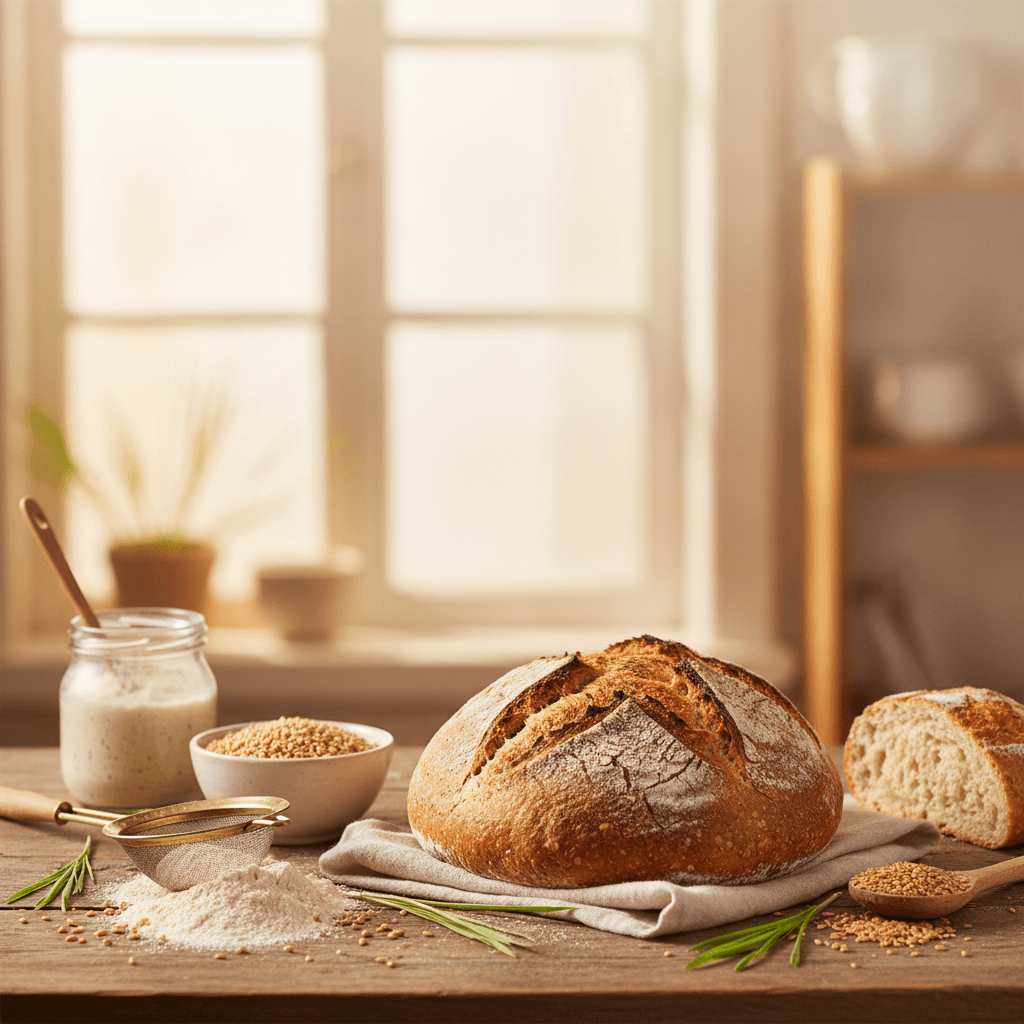
Sprouted grain flour behaves differently from conventional whole wheat flour in almost every measurable way — hydration, rise, sweetness, and shelf life all shift. If you swap it in without adjusting, you'll likely end up with dense, sticky, or overly dark results. Here's what actually changes and how to handle each difference.
Key takeaways
- Sprouted grain flour absorbs less water than standard whole wheat flour, so most batters and doughs need 10–15% less liquid to avoid a gummy crumb.
- The sprouting process partially breaks down starches into simpler sugars, which means baked goods brown faster and taste slightly sweeter without added sweetener.
- Sprouted wheat flour still contains gluten — sprouting does not make it safe for people with celiac disease or gluten intolerance.
- It works best as a partial or full replacement for whole wheat flour, not as a 1:1 swap for all-purpose flour, because the bran and germ are still present.
- Shelf life is shorter than conventional flour. Sprouted grain flour goes rancid faster due to higher enzyme activity, so refrigerating or freezing it is standard practice.
What sprouted grain flour actually is (and what it isn't)
Sprouted grain flour is made from whole grain kernels — most commonly wheat, but also spelt, rye, or other grains — that have been soaked in water until they begin to germinate, then dried and milled into flour. The germination window is typically 1–3 days, just long enough for the seed to start converting stored starches into sugars and for enzyme activity to increase.
This process is sometimes confused with malting, but malting allows the sprout to grow further and is typically used for brewing, not baking. Sprouted flour is dried and ground before the sprout develops significantly.
A common misconception: sprouted grain flour is not gluten-free. If the base grain is wheat, spelt, or rye, the flour still contains gluten. The sprouting process may alter gluten structure slightly, but not enough to make it safe for anyone who needs to avoid gluten. If you're baking for someone with celiac disease or a wheat allergy, sprouted wheat flour is not a substitute. For genuinely gluten-free options, check out our guide on gluten-free baking.
5 ways sprouted grain flour changes your baking results
1. It absorbs less liquid than conventional whole wheat
Because sprouting partially breaks down the starch granules in the grain, sprouted flour doesn't soak up water the same way regular whole wheat does. If you use the same amount of liquid your whole wheat recipe calls for, the dough or batter will be noticeably wetter and slacker. Most bakers who work with sprouted flour reduce liquid by roughly 10–15%, though the exact amount depends on the brand and the grain.
This is the single most common reason sprouted flour bakes fail. The batter looks fine going in, but the center stays gummy because there's too much unbound moisture. If you're already familiar with how different flours handle hydration, you know that even small shifts matter — the same principle applies when working with whole wheat flour substitutes of any kind.
2. Baked goods brown faster and darker
The enzymatic activity during sprouting converts a portion of the flour's starch into maltose and other simple sugars. More available sugar at the surface means faster Maillard browning. If you bake a loaf of sprouted wheat bread at the same temperature and time as a conventional whole wheat loaf, the crust will be noticeably darker — sometimes to the point of looking overbaked even when the interior is still underdone.
Reducing oven temperature by about 25°F (roughly 15°C) compared to what a recipe calls for with standard flour is a widely cited adjustment. You may also need to tent the top with foil partway through baking if the crust darkens too quickly. This faster browning is something to watch for in cookies and muffins too — a batch that normally takes 12 minutes might be done at 10.
3. The flavor is sweeter and more complex
That same starch-to-sugar conversion gives sprouted flour a naturally sweeter taste compared to conventional whole wheat, which tends toward bitter or grassy notes. Many bakers find they can reduce added sweetener modestly — perhaps by 1–2 tablespoons per cup of flour — without the result tasting flat. This makes sprouted grain flour a natural fit for low-sugar baking, where every bit of inherent sweetness helps compensate for reduced sugar.
The flavor also has a slightly nutty, malty quality that works well in pancakes, banana bread, muffins, and yeasted loaves. It's less ideal in delicate pastries where you want a neutral flour flavor — the earthiness can compete with subtle ingredients like vanilla or citrus zest.
4. Gluten structure behaves differently
Sprouting partially breaks down some of the proteins in the grain, including gluten. The result is a flour that still forms gluten networks (assuming it's wheat-based), but those networks tend to be weaker and more extensible than what you'd get with conventional bread flour or even standard whole wheat flour.
For bread bakers, this means sprouted wheat flour produces a softer, more tender crumb but may not hold up to aggressive shaping or long bulk fermentation the way a high-protein bread flour would. Many bread bakers blend sprouted flour with conventional bread flour — often in a 50/50 ratio — to get the flavor benefits of sprouting while maintaining enough gluten strength for a good rise and open crumb.
For quick breads, muffins, and cookies, the weaker gluten is actually an advantage. Less gluten development means a more tender texture, which is usually what you want in those applications. If you're interested in how protein content affects flour performance more broadly, our post on high-protein flour substitutes covers the tradeoffs.
5. Shelf life is significantly shorter
The increased enzyme activity that makes sprouted flour interesting for baking also makes it spoil faster. The oils in the germ oxidize more quickly, and the higher sugar content can encourage microbial growth. An unopened bag of conventional all-purpose flour might last 6–12 months in a cool pantry. Sprouted grain flour, by contrast, is generally recommended to be stored in the refrigerator or freezer, where it can last 3–6 months. At room temperature, it can go rancid in as little as a few weeks, especially in warm or humid climates.
If your sprouted flour smells sour, musty, or like old paint, it's gone off. Rancid flour won't make you sick in small amounts, but it will ruin the flavor of everything you bake with it.
Where sprouted grain flour works best
Not every baked good benefits equally from sprouted flour. Here's a realistic breakdown:
| Application | How well sprouted flour works | Notes |
|---|---|---|
| Yeasted bread | Good, especially blended 50/50 with bread flour | Expect softer crumb, faster browning; reduce liquid |
| Quick breads and muffins | Excellent — possibly the best use case | Tender texture, natural sweetness; can replace whole wheat 1:1 with liquid adjustment |
| Pancakes and waffles | Excellent | Slightly sweeter, browns faster on the griddle |
| Cookies | Good for chewy/soft styles | Watch bake time closely; may spread more due to higher sugar and weaker gluten |
| Pie crust | Fair | Can work but may be too tender and hard to handle; blend with all-purpose for structure |
| Delicate cakes | Limited | Earthy flavor competes with subtle flavors; bran creates denser texture |
| Pastry (croissants, puff pastry) | Not recommended | Weak gluten and fast browning make laminated doughs very difficult |
If you're exploring other nutrient-dense flour options for similar applications, our guide to high-fiber flour alternatives covers several options that overlap with sprouted flour's strengths.
Sprouted grain flour vs. regular whole wheat flour
Since sprouted wheat flour is the most common variety, here's how it stacks up directly against standard whole wheat flour:
| Factor | Sprouted wheat flour | Regular whole wheat flour |
|---|---|---|
| Flavor | Sweeter, nuttier, malty | Bitter, grassy, earthy |
| Hydration | Absorbs less water | Absorbs more water |
| Browning speed | Faster | Moderate |
| Gluten strength | Weaker, more extensible | Moderate to strong |
| Shelf life | Shorter (refrigerate or freeze) | Longer at room temperature |
| Price per pound | Typically $0.30–$0.60 more per pound | Standard pricing |
| Gluten-free | No | No |
The price difference is worth noting. Sprouted grain flour generally costs more because the sprouting and drying steps add time and equipment to the milling process. King Arthur and One Degree Organics are two widely available brands in the U.S. that sell sprouted wheat flour, and a 2-lb bag typically runs $6–$8 at retail — roughly 30–50% more than their conventional whole wheat equivalents. For bakers who go through flour quickly, buying in bulk (5-lb or 10-lb bags) can bring the per-pound cost down.
Common mistakes when baking with sprouted grain flour
These are the errors that trip up most bakers switching to sprouted flour for the first time:
- Using the same liquid ratios as the original recipe. This is the number one problem. Start with 10–15% less liquid and adjust from there. The dough or batter should look slightly drier than you'd expect.
- Baking at the same temperature and time. Reduce oven temperature by about 25°F and check for doneness a few minutes earlier than usual. The darker crust can fool you into thinking it's done when the center is still wet, or it can burn before the inside sets.
- Treating it as a 1:1 swap for all-purpose flour. Sprouted flour still has bran and germ, just like whole wheat. Swapping it directly for all-purpose flour in a recipe designed for refined flour will produce denser, heavier results. It's a better substitute for whole wheat flour, not white flour.
- Storing it in the pantry like regular flour. The higher enzyme activity and oil content mean it goes rancid much faster. Refrigerate or freeze it, and bring it to room temperature before baking if you want accurate hydration.
- Assuming it's gluten-free or lower in gluten. It's not. If you need a gluten-free flour, look at options like brown rice flour, buckwheat flour, or almond flour instead.
A note on the nutrition claims
You'll see a lot of marketing language around sprouted grain flour being "more nutritious" or "easier to digest" than conventional flour. Some of these claims have a basis in food science — sprouting does increase the bioavailability of certain minerals by reducing phytic acid, which is an anti-nutrient that binds to iron, zinc, and calcium. There's also evidence that sprouting increases certain B vitamins and may slightly increase the proportion of soluble fiber.
However, the magnitude of these differences varies widely depending on the grain, the sprouting conditions, and the drying and milling process. Some of the more dramatic claims — like "300% more folate" — come from studies on raw sprouted grains, not on flour that has been dried at high temperatures and then baked at 350°F or above. Heat degrades many of the vitamins that sprouting produces.
The honest takeaway: sprouted grain flour is a whole grain flour with a somewhat improved mineral profile and a more pleasant flavor compared to standard whole wheat. It's a reasonable choice for bakers who want to use whole grains. But it's not a superfood, and the nutritional differences between sprouted and conventional whole wheat flour are modest after baking.
Brands worth knowing about
A few brands dominate the sprouted flour market in the U.S.:
- King Arthur Sprouted Wheat Flour — Widely available, consistent grind, works well in bread and muffins. Their 2-lb bags run about $6.50 at most grocery stores.
- One Degree Organics — Offers sprouted wheat, spelt, and rye flours. Certified organic. Their sprouted spelt flour is popular for pancakes and quick breads.
- To Your Health Sprouted Flour Co. — Smaller operation with a wider variety of sprouted grains, including sprouted corn and sprouted einkorn. Often available online rather than in stores.
- Arrowhead Mills — Carries a sprouted wheat flour that's usually priced a bit lower than King Arthur, around $5–$6 for 2 lbs.
Grind consistency varies between brands. Finer grinds (like King Arthur's) tend to produce lighter results in muffins and quick breads. Coarser grinds can add a pleasant rustic texture to bread but may feel gritty in cakes. If grittiness is a recurring issue in your whole grain baking, our guide on fixing gritty texture covers some universal techniques that apply here too.
Frequently asked questions
Is sprouted grain flour gluten-free?
No. If the base grain is wheat, spelt, rye, barley, or any other gluten-containing grain, the sprouted version still contains gluten. Sprouting does not break down gluten enough to make it safe for people with celiac disease or non-celiac gluten sensitivity. For gluten-free baking, look at flours made from rice, buckwheat, almond, or other naturally gluten-free grains and seeds.
Can you substitute sprouted wheat flour 1:1 for all-purpose flour?
Not directly. Sprouted wheat flour is a whole grain flour, so it behaves more like conventional whole wheat flour than like refined all-purpose flour. It will produce denser, heavier baked goods if used as a straight swap for all-purpose flour. It works best as a replacement for whole wheat flour, with a 10–15% reduction in liquid.
Does sprouted flour need to be refrigerated?
Yes, refrigeration or freezing is strongly recommended. The higher enzyme activity and exposed oils from the germ make sprouted flour go rancid faster than conventional flour. At room temperature, it can spoil in a matter of weeks. In the refrigerator, it typically lasts 3–6 months; in the freezer, up to a year.
Why does my sprouted flour bread brown so fast?
Sprouting converts some of the grain's starch into simple sugars, which caramelize and undergo Maillard browning more quickly at oven temperatures. Reducing your oven temperature by about 25°F compared to the original recipe and checking doneness earlier are the standard adjustments. Tenting the loaf with foil midway through baking can also prevent the crust from getting too dark before the center is done.
Is sprouted grain flour healthier than regular whole wheat flour?
Sprouting can reduce phytic acid (which may improve mineral absorption) and slightly increase certain B vitamins and soluble fiber. However, many of these gains are diminished during high-heat drying and baking. The nutritional difference between sprouted and conventional whole wheat flour after baking is modest. Both are whole grain flours and both provide fiber, protein, and micronutrients. The bigger difference is flavor and baking behavior, not nutrition.

Written by
Co-founder, BakingSubs
Co-founder of BakingSubs, where he turns the science of ingredient substitutions into tested, reliable guidance for home bakers.
Related Posts
7 Common Healthy Baking Mistakes That Ruin Texture (and How to Fix Each One)
7 Texture Changes With Health Swaps That Catch Bakers Off Guard (and How to Handle Each One)

Gluten-Free Flour Weight Chart: Grams per Cup for 9 Major Brands (and Why the Spread Is Over 20%)
Bake with Confidence
See all
Confident Gluten-Free Baker Toolkit
The science-based system that replaces gluten's seven invisible jobs so your baking turns out soft, fluffy, and foolproof — every time.

Gluten-Free Recipe Vault
Instant access to our complete library of proven gluten-free recipes — no waiting, no guesswork, just results that work tonight.

Fix Your Gluten-Free Bread
Learn the 3-step formula to make bread rise and stay soft, discover why your loaves collapse, and get a tested sandwich bread recipe that actually works.