

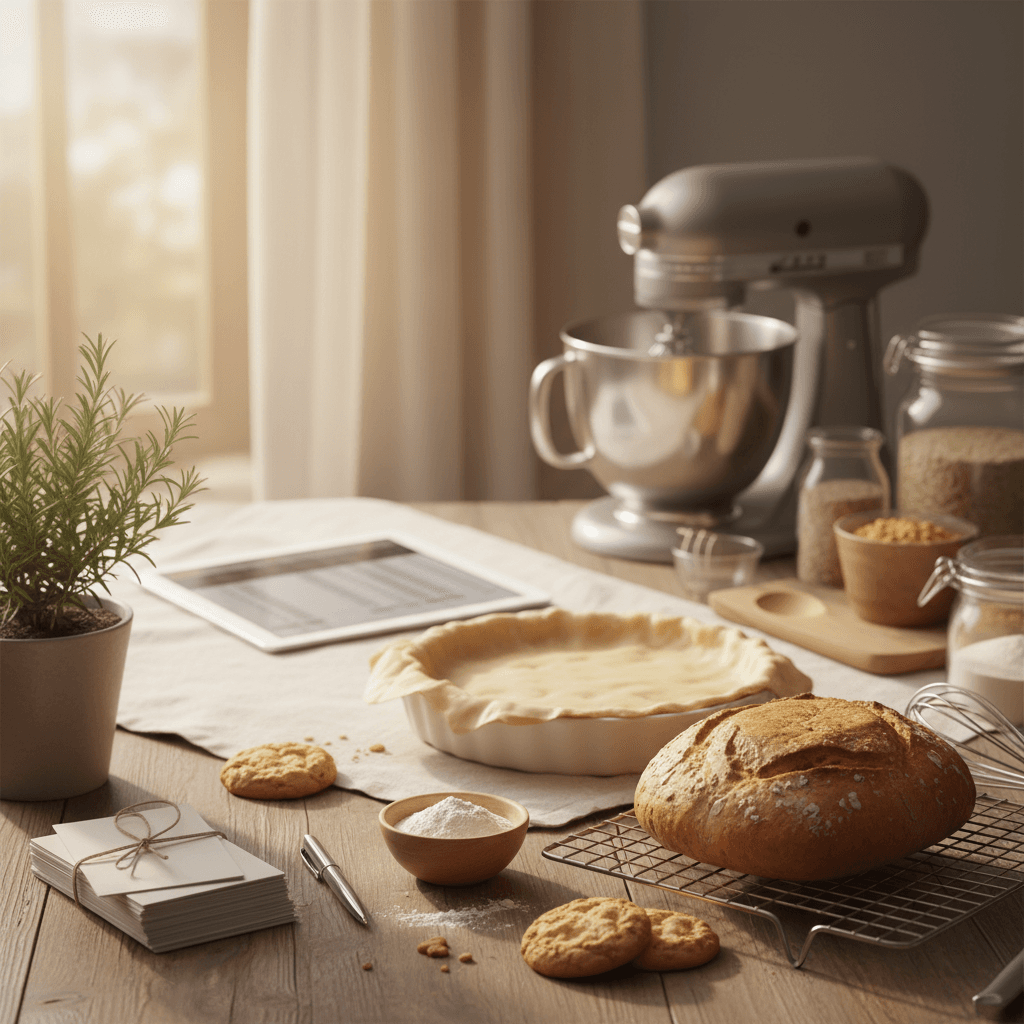
Starting a home bakery involves a lot of moving parts, and it's easy to miss something critical when you're juggling recipes, regulations, and marketing all at once. This checklist covers every phase — from legal setup to daily operations — so you can launch with confidence and avoid costly mistakes.
Key takeaways
- Most home bakers can legally launch for $500–$2,000 in startup costs, but skipping the legal and licensing steps can result in fines or a forced shutdown.
- Your state's cottage food laws dictate what you can sell, where you can sell it, and how much you can earn — always check these first.
- Pricing your products correctly from day one prevents the burnout cycle of undercharging and overworking.
- A focused menu of 5–8 items outperforms a long menu in both profitability and customer satisfaction.
- Systems for order management, bookkeeping, and customer communication should be set up before your first sale, not after you're overwhelmed.
- Insurance is optional in most states but strongly recommended — a single liability claim can wipe out everything you've built.
Phase 1: legal and licensing setup
The very first thing you need to do is confirm your state's cottage food laws and licensing requirements. Everything else depends on this — what you can sell, how much you can earn, and whether you need inspections or permits. Do not skip this step.
Here's what to check off in this phase:
- Research your state's cottage food law. Every state has different rules about allowed products, annual revenue caps, labeling requirements, and where you can sell. Our complete guide to cottage food laws for home bakers breaks down what you need to know.
- Determine your license requirements. Some states require a food handler's permit, a business license, or both. Others require kitchen inspections. Check our home bakery license requirements by state guide for specifics.
- Register your business name. Even as a sole proprietor, you'll likely need a DBA ("doing business as") filing with your county or state. Cost is typically $10–$50.
- Get an EIN from the IRS. This is free and takes five minutes online. You'll need it for business banking and tax filing.
- Open a separate business bank account. Mixing personal and business finances is one of the most common mistakes new home bakers make. A basic business checking account costs $0–$15/month.
- Look into home bakery insurance. Most states don't require it, but a general liability policy for a home bakery runs $200–$500/year and protects you from claims. Read our home bakery insurance guide to decide if it's right for you.
Phase 2: financial planning and pricing
Getting your finances right before you start selling is the difference between a sustainable business and an expensive hobby. Most home bakers undercharge significantly in their first year, so tackle this early.
- Calculate your startup costs. A typical home bakery launch costs $500–$2,000 depending on what equipment you already own. Our realistic home bakery cost breakdown walks through every expense category.
- Write a simple business plan. It doesn't need to be 30 pages. A one-page plan covering your products, target customer, pricing, and monthly revenue goal is enough to start. Our home bakery business plan template makes this easy.
- Price your products correctly. At minimum, your prices should cover ingredients, packaging, labor (pay yourself at least $20/hour), and overhead. A good starting formula is: (ingredient cost + packaging cost) x 3 = minimum retail price. For a deeper dive, check out our complete guide to pricing baked goods for a home bakery.
- Set up bookkeeping from day one. Track every ingredient purchase, supply cost, and sale. Even a spreadsheet works, though dedicated software saves time as you grow. Our best accounting software for cottage food business roundup covers options from free to $30/month.
- Set a monthly revenue goal. Know your number. If you want to net $1,000/month and your average order is $40, you need 25 orders per month — roughly 6 per week. Working backward from a goal makes everything more concrete.
If you're building a gluten-free home bakery specifically, our free Home Bakery Pro masterclass walks through getting consistent orders and building a sustainable business. It's worth watching before you finalize your plan.
Phase 3: kitchen setup and equipment
You don't need a commercial kitchen to start a home bakery — you need a clean, organized space with reliable equipment. Focus on what actually impacts your production capacity and consistency.
| Category | Essential items | Estimated cost |
|---|---|---|
| Mixing | Stand mixer (5–7 qt), mixing bowls, spatulas | $200–$450 |
| Measuring | Digital food scale, measuring cups and spoons | $25–$60 |
| Baking | Sheet pans, cooling racks, cake pans, muffin tins | $50–$120 |
| Storage | Airtight containers, ingredient bins, shelving | $40–$100 |
| Packaging | Boxes, bags, labels, tissue paper | $50–$150 |
| Safety | Food thermometer, timer, first aid kit | $20–$40 |
A few notes on this phase:
- Invest in a good scale. Weighing ingredients instead of using volume measurements is the single biggest upgrade for consistency. Our best food scale for commercial baking at home guide covers options at every price point.
- Don't overbuy equipment. Start with what you need for your initial menu. You can always add specialty pans and tools as demand grows.
- Organize for production, not home cooking. Set up dedicated zones for prep, baking, cooling, and packaging. Even in a small kitchen, this workflow matters. Our home bakery kitchen setup guide covers layout and compliance in detail.
- Stock up on packaging. Running out of boxes the night before a big order is a nightmare. Buy packaging in bulk and keep at least two weeks of supply on hand.
Phase 4: menu development and testing
A focused menu is more profitable and less stressful than trying to offer everything. Start with 5–8 items you can make consistently and excellently, then expand based on customer demand.
- Choose products allowed under your state's cottage food law. Most states allow baked goods like cookies, cakes, breads, and muffins. Some restrict items that need refrigeration.
- Pick items with good profit margins. Cookies, brownies, and quick breads typically have the best margins for home bakers. Custom cakes can be highly profitable but require more time per order.
- Standardize every recipe. Write down exact weights, times, and temperatures. If you can't make it the same way every time, don't put it on your menu.
- Test with real feedback. Give samples to people outside your family — friends of friends, neighbors, coworkers. Ask specific questions: "Is this too sweet?" "Would you pay $4 for this cookie?"
- Create your menu and pricing sheet. Our guide on how to create a menu for your home bakery walks through structure, pricing presentation, and what to include.
- Calculate food cost for every item. Know your cost per unit down to the penny. If a dozen cookies costs you $4.50 in ingredients and $1.50 in packaging, your floor price is $18 (using the 3x multiplier) — and that's the minimum.
Phase 5: branding and online presence
You don't need a massive marketing budget to look professional. But you do need a consistent brand identity and a way for customers to find and order from you.
Shopify
A real storefront with pre-orders, pickup scheduling and payments in one place. Free to try, then a monthly plan once weekly orders justify it.
Start a free trial →Affiliate link. We may earn a commission at no cost to you.- Choose a business name and visual identity. Pick a name that's easy to spell, easy to remember, and available as a social media handle. Get a simple logo made — Canva works fine for starting out.
- Set up a website or ordering page. Even a one-page site with your menu, prices, ordering process, and contact info is enough. Our best website builder for home bakery business comparison can help you choose a platform.
- Create social media accounts. Instagram and Facebook are the two most important platforms for home bakers. Post consistently — even 3 times per week makes a difference.
- Design your labels. Most states require specific labeling (business name, ingredients list, allergen warnings, "made in a home kitchen" disclaimer). Check your state's requirements and get compliant labels printed.
- Set up an ordering system. Decide how customers will place orders — DMs, a Google Form, a dedicated order management app, or your website. Having a clear process prevents miscommunication and missed orders.
Phase 6: operations and order management
This is where most home bakers get overwhelmed. The baking is the fun part — the systems are what keep you sane. Set these up before your first real order rush.
- Create an order workflow. Map out every step: order received, confirmed, ingredients purchased, baked, packaged, delivered/picked up. Write it down so it's repeatable.
- Set order minimums and lead times. A $25 minimum order and 48–72 hour lead time is standard for most home bakeries. This protects your time and lets you batch production efficiently.
- Establish a production schedule. Decide which days you bake, which days you handle admin, and which days are off. Burnout is the number one reason home bakeries fail in year one.
- Track orders and inventory. A notebook works when you have 5 orders a week. Beyond that, you'll want a system. Our best order management app for home bakers guide covers options from free spreadsheets to dedicated platforms.
- Set up payment processing. Venmo and Zelle work for casual orders, but a proper point of sale system looks more professional and tracks everything automatically.
- Create policies and communicate them. Cancellation policy, allergy disclaimers, delivery radius, payment terms — put these in writing and share them with every customer before they order.
Phase 7: marketing and getting your first customers
Your first 10 customers will probably come from your personal network. Your first 100 will come from being intentional about marketing. Here's how to build momentum:
- Tell everyone you know. Seriously. Post on your personal social media, tell your neighbors, mention it at school pickup. Word of mouth is still the most powerful marketing channel for home bakers.
- Join local community groups. Facebook groups for your neighborhood, town, or local parents' groups are goldmines for home bakery customers.
- Offer a launch special. A small discount or free add-on for your first 10 orders creates urgency and gets people to try your products.
- Ask for reviews and photos. After every order, ask the customer to share a photo or leave a review. Social proof compounds over time.
- Explore farmers markets. Many home bakers find their most loyal customers at local markets. The upfront cost is usually $25–$75 per market day for a booth.
- Build an email or text list. Even collecting phone numbers for a simple text blast about weekly specials is more reliable than social media algorithms.
For a deeper dive into customer acquisition strategies, our guide on how to get customers for a home bakery covers 15 proven tactics.
The complete home bakery business checklist at a glance
Here's everything above condensed into a single reference checklist you can print or save:
| Phase | Action item | Status |
|---|---|---|
| Legal | Research state cottage food laws | |
| Legal | Obtain required licenses and permits | |
| Legal | Register business name (DBA) | |
| Legal | Get EIN from IRS | |
| Legal | Open business bank account | |
| Legal | Research and purchase insurance | |
| Financial | Calculate startup costs | |
| Financial | Write a simple business plan | |
| Financial | Price all products with real numbers | |
| Financial | Set up bookkeeping system | |
| Financial | Set monthly revenue goal | |
| Kitchen | Acquire essential equipment | |
| Kitchen | Organize kitchen for production workflow | |
| Kitchen | Stock packaging supplies | |
| Menu | Select 5-8 initial products | |
| Menu | Standardize and document all recipes | |
| Menu | Calculate food cost per item | |
| Menu | Test products and gather feedback | |
| Branding | Choose business name and create logo | |
| Branding | Set up website or ordering page | |
| Branding | Create social media accounts | |
| Branding | Design compliant product labels | |
| Operations | Create order workflow | |
| Operations | Set order minimums and lead times | |
| Operations | Establish production schedule | |
| Operations | Set up order tracking system | |
| Operations | Set up payment processing | |
| Operations | Write and share customer policies | |
| Marketing | Announce launch to personal network | |
| Marketing | Join local community groups | |
| Marketing | Run a launch promotion | |
| Marketing | Build review and referral system | |
| Marketing | Start building email or text list |
Frequently asked questions
How long does it take to start a home bakery business?
Most home bakers can go from idea to first sale in 2–6 weeks. The biggest variable is licensing — some states process permits in days, others take weeks. While you wait, you can work on recipes, branding, and setting up your ordering system. Our complete guide to starting a home bakery walks through the full timeline.
Do I need a business license to sell baked goods from home?
It depends on your state. Some states let you sell under cottage food laws with no license at all, while others require a food handler's permit, business license, or both. Check our home bakery license requirements by state guide for your specific state's rules. Never assume — the penalties for selling without proper authorization can include fines and being shut down.
How much money do I need to start a home bakery?
A realistic starting budget is $500–$2,000, depending on what equipment you already own. The biggest expenses are typically a stand mixer ($200–$400), initial ingredient stock ($100–$200), packaging supplies ($50–$150), and licensing fees ($25–$200). Our detailed cost breakdown covers every category.
What should I sell first from my home bakery?
Start with 5–8 items you can make consistently and that have strong profit margins. Cookies, brownies, quick breads, and cupcakes are popular starting points because they're allowed in most states, travel well, and have low ingredient costs relative to their selling price. Custom cakes can be added once you have a steady customer base.
How do I know if my home bakery prices are too low?
If you're working more than you planned and still not hitting your income goal, your prices are probably too low. A quick check: calculate your ingredient and packaging cost for one item, then multiply by 3. If your current price is below that number, you're undercharging. Our pricing guide for home bakeries walks through the full calculation including labor and overhead.

Written by
Co-founder, BakingSubs
Co-founder of BakingSubs, where he turns the science of ingredient substitutions into tested, reliable guidance for home bakers.
Related Posts
Best Bread Proofing Box for Home Bakers (2026): 8 Compared on Specs That Matter
Best Bakery Display Case for Farmers Markets: 6 Options Compared on Specs, Not Sales Pitches
Bakery Recipe Cost Sheet: How to Cost a Recipe in 6 Steps (With a Table You Can Copy)
Bake with Confidence
See all
Confident Gluten-Free Baker Toolkit
The science-based system that replaces gluten's seven invisible jobs so your baking turns out soft, fluffy, and foolproof — every time.

Gluten-Free Recipe Vault
Instant access to our complete library of proven gluten-free recipes — no waiting, no guesswork, just results that work tonight.

Fix Your Gluten-Free Bread
Learn the 3-step formula to make bread rise and stay soft, discover why your loaves collapse, and get a tested sandwich bread recipe that actually works.