

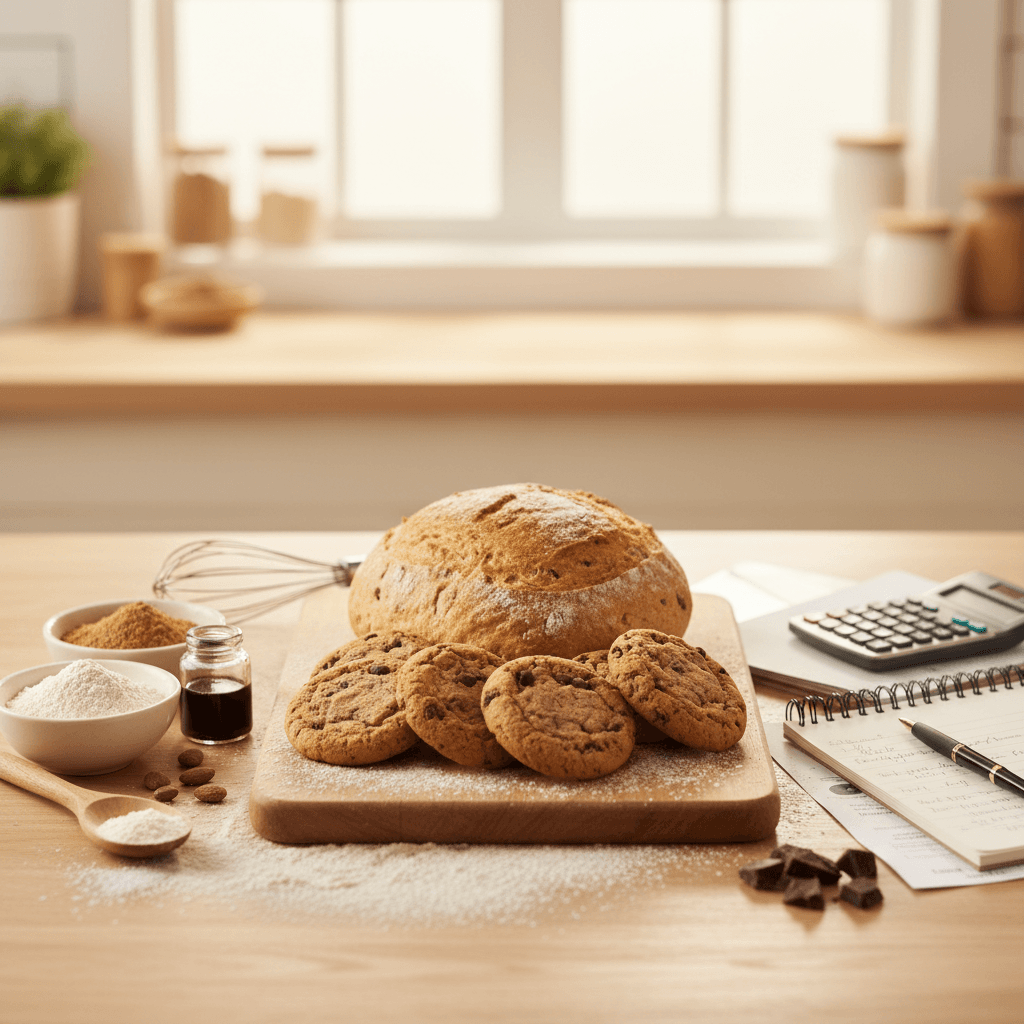
A solid business plan is the difference between a home bakery that thrives and one that fizzles out after a few months. This guide gives you a complete home bakery business plan template you can fill in today, with real examples and practical advice for every section.
Key takeaways
- A home bakery business plan does not need to be 30 pages long — a focused, practical document of 5-10 pages covers everything you need to launch and grow.
- Your plan should include seven core sections: executive summary, products and menu, target market, pricing strategy, startup costs, marketing plan, and financial projections.
- Gluten-free and allergy-friendly niches are among the most profitable home bakery specialties because the market is underserved and customers are willing to pay premium prices.
- Pricing based on cost-plus-margin (not competitor matching) is the single most important financial decision in your plan.
- You do not need a business plan to impress a bank — you need one to keep yourself organized, profitable, and focused.
- Cottage food laws vary by state and directly affect what you can sell, so your plan must account for your specific legal requirements.
Why you need a home bakery business plan
A home bakery business plan forces you to answer the hard questions before you spend money. It is not a formality or a document you write for someone else — it is your roadmap for making real income from baking. Without one, most home bakers undercharge, overbake, and burn out within a year.
Your plan does not need to look like an MBA thesis. It needs to be honest, specific, and something you actually refer back to. Think of it as a living document you update as you learn what sells and what does not.
If you are specifically planning a gluten-free home bakery, a business plan is even more critical. The gluten-free market is underserved in most local areas — there is less competition, customers are fiercely loyal, and they are willing to pay premium prices for baked goods they can trust. Your plan needs to capture that advantage clearly.
The seven sections of a home bakery business plan
Every effective home bakery business plan covers these seven areas. We will walk through each one with examples and the exact questions you need to answer.
| Section | Purpose | Length |
|---|---|---|
| Executive summary | Overview of your bakery concept, goals, and what makes you different | Half a page |
| Products and menu | What you will sell, your signature items, and any dietary specialties | 1-2 pages |
| Target market | Who your ideal customer is and how you will reach them | 1 page |
| Pricing strategy | How you price for profit, not just to cover ingredients | 1 page |
| Startup costs | Equipment, ingredients, packaging, licensing — everything you need to spend before earning | 1-2 pages |
| Marketing plan | How you will get and keep customers | 1 page |
| Financial projections | Revenue targets, monthly expenses, and break-even timeline | 1-2 pages |
Section 1: Executive summary
The executive summary is a half-page snapshot of your entire business. Write it last, even though it goes first. It should answer these questions in plain language:
- What is your bakery called?
- What do you bake and who do you bake for?
- What makes your bakery different from what is already available locally?
- What is your income goal for the first year?
Here is an example: "Sweet Rise Home Bakery is a cottage food bakery based in Austin, Texas, specializing in gluten-free celebration cakes and cupcakes. We serve customers with celiac disease and gluten sensitivities who currently have zero local options for custom decorated cakes. Our goal is to generate $2,000 per month in revenue within six months of launch."
That is it. Short, specific, and clear about what makes you different.
Section 2: Products and menu
This section defines exactly what you will sell. The biggest mistake new home bakers make is trying to offer everything. A focused menu of 5-8 items is far more profitable than a menu of 30.
How to choose your signature products
Start by answering these questions:
- What do people already ask you to bake?
- What can you make consistently well, every single time?
- What is missing in your local market?
- What does your cottage food law allow you to sell?
If you are considering a gluten-free specialty, you have a significant market advantage. Most local bakeries either do not offer gluten-free options or treat them as an afterthought. A dedicated gluten-free home bakery can command 30-50% higher prices because customers know there is no cross-contamination risk. Understanding flour substitutions and how to work with almond flour, brown rice flour, and other gluten-free flours is essential for consistent results.
Sample menu format for your plan
| Product | Size options | Price range | Estimated food cost |
|---|---|---|---|
| Chocolate cupcakes (GF) | 6-pack, 12-pack | $18 - $34 | $4 - $7 |
| Custom celebration cake (GF) | 6-inch, 8-inch, 10-inch | $45 - $95 | $10 - $22 |
| Banana bread loaf (GF) | Standard loaf | $14 | $3.50 |
| Cookie assortment box (GF) | 12-pack, 24-pack | $22 - $40 | $5 - $9 |
| Seasonal scones | 4-pack | $16 | $3 |
Notice the food cost column. Every item on your menu needs to have a clear cost-to-price ratio. We will dig into pricing in section 4.
If you are building out your home bakery kitchen, our guide to professional baking equipment worth investing in covers which upgrades actually change your results and which are not worth the money yet.
Ready to get serious about your home bakery? The free Home Bakery Pro masterclass walks you through getting consistent orders and building a sustainable home bakery — taught by a baker who replaced her full-time salary with home bakery income.
Section 3: Target market
Your target market is not "everyone who likes baked goods." The more specific you get, the easier it is to find customers and charge what your work is worth.
How to define your ideal home bakery customer
Write a brief profile that includes:
- Demographics: Age range, household income, location radius
- Needs: What problem does your baking solve for them? (Dietary restrictions, time savings, special occasions)
- Buying behavior: How often would they order? What is their budget?
- Where they hang out: Facebook groups, farmers markets, school events, local community boards
Example: "Our primary customer is a health-conscious parent aged 30-50 in the north Austin area with a household income above $75,000. They have a family member with celiac disease or gluten sensitivity and currently drive 30+ minutes to find safe baked goods for birthday parties and holidays. They order 1-2 times per month and are willing to spend $40-100 per order."
For gluten-free home bakeries, your target market research often reveals something powerful: there is almost no local competition. Most commercial bakeries cannot guarantee a gluten-free environment, which means your dedicated home kitchen is actually a selling point, not a limitation.
Section 4: Pricing strategy
Pricing is where most home bakeries fail. If you price based on what the grocery store charges or what your friend says "seems fair," you will lose money. Your business plan needs a real pricing formula.
The cost-plus pricing formula
Use this formula for every product:
Price = (Ingredient cost + Packaging cost + Labor cost) x Profit multiplier
Your profit multiplier should be at least 3x for most baked goods, and 4x or higher for specialty items like gluten-free or custom decorated cakes.
| Cost component | Example: GF chocolate cake (8-inch) |
|---|---|
| Ingredients | $12.00 |
| Packaging (box, board, ribbon) | $3.50 |
| Labor (2 hours at $20/hr) | $40.00 |
| Total cost | $55.50 |
| Price at 1.5x markup | $83.25 |
| Rounded selling price | $85.00 |
Notice that labor is included. Your time has value. Many home bakers only calculate ingredient costs and wonder why they feel burned out working for $3 an hour.
When sourcing ingredients, understanding where to splurge and where to save makes a real difference to your margins. Our guide to premium baking ingredients that make a real difference helps you figure out which upgrades your customers will actually taste.
Section 5: Startup costs
Your business plan needs an honest accounting of what you need to spend before you earn your first dollar. Here is a realistic breakdown for a home bakery startup.
Essential equipment and estimated costs
| Item | Estimated cost | Notes |
|---|---|---|
| Stand mixer | $280 - $450 | A KitchenAid Artisan 5-Quart Stand Mixer is the workhorse most home bakers start with |
| Digital kitchen scale | $25 - $50 | An OXO Good Grips 11lb Food Scale is reliable and accurate for recipe scaling |
| Commercial-grade sheet pans (set of 4) | $30 - $50 | Nordic Ware half sheet pans hold up to daily use |
| Cooling racks | $15 - $25 | Get wire racks that fit inside your sheet pans |
| Cake pans (6", 8", 10" sets) | $40 - $80 | Fat Daddio's anodized aluminum pans are the professional standard |
| Packaging supplies (first batch) | $75 - $150 | Boxes, bags, labels, stickers, tissue paper |
| Cottage food license/permit | $0 - $250 | Varies widely by state — some states have no fee |
| Food handler's certification | $10 - $25 | Required in most states, available online |
| Initial ingredient stock | $100 - $200 | Flours, sugars, butter, eggs, leaveners, specialty items |
| Business cards and basic branding | $30 - $75 | Canva for design, Vistaprint or similar for printing |
Estimated total startup cost: $605 - $1,355
This is one of the lowest startup costs of any legitimate business. You likely already own some of this equipment. Our budget vs premium baking equipment comparison can help you decide where to invest now and where to upgrade later.
Ongoing monthly expenses to include in your plan
- Ingredients: $150-400/month depending on order volume
- Packaging: $50-100/month
- Insurance (if required): $20-40/month for a cottage food policy
- Marketing: $0-50/month (most home bakery marketing is free or very low cost)
- Website or ordering platform: $0-30/month
Section 6: Marketing plan
Your marketing plan does not need to be complicated, but it does need to exist. Write down the specific channels you will use and how often you will use them.
Most effective marketing channels for home bakeries
- Word of mouth and referrals: This is the number one driver for most home bakeries. Include a referral incentive in your plan (e.g., $5 off their next order for every new customer they refer).
- Local Facebook groups: Many communities have buy/sell/trade groups, neighborhood groups, and food-specific groups where you can post.
- Farmers markets: If your state allows cottage food sales at markets, this is excellent for building a customer base quickly.
- Instagram: Good for showcasing your work, but do not rely on it as your only channel.
- Repeat customer system: A simple text or email list of past customers is more valuable than 10,000 Instagram followers.
Your plan should include specific, measurable goals: "Get 10 paying customers in month one" is better than "build a social media presence."
Section 7: Financial projections
This is where your plan gets real. You need three numbers: your monthly expenses, your revenue target, and your break-even point.
How to build simple financial projections
Start with a conservative monthly scenario:
| Month | Orders per week | Average order value | Monthly revenue | Monthly expenses | Monthly profit |
|---|---|---|---|---|---|
| Month 1-2 | 2-3 | $45 | $360 - $540 | $250 | $110 - $290 |
| Month 3-4 | 4-6 | $50 | $800 - $1,200 | $350 | $450 - $850 |
| Month 5-6 | 6-8 | $55 | $1,320 - $1,760 | $400 | $920 - $1,360 |
| Month 7-12 | 8-12 | $60 | $1,920 - $2,880 | $450 | $1,470 - $2,430 |
These are realistic numbers for a home bakery that is actively marketing and building a repeat customer base. The key insight: your average order value should increase over time as you add premium products and customers trust you enough to order more.
Your break-even point is when your cumulative revenue exceeds your startup costs plus cumulative monthly expenses. For most home bakeries with the startup costs above, that happens within 2-4 months.
Filled-in sample: Sweet Hearth Home Bakery
Here is a complete, fictional example you can adapt. The numbers are realistic for a 2026 home bakery operating under cottage food laws in a moderate-cost-of-living US state. Swap in your own details.
1. Executive summary
Sweet Hearth Home Bakery is a cottage food operation based in Austin, Texas, specializing in scratch-made cookies, brownies, and seasonal pies. The owner has 6+ years of home baking experience and is launching with $1,291 in self-funded capital. Target revenue in year one is $18,000–$24,000 part-time (10–15 hours per week of active baking), serving busy professionals, gift-givers, and small office orders within a 15-mile delivery radius. The bakery is licensed under Texas Cottage Food Law and operates from a dedicated kitchen workspace with no employees in year one.
2. Products and menu
Three core products at launch, with seasonal rotations:
- Brown butter chocolate chip cookies — $24/dozen (signature item)
- Salted fudge brownies — $28 per 9-square pan
- Seasonal pies — $32 each (apple in fall, pecan for holidays, key lime in summer)
Custom orders (birthday cookie boxes, corporate gift trays) priced per quote with a $50 minimum. Menu intentionally narrow at launch to streamline production and ingredient buying.
3. Target market
Primary: working professionals aged 28–55 in Austin who order gift items 4–6 times per year (birthdays, holidays, thank-yous) and value scratch-made over store-bought. Secondary: small businesses (10–50 employees) ordering quarterly for client gifting and office events. Tertiary: home cooks who want a special-occasion dessert without baking themselves.
4. Pricing strategy
Cost-plus formula at a 2.5× retail multiplier (side-hustle pricing tier):
- Brown butter chocolate chip cookies, per dozen: ingredients $3.20 + labor $5.00 + overhead $1.40 = $9.60 cost × 2.5 = $24
- Salted fudge brownies, per 9-square pan: ingredients $4.10 + labor $5.50 + overhead $1.60 = $11.20 cost × 2.5 = $28
- Seasonal pie: ingredients $5.80 + labor $6.50 + overhead $1.80 = $14.10 cost × 2.5 ≈ $32 (rounded)
Prices reviewed quarterly. Minimum order $24. Delivery fee $5 within 10 miles, $10 within 15 miles.
5. Startup costs
- Cottage food permit (Texas): $0
- Food handler's certification: $15
- Stand mixer (used, KitchenAid Classic): $180
- Digital scale, half sheet pans (4), parchment, mixing bowls, basic tools: $220
- Initial ingredient inventory: $150
- Packaging supplies (boxes, labels, ribbon — first 100 orders): $180
- Domain + website builder (1 year): $216
- Liability insurance (annual): $240
- Branding (logo, business cards, design tools): $90
Total startup investment: $1,291. Self-funded, no loans.
6. Marketing plan
First 90 days focuses on direct outreach and one strong content channel — no paid ads.
- Direct outreach (weeks 1–4): personally message 50 contacts (friends, ex-coworkers, parents from kids' school) with a launch offer — first dozen $18 instead of $24.
- Local Facebook groups (ongoing): 1 post per week in 3 neighborhood groups, featuring specials and seasonal items.
- Instagram (single channel): 3 posts per week — finished product photos, behind-the-scenes, customer reactions. Goal: 500 followers by end of year one.
- Email list (from month 1): capture every customer email. Send 1 monthly update with new menu items and pre-order links.
- Repeat customer focus (ongoing): handwritten thank-you note in every order; loyalty bonus of a free dozen on the 12th order.
7. Financial projections (year 1)
- Months 1–3: ~$400/month average revenue (launch + friends and family). Net after costs: ~$180/month.
- Months 4–6: ~$900/month as repeat customers and referrals build. Net: ~$520/month.
- Months 7–9: ~$1,500/month with first corporate gift orders and consistent weekly customers. Net: ~$900/month.
- Months 10–12: ~$2,200/month including holiday peak (November–December = 35% of yearly revenue). Net: ~$1,400/month.
Year 1 totals: approx. $18,600 revenue, $9,000 costs, $9,600 net before income tax. Break-even on the $1,291 startup investment: month 3.
Year 2 target: $36,000 revenue at ~15 hrs/week, with 60% from repeat customers and 25% from corporate gifting.
Putting your plan together
You do not need fancy software to write your business plan. A Google Doc works perfectly. Here is the process:
- Start with sections 2-7 first. Fill in the details for your specific bakery, market, and state laws.
- Write the executive summary last — it is a summary of everything else.
- Keep the total document to 5-10 pages. Longer is not better.
- Review and update it monthly for the first six months, then quarterly after that.
- Share it with one trusted person (a spouse, business mentor, or fellow baker) for feedback.
If you are stocking your pantry for the first time, our guide on how to stock a baking pantry on a budget will help you get everything you need without overspending on ingredients you will not use.
Tips for gluten-free home bakery business plans
If you are planning a gluten-free home bakery specifically, your business plan should emphasize several unique advantages:
- Market gap: Document how many (or how few) gluten-free options exist within a 20-mile radius. In most areas, the answer is almost none.
- Premium pricing: Gluten-free customers expect to pay more and are happy to do so for quality products they can trust. Your plan should reflect pricing 30-50% above conventional equivalents.
- Customer loyalty: Once a celiac or gluten-sensitive customer finds a baker they trust, they rarely switch. Your repeat order rate will be significantly higher than a conventional bakery.
- Cross-contamination protocols: Include your specific procedures for preventing cross-contamination. This is both a safety requirement and a marketing advantage. Our gluten-free baking guide covers the fundamentals you need to get right.
- Ingredient sourcing: Document your certified gluten-free ingredient suppliers. Customers will ask, and having this in your plan shows you take it seriously.
Frequently asked questions
Do I need a business plan for a cottage food bakery?
You are not legally required to have a business plan for a cottage food bakery in any state. However, having one dramatically increases your chances of actually making money. A plan forces you to calculate your real costs, set profitable prices, and identify your target customers before you invest time and money. Even a simple 5-page plan is far better than winging it.
How much does it cost to start a home bakery business?
Most home bakeries can launch for $600-$1,400, depending on what equipment you already own. The biggest expenses are a quality stand mixer ($280-$450), initial ingredient stock ($100-$200), packaging supplies ($75-$150), and any required licensing fees ($0-$250). You can start on the lower end by using equipment you already have and scaling up as revenue comes in. Our baking essentials on a budget guide covers affordable options for getting started.
What should I include in a home bakery business plan?
A complete home bakery business plan includes seven sections: executive summary, products and menu, target market analysis, pricing strategy, startup costs, marketing plan, and financial projections. Each section should be specific to your bakery — not generic templates copied from the internet. Include real numbers for your ingredients, your local market, and your state's cottage food laws.
Is a gluten-free home bakery more profitable than a regular one?
In most local markets, yes. Gluten-free home bakeries can charge 30-50% more than conventional bakeries because the demand far exceeds supply. Customers with celiac disease or gluten sensitivities have very few safe options and are willing to pay premium prices for baked goods from a dedicated gluten-free kitchen. Customer loyalty is also significantly higher — once they find a trusted baker, they keep ordering.
How do I price my home bakery products?
Use a cost-plus pricing formula: add up your ingredient cost, packaging cost, and labor cost (pay yourself at least $20/hour), then multiply by a profit factor of at least 3x. For specialty items like gluten-free or custom cakes, use a 4x multiplier or higher. Never price based on what grocery stores charge — your products are handmade, custom, and far superior in quality.
Get your first customers (the hardest part)
Getting your first customers is the hardest part of starting a home bakery. This free masterclass from a baker who replaced her full-time salary with home bakery income shows you exactly how to get consistent repeat orders — without relying on social media.

Written by
Co-founder, BakingSubs
Co-founder of BakingSubs, where he turns the science of ingredient substitutions into tested, reliable guidance for home bakers.
Related Posts
Gluten-Free Flour Weight Chart: Grams per Cup for 9 Major Brands (and Why the Spread Is Over 20%)
Best Low Carb Tortillas (2026): 6 Brands Compared by Net Carbs
Best Sugar-Free Cake Mix and Brownie Mix (2026): 14 Options Ranked by Net Carbs, Sweetener, and Price
Bake with Confidence
See all
Confident Gluten-Free Baker Toolkit
The science-based system that replaces gluten's seven invisible jobs so your baking turns out soft, fluffy, and foolproof — every time.

Gluten-Free Recipe Vault
Instant access to our complete library of proven gluten-free recipes — no waiting, no guesswork, just results that work tonight.

Fix Your Gluten-Free Bread
Learn the 3-step formula to make bread rise and stay soft, discover why your loaves collapse, and get a tested sandwich bread recipe that actually works.