

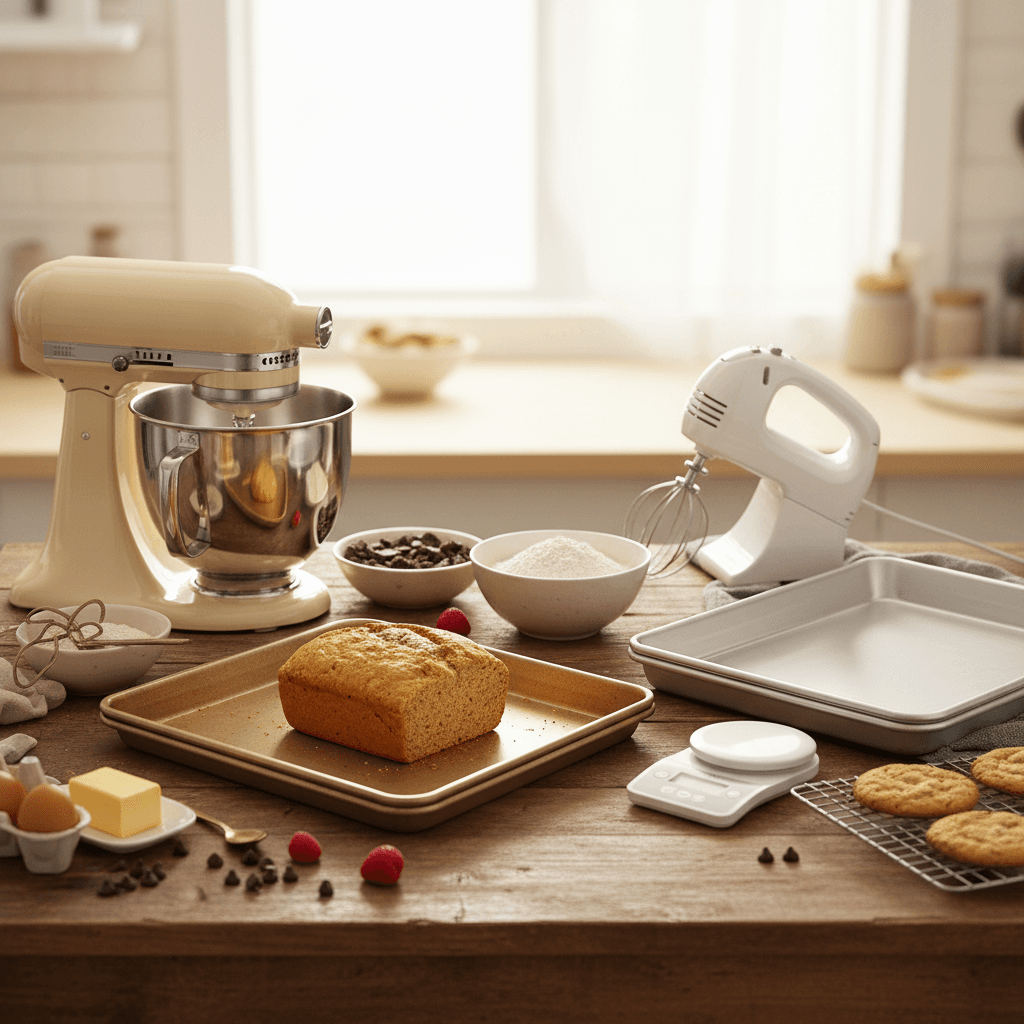
Not every expensive baking tool is worth the price, and not every budget option is a compromise. We compared common budget and premium baking equipment head-to-head so you can spend wisely and bake better.
Key takeaways
- Premium stand mixers are worth the investment for gluten-free baking because they handle thick, sticky doughs that burn out cheap motors.
- Budget sheet pans and cooling racks perform nearly identically to premium versions.
- A quality digital scale is one of the best investments you can make, but you do not need to spend more than $30.
- Silicone baking mats are one category where budget and premium options are virtually indistinguishable.
- Oven thermometers are universally cheap and universally necessary, regardless of your oven's price tag.
- Investing in a few key premium items while saving on the rest gives you the best results per dollar spent.
Why this comparison matters for gluten-free bakers
Gluten-free batters and doughs behave differently from their wheat-based counterparts. They tend to be stickier, wetter, and more sensitive to temperature inconsistencies. That means your equipment has to work harder in some areas and barely matters in others. Across price points, the pattern is fairly consistent: a few categories genuinely reward premium spending, while most do not.
If you are building out a gluten-free baking setup, our Confident Gluten-Free Baker Toolkit walks you through exactly which tools and ingredients to prioritize so you are not guessing.
Stand mixers: KitchenAid Artisan vs Hamilton Beach budget stand mixer
The stand mixer is the single biggest equipment investment most home bakers make, and it is also the category where premium matters most. Gluten-free bread doughs, in particular, demand sustained mixing at medium-high speeds to properly hydrate starches and activate binders like xanthan gum. Budget motors overheat and stall under that load.
The head-to-head breakdown
| Feature | Hamilton Beach 63326 (~$70) | KitchenAid Artisan 5-Qt (~$350) |
|---|---|---|
| Motor wattage | 300W | 325W (direct drive) |
| Bowl capacity | 4 quarts | 5 quarts |
| Mixing action | Planetary | Planetary (59-point) |
| Handling thick GF dough | Struggles, motor heats up | Handles it without strain |
| Durability | Plastic gears, 1-2 year lifespan with heavy use | Metal gears, 10+ year lifespan |
| Attachment ecosystem | Limited | Extensive (pasta, grain mill, etc.) |
The verdict
Premium wins decisively. The KitchenAid Artisan is the better long-term investment by a wide margin. If you bake gluten-free bread even once a month, a budget stand mixer will frustrate you within a year. The Hamilton Beach is fine for occasional cookie doughs and cake batters, but it cannot handle the demands of serious gluten-free baking. If budget is truly tight, consider a refurbished KitchenAid from their official outlet before buying a budget brand new.
Digital kitchen scales: budget vs premium
A kitchen scale is non-negotiable for gluten-free baking. Measuring flour by volume can throw off your ratios by 20% or more, which is the difference between a tender crumb and a dry, crumbly disaster. The good news is that you do not need to spend much to get an excellent scale.
The head-to-head breakdown
| Feature | Amazon Basics Kitchen Scale (~$12) | OXO Good Grips 11lb Scale (~$55) |
|---|---|---|
| Accuracy (1g increments) | Yes | Yes |
| Max capacity | 11 lbs | 11 lbs |
| Pull-out display | No | Yes |
| Tare function | Yes | Yes |
| Build quality | Adequate plastic | Sturdy, easy-clean surface |
| Reading visibility with large bowl | Blocked easily | Pull-out display stays visible |
The verdict
Budget works, but premium is a nice quality-of-life upgrade. Both scales are accurate to the gram, which is what actually matters for baking performance. The OXO Good Grips pull-out display is genuinely useful when you have a big mixing bowl sitting on top, but the Amazon Basics scale does the core job just fine. If you are watching your budget, this is a safe place to save.
Sheet pans: Great Value vs Nordic Ware
Sheet pans take a beating, and gluten-free cookies and biscuits are especially sensitive to hot spots and warping. A warped pan means uneven browning, which is already a challenge when you are working with rice flour blends that brown differently than wheat.
The head-to-head breakdown
| Feature | Great Value half-sheet pan (~$8) | Nordic Ware Natural Aluminum (~$18) |
|---|---|---|
| Material | Aluminum-coated steel | Pure aluminum |
| Warping resistance | Warps within months | Stays flat for years |
| Even heat distribution | Decent when new | Consistently excellent |
| Durability | Coating chips over time | Develops patina, lasts decades |
The verdict
Premium wins on durability and performance. The Nordic Ware half-sheet pan is one of those rare items that costs only slightly more but lasts dramatically longer. A warped sheet pan is not just annoying; it actively sabotages your results. At roughly double the price of a budget pan but ten times the lifespan, this is an easy call. If you are shopping for baking gear at big-box stores, check out our guide to gluten-free products at Walmart to pair your equipment shopping with pantry stocking.
Silicone baking mats: budget vs Silpat
Silicone baking mats prevent sticking without parchment waste, and they are especially helpful for gluten-free cookies that tend to spread and stick more than wheat-based ones. This is one of the most surprising categories in our comparison.
The head-to-head breakdown
| Feature | Amazon Basics silicone mat (~$9 for 2) | Silpat Premium (~$25 for 1) |
|---|---|---|
| Non-stick performance | Excellent | Excellent |
| Heat tolerance | Up to 480 degrees F | Up to 480 degrees F |
| Thickness | Slightly thinner | Slightly thicker |
| Durability | Good for 1-2 years of regular use | Good for 3-5 years of regular use |
| Effect on baking results | Identical | Identical |
The verdict
Budget wins. There is no meaningful difference in baking results between a budget silicone mat and a Silpat. The Amazon Basics mats may wear out a bit sooner, but at roughly one-fifth the per-mat cost, you can replace them multiple times and still come out ahead. Save your money here.
Mixing bowls: melamine sets vs stainless steel
Mixing bowls seem like a boring topic until you realize how much time you spend with them. For gluten-free baking, you often need more bowls than conventional baking because you are blending dry ingredients separately, whisking binders, and sometimes tempering ingredients to avoid gummy centers.
The verdict
Premium stainless steel wins for serious bakers. A good set of stainless steel mixing bowls with non-slip bases costs around $30-40 and lasts forever. Budget melamine or plastic bowls stain, absorb odors, and cannot go from fridge to oven prep without cracking. The Cuisinart stainless steel set is a good example, with nested storage and non-slip bottoms. That said, a basic set of budget stainless steel bowls from any brand will outperform fancy plastic ones, so do not overthink the brand here.
Oven thermometers: the one category where everyone should go budget
Every oven lies about its temperature. Even expensive ovens can be off by 25 degrees or more, and that kind of variance wreaks havoc on gluten-free baked goods that depend on precise temperatures for proper rise and structure. An oven thermometer fixes this problem for about three dollars.
The Rubbermaid oven thermometer and similar budget models are just as accurate as pricier digital versions for stationary oven readings. This is the single best return on investment in any baker's kitchen. Buy one, hang it from your oven rack, and calibrate your baking accordingly. If you are troubleshooting poor rise in your gluten-free bakes, an inaccurate oven is often the hidden culprit.
Measuring cups and spoons: does premium matter?
For dry measuring cups and spoons, the honest answer is that premium barely matters as long as the measurements are accurate. Where premium does help is with liquid measuring cups. A heavy-duty glass measuring cup like the Pyrex 2-cup is more accurate and durable than a flimsy plastic one, and the difference is only a few dollars.
Bottom line: Buy budget dry measuring cups and spoons. Spend a little more on a glass liquid measuring cup. But honestly, if you are using a kitchen scale (and you should be), you will barely touch measuring cups at all.
The complete budget vs premium verdict
Here is our overall recommendation for where to save and where to splurge, based on how each category holds up in a gluten-free kitchen.
| Equipment | Our recommendation | Why |
|---|---|---|
| Stand mixer | Go premium | Thick GF doughs destroy budget motors |
| Digital scale | Budget is fine | Accuracy is identical at every price point |
| Sheet pans | Go premium | Warping ruins even baking |
| Silicone mats | Budget wins | No meaningful difference in baking results |
| Mixing bowls | Mid-range stainless steel | Durability matters, brand does not |
| Oven thermometer | Budget always | A $3 thermometer is just as accurate |
| Measuring cups | Budget (use a scale instead) | Scales are more accurate anyway |
The pattern is clear: spend on items with motors and items that need to stay flat under high heat. Save on everything else. For more equipment recommendations tailored to gluten-free baking, see our reviews of the best countertop ovens for baking and the best proofing boxes for bread.
Frequently asked questions
Is a KitchenAid mixer worth it for gluten-free baking?
Yes, a KitchenAid stand mixer is one of the best investments for gluten-free baking. Gluten-free bread and pizza doughs are thick and sticky, requiring sustained mixing that burns out budget motors. The KitchenAid's metal gears and direct-drive motor handle these doughs without overheating, and the machine typically lasts over a decade.
Do I need an expensive kitchen scale for baking?
No, a budget kitchen scale works just as well as a premium one for baking accuracy. Both measure to the gram, which is what matters. The main advantage of a premium scale like the OXO Good Grips is the pull-out display, which stays visible under large bowls. But a $12 scale gives you the same measurement precision.
What baking equipment should I buy first on a tight budget?
Start with a digital kitchen scale, an oven thermometer, and a quality half-sheet pan. These three items have the biggest impact on baking results per dollar spent. A scale ensures accurate measurements, the thermometer fixes oven inconsistencies, and a good sheet pan prevents warping and uneven browning. You can find more starter guidance in our gluten-free baking guide.
Are expensive silicone baking mats better than cheap ones?
Expensive silicone baking mats like Silpat produce essentially identical baking results to budget options from Amazon Basics. The premium mats may last slightly longer, but at five times the price per mat, budget versions are the smarter buy. Replace them every year or two and you will still spend less overall.
Does cheap bakeware affect gluten-free baking results?
It depends on the item. Cheap sheet pans warp and create hot spots that cause uneven browning, which is a real problem for gluten-free cookies and biscuits. Cheap stand mixers struggle with thick doughs. But cheap scales, silicone mats, and measuring tools perform just as well as premium versions. Focus your spending on the items that directly affect heat distribution and mixing power.

Written by
Co-founder, BakingSubs
Co-founder of BakingSubs, where he turns the science of ingredient substitutions into tested, reliable guidance for home bakers.
Related Posts
Bake with Confidence
See all
Confident Gluten-Free Baker Toolkit
The science-based system that replaces gluten's seven invisible jobs so your baking turns out soft, fluffy, and foolproof — every time.

Gluten-Free Recipe Vault
Instant access to our complete library of proven gluten-free recipes — no waiting, no guesswork, just results that work tonight.

Fix Your Gluten-Free Bread
Learn the 3-step formula to make bread rise and stay soft, discover why your loaves collapse, and get a tested sandwich bread recipe that actually works.