

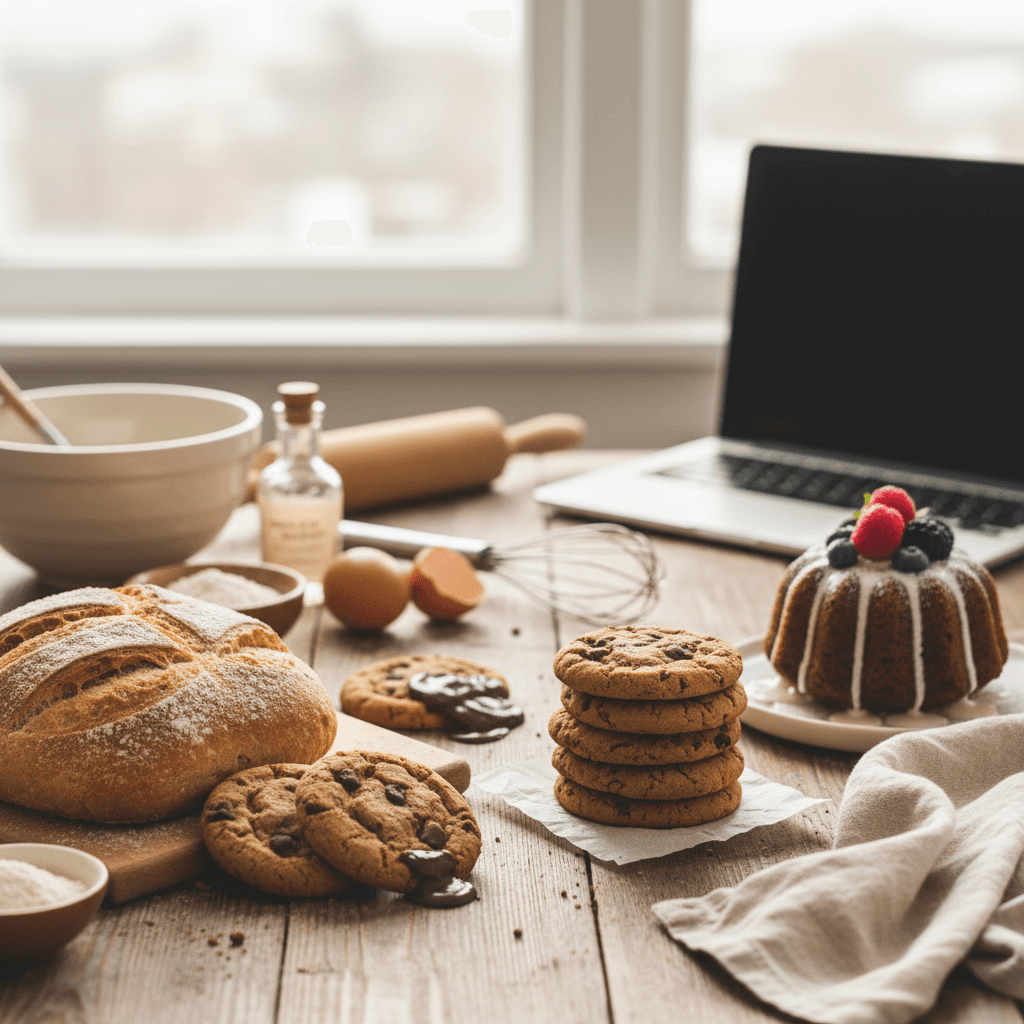
Finding your first home bakery customers can feel like shouting into the void, but it does not have to be that hard. Here are 15 practical strategies that real home bakers use to build a steady stream of orders — no massive social media following required.
Key takeaways
- Word of mouth from friends, family, and coworkers is the fastest way to get your first 10-20 customers, and you should actively ask for referrals rather than waiting for them.
- Farmers markets and local events let you put product directly into people's hands, which converts browsers into repeat customers far better than any online ad.
- Specializing in a niche like gluten-free, vegan, or allergen-friendly baking gives you a massive advantage because those customers are underserved and fiercely loyal.
- A simple website or ordering page builds trust and makes it easy for people to actually place orders — friction kills sales.
- Consistent quality and professional packaging turn one-time buyers into repeat customers who do your marketing for you.
- You do not need thousands of followers on social media to build a profitable home bakery — most successful home bakers get the majority of their orders through local connections and repeat business.
Start with your existing network (it is bigger than you think)
Your first customers are almost always people you already know. This is not a consolation prize — it is actually the most effective marketing channel for a new home bakery because people buy baked goods from people they trust.
Here is how to work your network strategically rather than just hoping people notice:
- Make a direct announcement. Text or message your friends, family, and coworkers individually. A personal message like "Hey, I'm starting a home bakery and would love for you to try my cinnamon rolls — can I bring you a sample?" converts 10x better than a generic social media post.
- Bring samples to work. If you or your partner works in an office, bring a tray of your best items with business cards. Office workers are hungry, they talk, and they have events that need baked goods.
- Ask for referrals explicitly. After someone orders and loves it, say "I'd really appreciate it if you'd tell a friend or two. I'm building my business through word of mouth." Most people are happy to help — they just need to be asked.
- Tap into parent groups. School events, sports teams, PTA meetings, and playdate circles all need baked goods regularly. Volunteer to bring something amazing to the next event and leave cards.
Working your existing network intentionally can be enough to fill your early order book. Do not skip this step thinking it is too small — it is your foundation.
Why specializing in gluten-free or allergen-friendly baking is a massive advantage
If you are already comfortable with gluten-free baking, you are sitting on a goldmine that most home bakers overlook. Here is why: gluten-free customers are chronically underserved in most local markets. Most bakeries either do not offer gluten-free options or treat them as an afterthought, which means the quality is mediocre at best.
This creates a perfect opportunity for you:
- Less competition. While dozens of home bakers in your area might sell cupcakes and cookies, very few can deliver gluten-free baked goods that actually taste incredible.
- Higher prices. Gluten-free customers expect to pay more and are willing to because they know specialty ingredients cost more. You can typically charge 20-40% more than conventional baked goods.
- Extreme loyalty. When someone with celiac disease or a gluten sensitivity finds a baker they trust, they do not shop around. They tell every person in their support group, their doctor, and their friends. One happy gluten-free customer can send you five more.
- Built-in communities. Celiac and gluten-free support groups exist in almost every area — both online and in person. These are concentrated groups of your ideal customers.
If you are still building your gluten-free baking skills, our guide to stocking a gluten-free baking pantry on a budget is a great place to start. And if you are already baking gluten-free, consider making it the centerpiece of your brand rather than just one option on your menu.
If you want to get serious about building a home bakery that actually generates consistent income, the free Home Bakery Pro masterclass walks you through exactly how one baker replaced her full-time salary with home bakery income. It is worth watching before you invest a lot of time and money into strategies that may not work.
Farmers markets and local events: putting product in people's hands
Farmers markets are one of the highest-converting customer acquisition channels for home bakers because people can see, smell, and taste your products before buying. That sensory experience is something no Instagram post can replicate.
How to get started at farmers markets
- Research your local markets. Most cities have multiple farmers markets with different vibes, foot traffic, and vendor fees. Visit several as a customer first to see which ones attract your target buyers.
- Apply early. Popular markets fill up months in advance. Many open applications in January or February for the spring/summer season.
- Start with a small booth. You do not need an elaborate setup. A clean table, a tablecloth, clear signage, and samples are enough to start. Vendor fees typically range from $25-75 per market day.
- Offer samples generously. Cut your best items into small pieces and offer them freely. People who taste something delicious almost always buy.
- Collect contact information. Have a simple sign-up sheet or QR code for a text list or email list. This turns a one-time market visitor into a repeat customer who can order from you directly.
Other local events worth targeting
- Church bazaars and community fairs
- School fundraisers (offer to donate a portion of proceeds)
- Local craft shows and holiday markets
- Neighborhood block parties
- Office holiday parties and corporate events
The key insight here is that every in-person interaction is worth 100 social media impressions. Prioritize getting your product into people's mouths.
Build a simple online ordering system
You do not need a fancy website, but you absolutely need some way for people to find you and place orders without friction. When someone hears about your bakery from a friend, the first thing they will do is search for you online. If they cannot find anything — or if the only way to order is to DM you on Instagram — you will lose a significant percentage of potential customers.
Here are your options from simplest to most robust:
| Platform | Cost | Best for | Limitations |
|---|---|---|---|
| Google Business Profile | Free | Being found in local search | No ordering built in |
| Square Online | Free tier available | Simple ordering with payment processing | Limited customization on free plan |
| Shopify | $39/month | Full online store with delivery options | Monthly cost adds up |
| BakerInk or CakeBoss | $15-30/month | Bakery-specific ordering and scheduling | Smaller platforms, fewer integrations |
| Simple Google Form + Venmo | Free | Absolute beginners testing demand | Not professional long-term |
At minimum, set up a free Google Business Profile. This is how people find local businesses, and it is completely free. Add your hours, photos of your products, and a way to contact you. This single step will bring you customers who are actively searching for home bakers in your area.
Use social media strategically (not obsessively)
Social media can help you get customers, but it should not be your only strategy — or even your primary one. It is common for home bakers to spend hours creating content for Instagram while neglecting the local, in-person strategies that actually fill their order books.
That said, here is how to use social media effectively without it consuming your life:
What actually works on social media for home bakers
- Process videos. Short clips of you frosting a cake, pulling bread from the oven, or decorating cookies. These perform well because they are satisfying to watch and showcase your skill.
- Before and after shots. Raw dough to finished product. People love transformations.
- Customer testimonials. Screenshot a text from a happy customer (with permission) and share it. Social proof is powerful.
- Local hashtags. Use hashtags specific to your city or neighborhood, not generic ones like #homebaker. You want local people finding you, not bakers in another state.
- Menu and ordering posts. Make it crystal clear what you sell, how to order, and when you are available. Post this regularly because new followers will not scroll back through your feed.
What does not work (and wastes your time)
- Posting daily just to maintain an algorithm — quality over quantity
- Spending hours on Reels editing when you could be baking and selling
- Comparing your account to bakers with 50K followers — their business model is different from yours
- Relying solely on social media for orders
Aim for 3-4 posts per week maximum. Spend the rest of your marketing time on the strategies in this article that put you directly in front of local buyers.
Partner with local businesses
One of the most underused strategies for home bakers is partnering with complementary local businesses. These partnerships can send you a steady stream of customers with very little ongoing effort.
- Coffee shops without in-house baking. Many independent coffee shops would love to sell fresh baked goods but do not have the kitchen space or staff to make them. Approach them with samples and a wholesale price list. Even if they only order a few dozen items per week, it is consistent revenue and exposure.
- Wedding and event planners. Introduce yourself to local event planners and offer to be their go-to baker for smaller events. Bring a sample box with your best items and a price sheet.
- Florists and gift shops. Some florists and boutique gift shops sell add-on items like baked goods, especially around holidays. Your premium ingredients become a selling point here — customers shopping at boutiques expect quality.
- Gyms, yoga studios, and health food stores. If you specialize in gluten-free, keto, or health-conscious baking, these are perfect partners. The gluten-free baking essentials you already use position you perfectly for health-conscious consumers.
- Real estate agents. Some agents give closing gifts to clients. A box of beautiful baked goods with your card is a memorable gift that introduces you to new potential customers.
Packaging and presentation that turns buyers into repeat customers
How your products look when a customer receives them matters more than most home bakers realize. Professional-looking packaging does three things: it justifies your prices, it makes customers feel good about their purchase, and it makes your products Instagram-worthy (which means free marketing when customers share photos).
You do not need to spend a fortune on packaging. Here is what we recommend:
- Branded stickers. Order custom stickers with your bakery name and logo from Sticker Mule or Avery. A roll of 250 stickers costs around $30-50 and instantly makes any plain box look professional.
- Quality boxes and bags. Kraft bakery boxes with windows (around $20-25 for a pack of 50) let customers see the product while keeping it protected. They look clean and professional.
- Tissue paper and ribbon. A sheet of tissue paper and a simple ribbon or twine tie elevates the unboxing experience dramatically for pennies per order.
- Clear ingredient labels. Especially important if you bake gluten-free or allergen-friendly. A clear label listing ingredients builds trust and is often required by cottage food laws.
- Business cards in every order. Include a card with your contact info, social media handle, and ordering instructions. Make it easy for the recipient to find you again or share your info with a friend.
Think of every order as a miniature marketing campaign. The customer is going to open it, probably in front of other people, and their reaction in that moment determines whether they order again and tell others about you.
Leverage reviews and testimonials
Social proof is the single most powerful marketing tool for a home bakery. When a potential customer sees that real people love your products, it removes the risk of trying something new. Here is how to systematically collect and use testimonials:
- Ask after every order. Send a quick text or message the day after delivery: "How did you enjoy the brownies? I'd love to hear your feedback!" Most people will respond positively.
- Ask permission to share. When someone sends you a glowing text, ask "Would you mind if I shared this on my page? It really helps my small business." Almost everyone says yes.
- Post testimonials regularly. Share customer reviews on your social media, your website, and your Google Business Profile. A steady stream of positive reviews builds credibility faster than any ad.
- Encourage Google reviews. Send customers a direct link to leave a Google review. These show up when people search for bakers in your area and carry enormous weight.
- Create a "wall of love." Dedicate a section of your website or a social media highlight to customer testimonials. New visitors will check this before ordering.
Price your products so you can actually sustain this
Underpricing is the number one reason home bakers burn out and quit. If you are not charging enough to cover your ingredients, time, packaging, and overhead, you are running a very expensive hobby — not a business.
Here is a simple pricing framework:
| Cost component | How to calculate | Example (dozen cookies) |
|---|---|---|
| Ingredients | Actual cost of everything in the recipe | $4.50 |
| Packaging | Box, sticker, tissue, card | $1.50 |
| Labor | Your time at a fair hourly rate ($20-30/hr) | $8.00 (30 min) |
| Overhead | Utilities, equipment wear, marketing (15-20% of above) | $2.10 |
| Total cost | $16.10 | |
| Retail price (2x markup) | $32.00 |
That $32 for a dozen specialty cookies might feel high, but it is completely in line with what artisan and specialty bakeries charge. If you are baking gluten-free with premium ingredients, your customers understand that quality costs more. Do not apologize for your prices — own them.
Create a menu that drives repeat orders
A smart menu is not just a list of everything you can bake. It is a strategic tool that makes ordering easy, encourages repeat purchases, and keeps your workload manageable.
- Start with 5-8 core items. These should be your absolute best products — the ones that make people's eyes roll back. Resist the urge to offer 30 things. A focused menu lets you batch efficiently and maintain consistent quality.
- Rotate seasonal specials. Add 1-2 seasonal items each month to give repeat customers a reason to order again. Pumpkin everything in fall, peppermint in winter, lemon in spring.
- Offer a "baker's choice" box. A curated assortment at a set price point ($25, $40, etc.) makes ordering effortless for customers who do not want to decide. It also gives you flexibility to use what you have on hand.
- Build in subscription options. A weekly bread delivery or monthly cookie box creates predictable recurring revenue. Even 10 subscribers at $30/month is $300 of guaranteed income.
If you are building a gluten-free menu, having a solid understanding of almond flour, cassava flour, and other specialty flours will help you create items that stand out from the mediocre gluten-free options most people are used to.
Invest in the right equipment without overspending
You do not need a commercial kitchen to start a home bakery, but you do need reliable equipment that can handle increased volume without breaking down. The good news is that you can start with equipment you probably already own and upgrade strategically as orders grow.
Our guide to professional baking equipment worth investing in covers this in detail, but here are the essentials for a home bakery specifically:
- A stand mixer that can handle double batches. The KitchenAid Professional 600 (around $350-400) is the workhorse of most home bakeries. The 6-quart bowl handles double batches of most recipes.
- A reliable digital scale. Weighing ingredients is non-negotiable for consistency, especially in gluten-free baking where ratios matter more. The OXO Good Grips 11lb food scale (around $50) is a reliable option.
- Commercial-grade sheet pans. Thin, flimsy pans warp and create uneven baking. Nordic Ware commercial half sheet pans (around $15 each) last forever and bake evenly.
- A second oven thermometer. Home ovens lie about their temperature. A $10 oven thermometer ensures your products come out consistent every single time.
Get found in local search results
When someone in your area searches "home bakery near me" or "gluten-free baker in [your city]," you want to show up. Local SEO is free and incredibly effective for home bakeries. Here is what to do:
- Claim and optimize your Google Business Profile. Add your business name, category (bakery), service area, hours, photos, and a detailed description that includes what you specialize in.
- Add photos regularly. Google favors profiles with fresh, high-quality photos. Upload new product photos weekly.
- Collect Google reviews. The number and quality of your reviews directly impacts how high you rank in local search. Make asking for reviews part of your post-delivery process.
- List yourself in local directories. Yelp, Nextdoor, and local Facebook groups all help you show up when people search for bakers in your area.
- Use location-specific keywords. If you have a website, make sure it mentions your city and neighborhood naturally. "Gluten-free home bakery in Austin, TX" is the kind of phrase that drives local traffic.
Join online communities where your customers already are
Your ideal customers are already gathering in online communities — you just need to show up and be genuinely helpful before you ever mention your business.
- Local Facebook groups. Neighborhood groups, buy/sell/trade groups, and community groups are goldmines. When someone posts asking for bakery recommendations, birthday cake ideas, or where to find gluten-free treats, you can respond helpfully and mention your business.
- Celiac and gluten-free support groups. If you bake gluten-free, these groups are filled with people who are desperately looking for safe, delicious options. Be a helpful member first, and business will follow naturally.
- Nextdoor. This neighborhood-based platform is perfect for home bakeries because it is inherently local. Post about your business in the business section and respond to relevant conversations.
- Local subreddits and community forums. Many cities have active Reddit communities or local forums where people ask for food recommendations.
The key rule for all of these: give value first, sell second. Answer questions, share tips, be a real community member. People buy from people they like and trust.
Offer strategic promotions (without devaluing your products)
Discounts can be a useful tool for getting new customers, but you need to use them carefully. Constant discounting trains people to wait for sales and devalues your work. Here are promotions that attract customers without undermining your pricing:
- First-order bonus. Instead of a discount, add a free sample of another product to first orders. This introduces customers to more of your menu and costs you very little.
- Referral rewards. Give existing customers a free item or credit when they refer someone who places an order. This turns every happy customer into a salesperson.
- Holiday pre-order specials. Offer a small discount (10%) for orders placed by a certain date. This helps you plan production and guarantees revenue.
- Bundle deals. A "party pack" or "gift box" at a slight discount per item encourages larger orders while increasing your total revenue per transaction.
Track what is working and double down
Once you have been using several of these strategies for a few weeks, pay attention to where your customers are actually coming from. Ask every new customer how they heard about you and keep a simple log. You might discover that farmers markets are your best channel, or that one Facebook group sends you more orders than everything else combined.
Once you know what works, invest more time and energy there. Stop spending time on strategies that are not producing results. A home bakery has limited hours, and your marketing time is just as valuable as your baking time.
Frequently asked questions
How long does it take to get consistent customers for a home bakery?
Most home bakers who actively market themselves using the strategies above start getting regular orders within 4-8 weeks. Building a fully booked schedule typically takes 3-6 months of consistent effort. The bakers who get there fastest are the ones who specialize in a niche (like gluten-free) and work their local network aggressively from day one.
Do I need social media to get home bakery customers?
No, social media is helpful but not required. Many successful home bakers get the majority of their orders through word of mouth, farmers markets, local business partnerships, and Google search. Social media is one tool in your toolkit, not the whole toolkit. Focus on in-person connections first.
How much should I charge for home bakery products?
Price your products at a minimum of 2x your total costs (ingredients, packaging, labor, and overhead). For specialty items like gluten-free or allergen-friendly baked goods, you can often charge 2.5-3x costs. Do not base your prices on grocery store products — you are offering artisan quality with premium ingredients, and your customers understand the difference.
What is the best niche for a home bakery?
Gluten-free baking is one of the most profitable niches because there is less competition, customers are extremely loyal, and they are willing to pay premium prices. Other strong niches include vegan baking, allergen-friendly baking (nut-free, dairy-free), and decorated cookies for events. The best niche is one where you have genuine skill and there is underserved demand in your local market.
Do I need a website for my home bakery?
At minimum, you need a Google Business Profile (free) so people can find you in local search. A simple website or ordering page on Square Online (also free) makes it significantly easier for customers to place orders. You do not need anything fancy — just clear photos, your menu, prices, and a way to order.
Ready to build a home bakery that actually pays the bills?
Getting your first customers is the hardest part. Once you have a system for attracting and retaining buyers, everything else gets easier. But most home bakers waste months figuring this out through trial and error.
This free masterclass from a baker who replaced her full-time salary with home bakery income shows you exactly how to get consistent repeat orders — without relying on social media.

Written by
Co-founder, BakingSubs
Co-founder of BakingSubs, where he turns the science of ingredient substitutions into tested, reliable guidance for home bakers.
Related Posts
Gluten-Free Flour Weight Chart: Grams per Cup for 9 Major Brands (and Why the Spread Is Over 20%)
Best Low Carb Tortillas (2026): 6 Brands Compared by Net Carbs
Best Sugar-Free Cake Mix and Brownie Mix (2026): 14 Options Ranked by Net Carbs, Sweetener, and Price
Bake with Confidence
See all
Confident Gluten-Free Baker Toolkit
The science-based system that replaces gluten's seven invisible jobs so your baking turns out soft, fluffy, and foolproof — every time.

Gluten-Free Recipe Vault
Instant access to our complete library of proven gluten-free recipes — no waiting, no guesswork, just results that work tonight.

Fix Your Gluten-Free Bread
Learn the 3-step formula to make bread rise and stay soft, discover why your loaves collapse, and get a tested sandwich bread recipe that actually works.