

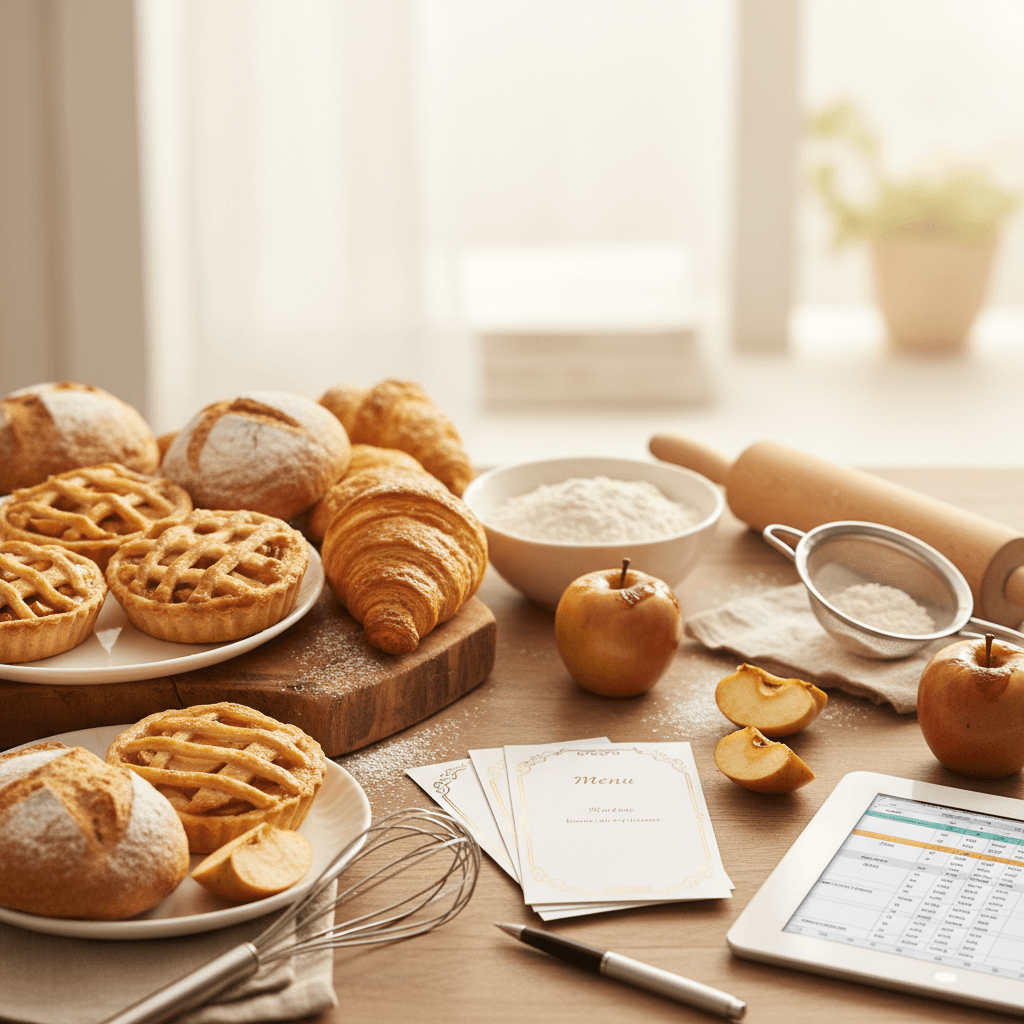
Your menu is the single most important business decision you will make as a home baker. Get it right and you will have repeat customers ordering week after week. Get it wrong and you will burn out making dozens of items nobody asked for. Here is how to build a menu that works.
Key takeaways
- Start with 5-8 items maximum — a focused menu reduces waste, speeds up production, and makes you look like a specialist rather than a generalist.
- Price your menu based on ingredient cost, labor, and packaging, not what the grocery store charges. Your floor should be a 3x ingredient cost multiplier at minimum.
- Build your menu around items that share ingredients and prep techniques so you can batch efficiently on bake days.
- Offering a niche like gluten-free or allergy-friendly baking gives you a massive competitive advantage because most local markets are underserved.
- Rotate seasonal specials to keep regulars excited without expanding your permanent menu.
- Your menu format matters — customers need to see clear item names, sizes, prices, and ordering instructions at a glance.
Why a smaller menu makes you more money
A focused menu of 5-8 items will almost always outperform a menu of 20+. When you offer fewer items, you buy ingredients in larger quantities (lowering your per-unit cost), you get faster at production (increasing your hourly earnings), and your customers actually remember what you sell. The paradox of choice is real — when people see too many options, they often buy nothing.
Think about the most successful bakeries you know. They are famous for a handful of things, not everything. Your home bakery should work the same way. Pick your strongest items, the ones people already ask you to make, and build from there.
If you are just getting started and need to stock your kitchen without overspending, our complete baking essentials guide covers every product you need at every budget level.
How to choose which items to put on your home bakery menu
The best menu items hit three criteria at once: you enjoy making them, they are profitable, and there is local demand. Here is how to evaluate each potential item.
Start with what people already ask you to bake
If friends and family constantly request your cinnamon rolls or your chocolate chip cookies, that is market research. Those items have proven demand before you spend a dollar on packaging. Write down every item someone has complimented or requested in the last year — that is your starting list.
Check what your local competition is not doing
Search Facebook Marketplace, Instagram, and local cottage food directories for home bakers in your area. What is everyone else selling? If there are already five people doing custom decorated sugar cookies, that is a crowded lane. Look for gaps.
This is where gluten-free and allergy-friendly baking becomes a serious advantage. In most local markets, there are very few (if any) home bakers offering dedicated gluten-free products. Customers with celiac disease or food allergies are incredibly loyal when they find a baker they trust, and they are willing to pay premium prices because their options are so limited. If you have gluten-free baking skills, you are sitting on an underserved market. Our gluten-free baking essentials guide can help you stock up on the right ingredients.
Evaluate profitability before you commit
Not every item you love to bake is worth selling. A gorgeous layered cake that takes 6 hours might earn you less per hour than a batch of scones you can knock out in 90 minutes. For each potential menu item, calculate:
- Ingredient cost per unit
- Estimated labor time
- Packaging cost
- What the market will pay
If your ingredient cost for a loaf of banana bread is $3.50, your packaging is $1.00, and you can sell it for $14, that is a healthy margin. If your ingredient cost for a custom cake is $18 and you can only charge $40 after 4 hours of work, that math does not favor you.
Want to get your home bakery business off the ground the right way? The free Home Bakery Pro masterclass walks you through building a sustainable home bakery — including how to price and position your menu for consistent orders.
The best home bakery menu categories to consider
Not all baked goods are created equal when it comes to home bakery profitability. Here is a breakdown of common categories and how they stack up.
| Category | Profit margin | Shelf life | Production speed | Best for |
|---|---|---|---|---|
| Cookies (by the dozen) | High | 5-7 days | Fast — large batches | Farmers markets, weekly orders |
| Quick breads and loaves | High | 3-5 days | Fast — minimal hands-on | Repeat weekly customers |
| Muffins and scones | High | 2-3 days | Fast | Morning delivery, markets |
| Cinnamon rolls and sweet rolls | High | 2-3 days | Moderate — requires proofing | Weekend pre-orders |
| Artisan bread | Moderate | 1-3 days | Slow — long fermentation | Subscription model, weekly orders |
| Custom decorated cakes | Low to moderate | 1-2 days | Very slow | Special occasions only |
| Pies and tarts | Moderate | 2-4 days | Moderate | Seasonal specials, holidays |
Notice that the fastest, highest-margin items tend to be the simplest ones. Cookies, quick breads, and muffins are the workhorses of most successful home bakeries. Custom cakes look glamorous on social media, but the labor math is often brutal.
How to structure your home bakery menu for maximum orders
Once you have chosen your items, how you present them matters enormously. A confusing menu loses sales. Here is what your menu should include for every single item.
Essential information for each menu item
- Clear item name — "Classic Chocolate Chip Cookies" not "Grandma's Special Surprise"
- Brief description — one sentence about what makes it special (ingredients, flavor notes)
- Size or quantity — "dozen," "half dozen," "9-inch loaf," "6-pack"
- Price — no "DM for pricing." Customers who have to ask often do not buy.
- Allergen information — list major allergens present or note if items are gluten-free, nut-free, etc.
- Lead time — how far in advance do they need to order?
Sample home bakery menu layout
Here is a simple example of how a focused menu might look:
| Item | Description | Size | Price |
|---|---|---|---|
| Classic chocolate chip cookies | Brown butter, sea salt, semi-sweet chocolate | Dozen | $18 |
| Lemon blueberry scones | Fresh blueberries, lemon glaze | Half dozen | $16 |
| Banana walnut bread | Three-banana recipe, toasted walnuts | Full loaf | $14 |
| Cinnamon rolls | Yeasted dough, cream cheese frosting | Half dozen | $22 |
| Seasonal special (rotating) | Changes monthly — ask for this month's flavor | Varies | Varies |
Clean, scannable, no guesswork. That is what converts browsers into buyers.
How to price your home bakery menu items
Pricing is where most new home bakers undercharge dramatically. The minimum formula you should use is ingredient cost multiplied by 3, then add packaging and a labor charge. Many successful home bakers use a 4x or even 5x multiplier.
Here is a real example. Say your chocolate chip cookie recipe makes 48 cookies and costs $8.40 in ingredients:
- Ingredient cost per dozen: $2.10
- Packaging (box, tissue, label): $1.25
- Labor (15 minutes per dozen at $20/hour): $5.00
- Minimum price per dozen: $8.35
- Recommended retail price: $16-20 per dozen
That $16-20 range gives you a healthy margin and accounts for overhead like electricity, equipment wear, and your time doing admin work (responding to messages, posting on social media, doing deliveries). If you are offering gluten-free versions, you can and should charge more — specialty ingredients cost more, and your customers understand that.
For tracking ingredient costs accurately, a kitchen scale is non-negotiable. A reliable option is the OXO Good Grips 11lb Food Scale.
How to build a menu around shared ingredients
Smart menu design means your items share a pantry. When multiple menu items use the same base ingredients, you buy in bulk, reduce waste, and streamline your bake days.
For example, if your menu includes chocolate chip cookies, banana bread, and blueberry muffins, all three use flour, sugar, butter, eggs, and vanilla. You are buying five core ingredients in volume instead of stocking 30 specialty items for 30 different recipes.
This is especially important for gluten-free home bakers. Gluten-free flours and starches like brown rice flour, tapioca starch, and potato starch can be expensive in small bags. If your entire menu uses the same flour blend, you can buy 25-pound bags and dramatically cut your per-recipe cost. Our guide on how to stock a baking pantry on a budget has specific tips for buying in bulk.
Ingredient overlap planning worksheet
Before finalizing your menu, make a simple grid. List every item across the top and every ingredient down the side. Put a checkmark where they overlap. If an ingredient only appears in one item, ask yourself whether that item is worth the extra inventory. Aim for at least 60-70% ingredient overlap across your menu.
When and how to add seasonal specials
Seasonal specials are the best way to keep your menu exciting without permanently expanding it. They create urgency ("only available in October"), give you a reason to post on social media, and let you test new items before committing to them full-time.
A good rhythm is one rotating special per month. Some ideas by season:
- Spring: Lemon lavender shortbread, strawberry scones, carrot cake loaf
- Summer: Peach cobbler muffins, key lime cookies, fresh berry galettes
- Fall: Pumpkin bread, apple cider donuts, maple pecan bars
- Winter: Gingerbread cookies, peppermint brownies, cranberry orange scones
If a seasonal special gets massive demand, that is your signal to consider adding it to the permanent menu — and possibly rotating out your weakest seller.
How to format and share your home bakery menu
Your menu needs to live in multiple places, and it needs to look professional. Here are the most effective formats:
Digital menu (essential)
Create a clean, mobile-friendly menu using Canva, Google Docs, or a simple website page. This is what you will link to from social media, text to customers, and share in local groups. Make sure it loads fast on phones — most of your customers will view it on mobile.
Printed menu (for markets and events)
If you sell at farmers markets or pop-ups, a printed menu card or small sign is essential. Laminate it so it survives outdoor conditions. Include a QR code that links to your online ordering page.
Social media menu posts
Post your full menu at least once a week. Many home bakers post their weekly menu every Sunday or Monday with a clear ordering deadline. Keep the format consistent so regulars recognize it instantly in their feed.
For packaging your menu items professionally, the kraft bakery boxes with windows in the 6x6x3 size are a versatile option that works for cookies, muffins, scones, and pastries. They typically run $15-20 for a pack of 25.
Common home bakery menu mistakes to avoid
These mistakes are common, and they are all fixable:
- Too many items — You are one person in a home kitchen. Five to eight items is plenty to start.
- No prices listed — "DM for pricing" kills conversions. Be transparent.
- Underpricing — You are not competing with Walmart. You are selling handmade, fresh, local food. Price accordingly.
- Vague descriptions — "Yummy cookies" tells customers nothing. "Brown butter chocolate chip cookies with Maldon sea salt" tells them everything.
- No ordering instructions — Tell people exactly how to order, when to order by, and when they will receive their items.
- Ignoring dietary niches — If you can offer gluten-free, vegan, or allergy-friendly options, call that out prominently. Those customers are actively searching for you.
Frequently asked questions
How many items should a home bakery menu have?
Start with 5-8 items. This keeps your ingredient costs manageable, your production efficient, and your brand focused. You can always add items later once you have consistent demand and a smooth workflow. Many successful home bakers never go above 10 permanent items.
How do I price items on my home bakery menu?
Use a minimum of 3x your ingredient cost, then add packaging costs and a labor charge based on your time. For specialty items like gluten-free baked goods, you should charge a premium because your ingredients cost more and your customers have fewer local options. Never price based on what grocery stores charge — you are selling a completely different product.
Should I offer custom orders on my home bakery menu?
Only if you set strict boundaries. Custom orders can be profitable, but they can also consume disproportionate time for communication, recipe testing, and execution. If you offer custom work, limit it to specific categories (like custom cake flavors, not entirely new products) and charge a premium for the extra labor.
How often should I change my home bakery menu?
Keep your core menu stable and add one rotating seasonal special per month. Changing your entire menu frequently confuses repeat customers who want to reorder their favorites. Consistency builds loyalty. Use seasonal specials to test new items, and only promote something to the permanent menu if it proves itself with strong demand over multiple months.
Do I need to list allergens on my home bakery menu?
Check your state's cottage food laws for specific labeling requirements, but regardless of legal obligations, listing major allergens is smart business practice. It builds trust, protects you from liability, and attracts allergy-conscious customers. At minimum, note the presence of common allergens like wheat, dairy, eggs, nuts, and soy for each item.
Get your first consistent customers
A great menu is step one, but getting reliable, repeat orders is what turns a hobby into real income. Getting your first customers is the hardest part. This free masterclass from a baker who replaced her full-time salary with home bakery income shows you exactly how to get consistent repeat orders — without relying on social media.

Written by
Co-founder, BakingSubs
Co-founder of BakingSubs, where he turns the science of ingredient substitutions into tested, reliable guidance for home bakers.
Related Posts
Gluten-Free Flour Weight Chart: Grams per Cup for 9 Major Brands (and Why the Spread Is Over 20%)
Best Low Carb Tortillas (2026): 6 Brands Compared by Net Carbs
Best Sugar-Free Cake Mix and Brownie Mix (2026): 14 Options Ranked by Net Carbs, Sweetener, and Price
Bake with Confidence
See all
Confident Gluten-Free Baker Toolkit
The science-based system that replaces gluten's seven invisible jobs so your baking turns out soft, fluffy, and foolproof — every time.

Gluten-Free Recipe Vault
Instant access to our complete library of proven gluten-free recipes — no waiting, no guesswork, just results that work tonight.

Fix Your Gluten-Free Bread
Learn the 3-step formula to make bread rise and stay soft, discover why your loaves collapse, and get a tested sandwich bread recipe that actually works.