

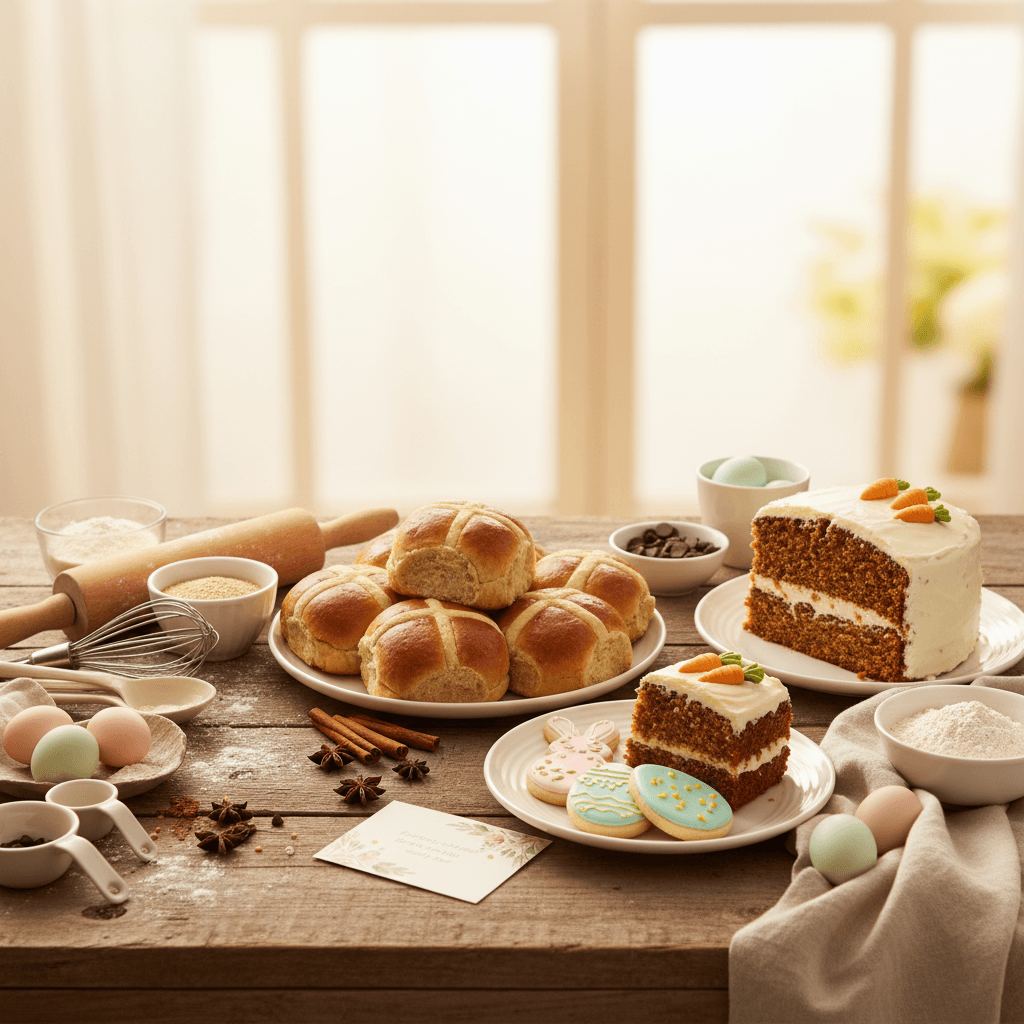
Easter is one of those holidays where food is the centerpiece — and if you're gluten-free, it can feel like you're watching from the sidelines. Not this year. Whether you want to bake from scratch, adapt Grandma's famous recipe, or just grab something delicious off the shelf, we've got you covered.
Key takeaways
- Most traditional Easter baked goods — hot cross buns, carrot cake, lemon bars — adapt beautifully to gluten-free with the right flour blend and a few technique tweaks.
- A good 1:1 gluten-free flour blend (like Bob's Red Mill or King Arthur Measure for Measure) handles about 80% of Easter baking without any recipe changes.
- If you're short on time, several excellent store-bought gluten-free options exist for Easter bread, cake mixes, and cookie decorating kits.
- Order store-bought gluten-free products by early April to guarantee delivery before Easter Sunday.
- Adding xanthan gum or psyllium husk to homemade flour blends prevents the dry, crumbly texture that ruins gluten-free holiday baking.
- Cross-contamination is the hidden risk at Easter gatherings — bake gluten-free items first and store them separately.
How to adapt traditional Easter recipes to gluten-free
The fastest path to gluten-free Easter baking is taking your family's existing recipes and swapping the flour. For most Easter favorites — carrot cake, lemon bars, sugar cookies — you can replace all-purpose flour with a 1:1 gluten-free blend and get results that are remarkably close to the original.
The key is understanding what gluten actually does in each recipe. In cakes and cookies, gluten provides structure but isn't doing heavy lifting, so a direct swap works well. In yeast breads like hot cross buns or Easter bread, gluten is what creates that stretchy, chewy crumb — so you'll need to add a binder like psyllium husk or xanthan gum to compensate.
Here's a quick reference for the most common Easter baking swaps:
| Traditional ingredient | Gluten-free swap | Notes |
|---|---|---|
| All-purpose flour | 1:1 GF flour blend | Works for cakes, cookies, bars |
| Bread flour | GF bread flour + psyllium husk | Essential for hot cross buns, Easter bread |
| Cake flour | GF flour blend + 2 tbsp cornstarch per cup | Lighter crumb for layer cakes |
| Self-rising flour | GF flour blend + baking powder + salt | Common in quick breads and scones |
| Graham cracker crust | GF graham crackers or almond flour crust | Great for cheesecake and pie |
If you're troubleshooting results that come out dry and crumbly or with a gritty texture, those are the two most common gluten-free pitfalls — and both are fixable.
Gluten-free hot cross buns from scratch
Hot cross buns are arguably the quintessential Easter bake, and yes, you can absolutely make them gluten-free. The secret is using a combination of brown rice flour, tapioca starch, and potato starch, bound together with psyllium husk powder to mimic gluten's elasticity.
A great starting point is the recipe from King Arthur Baking, which uses their Measure for Measure flour. The dough will be stickier than traditional hot cross bun dough — that's normal. Don't add extra flour. Use wet hands to shape the buns, and let them rise in a warm spot for about 90 minutes (gluten-free yeast doughs are slower).
A few tips that make the difference:
- Warm your milk to about 110 degrees F before adding yeast — gluten-free doughs need all the help they can get for a good rise
- Add an extra egg for moisture and binding
- Brush with an egg wash right before baking for that gorgeous golden sheen
- Pipe the crosses on before baking using a thick paste of GF flour and water
If your buns come out dense, check our guide on fixing poor rise in gluten-free baking — it's almost always a yeast or hydration issue.
If you're loving the idea of nailing gluten-free holiday baking but want a deeper foundation in how substitutions actually work, the Confident Gluten-Free Baker Toolkit walks you through the science behind every swap so you can adapt any recipe with confidence — not just at Easter, but year-round.
Gluten-free carrot cake with cream cheese frosting
Carrot cake is one of the easiest traditional Easter cakes to make gluten-free because the shredded carrots, oil, and eggs already provide so much moisture and structure. A straight 1:1 flour swap works beautifully here.
Use your favorite carrot cake recipe and simply replace the wheat flour with a gluten-free all-purpose blend. If the recipe calls for nuts, keep them — they add structure that helps compensate for the missing gluten. The warm spices (cinnamon, nutmeg, ginger) taste exactly the same regardless of flour type, so the flavor profile stays spot-on.
For the cream cheese frosting, no changes needed — it's naturally gluten-free. Just double-check that your powdered sugar doesn't contain wheat starch (most don't, but some store brands do).
If you want to reduce the sugar, check our guide on choosing sugar alternatives for options that work well in layer cakes.
Gluten-free Easter sugar cookies for decorating
Decorated sugar cookies are the craft project of Easter baking, and kids especially love them. The good news is that gluten-free sugar cookie dough actually rolls out and holds its shape better than you might expect — the lack of gluten means less shrinkage during baking.
The trick is chilling your dough thoroughly (at least 2 hours, overnight is better) and rolling it between two sheets of parchment paper. Gluten-free dough warms up faster and gets sticky, so work in small batches and pop the rest back in the fridge.
For cutters, classic Easter shapes — eggs, bunnies, chicks, crosses — all work well. Avoid anything with very thin or detailed extensions (like bunny ears thinner than half an inch) because gluten-free cookies are slightly more fragile.
For royal icing, use meringue powder instead of raw egg whites for food safety, and make sure your food coloring is gluten-free (most gel colors are). We like the Americolor Soft Gel Paste set — the colors are vibrant and a little goes a long way.
Gluten-free lemon bars
Lemon bars are an Easter classic that translates perfectly to gluten-free. The buttery shortbread crust swaps easily with a blend of almond flour and a little tapioca starch, and the lemon curd filling is naturally gluten-free since it's just eggs, sugar, lemon juice, and butter.
For the crust, combine 1.5 cups almond flour, 1/3 cup powdered sugar, 2 tablespoons tapioca starch, a pinch of salt, and 3 tablespoons cold butter. Press into a parchment-lined 8x8 pan and bake at 350 degrees F for 12-15 minutes until lightly golden. Pour the lemon curd over the hot crust and bake another 20 minutes.
The almond flour crust actually tastes better than the wheat version — it's richer and more flavorful. This is one recipe where going gluten-free is an upgrade, not a compromise.
Gluten-free Easter bread (Tsoureki and Italian Easter bread)
Rich, eggy Easter breads are found in nearly every culture — Greek Tsoureki, Italian Easter bread with colored eggs, Russian Kulich. These are the most challenging Easter bakes to make gluten-free because they rely heavily on gluten development for their soft, pull-apart texture.
The approach that works best is using a dedicated gluten-free bread flour blend (not all-purpose) plus 2 teaspoons of psyllium husk powder per cup of flour. The psyllium creates a gel network that mimics gluten's stretchy quality.
Key adjustments for gluten-free Easter bread:
- Increase eggs by one — the extra protein helps with structure
- Use room temperature butter, not cold — it incorporates more easily into GF dough
- Let the dough rise once (skip the punch-down and second rise that wheat recipes call for)
- Braid loosely — GF dough doesn't stretch as much during proofing
- Bake at a slightly lower temperature (325 degrees F instead of 350 degrees F) for longer to avoid a dark crust with a gummy center
If you're getting gummy centers, that lower temperature and longer bake time is usually the fix.
Gluten-free coconut macaroons
Here's the Easter dessert that requires zero adaptation: coconut macaroons are naturally gluten-free. They're just shredded coconut, sugar, egg whites, and vanilla. Dip the bottoms in melted chocolate and you have something that looks like it came from a fancy bakery.
The recipe is simple — 14 ounces sweetened shredded coconut, 2/3 cup sugar, 4 egg whites, 1 teaspoon vanilla, and a pinch of salt. Mix, scoop into mounds, bake at 325 degrees F for 20-25 minutes. Done.
These are also perfect for Easter baskets and gifting. They hold up well at room temperature for 3-4 days and ship without crumbling.
Make it easy: best store-bought gluten-free Easter treats
Not everyone wants to bake from scratch, and that's completely fine. Whether you're short on time, low on energy, or just want a guaranteed win, these store-bought options deliver. Order by early April to make sure everything arrives before Easter Sunday — gluten-free specialty items can sell out fast.
| Product | Best for | Price range |
|---|---|---|
| King Arthur GF Yellow Cake Mix | Layer cakes, cupcakes, sheet cake | $6-8 |
| Simple Mills Almond Flour Cookies | Cookie platters, Easter baskets | $5-7 |
| Canyon Bakehouse Heritage Style Bread | Easter morning toast, bread pudding | $6-8 |
| Schar Hot Cross Buns (seasonal) | Traditional Easter breakfast | $5-7 |
| Pamela's Sugar Cookie Mix | Decorating with kids | $5-6 |
Here are our top picks with links to grab them:
- King Arthur Gluten-Free Yellow Cake Mix — one of the most reliable GF cake mixes available. Makes a perfect Easter layer cake with cream cheese or buttercream frosting.
- Simple Mills Almond Flour Cookies — clean ingredients, great flavor. Perfect for filling Easter baskets or setting out on a dessert table.
- Pamela's Gluten-Free Sugar Cookie Mix — rolls out well for cookie cutters and holds its shape. Add royal icing and you've got decorated Easter cookies with minimal effort.
- Canyon Bakehouse Heritage Style Bread — if you want to make a quick bread pudding or French toast for Easter brunch, this is the bread to use.
Gluten-free Easter baking timeline
Holiday baking is less stressful when you spread it out. Here's a realistic schedule that keeps you sane:
| When | What to do |
|---|---|
| 2-3 weeks before | Order specialty flours and store-bought items online. Stock up on psyllium husk, xanthan gum, and your preferred GF flour blend. |
| 1 week before | Bake sugar cookies (unfrosted) and freeze. Make lemon bar crust and freeze unbaked. |
| 3-4 days before | Bake coconut macaroons. Make and freeze Easter bread dough if braiding. |
| 1-2 days before | Bake carrot cake layers and wrap tightly. Thaw and decorate sugar cookies. |
| Easter morning | Bake hot cross buns fresh. Frost carrot cake. Assemble lemon bars. Arrange everything on platters. |
Tips for keeping Easter baking safe from cross-contamination
If you're baking gluten-free alongside regular baked goods for a mixed household, cross-contamination is a real concern — especially during a busy holiday cooking session. A few practical steps make a big difference:
- Bake all gluten-free items first, before any wheat flour is opened
- Use dedicated baking sheets, mixing bowls, and wooden spoons for GF baking (flour dust lingers on porous surfaces)
- Store finished gluten-free items in sealed containers on a separate shelf or counter
- Label everything clearly — especially at a gathering where people are serving themselves
- If someone in your family has celiac disease, consider using a separate set of measuring cups and a dedicated sifter
Our gluten-free baking guide covers contamination prevention in more detail if you want to go deeper.
Easter baking as a home bakery opportunity
If you've been thinking about turning your gluten-free baking skills into income, Easter is one of the best seasonal opportunities. Gluten-free hot cross buns, decorated sugar cookies, and carrot cakes are in high demand — and most traditional bakeries don't offer safe gluten-free options. If that interests you, our guide on how to start a gluten-free home bakery walks you through everything from licensing to pricing.
Frequently asked questions
Can I use a 1:1 gluten-free flour blend for all Easter baking?
A 1:1 blend works for about 80% of Easter recipes — cakes, cookies, bars, quick breads, and muffins. For yeast-based recipes like hot cross buns and Easter bread, you'll get better results with a dedicated GF bread flour plus a binder like psyllium husk. Check our all-purpose flour substitution guide for specific ratios.
What is the best gluten-free flour for Easter cookies?
For sugar cookies and shortbread-style cookies, a 1:1 blend like Bob's Red Mill or King Arthur Measure for Measure gives the most consistent results. For richer cookies, almond flour adds great flavor and a tender crumb. The key is chilling the dough well before rolling — GF cookie dough softens faster than wheat-based dough.
How far in advance can I bake gluten-free Easter treats?
Most gluten-free baked goods freeze beautifully for 2-3 weeks. Sugar cookies (unfrosted), cake layers, and bread dough all freeze well. Coconut macaroons keep at room temperature for 3-4 days. Frost and assemble cakes 1-2 days before Easter and store in the fridge. Hot cross buns are best baked fresh on Easter morning. If your baked goods tend to go stale quickly, our guide on preventing quick staling has practical fixes.
Are store-bought gluten-free Easter products safe for celiac disease?
Look for products that are certified gluten-free (the crossed-grain symbol or GFCO certification), not just labeled "gluten-free." Certified products are tested to contain less than 10-20 ppm of gluten. Brands like King Arthur, Canyon Bakehouse, and Schar all carry certification. Always read labels each time you buy, as formulations can change.
How do I make gluten-free Easter baking taste less "gluten-free"?
Three things make the biggest difference: using a high-quality flour blend (cheap blends often taste gritty or beany), adding a little extra fat (butter or oil) for moisture, and not overbaking. Gluten-free baked goods go from perfect to dry in just a few minutes, so start checking 5 minutes before the recipe says. If you're dealing with off-flavors, our guide on fixing strange aftertaste can help you troubleshoot.

Written by
Co-founder, BakingSubs
Co-founder of BakingSubs, where he turns the science of ingredient substitutions into tested, reliable guidance for home bakers.
Related Posts
Best Low Carb Bread Brands (2026): 8 Compared by Net Carbs, Ingredients, and Price
Best Keto Buns, Bagels, and English Muffins: 10 Products Compared by Net Carbs and Ingredients
Gluten-Free Flour Weight Chart: Grams per Cup for 9 Major Brands (and Why the Spread Is Over 20%)
Bake with Confidence
See all
Confident Gluten-Free Baker Toolkit
The science-based system that replaces gluten's seven invisible jobs so your baking turns out soft, fluffy, and foolproof — every time.

Gluten-Free Recipe Vault
Instant access to our complete library of proven gluten-free recipes — no waiting, no guesswork, just results that work tonight.

Fix Your Gluten-Free Bread
Learn the 3-step formula to make bread rise and stay soft, discover why your loaves collapse, and get a tested sandwich bread recipe that actually works.